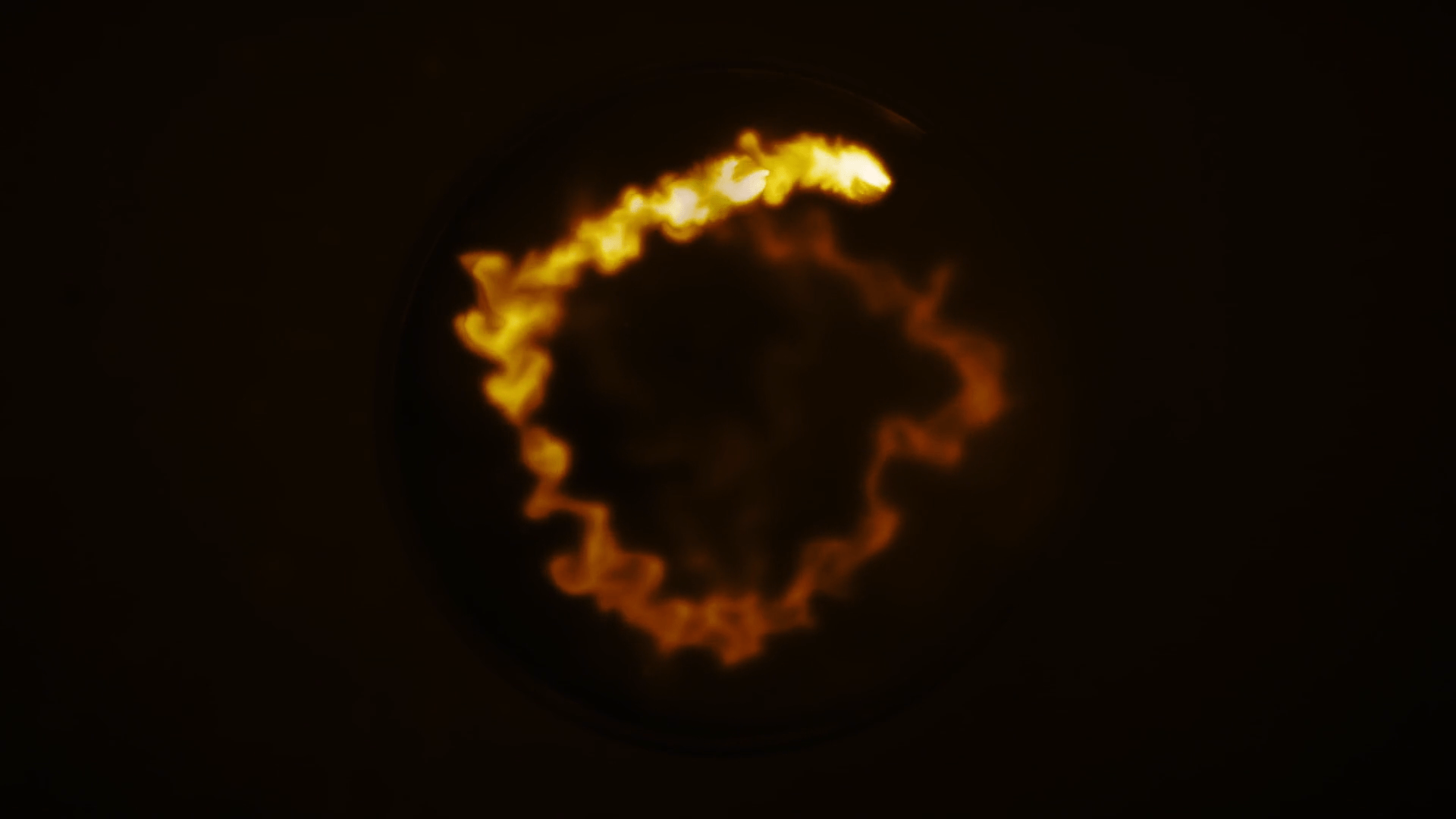
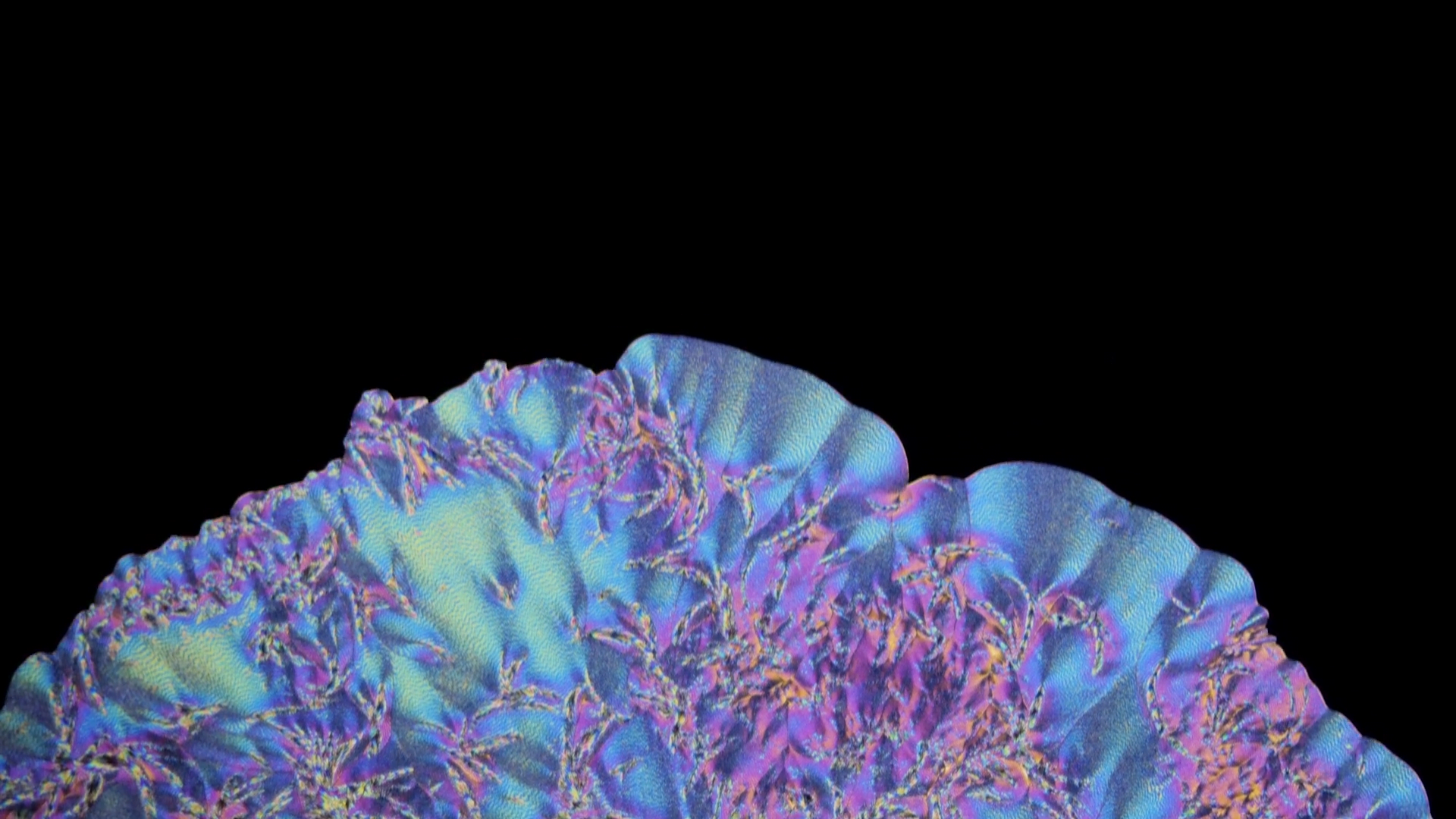
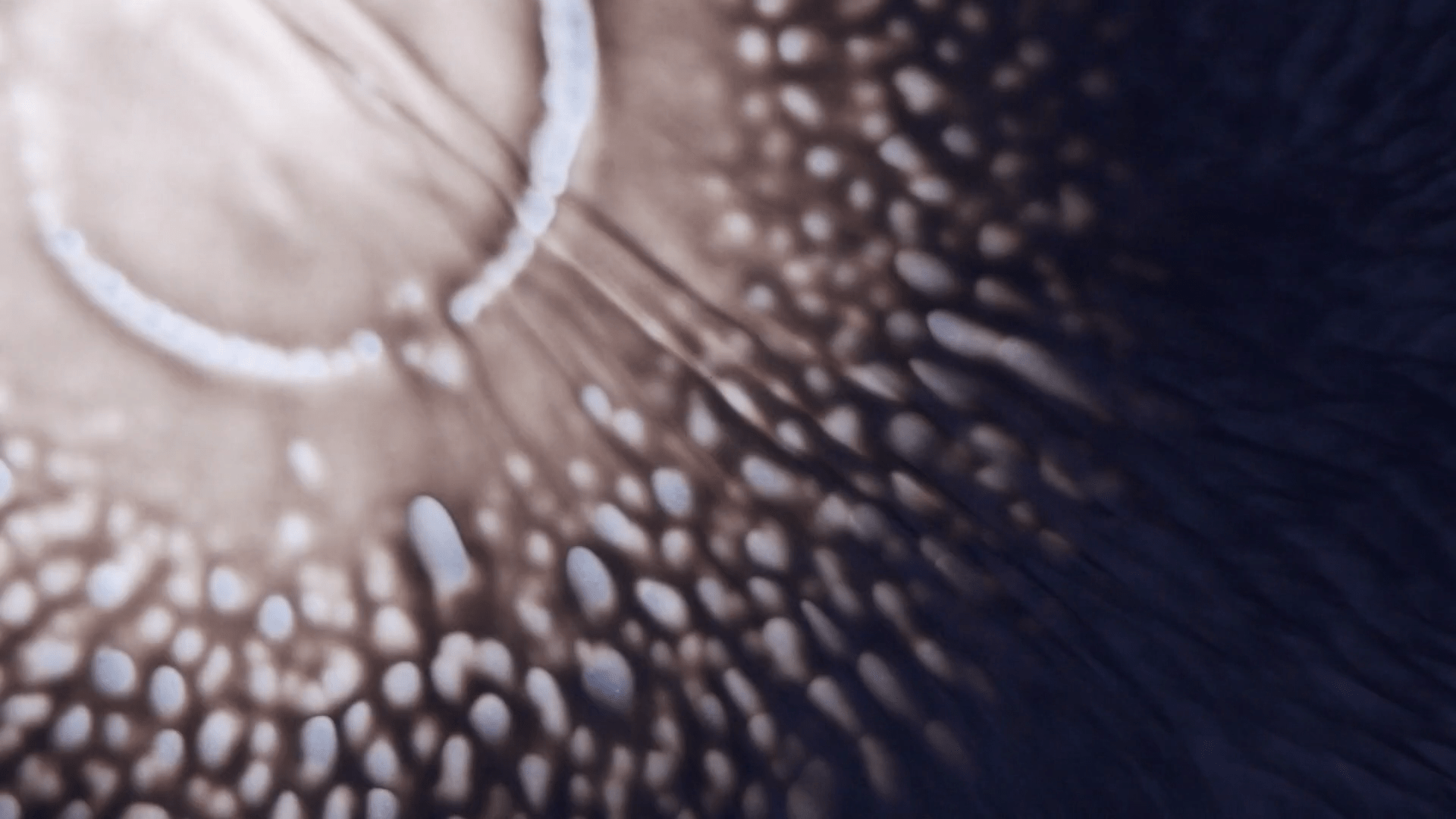
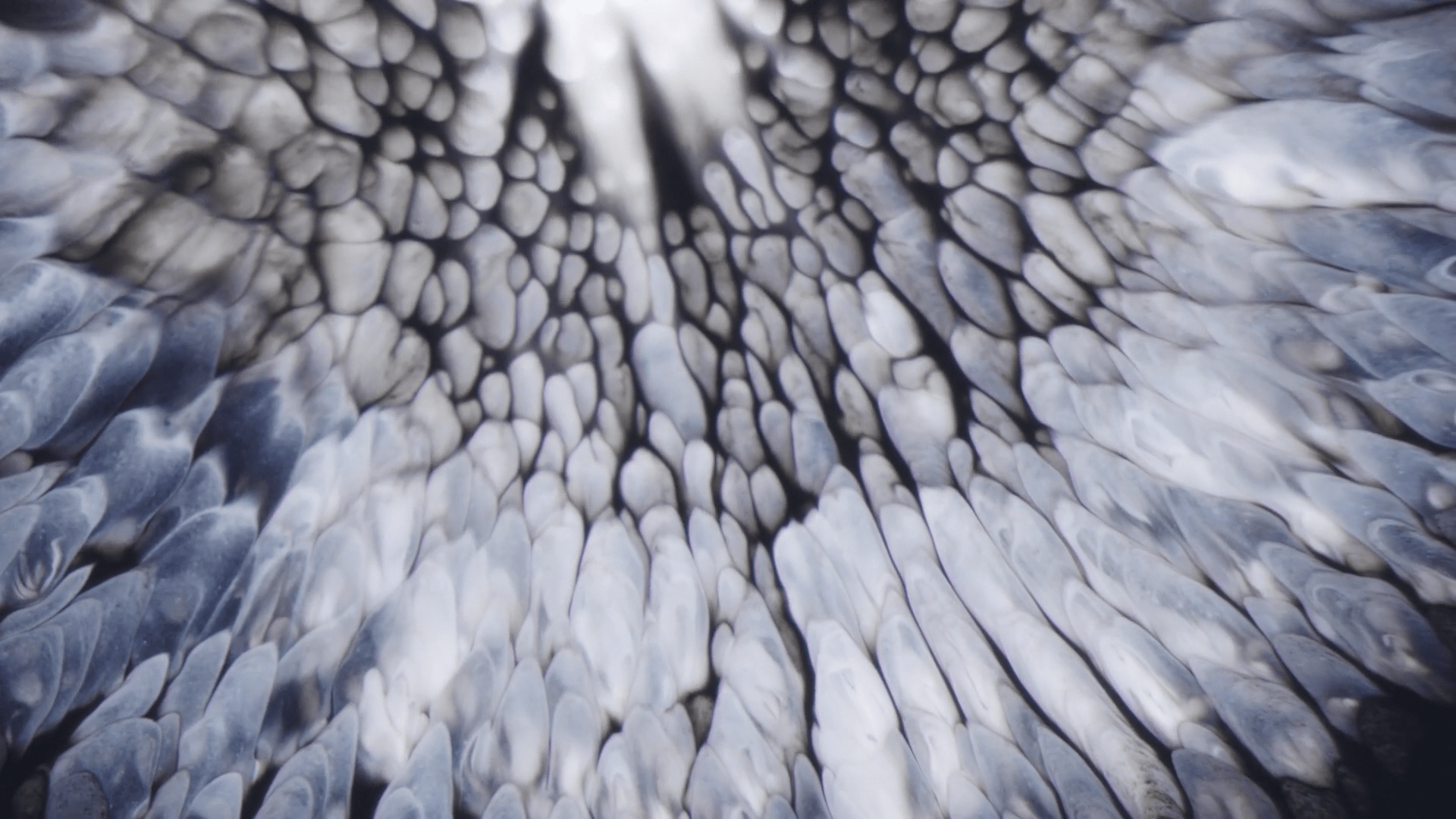
Sandro Bocci’s short film “Flux Capacitor” explores the geometry and dynamics of soap films. When you dip wire models into soapy solution, the films that cling to the model can form complicated shapes as surface tension works to minimize the overall surface area. Bocci’s macro photography highlights the intense flows going on in the narrow regions where films meet. It’s a different take on soap films and neat to see! (Image, video, and submission credit: S. Bocci et al.)
Tag: physics

Gathering Droplets
In deserts around the world, plants have adapted to collect as much moisture as they can. Geometry aids them in this endeavor because droplets on the tip of a cone will move toward its thicker base. The motion takes place due to a imbalance in surface tension forces on either end of the droplet.
As the droplet moves up a cone, it changes shape from a barrel-like drop that fully covers the conical surface to a clamshell-shaped droplet that hangs only from the bottom of the cone. (Image and research credit: J. Van Hulle et al.)

Jellyfish Make Their Own Walls
When we walk, the ground’s resistance helps propel us. Similarly, flying or swimming near a surface is easier due to ground effect. Most of the time swimmers don’t get that extra help, but a new study shows that jellyfish create their own walls to get that boost.
Of course, these walls aren’t literal, but fluid dynamically speaking, they are equivalent. Over the course of its stroke, the jellyfish creates two vortices, each with opposite rotation. One of these, the stopping vortex, lingers beneath the jellyfish until the next stroke’s starting vortex collides with it. When two vortices of equal strength and opposite rotation meet, the flow between them stagnates — it comes to halt — just as if a wall were there.
In fact, mathematically, this is how scientists represent a wall: as the stagnation line between a real vortex and a virtual one of equal strength and opposite rotation. It just turns out that jellyfish use the same trick to make virtual walls they can push off! (Image and research credit: B. Gemmell et al.; via NYTimes; submitted by Kam-Yung Soh)

Coastal Erosion
The same dynamic forces that make coastlines fascinating create perennial headaches for engineers trying to maintain coastlines against erosion. This Practical Engineering video discusses some of the challenges of coastal erosion and how engineers counter them.
In a completely undeveloped coastline, waves and storms erode the shoreline while rivers and currents replenish sand through sedimentation. Manmade structures tend to strengthen erosion processes while disrupting the sedimentation that would normally counter it. Beach nourishment — where sand gets dredged up and deposited on a beach — is an engineered attempt to replace natural sedimentation.
Dunes, mangrove forests, and wetlands are all nature’s way of protecting and maintaining coastlines. We engineers are still learning how to both utilize and protect shorelines. (Image and video credit: Practical Engineering)

Why Food Sticks to Nonstick Pans
Whether you’re cooking with ceramic, Teflon, or a well-seasoned cast iron pan, it seems like food always wants to stick. It’s not your imagination: it’s fluid dynamics.
As the thin layer of oil in your pan heats up, it doesn’t heat evenly. The oil will be hotter near the center of the burner, which lowers the surface tension of the oil there. The relatively higher surface tension toward the outside of the pan then pulls the oil away from the hotter center, creating a hot dry spot where food can stick.
To avoid this fate, the authors recommend a thicker layer of oil, keeping the burner heat moderate, using a thicker bottomed pan (to better distribute heat), and stirring regularly. (Image and research credit: A. Fedorchenko and J. Hruby)

“Mini Planets”
In Thomas Blanchard’s “Mini Planets” oil-coated paint droplets swirl on colorful backgrounds. With band-like streaks, they truly do look like miniature planets rotating. I love that a few of them even have distinctive vortices! (Image and video credit: T. Blanchard)

When Honey Flows Faster Than Water
With its high viscosity, no one would ever pick honey to beat water in a race. But a new study shows there’s at least one circumstance where honey wins: inside a narrow, superhydrophobic tube with one or both ends closed. Inside these specially coated tubes a narrow cushion of air stays between the drop and the wall, reducing friction and increasing flow speed for both fluids.
But when one or both ends of the tube are blocked, the drops can only move when air squeezes past. In less viscous fluids, like water, the researchers found rapid internal flows inside the drop. These flows pressed the surface of the drop outward, reducing the air cushion and making it harder for air to squeeze past so that the drop could flow. In contrast, honey showed very little internal flow and so was able to flow through the tubes ten times faster than water! (Image and research credit: M. Vuckovac et al.; via Physics World; submitted by Kam-Yung Soh)

Brown Dwarfs and Their Stripes
Brown dwarfs are neither stars nor gas giants but something in between. Our two nearest brown dwarf neighbors are roughly equivalent to Jupiter in size but about 30 times more massive. Since these objects are so dim, little is known about their structure. Do they resemble stars in their atmospheric patterns or gas giants like Jupiter?
To find out, a team of researchers studied two nearby brown dwarfs with the Transiting Exoplanet Survey Satellite. They were able to map the objects’ varying lightcurves and model an upper atmosphere consistent with those observations. They found that both dwarfs have high-speed winds running parallel to their equators, meaning that they likely have stripes like Jupiter. The similarities even extended to the brown dwarfs’ poles, where — like on Jupiter — the atmosphere became dominated by local vortices. (Image credit: NASA/JPL; video credit: Steward Observatory; research credit: D. Apai et al.; via Gizmodo)

Ultrasonic Vibrations
Ultrafast vibrations can break up droplets, mix fluids, and even tear voids in a liquid. Here, the Slow Mo Guys demonstrate each of these using an ultrasonic homogenizer, a piece of lab equipment capable of vibrating 30,000 times a second. At that speed generating cavitation bubbles is trivial, and the flow induced by that cavitation is well-suited to emulsifying otherwise immiscible liquids like oil and water. They also show how a lone droplet gets torn into many microdroplets, a process formally known as atomization. (Image and video credit: The Slow Mo Guys)
How Wombats Make Stackable Feces
Wombats are unique among the animal kingdom for their ability to produce cubic feces approximately the size and shape of dice. Researchers found that wombats accomplish this geometric feat thanks to the structure of their intestines, which have bands of differing stiffness that run the full length of their guts. When the intestines contract, the stiffer bands contract first, gradually shaping and sculpting the corners of the feces.
The results have implications both for manufacturing soft materials and for human health. One of the early effects of colon cancer is a stiffening of portions of the intestine; that means that doctors may be able to use changes in the shape of a patient’s feces as a warning sign for diagnosis. (Image and research credit: P. Yang et al.; video credit: Royal Society of Chemistry; via Gizmodo)