Tag: physics

  • Martian Polar Troughs

    Martian Polar Troughs

    Mars‘s northern pole is capped by a spiral-like pattern of deep troughs that are covered by carbon dioxide ice in winter but visible from orbit in summer. A new study posits that the spiral formed by wind erosion, exposing layer after layer of Martian geology.

    The center of Mars’s polar cap is higher in the center than toward the edges, so katabatic winds — cold, dense flows beginning at high elevation — rush down from the pole. But because Mars spins, the Coriolis force causes those winds to flow in an anti-clockwise spiral. As those winds encounter depressions perpendicular to their path, they generate vortices that erode the depression. Eventually, a depression deepens, merges with other depressions, and forms a trough. According to this theory, the clockwise spiral of the troughs is a direct result of the katabatic winds flowing across them. Head over to Bad Astronomy or check out the original paper for more. (Image credit: ESA/DLR/FU Berlin/J. Cowart; research credit: J. Rodriguez et al.; via Bad Astronomy; submitted by Kam-Yung Soh)
  • Featured Video Play Icon

    Unusual Insects Taking Off

    What do you do when you’re an insect researcher with a high-speed camera? Why, film all sorts of unusual insects from your backyard as they take off and fly! Here Dr. Adrian Smith of Ant Lab shows us a slew of insects that are not unusual for their rarity — you can probably find many of these in your own yard — but they are rarely seen in insect flight research. Like many of the species we’ve seen before, lots of these fliers use a figure-8 wingstroke to stay aloft. But one feature that really struck me as I watched was how amazingly flexible many of their wings were. For many of them, parts of their wings actually curl back on themselves during parts of the stroke. As engineers, our first instinct would be to avoid that kind of complexity, but I expect that it must give the insects some kind of benefit — otherwise nature would have eliminated it. (Image and video credit: Ant Lab/A. Smith; via Colossal)

  • How Frogs Block Unwanted Noise

    How Frogs Block Unwanted Noise

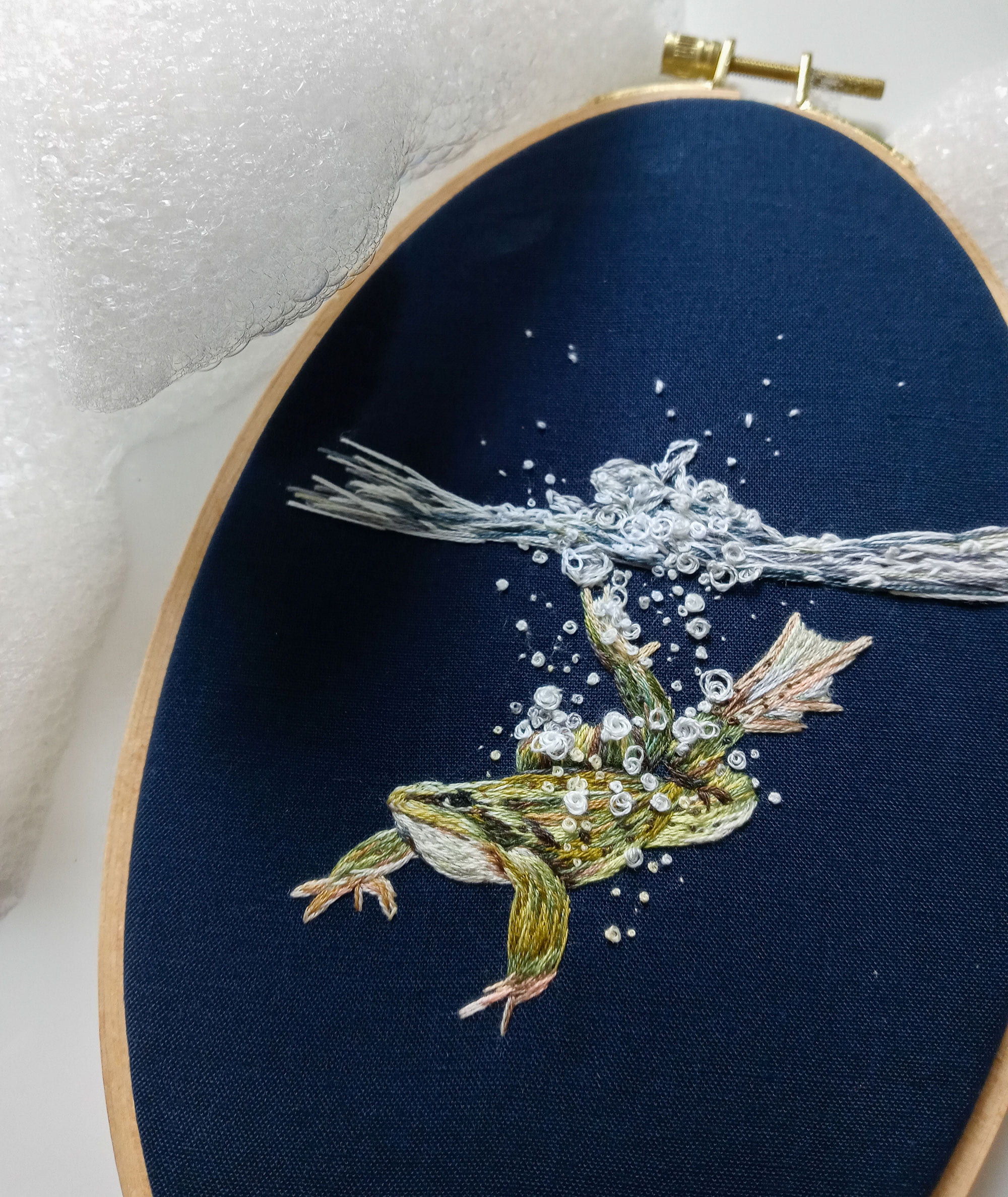
    In a crowded room, it can be hard to pick out the one conversation you want to hear. This so-called “cocktail party problem” is one animals have to contend with, too, when a noisy landscape can obscure the calls of potential mates. American green tree frogs have a clever solution to the problem: inflating their lungs to dampen out other frog species’ calls.

    This method works because frogs have a direct anatomical connection between their lungs and their eardrums. Researchers found that when these frogs inflate their lungs, there’s a pronounced drop in their sensitivity to sound in the 1.4 – 2.2 kHz frequency band. That frequency range falls between the green tree frog’s peak mating call frequencies, but it coincides with the frequencies of other frogs living in the same regions. So rather than using their lungs to make themselves louder, these clever amphibians use them to make other frogs quieter! (Image credit: B. Gratwicke; research credit: N. Lee et al.; via Physics Today)

  • Featured Video Play Icon

    “Playing With Time”

    The Macro Room team is back with this clever video that messes with our perception of time. I’d hate to give anything away here, so just go check it out! (Image and video credit: Macro Room)

  • Featured Video Play Icon

    When Rivers Break Their Banks

    Rivers often change their course, but they do not always do so gradually. River avulsions are a bit like earthquakes — they happen suddenly and with disastrous potential. Researchers find that these sudden course changes happen when silt builds up in a river and reduces the amount of water it can carry. Eventually, the resistance to flow is large enough that the river bursts its banks in search of an easier route to the sea. That’s a deadly problem for the communities that live nearby and rely on the river’s sedimentation for their fertile farmland. But using small-scale models, scientists are beginning to unravel the physics behind avulsions, bringing hope that they can be predicted or even sustainably averted. (Video and image credit: Science)

  • Featured Video Play Icon

    Springtails Jump Off Water

    Springtails are tiny hexapods often found near water, where they execute their superpower: backflipping off the water’s surface. When standing on the water, the springtail’s hydrophilic claws protrude beneath the water surface and give it traction. But its spring-loaded furcula is hydrophobic, so when it snaps down it strikes the water without breaking through. The impact propels the springtail upward and sets it spinning at an incredible rate — Smith saw up to 290 backflips a second! (Image and video credit: Ant Lab/A. Smith)

  • Featured Video Play Icon

    When Squids Fly

    Some species of squid fly at speeds comparable to a motorboat for distances of 50 meters. The cephalopods get into the air the same way they swim underwater: by expelling a jet of water through the center of their body. Once aloft, the squids spread their tentacles to form a semi-rigid wing-like surface for lift. They can also use fins on their mantle as a canard for additional lift or control of their altitude. Researchers suspect the squids use flight as an escape mechanism to put distance between themselves and predators, but it could also be a low-energy migration strategy since a single pulse carries a squid farther in air than in water. (Video and image credit: TED-Ed)

  • The Variable Venusian Day

    The Variable Venusian Day

    Venus is a thoroughly unpleasant place thanks to its hellish temperatures and acidic clouds, but a new study adds another wrinkle to our strange sister planet: Venus’s day varies by up to 21 minutes in length. This peculiar factoid is the result of 15 years spent monitoring Venus’s rotation via radar. Previous attempts to pin down the exact length of Venus’s day produced differing answers; those disagreements make more sense in light of the new study, where individuals measurements of Venus’s rotation rate could differ by 3 minutes just from one (Earth) day to the next!

    So why does Venus’s rotation rate change so dramatically? Venus’s atmosphere is massive — 100 times more massive than Earth’s — and it spins incredibly fast. The upper layers of Venus’s atmosphere can complete a rotation in 4 Earth days, while the solid ground requires 243 Earth days. As the atmosphere spins and sloshes, some of its angular momentum gets transferred to the ground, changing the planet’s rotation rate. (Image credit: NASA/JPL-Caltech; research credit: J. Margot et al.; via AGU Eos; submitted by Kam-Yung Soh)

  • “Phoenix Rising”

    “Phoenix Rising”

    This aerial photo of Lake Owens by Paul Hoelen won a 2020 Drone Photo Award in the Abstract category. As Hoelen notes, “The phoenix rising is a symbol of re-emergence from the ashes of fire.” Lake Owens was used for years in mining and other industries, which left the lake desiccated and depleted. But nature is beginning to recover; migratory birds have returned to the lake, and life is beginning anew. (Image credit: P. Hoelen; via Colossal)

  • Featured Video Play Icon

    Flamingo Filter-Feeding

    Flamingoes are strange and ungainly creatures, but their hooked bills make much more sense when you see them eating underwater. The birds are filter feeders, and they suck water, mud, and silt in through the front of their bills and pump it back out the sides. In between hairy structures called lamellae help them separate algae, brine shrimp and other food from the mix. Be sure to turn the sound up on the video so that you can hear the sound of flamingoes at work. (Image and video credit: San Diego Zoo; via Colossal)