When rain falls, some of that water turns into run-off in storm systems but much of it seeps into the ground. What happens to that water? In most places, it joins the local aquifer, infusing the spaces between soil particles underground. In this video, Grady takes us through some of the interactions between surface water, aquifers, and the wells we use to access water underground. He’s even built some great demonstrations to show how aquifers and surface water like rivers pass water back and forth. (Image and video credit: Practical Engineering)
In “I See You,” filmmaker Rus Khasanov captures fluid flows that give the screen an eye with which to gaze back at us. The textures visible in the flows are incredible at mimicking the details of a human iris. These are some seriously neat Marangoni flows. For a similar effect, check out this film of his. (Image and video credit: R. Khasanov)
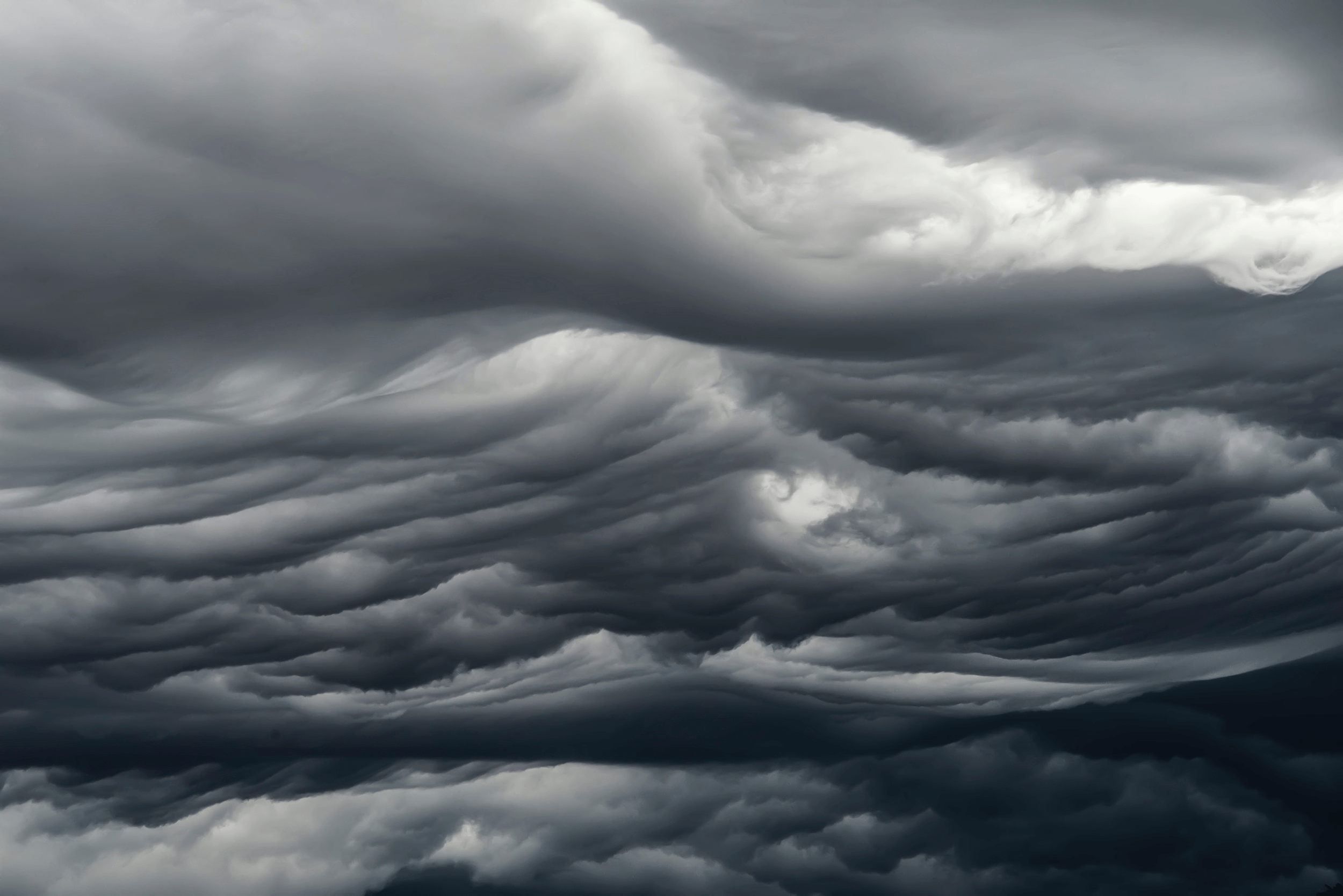
In 2017, the World Meteorological Organization named a new cloud type: the wave-like asperitas cloud. How these rare and distinctive clouds form is still a matter of debate, but this new study suggests that they need conditions similar to those that produce mammatus clouds, plus some added shear.
Using direct numerical simulations, the authors studied a moisture-filled cloud layer sitting above drier ambient air. Without shear, large droplets in this cloud layer slowly settle downward. As the droplets evaporate, they cool the area just below the cloud, changing the density and creating a Rayleigh-Taylor-like instability. This is one proposed mechanism for mammatus clouds, which have bulbous shapes that sink down from the cloud.
When they added shear to the simulation, the authors found that instead of mammatus clouds, they observed asperitas ones. But the amount of shear had to be just right. Too little shear produced mammatus clouds; too much and the shear smeared out the sinking lobes before they could form asperitas waves. (Image credit: A. Beatson; research credit: S. Ravichandran and R. Govindarajan)
Surfers flock to northern Peru to enjoy what’s been called the world’s longest wave. These waves are generated by storms thousands of miles away in the Pacific and Southern Oceans. In the open water between, the waves sort themselves into groups of similar wavelength and speed. With the deep water off Peru, the large swells continue to travel together until close to the shore. Surfers also benefit from the tendency for incoming waves to arrive nearly parallel to the coastline, creating long shoreline stretches for breaking. Where many famous wave breaks can be ridden for seconds, surfers can ride these for minutes! (Image credit: L. Dauphin; via NASA Earth Observatory)
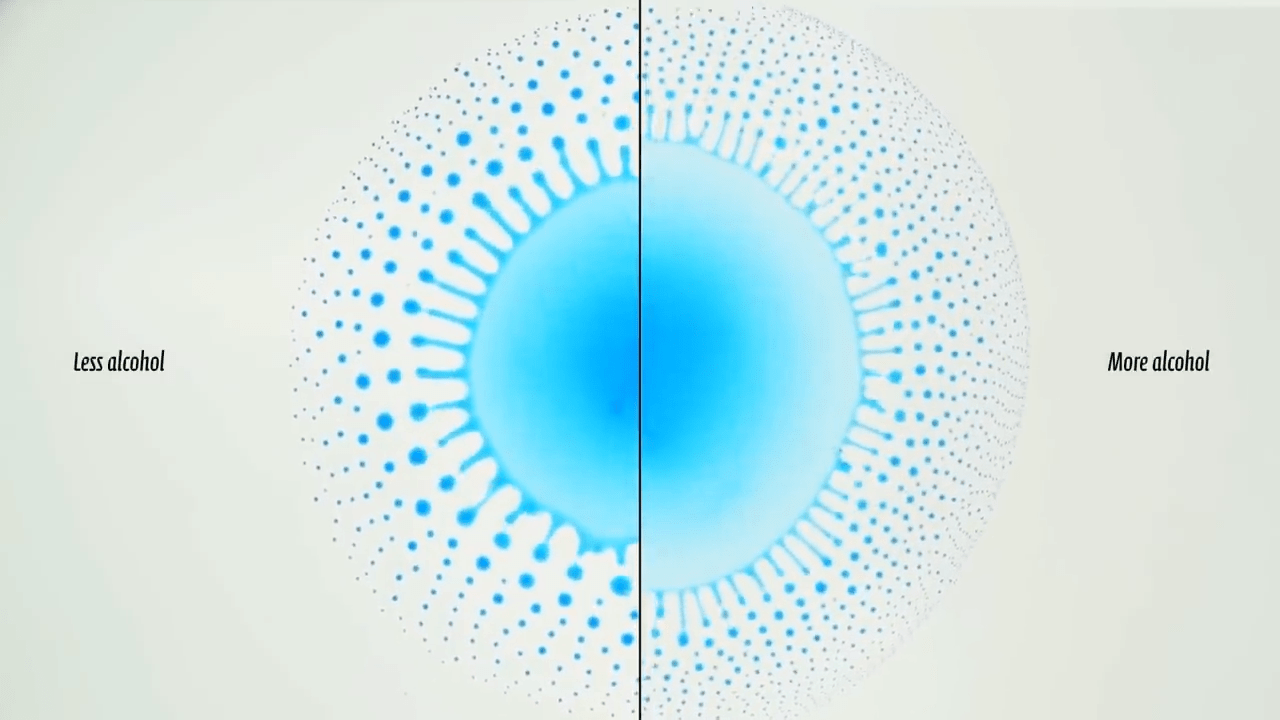
Adding dye to a flow is a common technique for visualization. After all, many flows in fluids like air and water are invisible to our bare eyes. But for some classes of flows — especially those driven by variations in surface tension — adding dye can have unforeseen effects. A recent study shows how true this is for bursting Marangoni droplets, where evaporation and alcohol concentration can pull a water-alcohol droplet apart.
As more dye is added to the experiment, the daughter droplets grow larger and more ligaments form. In the first three images, a dashed black line has been added to show the location of the droplet rim.
Without dye, it’s nearly impossible to see the phenomenon since the refractive indices of the two component liquids are so close. But the researchers found that, as they added more methyl blue dye, it did more than increase the contrast in the flow. It changed the flow, making the droplets larger and creating ligaments between them. They believe that the dye’s own surface tension creates local gradients that alter the flow. It’s a reminder that experimentalists have to be careful to consider how our efforts to measure and observe a flow can change it. (Image credit: top – The Lutetium Project, bottom – C. Seyfert and A. Marin with modification; research credit: C. Seyfert and A. Marin)
Birds, fish, and other creatures form amazing, undulating swarms of individuals. How these collectives comes together and move continues to fascinate scientists. Here, researchers look at simple particles with two “instructions,” if you will. One causes the particle to self-navigate toward a target; the other causes short-range repulsion if the particle gets too close to another one. With only these two simple guidelines, a flock of these particles forms complex, ever-changing flows! (Image and video credit: M. Casiulis and D. Levine)
Though it looks like a strange underwater panorama, this image by photographer Marek Miś actually captures air bubbles trapped beneath the slip cover of a microscope slide smeared with drying callus remover. According to Miś, “Callus remover is one of my favourite agents for taking micrographs. It can create unusual crystalline forms. This time I found on the slide these interesting air bubbles before the callus remover started to crystallise.” I confess that I wouldn’t have thought to use callus remover for art!
This image earned 3rd place in the Micro category of the Close-Up Photographer of the Year awards. See more winners here, and find more from Miś on the web and Instagram. (Image credit: M. Miś)
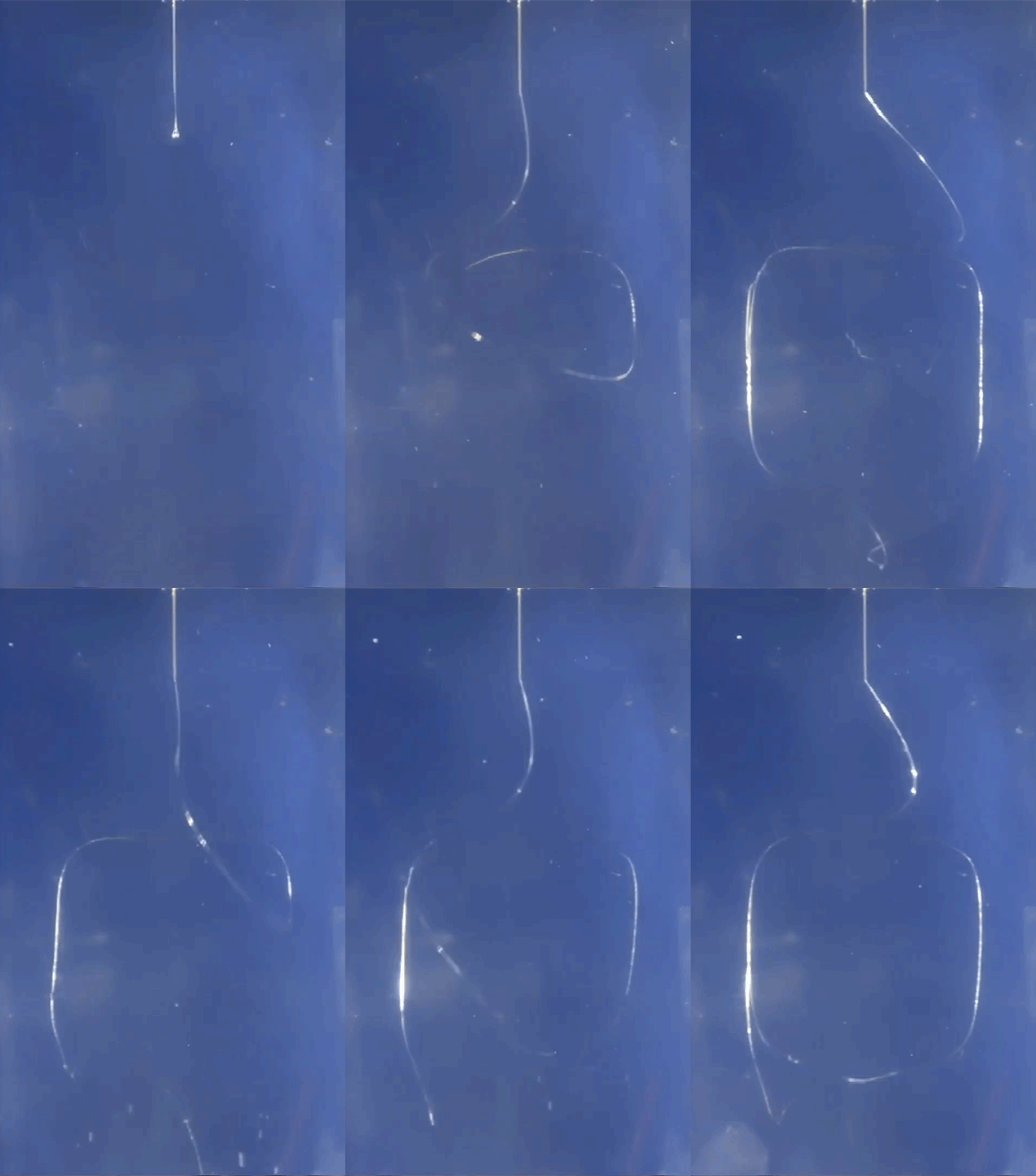
Using electromagnetism, researchers are bending and shaping soft liquid wires even against gravity. The team used galinstan — an alloy of gallium, indium, and tin that remains liquid at room temperature. On its own, galinstan has a high surface tension and forms droplets. But with a voltage applied, that surface tension is suppressed, making the liquid form a long, thin, still-liquid wire. Adding a magnetic field allowed the researchers to manipulate the falling stream of liquid, even levitating loops of the metal against the force of gravity! (Image, video, and research credit: Y. He et al.; via Cosmos; submitted by Kam-Yung Soh)
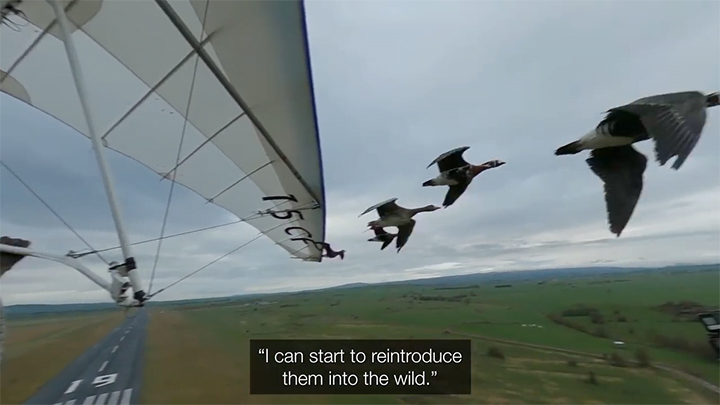
Some people fly with geese to train them for wind tunnel tests, and some people fly with them to teach them safer migratory paths. Today’s video focuses on the latter, specifically conservationist Christian Moullec, who has spent decades living and flying with lesser white-fronted geese as part of an effort to save the threatened species. He flies with them using an ultralight aircraft, exercising daily to prepare for the cross-continental migration. To help fund the effort, he offers passengers a spot on his short flights, letting people fly with the birds! (Image and video credit: T. Scott; via Colossal)
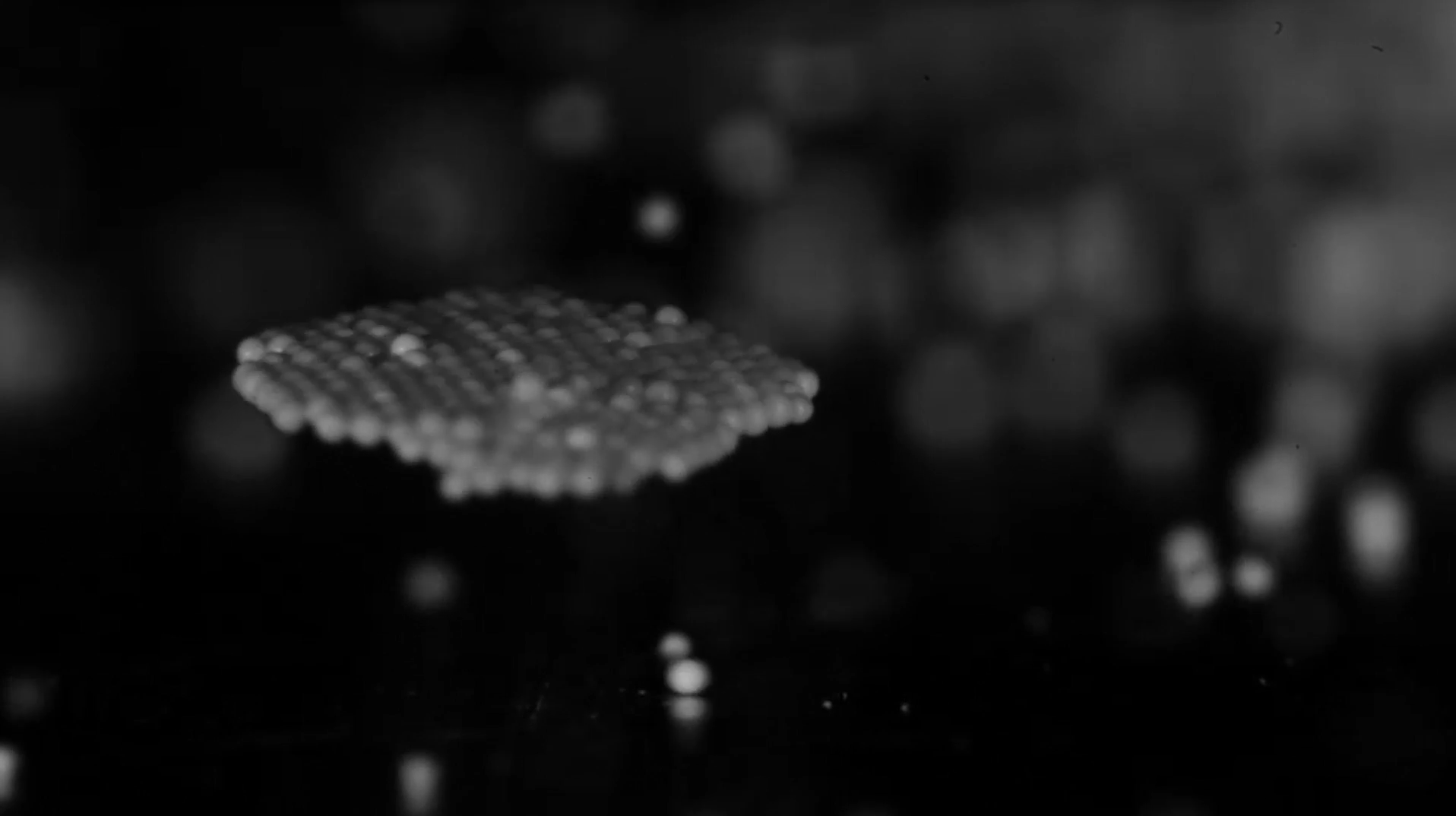
In nature, objects like asteroids, black holes, and atomic nuclei can get distorted when spinning rapidly. Researchers are exploring these objects using a new model platform: particle raftslevitated by sound. The individual particles are less than a millimeter wide and tend to clump together due to the scattering of sound waves off neighboring particles. This effect provides a cohesive force — similar to surface tension or the effects of gravity — that draws the particles together. With the right frequency, the sound waves can also make the granular rafts spin, setting up a tug-of-war between cohesion and centrifugal force.
Using sound waves for levitation, particles slowly rise and clump together. Particles are approximately 190 micrometers each, and the video is drastically slowed down from real-time.
As the rafts spin, they distort, pull apart, and come back together. Interestingly, the cohesive force a raft experiences increases with the raft’s size. That makes the attractive force unlike surface tension (which is the same whether you have a bucket of water or a lake) and more like gravity (which is stronger with more material.) Because of this size dependence, the team hopes their granular rafts could be a new way to study the formation of rubble-pile asteroids and similarly granular systems.
As the raft’s rotation increases, it’s pulled apart by centrifugal forces, but the pieces later reconnect. Video is slowed down by a factor of 60.