Tag: particle suspension

  • Particle-filled Splashes

    Particle-filled Splashes

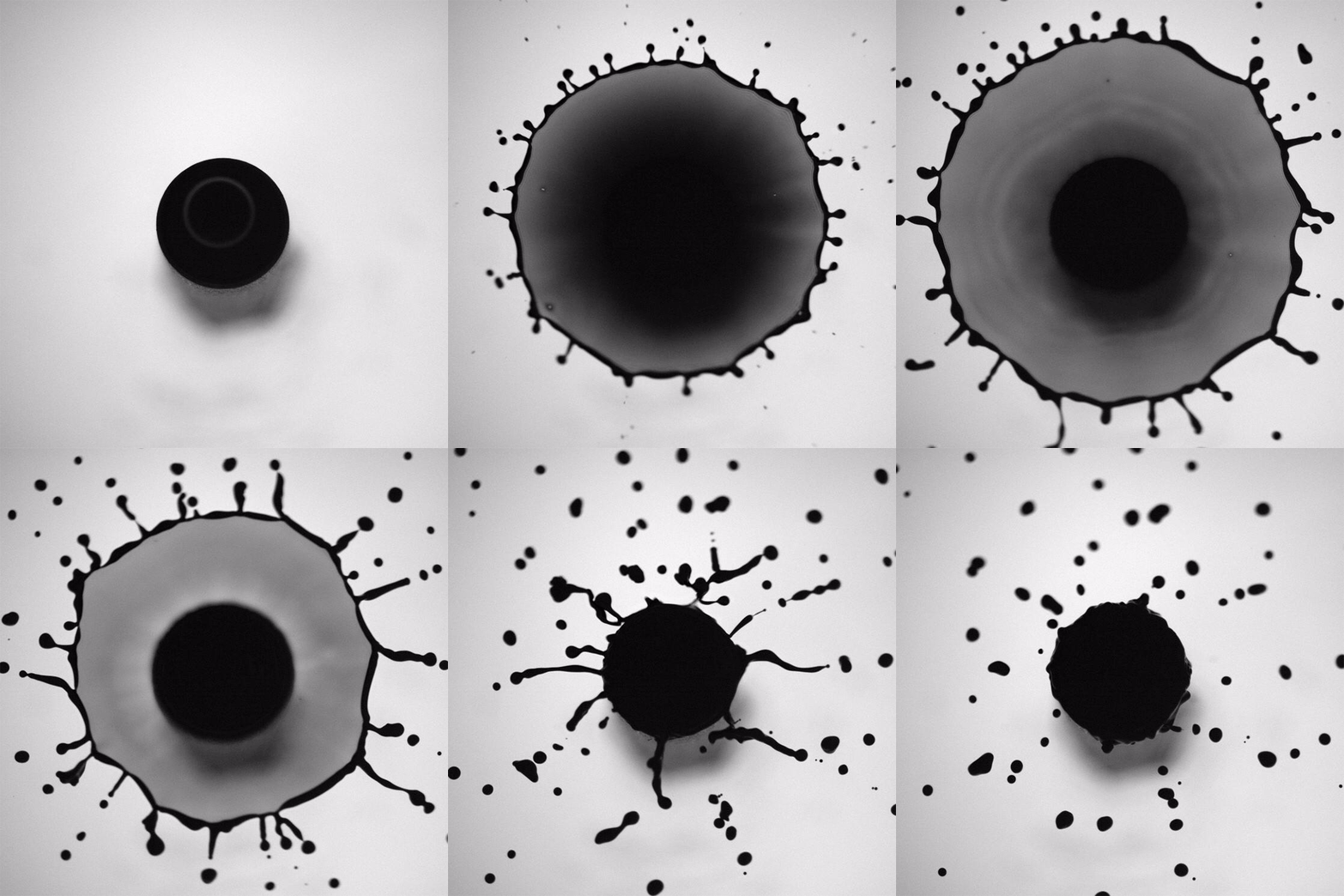
    Adding particles to a liquid can significantly alter its splash dynamics, as shown in this new study. In the first image, a purely-liquid droplet spreads on impact into a thin liquid sheet that destabilizes from the rim inward, ripping itself into a spray of droplets. At first glance, the particle-filled droplet in the second image behaves similarly; it, too, spreads and then disintegrates. But there are distinctive differences.

    During expansion, the particles increase the drop’s effective viscosity, meaning that the splash sheet does not expand as far. That apparent viscosity increase is also part of why the drops the splash sheds are bigger than those without particles. The other part of that story comes from the retraction, where the variations in thickness caused by the particles and their menisci create preferential paths for the flow. As a result, the particle-filled splash breaks up faster and into larger droplets compared to its purely-liquid counterpart. (Image and research credit: P. Raux et al.)

  • Floccing Particles

    Floccing Particles

    Adding particles to a viscous fluid can create unexpected complications, thanks to the interplay of fluid and solid interactions. Here we see a dilute mixture of dark spherical particles suspended in a layer of fluid cushioned between the walls of an inner and outer cylinder. Initially, the particles are evenly distributed, but when the inner cylinder begins to rotate, it shears the fluid layer. Hydrodynamic forces assemble the particles together into loose conglomerates known as flocs. Once the particles form these log-like shapes, they remain stable thanks to the balance between viscous drag on particles and the attractive forces that pull particles toward one another. (Image and research credit: Z. Varga et al.; submitted by Thibaut D.)

  • Dip Coating

    Dip Coating

    Imagine dipping a rod into a liquid mixture filled with particles. When you pull the rod out, do particles stick to it? The answer depends on the relative importance of two sets of forces: the viscous drag as you lift the rod and adhesive power of surface tension. Scientists express this as a dimensionless ratio known as the capillary number.

    When the capillary number is small, viscous drag dominates, and any particles that try to stick to the rod get pulled away (upper left). But as you increase the capillary number, surface tension helps particles clump together and stick to the rod (lower left and right). If the surface tension forces are strong enough – meaning that the capillary number is high –  you can actually get multiple layers of particles adhering to the dipped surface. (Image and research credit: E. Dressaire et al.)

  • Bead-Infused Droplet

    Bead-Infused Droplet

    A Leidenfrost droplet impregnated with hydrophilic beads hovers on a thin film of its own vapor. The Leidenfrost effect occurs when a liquid touches a solid surface much, much hotter than its boiling point. Instead of boiling entirely away, part of the liquid vaporizes and the remaining liquid survives for extended periods while the vapor layer insulates it from the hot surface. Hydrophilic beads inserted into Leidenfrost water droplets initially sink and are completely enveloped by the liquid. But, as the drop evaporates, the beads self-organize, forming a monolayer that coats the surface of the drop. The outer surface of the beads drys out, trapping the beads and causing the evaporation rate to slow because less liquid is exposed. (Photo credit: L. Maquet et al.; research paper – pdf)

  • Featured Video Play Icon

    Evaporating Drops

    When still drops evaporate from a surface, they do so in several phases, as illustrated in the video above. Initially, the drop forms a spherical cap. At this point the velocity within the droplet is so small that it is difficult to resolve, but particles within the drop move outward toward the contact line. As the drop evaporates, they form a circle of sediment – the familiar coffee ring. As the drop flattens, radial velocity increases, drawing more and more particles to the coffee ring. Eventually the drop pulls away from the ring, leaving surface tension and evaporation to compete in driving the internal flow. During this phase, some parts of the contact line try to re-establish the flow pattern that made the first ring; this leaves behind circular segments broken up by the increasing instabilities in the contact line. In the final stage, surface tension smooths some of the irregularities and drives an inward velocity that leaves behind radial sediment segments. (Video credit: G. Hernandez-Cruz et al.)

  • Featured Video Play Icon

    Particle Patterning

    Here a container filled with a suspension of neutrally buoyant polystyrene beads and fluid is rotated. As the container rotates, a thin layer of fluid and bunches of particles get drawn up onto the wall by capillary forces capable of holding the particles in place even if the container stops rotating. The density and patterning of the particles on the wall depends on the container’s rotation speed and the volume fraction of particles. (Video credit: J. Kao and A. Hosoi)

  • Featured Video Play Icon

    Staining Patterns

    This timelapse video shows a particulate suspension as it dries and the pattern formation that results. The mixture of silicon dioxide particles and water is spread over a glass slide. As the water evaporates, capillary action generates a flow toward the edges, but the fluid meniscus pins larger particles to the glass, trapping them. As more and more water evaporates, smaller particles are trapped, causing the formation of uneven stripes in the particulate deposits. You’ve probably seen these patterns before on the side of a muddy car after a rainy day! (See also: how coffee rings form; Video credit: Bjornar Sandnes)

  • Chaos in Suspension

    Chaos in Suspension

    In science, the term chaotic is used to describe a system whose behavior is highly sensitive to initial conditions. This means that the end state can vary widely based on small changes at the start–also commonly known as the butterfly effect. Many fluid dynamical systems are chaotic, especially turbulent ones. Above are a series of photos showing the suspension of particles in a horizontally rotating cylinder. In parts A-D, the speed of rotation of the cylinder is increased, resulting in dispersion of the particles. As rotation rate is increased further, interesting concentration patterns form. #