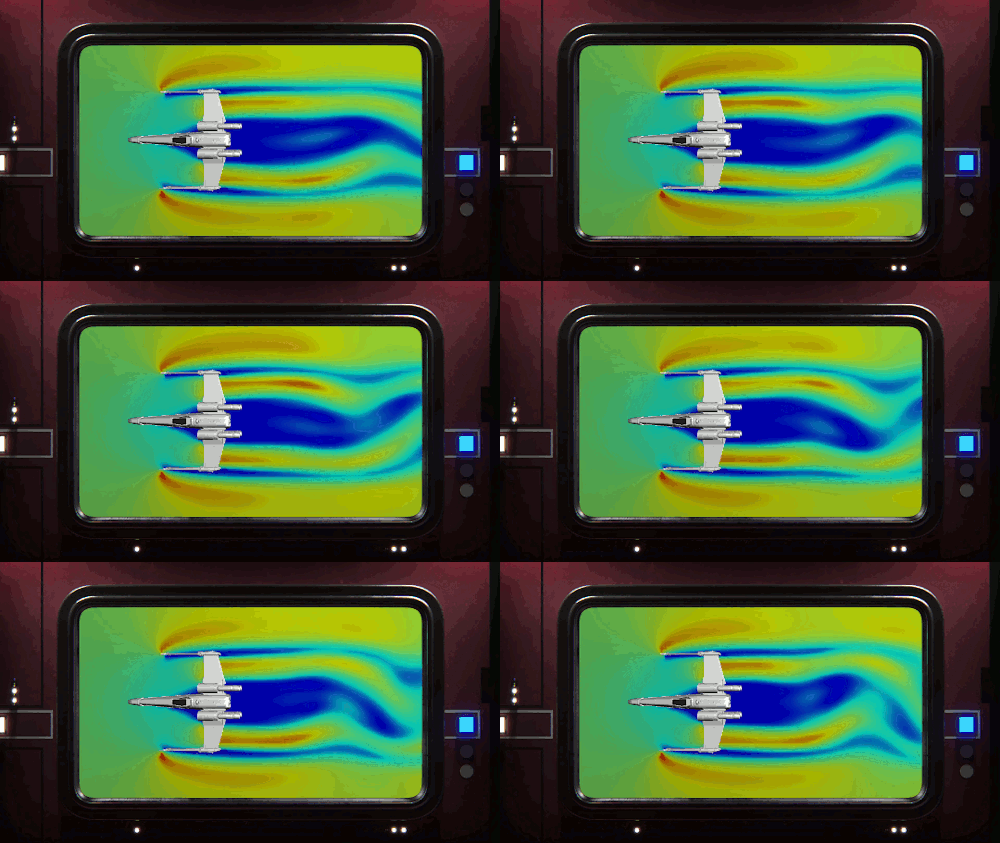
Science fiction is not always known for hewing to scientific fact, so it will probably come as little surprise that Star Wars’ ships have terrible aerodynamics. But it’s nevertheless fun to see EC Henry’s analysis of drag coefficients of various Rebel and Imperial ships and just how poorly they fare against our own designs.
Drag coefficients really only give a tiny piece of the story, though. We don’t know what speed Henry is testing the ships at, and we get no information about properties like lift or lift-to-drag ratio, which can be even more important than just the drag when it comes to evaluating an aircraft.
There are some intriguing hints about other aerodynamic properties in the clips of flow around an X-wing and TIE fighter, though. Notice that the wake of both ships meanders back and forth. This is an indication of vortex shedding, and it means that both spacecraft would tend to be buffeted from side-to-side when flying in an atmosphere. Either the ships would need some kind of active control to counter those forces, or pilots would need iron constitutions to operate under those conditions! (Video and image credit: EC Henry)
Humans may not be fast enough to run across water, but we’ve found other ways to conquer the waves. It’s even possible (though definitely not recommended) to ride across stretches of water on a dirt bike. To do so, you have to keep the bike (hydro)planing, and to understand what that means, let’s take a moment to talk about boats.
At low speeds, boats stay afloat based on buoyancy, a force that depends on how much water they displace. But when moving at high speeds, modern speedboats lift mostly out of the water and skim the surface instead. At this point, it’s hydrodynamic lift that keeps the boat above the surface and we say that the boat is planing. Calculating that hydrodynamic lift is fairly complicated and depends on many factors – for those who are interested, check out some of David Savitsky’s papers – but, generally speaking, going faster gives you more lift.
This brings us back to the dirt bike. There’s nothing particularly hydrodynamic about a dirt bike. It’s not shaped to provide hydrodynamic lift, but it does come with a high power-to-weight ratio. It’s this ability to create pure speed, and a rider’s keen sense for holding the bike at the right angle, that enables pros to cross open water. Needless to say, this is the kind of stunt that could end reallybadly, so don’t try it yourself. (Image credits: C. Alessandrelli, source; EnduroTripster, source; via Digg; submitted by 1307phaezr)
One of the most vexing topics for fluid dynamicists and their audiences is the subject of how wings generate lift. As discussed in the video above, there are a number of common but flawed explanations for this. Perhaps the most common one argues that the shape of the wing requires air moving over the top to move farther in the same amount of time, therefore moving faster. The flaw here, as my advisor used to say, is that there is no Conservation of Who-You-Were-Sitting-Next-To-When-You-Started. Nothing requires that air moving over the top and bottom of a wing meet up again. In fact, the air moving over the top of the wing outpaces air moving underneath it.
In the Sixty Symbols video, the conclusion presented is that any complete explanation requires use of three conservation principles: mass, momentum, and energy. In essence, though, this is like saying that airplanes fly because the Navier-Stokes equations say they do. It’s not a terribly satisfying answer to someone uninterested in the mathematics.
Part of the reason that so many explanations exist – here’s one the video didn’t touch on using circulation – is that no one has presented a simple, intuitive, and complete explanation. This is not to say that we don’t understand lift on fixed wings – we do! It’s just tough to simplify without oversimplifying.
Here’s the bottom line, though: the shape of the wing forces air moving around it to change direction and move downward. By Newton’s 3rd law (equal and opposite reactions), that means the air pushes the wing up, thereby creating lift. (Video credit: Sixty Symbols)
Nature includes many animals that are so-called fliers: flying squirrels, flying snakes, and draco lizards, to name a few. These animals aren’t true fliers like birds, bats, or insects, though. Instead, they are expert gliders, able to produce enough lift to control their descent and land safely at a distance far greater than a normal leap could carry them. Like the flying squirrel, the draco lizard extends a thin membrane that acts as its wings. The additional area provides enough lift that the lizards can glide as far as 60 m (200 ft) while only losing 10 m (33 ft) in altitude. That’s an impressive glide ratio – about 3 times better than the Northern flying squirrel and twice as good as a wingsuit. (Video credit: BBC/Planet Earth II)
This short film for the 2016 Gallery of Fluid Motion features Montana State University students experiencing fluid dynamics in the classroom and in their daily lives. As in her previous film (which we deconstructed), Shanon Reckinger aims to illustrate some of our everyday interactions with fluids. This time identifying individual phenomena is left as an exercise for the viewer, but there are hints hidden in the classroom scenes. How many can you catch? I’ve labeled some of the ones I noticed in the tags. (Video credit: S. Reckinger et al.)
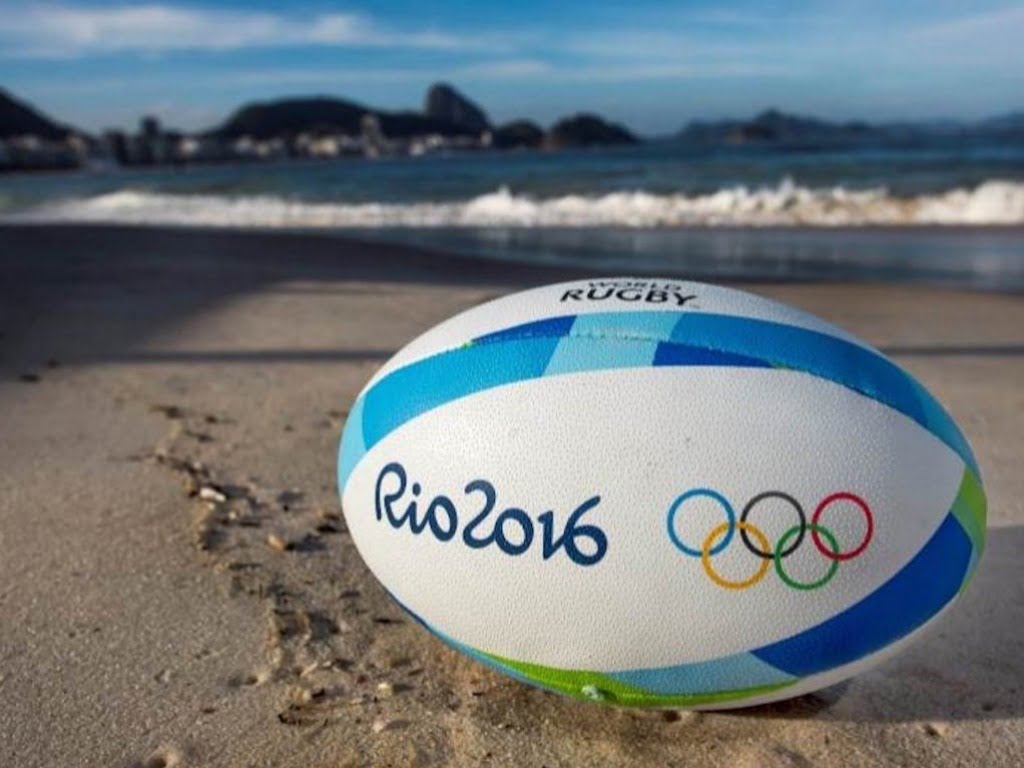
The sport of rugby returns to the Olympics in Rio this year. Rugby’s ball is somewhat similar in size and shape to an American football, but it is a little wider and more rounded. Aerodynamically, this means that the rugby ball has more drag, but it is also more stable in flight, allowing players to pass and kick accurately, with or without a spiral.
As seen in the flow visualizations above, air travels up and around the ball before separating on the far side. The more the ball is tilted, the larger this separated region is and the greater the drag. At the same time, though, that tilt provides lift on the ball. The ideal orientation is the one with the largest ratio of lift force and drag force. For a rugby ball, this occurs at about 40 degrees.(Image credits: Planet Rugby; A. Vance et al.)
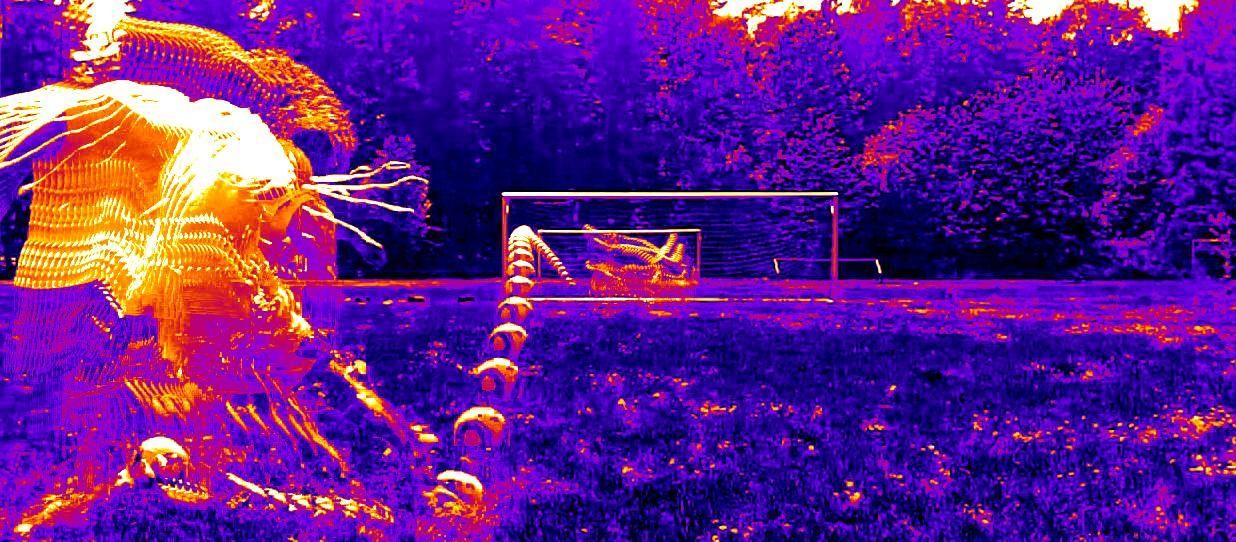
For more than a century, athletes have used the zigzagging path of a knuckleball to confound their opponents. Knuckleballing is best known in baseball but appears also in volleyball, soccer, and cricket. It occurs when the ball has little to no spin. The source of the knuckleball’s confusing trajectory, according to a new study, is the unsteadiness of the lift forces around the ball. As the ball flies, tiny variations occur in the flow on either side, causing small variations to the lift as well. Using experiments and numerical models, the researchers established that this white noise in the lift forces is sufficient to cause knuckleball-like path changes.
They were also able to explain why some sports see the knuckleball effect and others don’t. The wavelength of the deviations – the distance between a zig and a zag – is relatively long, so knuckleballing can only be noticed if the distance the ball flies is long enough for the deviation to be apparent. Additionally, the side-to-side motion is largest when flow on the ball is transitioning from laminar to turbulent flow, so knuckleballing also requires a very particular (and usually low) initial speed. (Image credit: L. Kang; research credit: B. Texier et al.; submitted by @1307phaezr)
We play with fluid dynamics all the time, though we don’t always think of it as such. Here are a few ways it shows up in the ways we play:
Aerodynamics This is the study of air moving past an object. Whether you’re throwing a paper plane, flying a kite, or riding a bike, aerodynamics has an impact on what you’re doing.
Lift
Skipping a rock won’t work unless its impact generates some lift, but we see lift in lots of other places, too, from birds and planes to racecars and sailboats.
Magnus Effect
The Magnus effect relates to lift forces on a spinning object. It can affect the way a frisbee flies, but we see it a lot in ball-related sports, too. The flight of golf balls, volleyballs, baseballs, and soccer balls can all be significantly impacted by the Magnus effect. Check out these videos for a primer on the Magnus effect and the reverse Magnus effect.
Bubbles
Everybody loves playing with bubbles. But they may have more of a impact than you realize, whether it’s in making the foam on your latte, enhancing the aroma of your champagne, or making your joints pop.
Tune in all week for more examples of fluid dynamics in daily life. (Image credit: S. Reckinger et al., source)
so, how is lift actually generated? i’ve been going through Anderson’s Introduction to Flight (6th Ed.) and while it offers the derivation of various equations very thoroughly, it barely touches on why lift is generated, or how camber contributes to the increase of C(L)
This is a really good question to ask. There are a lot of different explanations for lift out there (and some of the common ones are incorrect). The main thing to know is that a difference in pressure across the wing–low pressure over the top and higher pressure below–creates the net upward force we call lift. It’s when you ask why there’s a pressure difference across the wing that explanations tend to start diverging. To be clear, aerodynamicists don’t disagree about what produces lift – we just tend to argue about which physical explanation (as opposed to just doing the math) makes the most sense. So here are a couple of options:
Newton’s third law states that for every action there is an equal and opposite reaction. If you look at flow over an airfoil, air approaching the airfoil is angled upward, and the air leaving the aifoil is angled downward. In order to change the direction of the air’s flow, the airfoil must have exerted a downward force on the air. By Newton’s third law, this means the air also exerted an upward force–lift–on the airfoil.
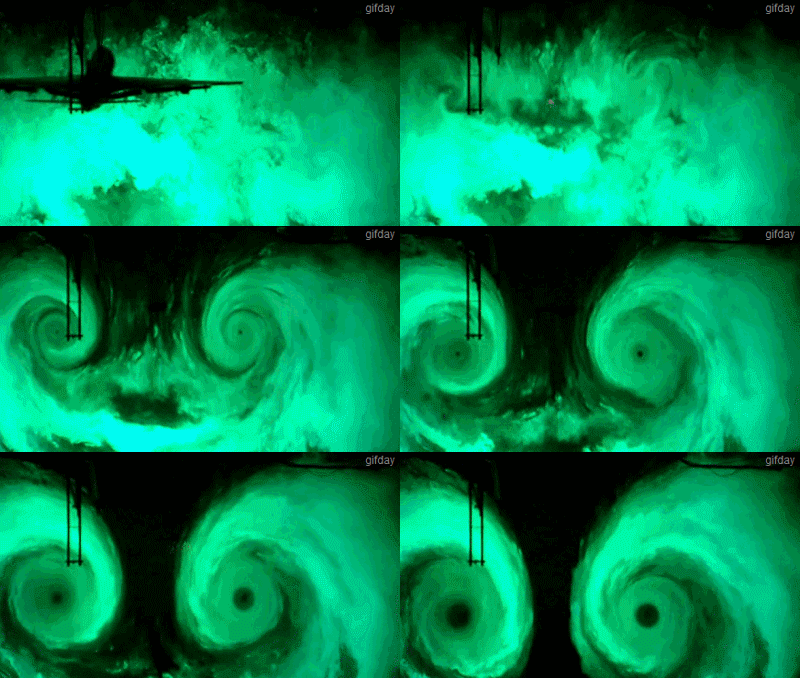
The downward force a wing exerts on the air becomes especially obvious when you actually watch the air after a plane passes:
This one can be harder to understand. Circulation is a quantity related to vorticity, and it has to do with how the direction of velocity changes around a closed curve. Circulation creates lift (which I discuss in some more detail here.) How does an airfoil create circulation, though? When an airfoil starts at rest, there is no vorticity and no circulation. As you see in the video above, as soon as the airfoil moves, it generates a starting vortex. In order for the total circulation to remain zero, this means that the airfoil must carry with it a second, oppositely rotating vortex. For an airfoil moving right to left, that carried vortex will spin clockwise, imparting a larger velocity to air flowing over the top of the wing and slowing down the air that moves under the wing. From Bernoulli’s principle, we know that faster moving air has a lower pressure, so this explains why the air pressure is lower over the top of the wing.
Asymmetric Flow and Bernoulli’s Principle
There are two basic types of airfoils – symmetric ones (like the one in the first picture above) and asymmetric, or cambered, airfoils (like the one in the image immediately above this). Symmetric airfoils only generate lift when at an angle of attack. Otherwise, the flow around them is symmetric and there’s no pressure difference and no lift. Cambered airfoils, by virtue of their asymmetry, can generate lift at zero angle of attack. Their variations in curvature cause air flowing around them to experience different forces, which in turn causes differing pressures along the top and the bottom of the airfoil surface. A fluid particle that travels over the upper surface encounters a large radius of curvature, which strongly accelerates the fluid and creates fast, low-pressure flow. Air moving across the bottom surface experiences a lesser curvature, does not accelerate as much, and, therefore, remains slower and at a higher pressure compared to the upper surface.
Frisbees are a popular summertime toy, but they involve some pretty neat physics, too. Two key ingredients to their long flight times are their lift generation and spin. A frisbee in flight behaves very much like a wing, generating lift by flying at an angle of attack. This angle of attack and the curvature of the disk rim cause air to accelerate over the top of the leading edge. Airflow over the top of the disk is faster than that across the bottom; thus, pressure is lower over the top of the frisbee and lift is generated. Aerodynamic lift and drag aren’t enough to keep the frisbee aloft long, though. Spin matters, too. If the frisbee is launched without spin, gravity acts on it through its center of mass, but lift and drag act through a point off-center because lift tends to be higher on the front of the disk than the back. This offset between gravitational forces and aerodynamic forces creates a torque that tends to flip the frisbee. By spinning the frisbee, the thrower gives it a high angular momentum acting about its spin axis. Now instead of flipping the disk, the torque caused by the offset forces just tips the angular momentum vector slightly. Physically, this is known as spin stabilization or gyroscopic stability. Tomorrow we’ll take a closer look at airflow over the frisbee. (Image credit: A. Leibel and C. Pugh, source video; recommended papers by: V. Morrison and R. Lorentz)