Tag: insects

  • Featured Video Play Icon

    Water-Jumping Springtails

    Springtails are small, jumping insects. Semiaquatic varieties use their tails to jump off water in order to move around and escape predation. Among these water jumpers, results vary; some, like in the third image, have little to no control over their landings and will frequently faceplant or land on their backs. But some species in the family have a better technique.

    These springtails grab a water droplet with their hydrophilic ventral tube (seen in the second image with a red identifying arrow) during take-off. This tiny water droplet serves several purposes. First, it adds extra weight to the insect, allowing it to better orient its body to land belly-down. Second, the drop gives the insect a way to adhere to the water during landing, preventing it from bouncing. Check out the video to see lots of high-speed video of these tiny acrobats! (Video and image credit: A. Smith/Ant Lab; research credit: V. Ortega-Jimenez et al.)

  • Featured Video Play Icon

    Pee-Flinging Sharpshooters

    The tiny glassy-winged sharpshooter feeds exclusively on nutrient-poor sap from plant xylem. Since the sap is 95% water, the insects have to consume massive amounts, necessitating lots of urination — up to 300 times their body weight each day! With so much urine to get rid of and so little energy to spare, the sharpshooter has developed an ingenious, low-energy method to expel its waste. The insect forms a droplet on its anal stylus and flings it. A recent study reveals just how clever the insect’s method is.

    Researchers found that sharpshooters fling their droplets 40% faster than their stylus moves. This superpropulsion is only possible because the stylus’s motion is finely tuned to the droplet’s elasticity. Essentially, the insects achieve single-shot resonance with every throw. The energy-savings for the insects is substantial; researchers estimate that making a jet of urine instead would cost four to eight more times energy. (Video credit: Georgia Tech; image and research credit: E. Challita et al.; via Ars Technica; submitted by Kam-Yung Soh)

  • Featured Video Play Icon

    Moths and Beetles in Flight

    Watching insects take flight in high-speed video is always mesmerizing. So often their wings look too small and fragile to lift their bulbous bodies, but they manage the feat easily. I especially like to watch how much their wings flex during each up- and downstroke. So often we think that stiffer wings — like those on airplanes — are better for flight, yet nature demonstrates at so many sizes that flexibility is better, especially in flapping flight. A flexible wing can maximize lift in the downstroke and curl to minimize drag on the upstroke. Even wings that fold away, as many beetle wings do, can do the job of lifting an insect once shaken out. (Image and video credit: Ant Lab)

  • Featured Video Play Icon

    Fire Ant Rafts

    When you run into a fire ant, you’re in for a bad day. But if you run into a colony-sized raft of fire ants, well, that’s going to be a very bad day. These insects evolved to survive Amazonian floods, and that prowess has helped them spread far from their original homes. When waters start rushing into their home, the ants set out on a rescue mission, pulling their young out. The ants lash themselves and the youngsters together with their own bodies and form a floating raft. Thanks to the hydrophobic hairs on the larvae and ants, they trap a layer of air near their bodies. This helps them breathe, even if they’re on the bottom of the raft. Learn lots more about fire ants, including how they act as fluid, over here. (Image and video credit: Deep Look)

  • Featured Video Play Icon

    Backswimmers

    Backswimmers rule the surface of ponds, streams, and other bodies of water. These insects spend much of their time clinging just beneath the air-water interface, where they hunt larvae and other insects. They use oversized, oar-shaped back legs to row, and they breathe using an air bubble that clings to their abdomen like a personal scuba tank. Oxygen from the water diffuses into the bubble, keeping the insect’s air supply fresh. When the time comes to move to greener pastures, they flip to the other side of the water’s surface, unfurl their wings, and take off. (Image and video credit: Deep Look)

  • Featherwings in Flight

    Featherwings in Flight

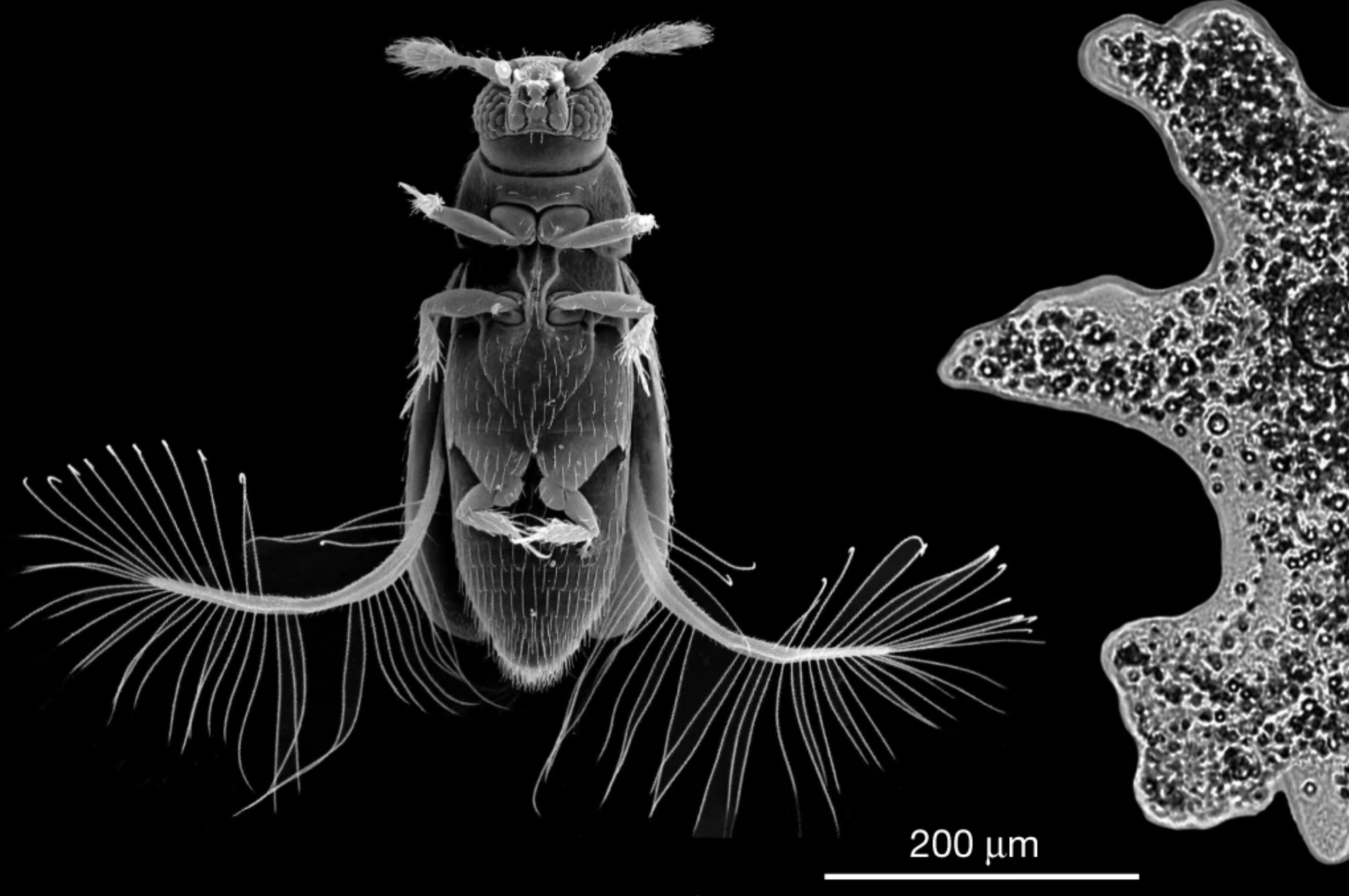
    The featherwing beetle is tiny, less than half a millimeter in length. At that scale, flying is a challenge, with air’s viscosity dominating the forces the insect must overcome. The featherwing beetle, as its name suggests, has feather-like wings rather than the membranes larger beetles use. But a new study shows that these odd wings work surprisingly well.

    The beetle’s bristled wings flap with an exaggerated figure-8 motion, with the wings clapping together in front of and behind the insect. The beetle expends less energy moving its feathery wings than it would if they were solid, and it moves its wing covers at the same time to counter each stroke and keep its body steady. (Image and research credit: S. Farisenkov et al.; video credit: Nature; submitted by Kam-Yung Soh)

  • Featured Video Play Icon

    Butterflies Emerging

    When a butterfly emerges from its chrysalis, it flaps its wings to help pump fluids through its body, essentially inflating its new adult form. You get a glimpse of that process here in this Ant Lab video, along with some spectacular slow motion footage of butterflies taking off. I’m always amazed to see how much butterfly wings flex with each wing beat! Even more impressive is the strength of the insect’s lift; as seen here, a butterfly is strong enough to take off while supporting both itself and a mated insect. (Image and video credit: Ant Lab/A. Smith)

  • The Best of FYFD 2021

    The Best of FYFD 2021

    A year ago I observed what a strange year 2020 had been, and in many ways, I could say the same of 2021. Before the pandemic, I spent quite a lot of time traveling. In 2021, the only nights I slept outside my own bed came on a long weekend up to the mountains with my family. But 2021 also saw a bit of a return to normalcy – I was giving keynote addresses and workshops again, albeit virtually. What will 2022 hold? Who knows?!

    As per tradition, here are the top FYFD posts of 2021:

    1. A superior mirage leaves a ship floating in mid-air
    2. Drone videos of sheep herding are mesmerizing
    3. Permeable pavement allows water to drain
    4. The slow and dreamy fluid landscape of “Le Temps et l’Espace”
    5. What do you do when you’re an insect researcher with a high-speed camera?
    6. Satellite images… or paint?
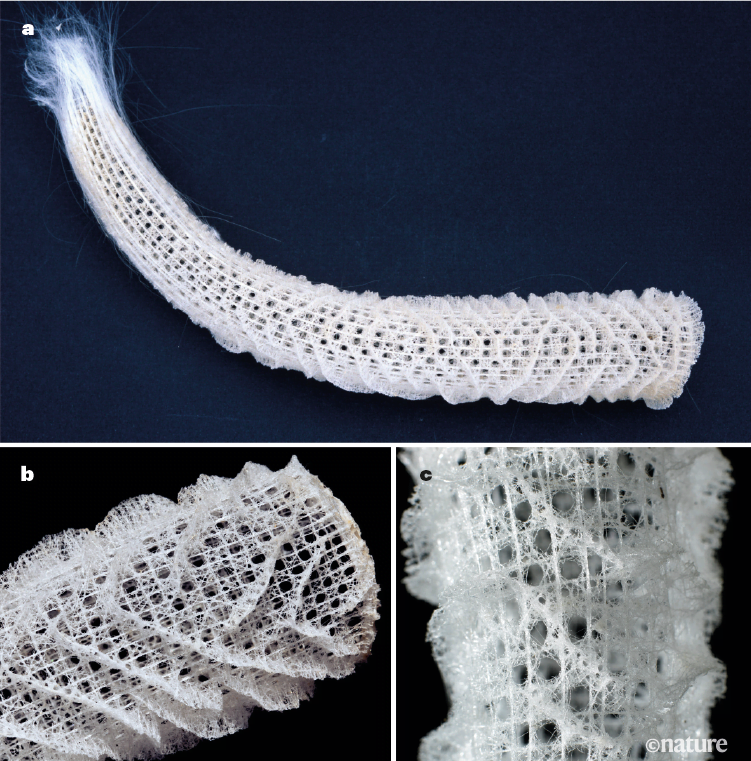
    7. The intricate lacework of the Venus’s flower basket sea sponge
    8. Building a Bluetooth speaker with ferrofluid music visualization
    9. Finding the acoustics of Stonehenge
    10. Making butter by traditional French methods

    It’s an eclectic mix of topics this year: bizarre phenomena, stunning art, archaeological exploration, and a touch of biophysics!

    If you enjoy FYFD, please remember that it’s primarily reader-supported. You can help support the site by becoming a patronmaking a one-time donationbuying some merch, or simply by sharing on social media. And if you find yourself struggling to remember to check the website, remember you can get FYFD in your inbox every two weeks with our newsletter. Happy New Year!

    (Image credits: mirage – D. Morris, sheep – L. Patel, pavement – Practical Engineering, Le Temps – T. Blanchard, insects – Ant Lab, Satellike – R. De Giuli, sea sponge – G. Falcucci et al., speaker – DAKD Jung, Stonehenge – T. Cox et al., butter – Art Insider)

  • Featured Video Play Icon

    Insects Taking Flight

    As awkward as they look sometimes, insects are amazing fliers. In this video from Ant Lab, we see all kinds of insects taking flight. Some, like the mantis, execute flying leaps to get in the air, whereas weevils begin flapping from a tripod stance. Watching these videos I’m always struck by how flexible insect wings are. They flex far more than I would imagine. And these insects have a lot of excess lift. Just check out that carrion beetle taking off despite being covered in mites! (Image and video credit: Ant Lab)

  • Featured Video Play Icon

    Moths in Flight

    As student engineers, we often use fixed-wing aircraft to build our intuition for flight, but nature has so many other incredible examples to offer. Here we see high-speed video of seven different moth species taking off, and understanding fixed-wing flight won’t help you here at all! These moths have small, rough, and incredibly flexible wings — all characteristics an aircraft designer typically avoids. Yet these insects are agile, fast, and capable fliers at a scale that continues to thwart engineers. Some of the earliest pioneers of flight watched birds for inspiration; for small crafts, there’s no better teacher than insects. (Image and video credit: A. Smith/AntLab)