Another look at the science behind the roaming rocks of Death Valley.
Tag: icing

Airfoil-shaped Ice
I discovered this interesting bit of icing a couple years ago near the foot of a waterfall in Ithaca, NY. The predominant wind was always heading toward the falls (left to right in these pictures), while the falls were always throwing spray up into the wind. The result was that ice airfoils (center) formed in the wake of each tree branch throughout most of the gorge (top).

Freezing Soap Bubbles
This is what it looks like when a soap bubble freezes. Perhaps not strictly fluid mechanical in nature, but it’s a nice thermodynamics demonstration.
Frost on Superhydrophobic Surfaces
Frost formation and ice adhesion on superhydrophobic surfaces
For anyone with further interest in the ice formation on superhydrophobic surfaces story we posted recently, the published paper is currently offered by AIP for free. #

Frosting on Superhydrophobic Surfaces
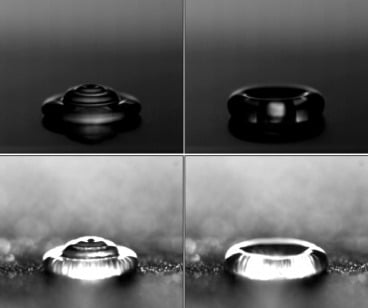
Icing on airplane wings can be disastrous for lift and control, and thus how ice initially forms on a wing is an active area of research. New work shows that superhydrophobic (water-fearing) surfaces may actually promote ice buildup. Superhydrophobic surfaces are prone to frosting–collecting ice that forms directly from a vaporous state–and that fine layer of frost is conducive to further ice buildup from a liquid state. The photo above shows a water droplet striking a dry superhydrophobic surface (top) and a frosted superhydrophobic surface (bottom). (via Gizmodo) #

How to Grow Straight Icicles
New research suggests that icicles grow straighter when exposed to moving air while exposure to still air can cause icicles to sprout at their tips. To grow icicles, the researchers built a refrigerated box that dripped water from the top while the growing icicle rotated. Understanding ice growth is important for flight aerodynamics and icing on airplane wings. For videos and more on icicle growth, see the article at Wired Science. #