Tag: fluid-solid interaction

  • Nestling Droplets

    Nestling Droplets

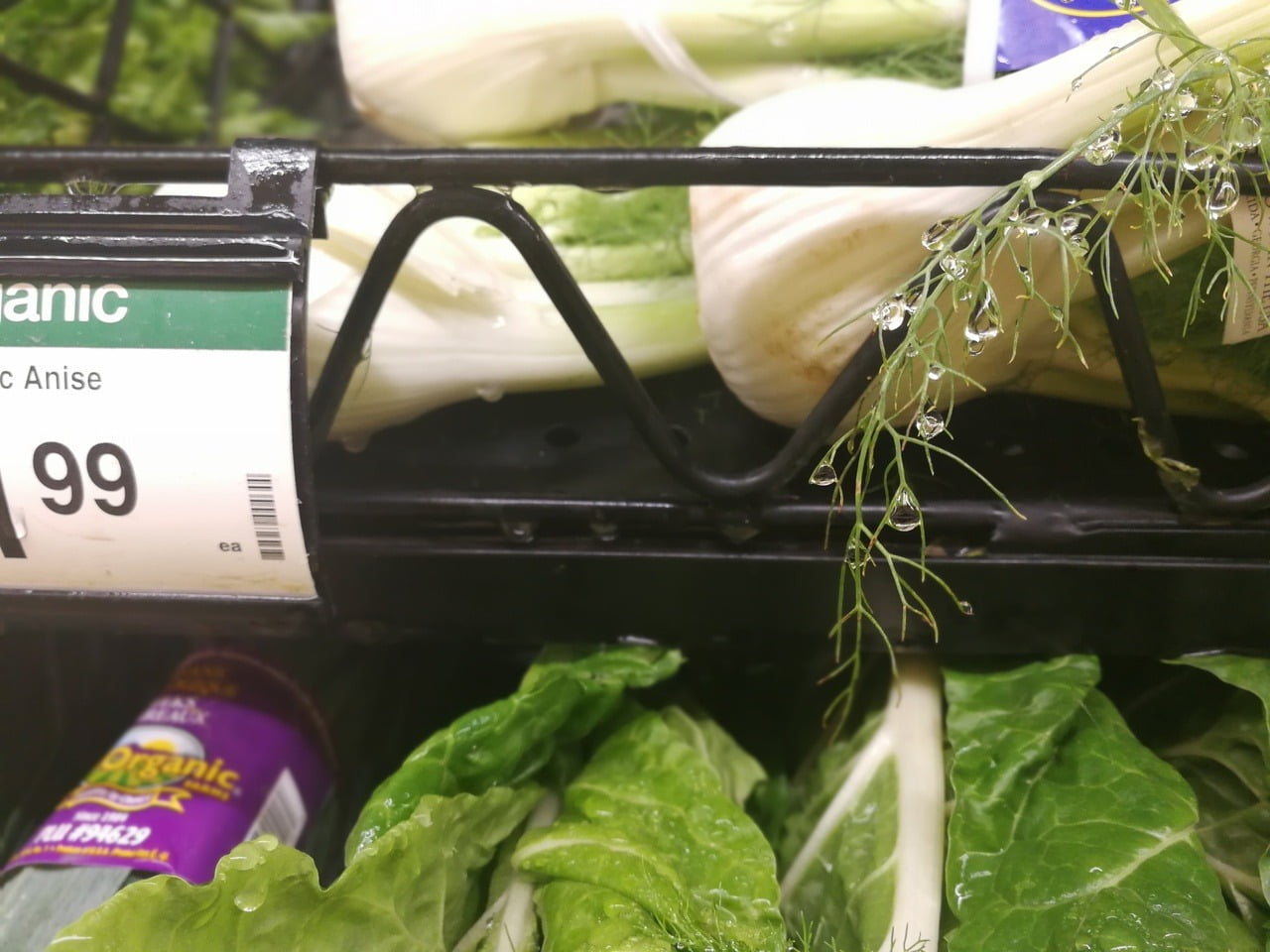
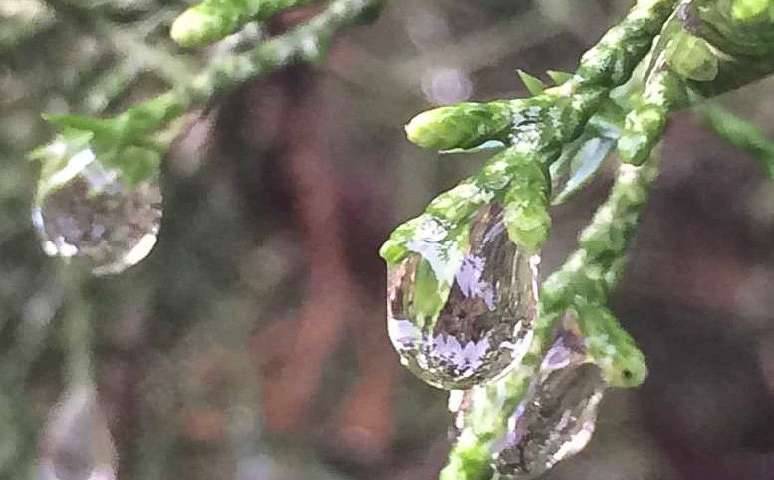
    Pay attention after a rainfall, and you may notice beads of water gathering in the corners of a spider’s web or along the leaves of a cypress tree (bottom right). Look closely and you’ll notice that the largest droplets don’t form along a straight fiber. Instead they nestle into the corners of a bent fiber (top image). Researchers recently characterized this corner mechanism and found that the angle at which the largest droplets form is about 36 degrees. This angle provides the optimal conditions for capillary action and surface tension to hold large drops in place. At smaller angles, a growing droplet’s weight pulls it down until the thin film holding the droplet near the top ruptures and the droplet falls. At larger angles, a heavy droplet will slowly detach from one side of its fiber and shift toward the other side until its weight is too great for the wetted length of fiber to hold. Then it detaches completely and falls. (Research and image credit: Z. Pan et al.; via T. Truscott)
  • Flag Flapping

    Flag Flapping

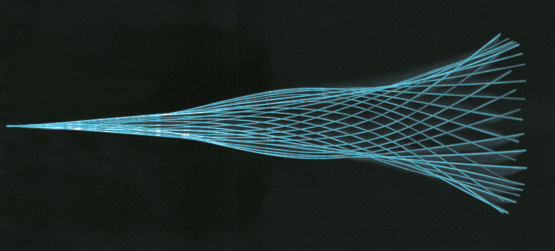
    Everyone has watched a flag flutter in the breeze, but you may not have given much thought to it. One of the earliest scientists to consider the problem was Lord Rayleigh, who wrote an aside on the mathematics of an infinite flag flapping in a paper on jets (pdf). Today researchers consider the problem in terms of fluid-solid interaction; in other words, to study a fluttering flag, you must consider both the properties of the flag – its flexibility, length, elasticity, and so on – and the properties of the fluid – air speed, viscosity, etc. The combination of these factors governs the complicated shapes taken on by a flag. The image above is a composite of several photos of a string (a 1-d flag) flapping in a flow that moves from left to right. By combining photos, the image highlights the envelope of shapes the flag takes and demonstrates at a glance just how far the flag flutters in either direction along its length. (Image credit: C. Eloy)

  • Featured Video Play Icon

    Soap Film Grass

    In the summer months, a breeze can set long grasses waving in an impressive display. Similar behaviors are seen in aquatic plants during tides. Researchers simulate the behavior in two-dimensions using a flowing soap film and nylon filaments. Flow visualization reveals the strong differences between flow above and between the grass. Vortices recirculate between the filaments at speeds much slower than the flow overhead. The instantaneous interaction of the high-speed freestream, the unsteady vortices, and the resistance of the grass results in familiar synchronous waves of grain.  (Video credit: R. Singh et al.)