Inside a cavity with a square cross-section, bubbles form an array. The shapes of their edges are determined by surface tension and capillarity (lower half of center image). Adding an elastic ribbon into the bubbles (upper half of center image) means that the bubbles’ shapes are determined by a competition between the elasticity of the ribbon and the capillarity of the fluid. Researchers found that they could tune the rigidity of the ribbon to dictate the shape of the bubble array, or, conversely, they could use the bubbles to set the shape of a UV-curable ribbon. (Image and research credit: M. Jouanlanne et al., see also)
Tag: fluid dynamics

Kelvin-Helmholtz Flows Downhill


Gravity currents carry denser fluids into lighter ones, like cold air drifting under your door in winter or dense fogs flowing downhill in San Francisco. Here, researchers visualize the situation using denser salt water flowing into fresh water. Once the gate separating the two fluids rises, the salt water slides down an artificial slope into the fresh water.
Very quickly the flow forms a Kelvin-Helmholtz instability due to the different flow speeds between the two fluids. Kelvin-Helmholtz waves form distinctive swirls and billows that are reminiscent of a cat’s eye. As the swirls rotate, they can flow over one another, and break up into turbulence. (Image and video credit: C. Troy and J. Koseff)
“The Dark Days”


“The Dark Days” is the third film in artist Thomas Blanchard’s N-UPRISING series. Like its siblings, this film features plants and insects, along with creeping — and sometimes overwhelming — fluid flows. The vivid colors of the orchids here make an uncomfortable juxtaposition with the air raid horns, sirens, and sounds of war that make up the soundtrack. It works well as a metaphor for life these days, where some of us can enjoy the new and the beautiful while others are caught up in war and suffering. (Image and video credit: T. Blanchard)

Icicles and Impurities
In nature, icicles often form horizontal ripples along their outer surface. Researchers found that these shapes only form when impurities are present in the water forming icicles; icicles made from pure water are smooth. Now researchers are uncovering more details of the ripple formation process, though the underlying mechanism remains unknown.

Icicle using sodium fluorescein as an impurity. a) A vertical cross-section through the icicle shows chevron-like inclusions where impurities are concentrated. b) A similar icicle using salt as the impurity shows a similar pattern. c) A horizontal cross-section through the icicle reveals tree-like rings of concentrated impurities. Researchers first grew wavy icicles, then melted through them to reveal cross-sections of the icicle. They found chevron-like patterns within the ice, corresponding to areas with higher concentrations of impurities. The team think these chevrons record the process by which flowing water accumulates on the surface of the icicle prior to freezing. (Image credit: top – M. Shturma, cross-sections – J. Ladan and S. Morris; research credit: J. Ladan and S. Morris; via APS Physics)
Exascale Simulations


Capturing what goes on inside a combustion engine is incredibly difficult. It’s a problem that depends on turbulent flow, chemistry, heat transfer, and more. To represent all of those aspects in a numerical simulation requires enormous computational resources. It’s not simply the realm of a supercomputer; it requires some of the fastest supercomputers in existence.
Exascale computing, like that used for the simulations in this video, is defined as at least 10^18 (floating-point) operations per second. For comparison, my PC has a recent, high-end graphics card, and it’s about a million times slower than that. These are absolutely gigantic simulations. (Image and video credit: N. Wimer et al.)
Dancing Over Ridges


When flowing over a ridged surface, particles follow a drifting, helical trajectory. In this video, researchers delve into the physics behind this phenomenon. Differences in the pressure gradient along different parts of the corrugation push particles along the groove. With their analysis, the team is able to predict particle trajectories above surface roughness of any shape. With these tools, they can design roughened microchannels that disperse particles at a desired speed, something that could be especially helpful in medical diagnostics. (Image and video credit: D. Chase et al.; research credit: D. Chase et al.)

Seashore Hunting
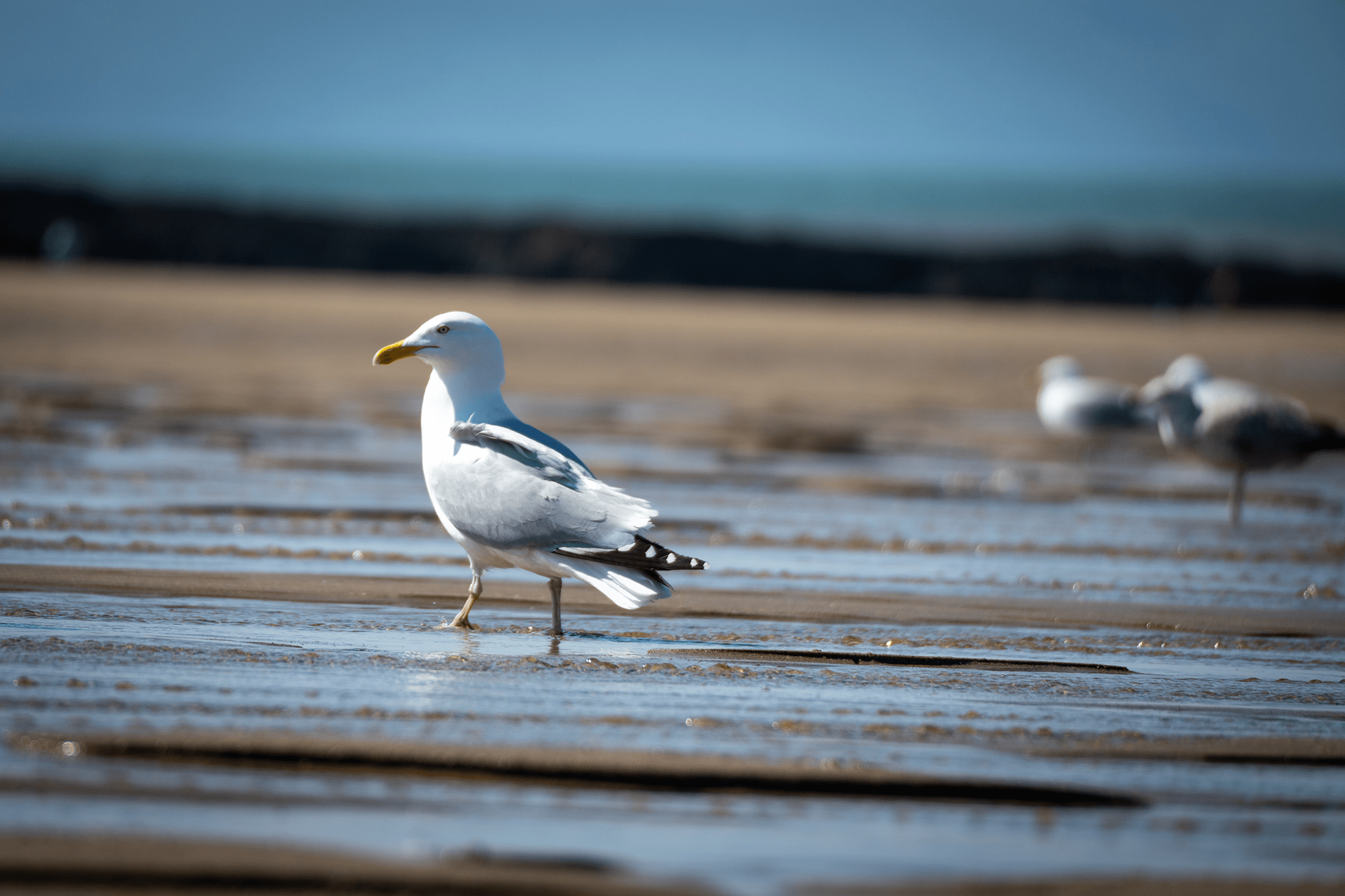
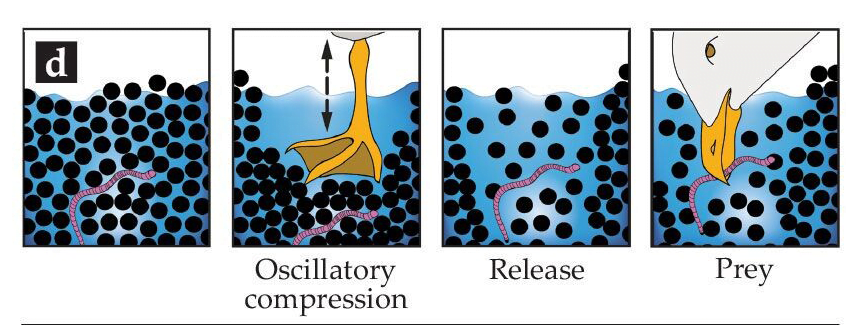
Watch sea gulls, plovers, and other birds hunt in the tidal zone, and you may notice them stepping over and over in the same spot. This is part of bird’s hunting strategy. Each footfall compresses the wet sand and drives water out. Mechanically, this is the same thing that happens when a human walks on wet sand; you’ll see the sand go from a glossy appearance to a matte one as the local water level falls. Once the weight is removed, the water will seep back and the sand appears glossy again.

Illustration of a gull’s hunting process. Compressing the sand by stepping on it drives water out of the area. Once the bird’s foot is removed, water floods back, diluting the sand, and making it easier for the bird to reach its prey without digging. For the birds, the flood of returning water loosens and dilutes the sand. That makes prey easier to expose and reach without the additional effort of digging. (Image credits: bird – C. Davis, illustration – P. Fischer; via Physics Today)

Beneath the Waves

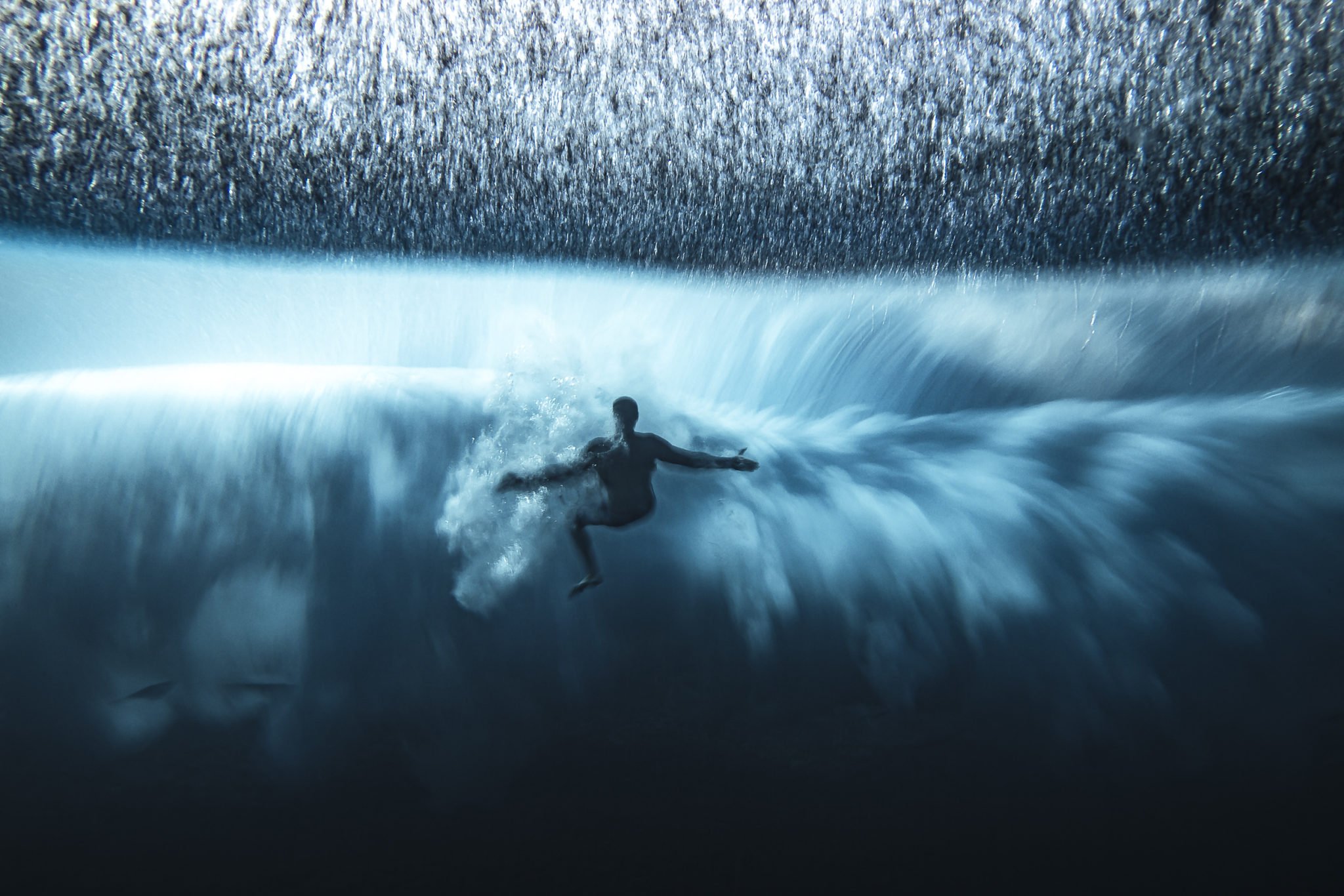

Surfing looks entirely different from below the wave. Photographer Ben Thouard captures his images by freediving and observing what goes on overhead. Whether the surfers nearby ride a barrel roll or bail into the churn, the results are incredible. You can find more of Thouard’s artwork on his website and Instagram. (Image credit: B. Thouard; via Oceanographic Magazine)

Slab Avalanche Physics
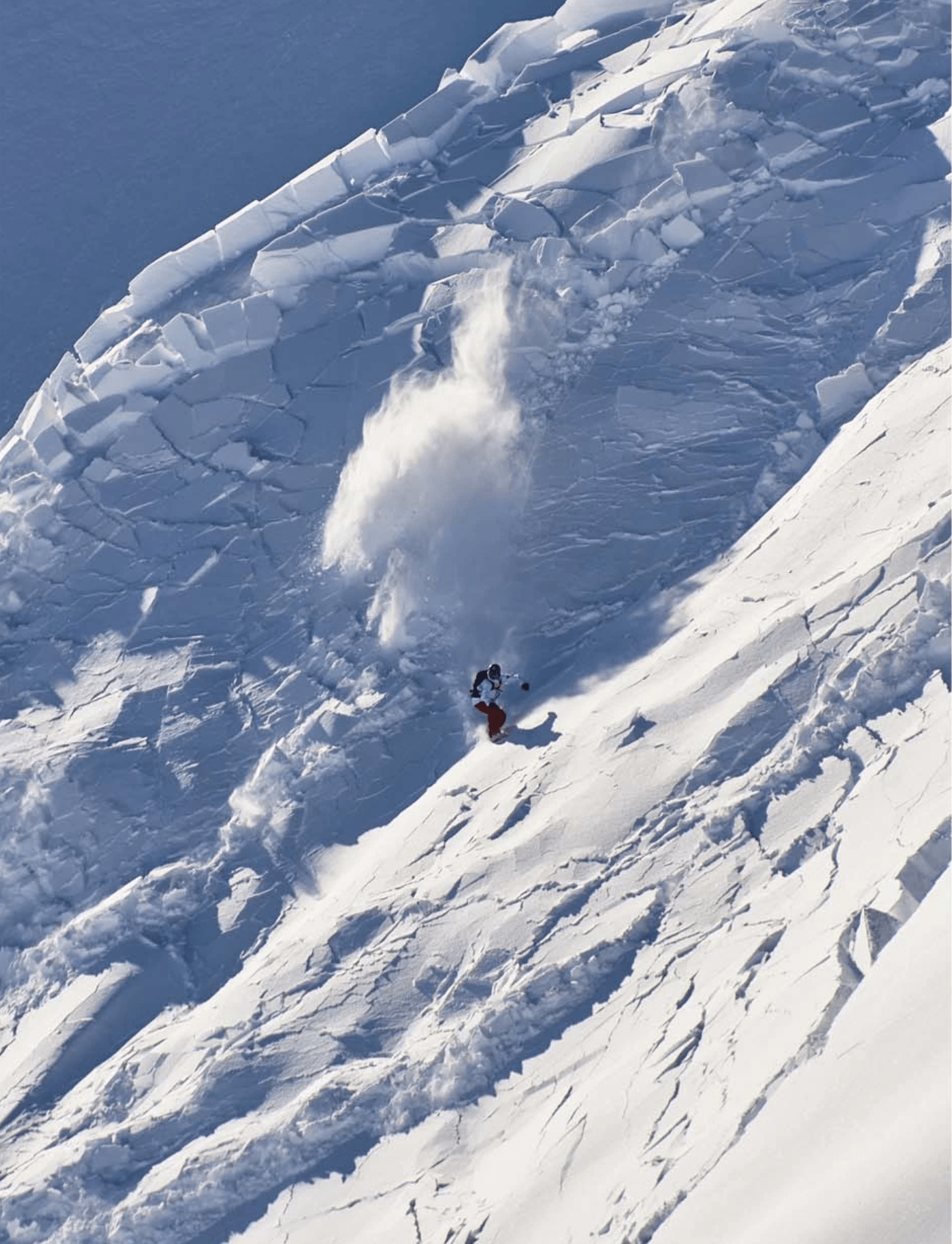
Slab avalanches like the one shown here begin after weak, porous layers of snow get buried by fresher, more cohesive snow layers. On a steep slope, the weight of the new snow can be too great for friction to hold the slab in place, causing the upper layer to crack and slide at speeds up to 150 meters per second. Scientists had two competing theories for how slab avalanches began. One theory presumed that the weak layer of snow failed under shear; the other argued that the collapse of the lower, porous layer was at fault.
In a new study combining large-scale numerical simulation with real-life observations, scientists came to a new conclusion: cracks began to form in the porous layer as the weight of heavier snow crushed down, but once the cracks formed, the shear mechanism took over. Cracks formed by shear could propagate along the existing cracks in the porous layer, allowing faster crack propagation than through undamaged snow. In the end, it’s the combination of the two mechanisms that triggers the avalanche. (Image credit: R. Flück; research credit: B. Trottet et al.; via Physics World)
Turbulence From Vortex Rings


When vortex rings collide, they reconnect into smaller, rings that eventually break down into chaos. Here, researchers experiment with colliding multiple vortex rings — focusing on an eight-ring collision. When they collide rings over and over, it creates a zone of isolated turbulence at the heart of the collisions.
Many of the theories and predictions that exist around turbulence assume that the flow is homogeneous and isotropic; what this means is that the (statistical) characteristics of the flow are the same in every direction. In reality, this kind of flow isn’t always easily achieved, which makes testing theoretical predictions challenging.
What’s neat about this set-up is that you get this desired turbulence in a very controlled way. It’s easy to tune the size and energy of your vortex rings, and those tweaks allow you to observe what — if any — changes occur in the resulting turbulence. (Image and video credit: T. Matsuzawa et al.)