A coronal mass ejection from the Sun set night skies ablaze in mid-October 2024. This composite panorama shows a busy night sky over New Zealand’s South Island. A widespread red aurora was joined by a green picket-fence aurora and a host of other magnetohydrodynamic phenomena. To the left shines a bright Stable Auroral Red (SAR) arc. On the right near the Moon hangs the purple arc of a STEVE — strong thermal emission velocity enhancement. All of these auroras (and aurora-adjacent phenomena) take place when high-energy particles from the solar wind interact with molecules in our atmosphere. Which molecules they encounter determines the color of the aurora, and the shape depends, in part, on which magnetic lines the particles get funneled down. With strong solar storms like this one, auroras can reach far from the poles, and, as seen here, can show up in many varieties. (Image credit: T. McDonald; via APOD)
Tag: fluid dynamics

Glimpses of Coronal Rain
Despite its incredible heat, our sun‘s corona is so faint compared to the rest of the star that we can rarely make it out except during a total solar eclipse. But a new adaptive optic technique has given us coronal images with unprecedented detail.

These images come from the 1.6-meter Goode Solar Telescope at Big Bear Solar Observatory, and they required some 2,200 adjustments to the instrument’s mirror every second to counter atmospheric distortions that would otherwise blur the images. With the new technique, the team was able to sharpen their resolution from 1,000 kilometers all the way down to 63 kilometers, revealing heretofore unseen details of plasma from solar prominences dancing in the sun’s magnetic field and cooling plasma falling as coronal rain.
The team hope to upgrade the 4-meter Daniel K. Inouye Solar Telescope with the technology next, which will enable even finer imagery. (Image credit: Schmidt et al./NJIT/NSO/AURA/NSF; research credit: D. Schmidt et al.; via Gizmodo)
Fediverse Reactions
-

Bow Shock Instability
There are few flows more violent than planetary re-entry. Crossing a shock wave is always violent; it forces a sudden jump in density, temperature, and pressure. But at re-entry speeds this shock wave is so strong the density can jump by a factor of 13 or more, and the temperature increase is high enough that it literally rips air molecules apart into plasma.
Here, researchers show a numerical simulation of flow around a space capsule moving at Mach 28. The transition through the capsule’s bow shock is so violent that within a few milliseconds, all of the flow behind the shock wave is turbulent. Because turbulence is so good at mixing, this carries hot plasma closer to the capsule’s surface, causing the high temperatures visible in reds and yellows in the image. Also shown — in shades of gray — is the vorticity magnitude of flow around the capsule. (Image credit: A. Álvarez and A. Lozano-Duran)
Fediverse Reactions
-

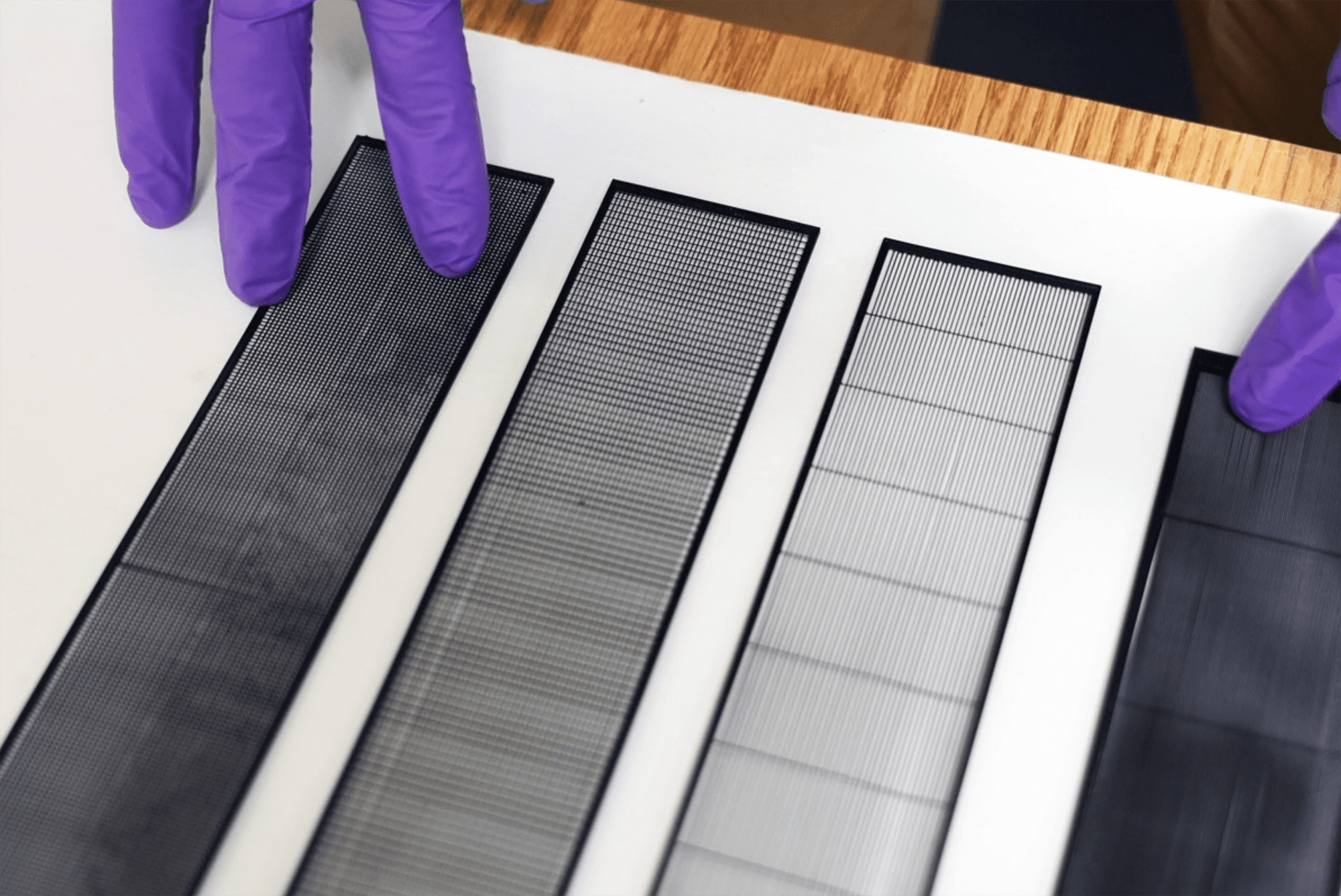
Building a Better Fog Harp
On arid coastlines, fog rolling in can serve as an important water source. Today’s fog collectors often use tight mesh nets. The narrow holes help catch tiny water particles, but they also clog easily. A few years ago, researchers suggested an alternative design — a fog harp inspired by coastal redwoods — that used closely spaced vertical wires to capture water vapor. At small scales, this technique worked well, but once scaled up to a meter-long fog harp, the strings would stick together once wet — much the way wet hairs cling to one another.
The group has iterated on their design with a new hybrid that maintains the fog harp’s close vertical spacing but adds occasional cross-wires to stabilize. Laboratory tests are promising, with the new hybrid fog harp collecting water with 2 – 8 times the efficiency of either a conventional mesh or their original fog harp. The team notes that even higher efficiencies are possible with electrification. (Image credit: A. Parrish; research credit: J. Kaindu et al.; via Ars Technica)
Fediverse Reactions
-

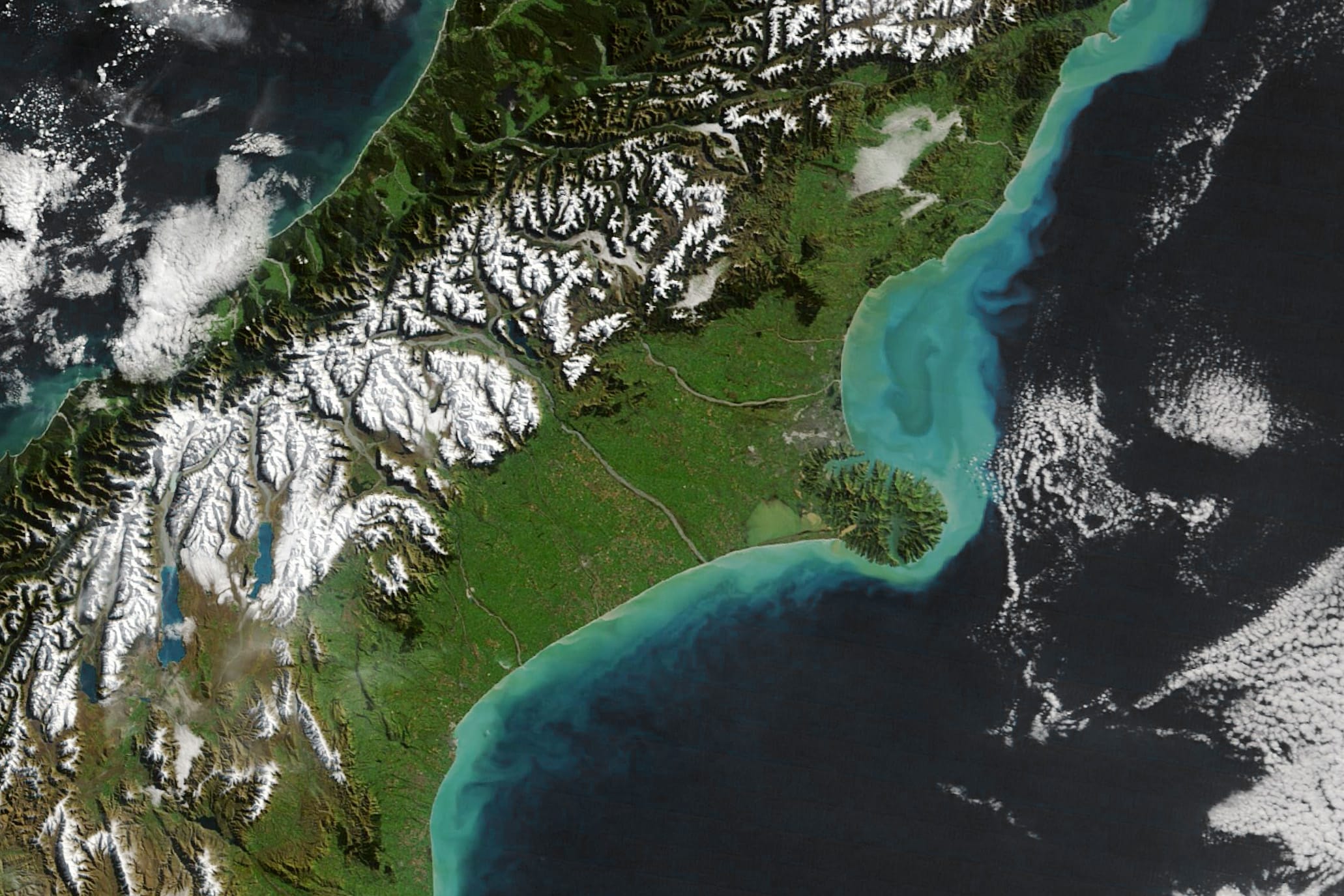
South Island Sediments
In April and May late autumn storms ripped through Aotearoa New Zealand. This image shows the central portion of South Island, where coastal waters are unusually bright thanks to suspended sediment. We typically think of storm run-off as water, but these flows can carry lots of sediment as well. Here, the large amount of sediment is likely a combination of increased run-off from rivers and coastal sediment stirred up by faster river flows. (Image credit: W. Liang; via NASA Earth Observatory)
Fediverse Reactions
-

Flying Foxes
A sweltering day in India brought out the local giant fruit bats (also called Indian flying foxes) to keep cool in the river. Normally nocturnal, they made a rare daytime appearance to beat the heat. Wildlife photographer Hardik Shelat was lucky enough to catch these awesome images of the bats in flight. True to their name, the animals have wingspans ranging from 1.2 to 1.5 meters, which should give them some impressive lift, even when gliding down near the water. (Image credit: H. Shelat; via Colossal)
Fediverse Reactions
-

Martian Streaks Are Dry
Dark lines appearing on Martian slopes have triggered theories of flowing water or brine on the planet’s surface. But a new study suggests that these features are, instead, dry. To explore these streaks, the team assembled a global database of sightings and correlated their map with other known quantities, like temperature, wind speed, and rock slides. By connecting the data across thousands of streaks, they could build statistics about what variables correlated with the streaks’ appearance.
What they found was that streaks didn’t appear in places connected to liquid water or even frost. Instead, the streaks appeared in spots with high wind speeds and heavy dust accumulation. The team included that, rather than being moist areas, the streaks are dry and form when dust slides down the slope, perhaps triggered by high winds or passing dust devils.
Although showing that the streaks aren’t associated with water may seem disappointing, it may mean that NASA will be able to explore them sooner. Right now, NASA avoids sending rovers anywhere near water, out of concern that Earth microbes still on the rover could contaminate the Martian environment. (Image credit: NASA; research credit: V. Bickel and A. Valantinas; via Gizmodo)
Fediverse Reactions
-

Listening for Pollinators
Can plants recognize the sound of their pollinators? That’s the question behind this recently presented acoustic research. As bees and other pollinators hover, land, and take-off, their bodies buzz in distinctive ways. Researchers recorded these subtle sounds from a Rhodanthidium sticticum bee and played them back to snapdragons, which rely on that insect. They found that the snapdragons responded with an increase in sugar and nectar volume; the plants even altered their gene expression governing sugar transport and nectar production. The researchers suspect that the plants evolved this strategy to attract their most efficient pollinators and thereby increase their own reproductive success. (Image credit: E. Wilcox; research credit: F. Barbero et al.; via PopSci)
Fediverse Reactions
-

Rolling Down Soft Surfaces
Place a rigid ball on a hard vertical surface, and it will free fall. Stick a liquid drop there, and it will slide down. But researchers discovered that with a soft sphere and a soft surface, it’s possible to roll down a vertical wall. The effect requires just the right level of squishiness for both the wall and sphere, but when conditions are right, the 1-millimeter radius sphere rolls (with a little slipping) down the wall.
Rolling requires torque, something that’s usually lacking on a vertical surface. But the team found that their soft spheres got the torque needed to roll from their asymmetric contact with the surface. More of the sphere contacted above its centerline than below it. The researchers compared the way the sphere contacted the surface to a crack opening (at the back of the sphere) and a crack closing (at the front of the sphere). That asymmetry creates just enough torque to roll the sphere slowly. The team hopes their discovery opens up new possibilities for soft robots to climb and descend vertical surfaces. (Image and research credit: S. Mitra et al.; via Gizmodo)
Fediverse Reactions
-

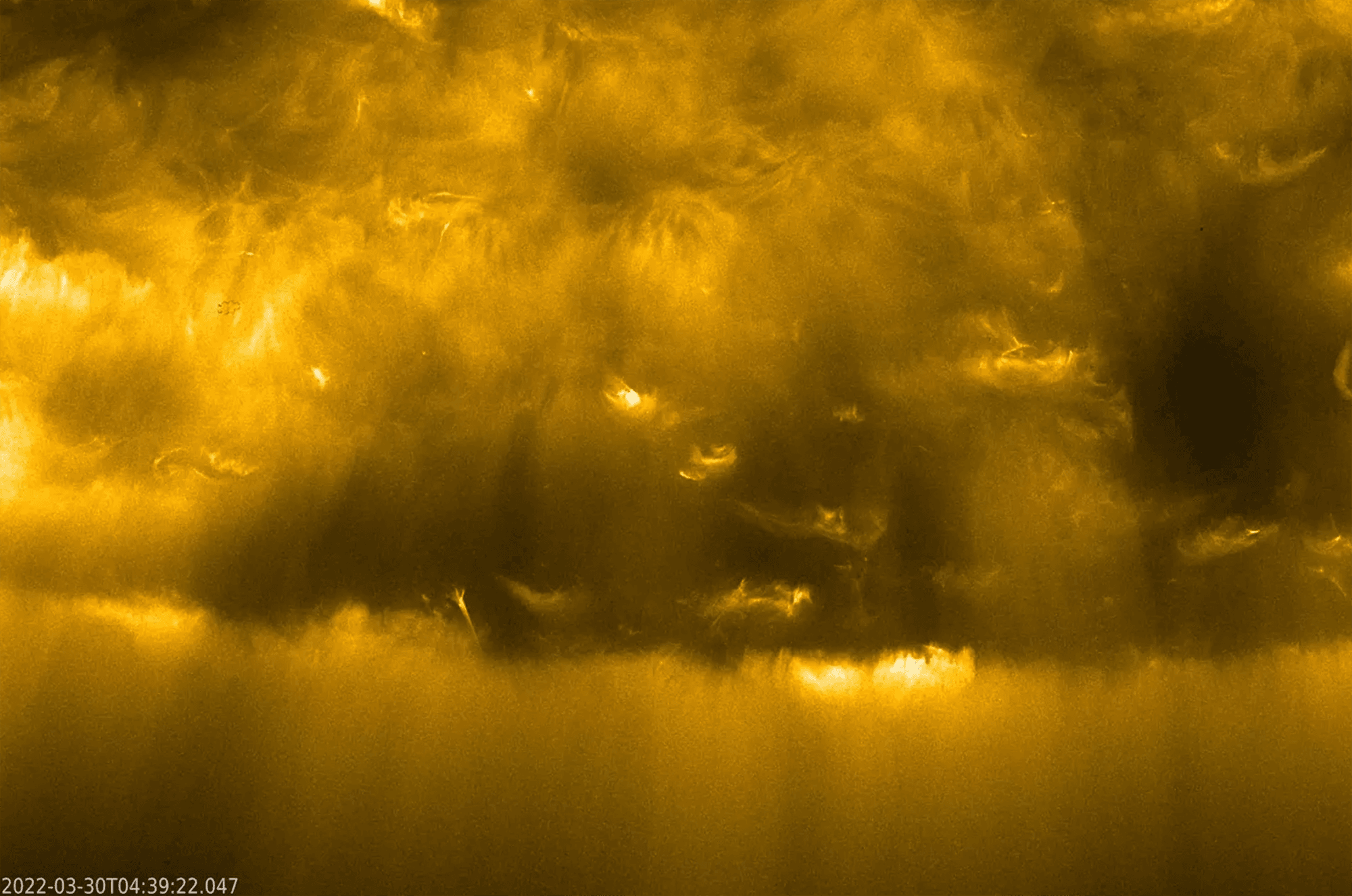
Seeing the Sun’s South Pole For the First Time
The ESA-led Solar Orbiter recently used a Venus flyby to lift itself out of the ecliptic — the equatorial plane of the Sun where Earth sits. This maneuver offers us the first-ever glimpse of the Sun’s south pole, a region that’s not visible from the ecliptic plane. A close-up view of plasma rising off the pole is shown above, and the video below has even more.
Solar Orbiter will get even better views of the Sun’s poles in the coming months, perfect for watching what goes on as the Sun’s 11-year-solar-cycle approaches its maximum. During this time, the Sun’s magnetic poles will flip their polarity; already Solar Orbiter’s instruments show that the south pole contains pockets of both positive and negative magnetic polarity — a messy state that’s likely a precursor to the big flip. (Image and video credit: ESA & NASA/Solar Orbiter/EUI Team, D. Berghmans (ROB) & ESA/Royal Observatory of Belgium; via Gizmodo)
Fediverse Reactions
-


































![[empty]](https://files.mastodon.social/accounts/avatars/106/887/462/825/018/571/original/52e5d4364f73668f.jpg)