Tag: fluid dynamics

  • Featured Video Play Icon

    Seismic Events Reveal Ocean Temperatures

    Decades ago, researchers proposed sending sound waves through the ocean to measure its temperature. Although the technique worked, it ran into noise pollution issues, but now it’s back, using naturally-occurring seismic events as the sound source.

    When fault lines shift, they generate seismic waves that travel through the ocean as sound. When they reach a land mass, the waves get converted back into seismic energy that’s then picked up by a receiver. Knowing the distance from the source to the receiver and the time necessary for the wave to travel, scientists can then determine the average temperature of the water based on the speed of sound.

    The technique can track temperature changes down to thousandths of a degree. Based on more than a decade of seismic data from the Indian Ocean, researchers found almost double the temperature increase measured by a different sensor network. (Image and video credit: Science; research credit: W. Wu et al.; submitted by Kam-Yung Soh)
  • Featured Video Play Icon

    The Strangeness of Sand

    Sand and other granular materials can flow, jam, and transmit forces in counterintuitive ways. This Lutetium Project video gives a nice overview of some of these bizarre properties.

    Many of sand’s odd characteristics come from the way forces move through grains that touch. Around 5:20 there’s a demo of one of these effects: the Janssen effect. Using a scale, the video shows the mass of a bunch of grains. Then, the host pours those grains into a narrow cylinder. If you watch the scale, you’ll see that it shows a smaller mass than before. That’s not because of a difference in mass between the bowl and the cylinder; the scale is calibrated to only measure the mass of the grains. In the narrow cylinder the grains appear to weigh less because part of their weight is being supported by force chains that run to the container’s walls. (Image and video credit: The Lutetium Project)

  • The Best of FYFD 2020

    The Best of FYFD 2020

    2020 was certainly a strange year, and I confess that I mostly want to congratulate all of us for making it through and then look forward to a better, happier, healthier 2021. But for tradition and posterity’s sake, here were your top FYFD posts of 2020:

    1. Juvenile catfish collectively convect for protection
    2. Gliding birds get extra lift from their tails
    3. How well do masks work?
    4. Droplets dig into hot powder
    5. Updating undergraduate heat transfer
    6. Branching light in soap bubbles
    7. Boiling water using ice water
    8. Concentric patterns on freezing and thawing ice
    9. Bouncing off superhydrophobic defects
    10. To beat surface tension, tadpoles blow bubbles

    There’s a good mix of topics here! A little bit of biophysics, some research, some phenomena, and some good, old-fashioned fluid dynamics.

    If you enjoy FYFD, please remember that it’s primarily reader-supported. You can help support the site by becoming a patronmaking a one-time donationbuying some merch, or simply by sharing on social media. Happy New Year!

    (Image credits: catfish – Abyss Dive Center, owl – J. Usherwood et al., masks – It’s Okay to Be Smart, droplet – C. Kalelkar and H. Sai, boundary layer – J. Lienhard, bubble – A. Patsyk et al., boiling – S. Mould, ice – D. Spitzer, defects – The Lutetium Project, tadpoles – K. Schwenk and J. Phillips)

  • Vanishing Spirits: Aging

    Vanishing Spirits: Aging

    The necessary ingredients for scotch whisky’s evaporation patterns are alcohol, surfactants, and polymers; some of those components are absorbed during the spirit’s aging in oak casks. Photographer Ernie Button explored how long it takes for whisky to absorb enough of these chemicals by photographing the stains left by samples aged between 1 and 5 weeks in an oak cask. He found that it takes about 5 weeks for the scotch patterns to begin emerging.

    The aging process for scotch and other cask-aged spirits depends on the fluid’s flow through the porous grain of the oak. Evaporation plays a significant role in the process, so the aging process differs based on environmental conditions. For example, distillers in the dry, high-altitude climate of Colorado must use climate-controlled storage, whereas Scottish distillers use a more humid natural climate to their advantage.

    Another major factor in the aging process is the charred oak cask itself. Some whiskys, like American bourbon, always use a brand new barrel, whereas scotch is often aged in a previously-used cask. With older casks, absorption of molecules from the wood takes longer, which is why scotch is typically aged for much longer than some other types of whisky. (Image, research, and submission credit: E. Button; see also)

  • Vanishing Spirits: Rice-Based Whisky

    Vanishing Spirits: Rice-Based Whisky

    In yesterday’s post, photographer Ernie Button showed us that barrel-aged gin can leave behind an evaporation pattern remarkably similar to scotch whisky. But even among whiskys not every spirit uses the same grains.

    Here we see patterns left behind by a 10-year-aged, rice-based whisky. The stains are entirely different than those of (barley-based) scotch. The rice leaves behind stains with distinct regions, including a radially uniform rim and an interior reminiscent of satellite photos. Presumably the interaction of rice and the cask leaves the whisky with surfactants and polymers that behave rather differently than those of scotch.

    It takes time for spirits to take on character from the casks they’re aged in. Tomorrow we’ll take a look at just how much aging is necessary for scotch’s patterns to emerge. (Image, research, and submission credit: E. Button; see also)

  • Vanishing Spirits: Gin

    Vanishing Spirits: Gin

    Photographer Ernie Button has spent years exploring the patterns left by evaporating scotch. A team of researchers found that the uniformity of scotch whisky’s stain requires three ingredients: alcohol to drive concentration gradients, surfactants to pull particulates away from the drop’s edge, and polymers to help stick particles to the glass.

    Button wondered whether other spirits might produce similar patterns, and, indeed, some do. The photos above are stains left behind by evaporated gin that’s been aged for a year in oak casks. The patterns are extremely similar in appearance to those from aged scotch whiskies, suggesting that the same fluid dynamical effects are at play here, despite the difference in liquor. But do all grain spirits make these patterns? Check back tomorrow to find out. (Image, research, and submission credit: E. Button; see also)

  • Featured Video Play Icon

    Rocket Yeast

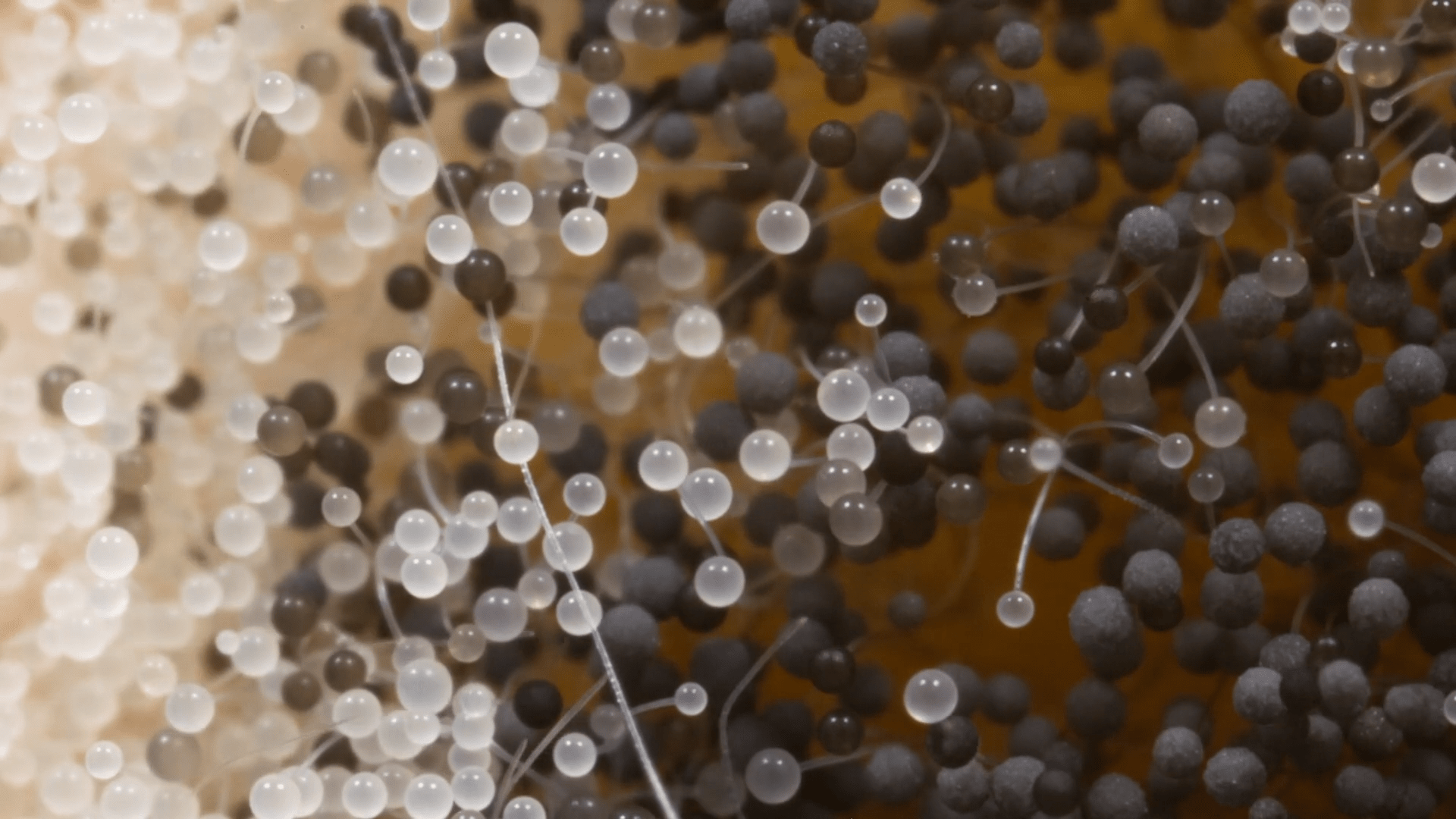
    Usually, microbial colonies are grown on a solid substrate, but what happens when they grow on a liquid surface? That’s the question explored in this Gallery of Fluid Motion video featuring colonies of brewer’s yeast on various liquid substrates. When the viscosity of the liquid is low enough, the colony actually gets pulled apart (Image 2). This behavior is driven by a convective flow in the liquid caused by the colony’s own growth. As the yeast grow, they deplete nearby sugar, creating a density gradient that triggers convection beneath the colony. (Image, video, and research credit: S. Atis et al.)

  • Featured Video Play Icon

    Dengue Dengue Dengue

    Musical duo Dengue Dengue Dengue create live audio/visual performances with fluid dynamics. Their visuals are created by adding various liquids and dyes atop an illuminated background. To add extra dynamism, they sometimes use a sheet of plastic to cover and pump the liquids, creating a pseudo-Hele-Shaw cell where they can trigger fluid instabilities in time to the music. The full performance in this video is nearly an hour long, but at least take some time to scrub through and see a few different sections. (Video credit: Dengue Dengue Dengue/Espacio Fundación Telefónica Lima; submitted by Tania S.)

  • Featured Video Play Icon

    Recreating Acoustics

    The cultural heritage of a site is made up of more than its appearance; its soundscape is vital, as well. Acousticians and historians work together to preserve and recreate the auditory landscape of important sites through acoustical measurements and digital reconstructions based on architecture and building materials. Thanks to projects like these, researchers can achieve feats like recreating a concert within the Notre Dame Cathedral as it was before the 2019 fire. To learn more about the technologies behind these feats, check out this Physics Today article. (Image and video credit: Ghost Orchestra; for more, see Physics Today)

  • Aging Fluids

    Aging Fluids

    If you’ve ever left a sealed container of Playdoh untouched for months, you know that there’s a big difference between the fresh stuff and what’s left in that can. Aging can have big effects on non-Newtonian fluids. In this video, we see drops of a synthetic clay impacting at different speeds. In the top row of images, the clay is fresh and unaged; on impact, the clay forms large crown-like splashes. In the bottom row, however, the aged clay behaves quite differently. Instead of a splash, the drops make more of a splat. (Image and video credit: R. Ewoldt et al.)