Tag: flow visualization

  • The Livers of Our Rivers

    The Livers of Our Rivers

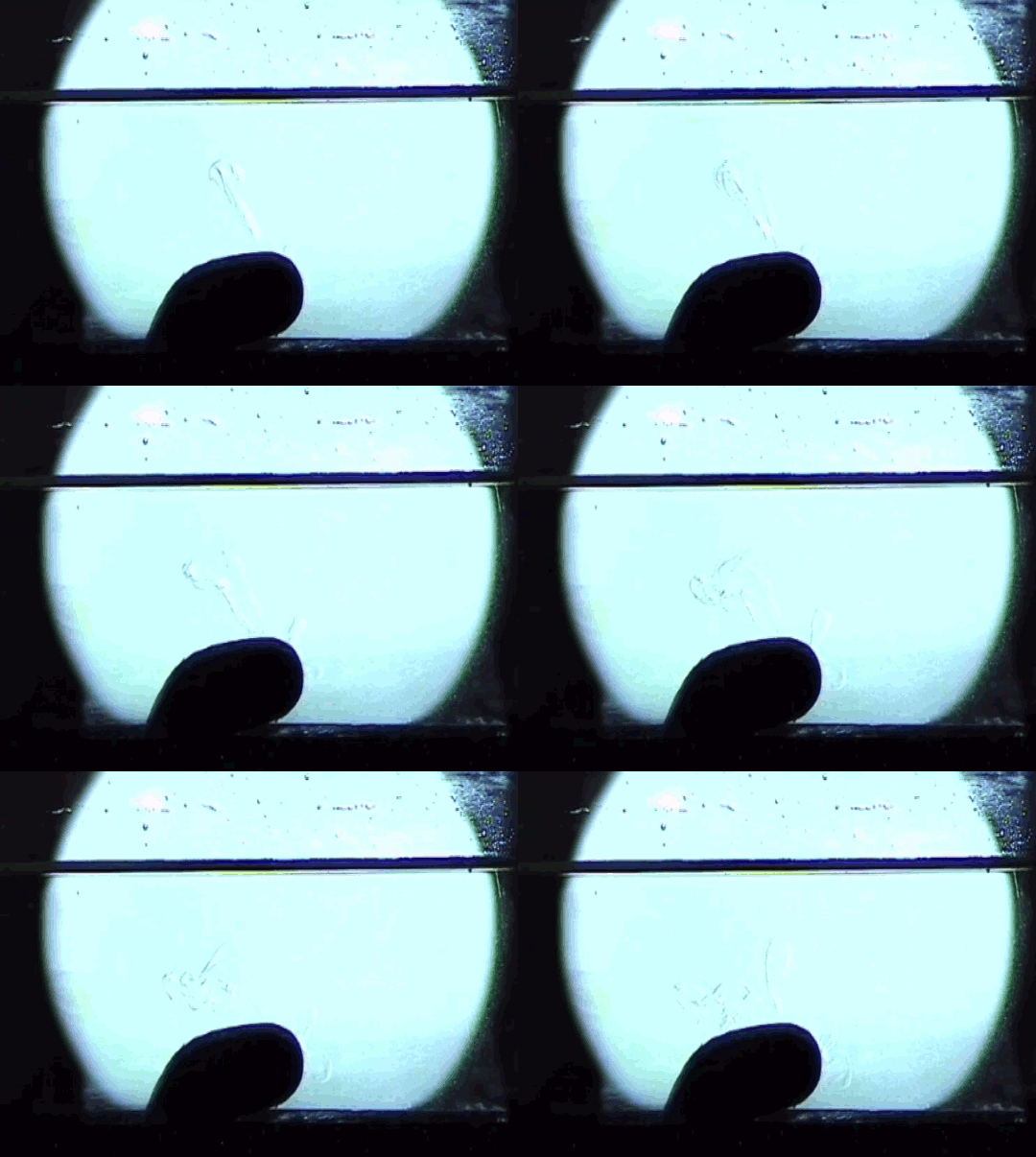
    To the naked eye, mussels and other bivalves don’t appear to be doing much. But these filter feeders are hard at work. The mussel takes in water through its incurrent siphon (on the right side in this image), and tiny cilia move the water through its gills, which filter out plankton and other edibles. Wastewater flows out the exacurrent siphon, seen here as the plume coming out the top of the mussel.

    Mussel species are important indicators of the health of both fresh and marine water bodies. Because they’re stationary and they are constantly processing the water, the health of these bivalves is indicative of the ecosystem’s overall health. (Image credit: S. Allen, source)

  • Merging Black Holes

    Merging Black Holes

    At the heart of many galaxies, including our own, lies a supermassive black hole millions of times the mass of our sun. Scientists have yet to observe the merger of two such black holes, but using simulations, they are trying to learn what such collisions might look like. Simulations like the one shown here require combining relativity, electromagnetism, and, yes, fluid dynamics to capture what happens during the in-spiral.

    Supermassive black holes like these are surrounded by gas disks that flow around them. Magnetic and gravitational forces heat the gas, causing it to emit UV light and, at times, high energy X-rays, both of which may be observable.

    Gravitational wave detectors, similar to LIGO, may also measure evidence of supermassive black hole mergers, but physicists expect that will require a next-generation observatory, like the space-based LISA to be launched in the 2030s.   (Image and video credit: NASA Goddard; research credit: S. d’Ascoli et al.; submitted by @lh7)

  • Watery Veins

    Watery Veins

    Glacial river veins wend and meander through these aerial photographs of Iceland by photographer Stas Bartnikas. Rivers naturally change their course over time, but here seasonal melts and the slow grinding of glaciers adds further chaos to the scene. Captured from above, these landscapes show the scars of past flows. (Image credit: S. Bartnikas; via Colossal)

  • How Mantas Filter But Never Clog

    How Mantas Filter But Never Clog

    Manta rays spend much of their time leisurely cruising through the water with their meter-wide mouths open. As they swim, they filter plankton, which makes up most of their diet, from the water. And they do so without ever clogging. 

    The inside of the manta’s mouth is lined with gill rakers (upper right), a series of comb-like teeth. When flow hits the leading edge of these (bottom), it creates a vortex that accelerates any particles caught in the flow. They essentially ricochet along the top of the gill rakers, getting led straight into the manta’s digestive system – while excess water gets deflected between the gill rakers and back out the manta’s gills. To drive this, all the manta has to do is swim; with the right flow speed, the shape of the gill rakers handles all the filtration with no additional effort. (Image credit: manta ray – G. Flood; gill rakers – M. Paig-Tran; flow vis – R. Divi et al., source; research credit: M. Paig-Tran et al.; via The Atlantic; submitted by Kam-Yung Soh)

  • Replacing Kalliroscope

    Replacing Kalliroscope

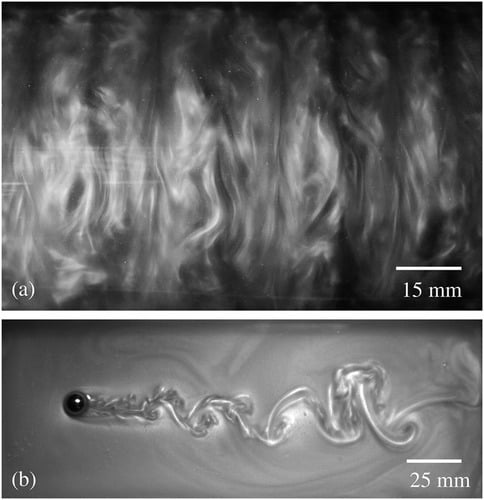
    Although you may not recognize the name, you’ve probably seen Kalliroscope (top image), a pearlescent fluid that creates beautiful flow patterns when swirled. This rheoscopic fluid was invented in the mid-1960s by artist Paul Matisse and, over the following decades, became a staple of flow visualization techniques. Kalliroscope contained a suspension of crystalline guanine. Since the crystals were asymmetric, they would orient themselves depending on the flow and, from there, scatter light, creating the beautiful pearlescent effect seen above.

    Unfortunately for researchers, the production of guanine crystals was expensive and difficult. The cosmetics industry was their main consumer and over time, they moved toward mica and other cheaper mineral alternatives. The company that produced Kalliroscope gave up production in 2014, leaving researchers scrambling for a suitable alternative.

    One contender for a new standard rheoscopic fluid is based on shaving cream. By diluting shaving cream 20:1 with water, researchers are able to extract stearic acid crystals, which form an admirable alternative to Kalliroscope (middle collage). Like Kalliroscope, the resulting fluid is pearlescent and reveals flow features well (bottom two images). Stearic acid crystals are also closer in density to water than guanine, so the fluid remains in suspension far better than Kalliroscope. Plus, the best shaving cream is cheap and widely available, meaning that this is a DIY project just about anyone can do! (Image credits: Kalliroscope – P. Matisse; other images – D. Borrero-Echeverry et al.; research credit: D. Borrero-Echeverry et al.)
  • The Challenges of Blowing Bubbles

    The Challenges of Blowing Bubbles

    Although every child has experience blowing soap bubbles with a wand, only in recent years have scientists dedicated study to this problem. It turns out to be a remarkably complex one, with subtleties that can depend on the size of the wand relative to the jet a bubble-blower makes as well as the speed at which the air impacts the film. A recent study found that, at low or
    moderate speeds, the film takes on a stable, curved shape (top image), but once you increase to a critical speed, the film will overinflate and burst. The key to forming a bubble, the authors suggest, is hitting that critical speed only briefly; if you slow down before the film ruptures, then the bubble has a chance to disconnect and form a sphere without breaking. 

    The work also suggests there are two reliable methods for bubble making in this way. One is to impulsively move the wand through the background fluid, as shown in the lower animation. The other is the one familiar to children: blow a jet just fast enough to overinflate the film, then let up so the bubble forms without breaking. (Image and research credit: L. Ganedi et al.; via Ars Technica; submitted by Kam-Yung Soh)

  • Visualizing Aerosols

    Visualizing Aerosols

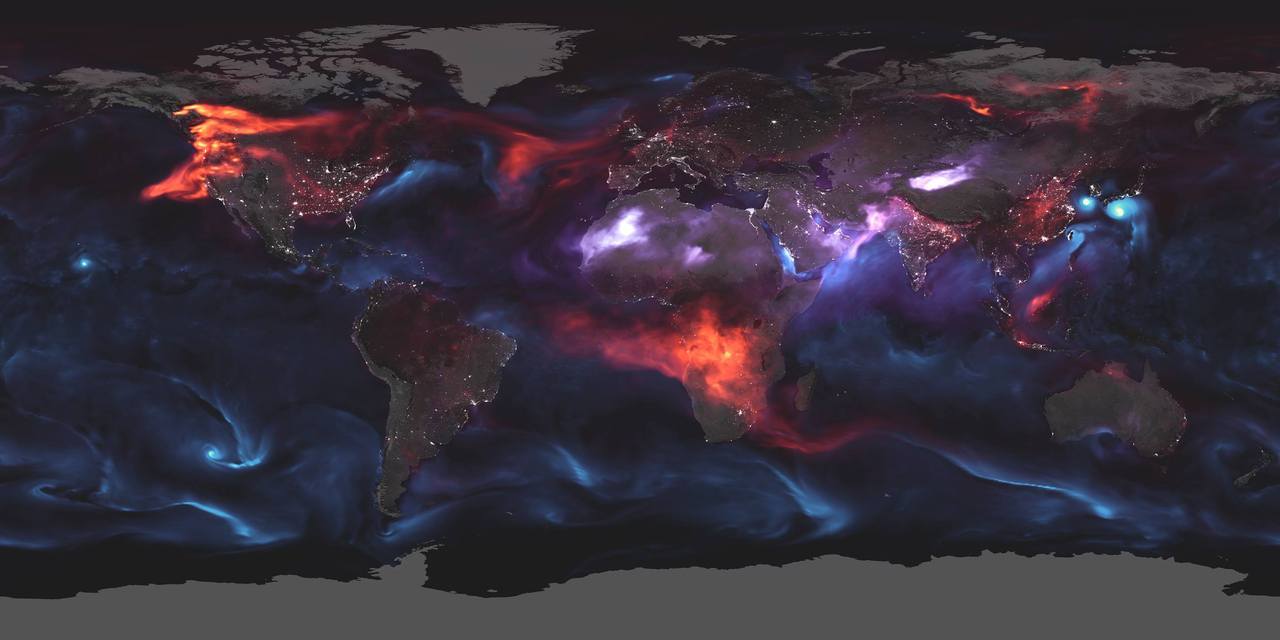
    Aerosols, micron-sized particles suspended in the atmosphere, impact our weather and air quality. This visualization shows several varieties of aerosol as measured August 23rd, 2018 by satellite. The blue streaks are sea salt suspended in the air; the brightest highlights show three tropical cyclones in the Pacific. Purple marks dust. Strong winds across the Sahara Desert send large plumes of dust wafting eastward. Finally, the red areas show black carbon emissions. Raging wildfires across western North America are releasing large amounts of carbon, but vehicle and factory emissions are also significant sources. (Image credit: NASA; via Katherine G.)

  • Swirling Blooms

    Swirling Blooms

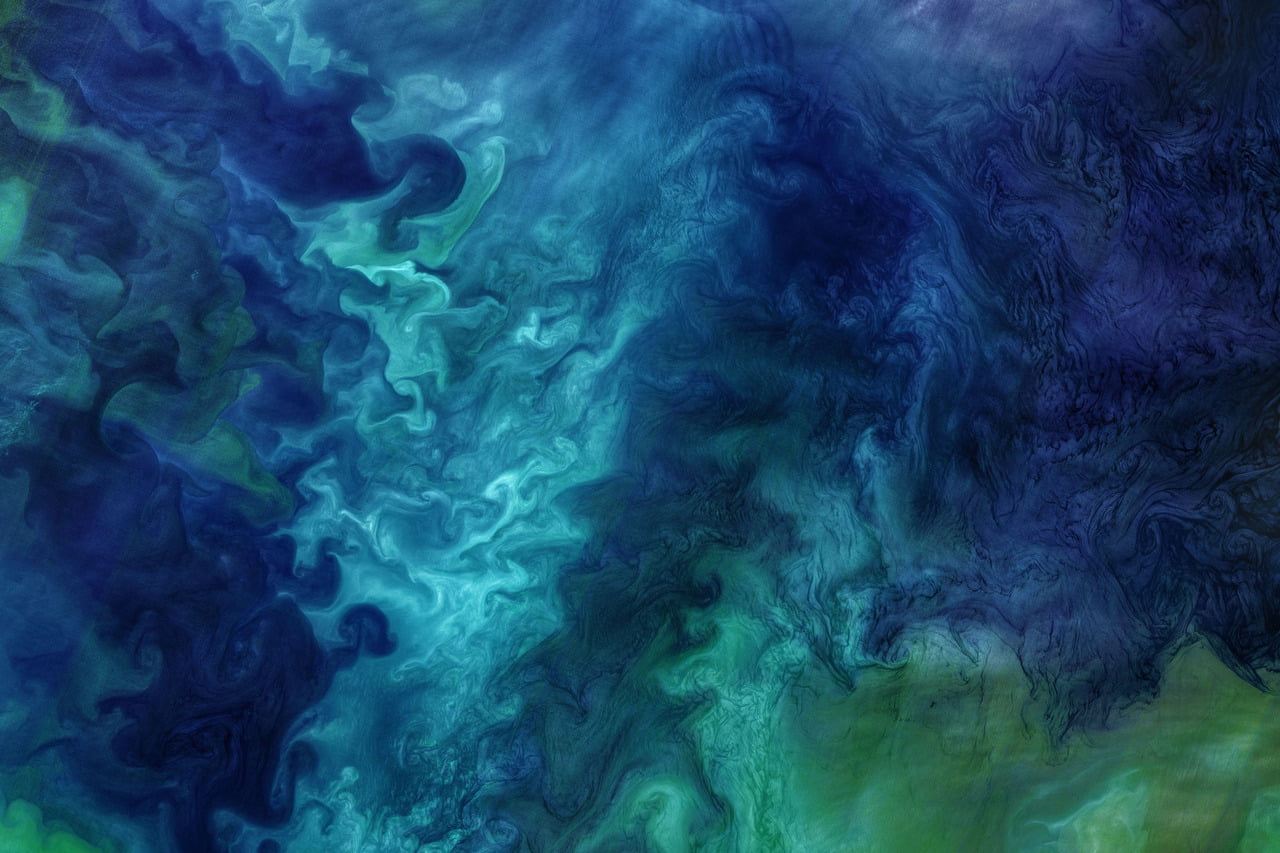
    Every summer, as the ice melts, the waters of the Chukchi Sea off the Alaskan coast come alive with phytoplankton blooms. In satellite images like this one, they can look like abstract paintings formed from swirling colors. In the Chukchi Sea, two main currents collide. One, water from the Bering Sea, is cold, salty, and nutrient-rich. This is the preferred home to phytoplankton known as diatoms, which are responsible for some of the greenish hues seen here.

    Coccolithophores, another variety of phytoplankton, prefer the warmer, less salty Alaskan coastal waters. Despite a relative lack of nutrients, the  coccolithophores thrive, creating the milky turquoise color seen in the image. Knowing these characteristics of the phytoplankton, observing the growth of blooms over time may tell scientists about how the flows in these areas shift and change from year to year. (Image credit: NASA; via NASA Earth Observatory)

  • Spinning Droplet Galaxies

    Spinning Droplet Galaxies

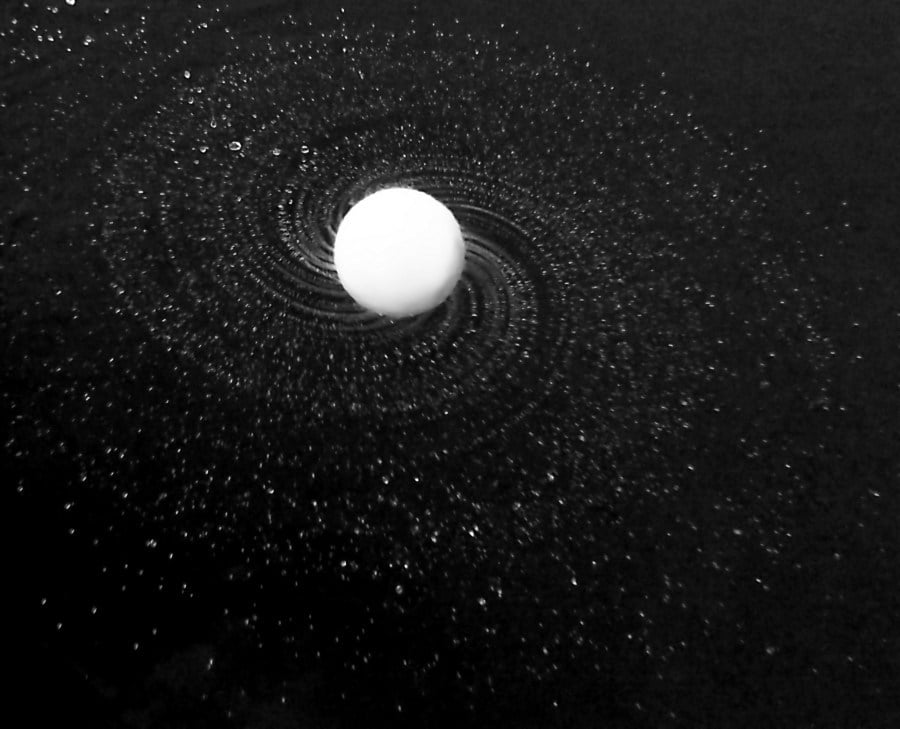
    Water flung from a spinning tennis ball takes on a shape reminiscent of a spiral galaxy. As it detaches, water leaves the surface with both the tangential velocity of the spinning ball and a radial velocity due to the centrifugal force flinging it. The continued spin of the ball makes the thin ligaments of water still attached to it spiral and stretch. Eventually, surface tension can no longer hold the water together against the centrifugal forces, and the ligaments split into a spray of droplets. (Image credit: W. Derryberry and K. Tierney)

  • Featured Video Play Icon

    Vortex Ring Collisions

    One of the most enduringly popular submissions I receive is T. Lim’s experimental footage of two vortex rings colliding head-on. It’s an devilishly tough experimental set-up to master because perfectly aligning the rings is incredibly difficult. The pay-off, however, is huge because the breakdown of the colliding rings and their transformation into secondary rings is breathtaking. Destin at Smarter Every Day and his team have worked hard to recreate the experiment (top video), but they’re not the only ones – nor are they the first in decades – to do so.

    Ryan McKeown and a team at Harvard have a set-up of their own for vortex ring collisions, and you can see a little of it in action in the middle video. Ryan’s set-up is, frankly, incredible. It scans a light sheet through the vortex rings at high-speed, allowing him to capture the collision and break-up in minute detail in both space and time. What you see in the latter half of his video is a digital reconstruction of that data – not a simulation but real data! His work is capturing vortex collisions in unprecedented detail, allowing researchers to probe the smallest scales of the phenomenon.

    When two vortex rings approach one another, they can undergo what’s known as a vortex reconnection event. Bubbles rings are a great place to see this. The vortex cores get distorted when they’re close to one another due to the influence of the other vortex ring’s velocity field. This often stretches and flattens the vortex core. It’s impossible for the rings to simply break apart, though, (per Helmholtz’s second theorem). So when the original vortex rings thin to the point of breaking, they immediately reconnect to a piece of the other ring, creating a series of small vortex rings around the remains of the originals. The exact details of how this works are what investigators like Ryan and his colleagues are trying to understand. You can hear a little more about their work in my interview with Ryan in the bottom video, starting at ~2.54. (Video credits: Smarter Every Day, R. McKeown et al., and N. Sharp and T. Crawford; submission credit: a huge number of readers)