Tag: fish

  • Catching Prey

    Catching Prey

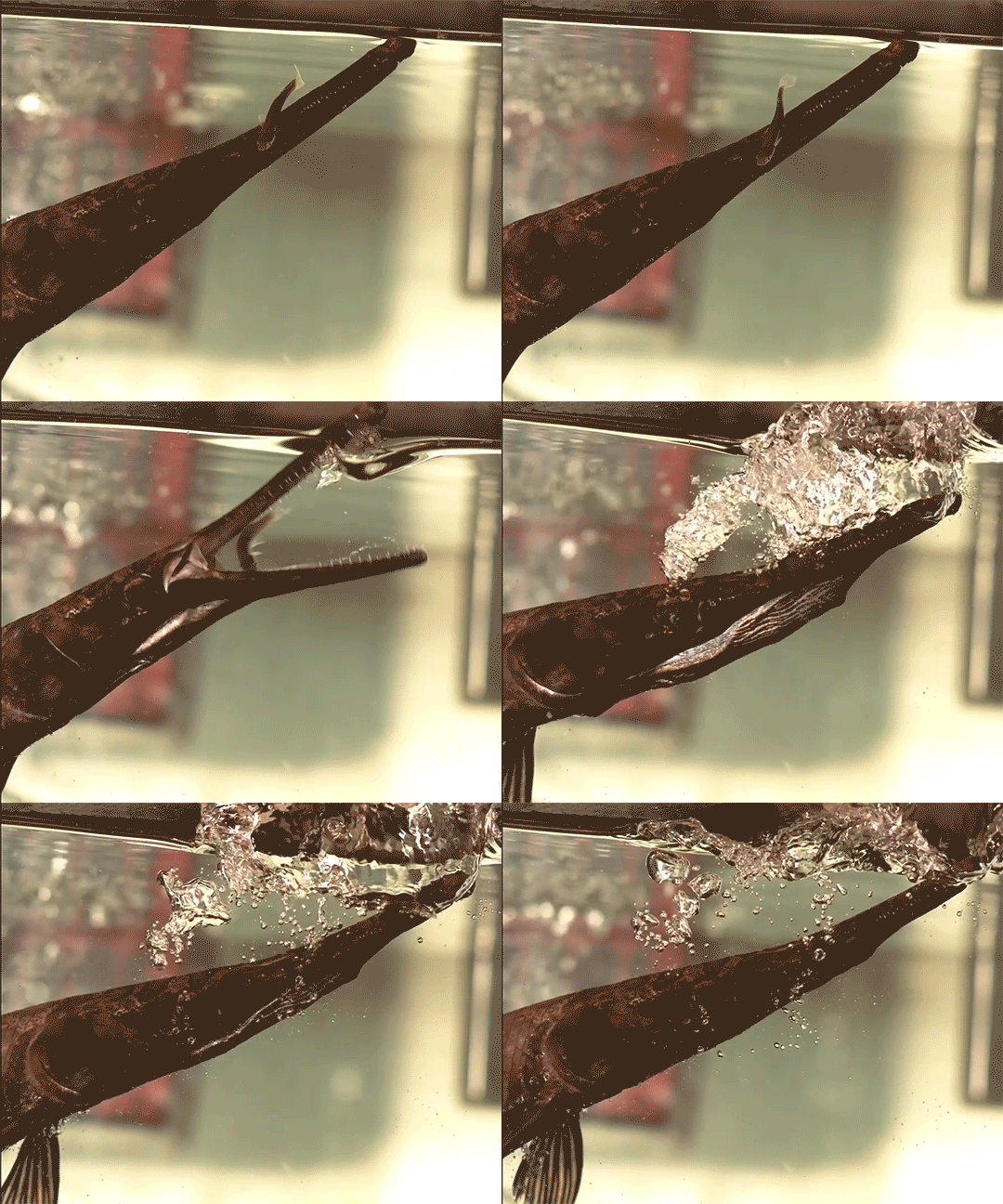
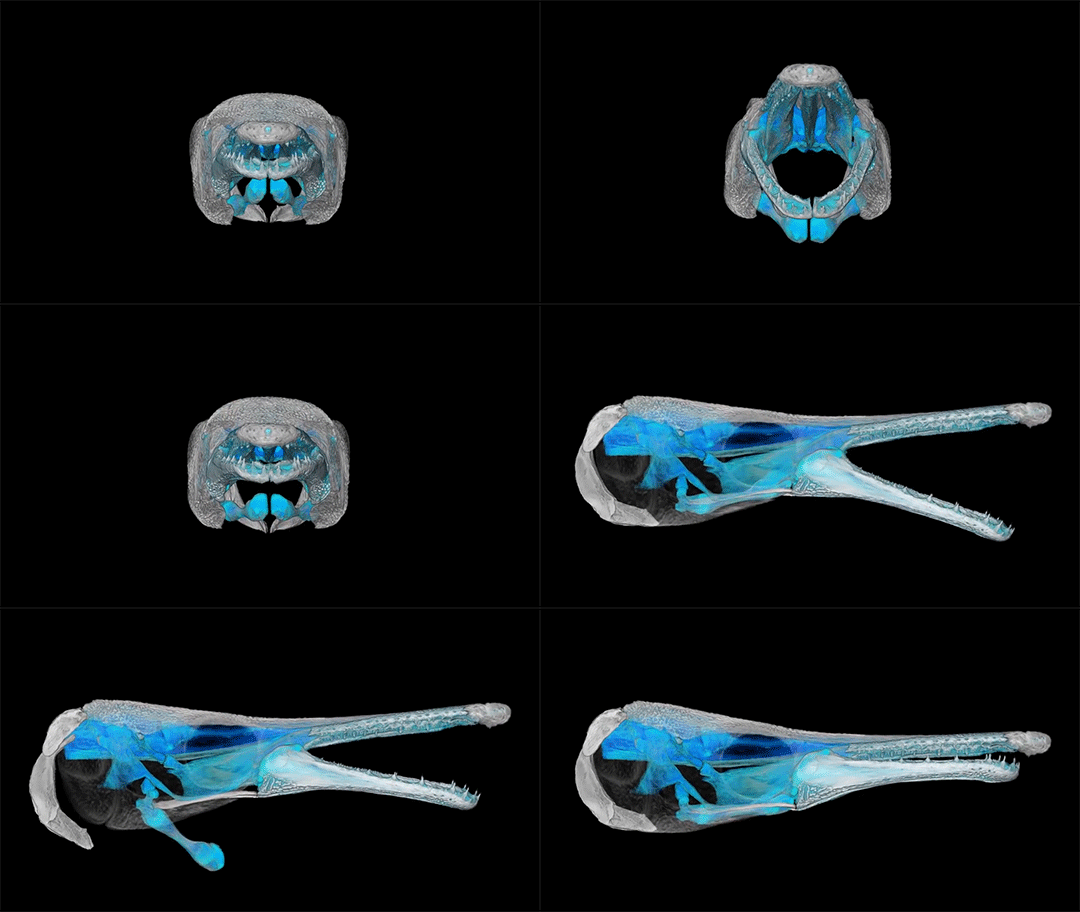
    The skinny, freshwater alligator gar can grow to more than 2 meters in length, giving it a distinct resemblance to its namesake. But this fish’s history traces back more than a hundred million years to the Early Cretaceous. And a new (pre-printed) study, combining live observations and numerical models built from CT-scans, is shedding new light on how the gar and its prehistoric ancestors feed.

    The gar uses a lateral strike (top) to come at its prey from the side. But hydrodynamically speaking, that’s a tough way to catch dinner. As soon as the gar’s snout accelerates toward its prey, it pushes a bow wave ahead of it, like an early warning signal. To counter that disadvantage, the gar has a complex bone structure in its skull (bottom) that helps it generate suction. Note how the gar’s jaw and throat open sequentially from front to back. Each expansion sucks in water, and by timing them just right, the gar produces suction throughout its entire attack. The bow wave warning does its prey no good if both are already getting sucked into the gar’s mouth! (Image and research credit: J. Lemberg et al., bioRxiv pre-print; via Science; submitted by Kam-Yung Soh)

  • Review: “How to Walk on Water and Climb Up Walls”

    Review: “How to Walk on Water and Climb Up Walls”

    “An eight-year-old girl kicked her feet back and forth on the seat of a Long Island Railroad train. I beckoned her to cover over and pointed to the top of my winter jacket, which I slowly unzipped. Inside, nestling against me for warmth, were ten snakes, their forked tongues waving back and forth. The child shrieked and ran back over to her mother, who was napping. ‘That man has a coat full of snakes,’ she shouted.”

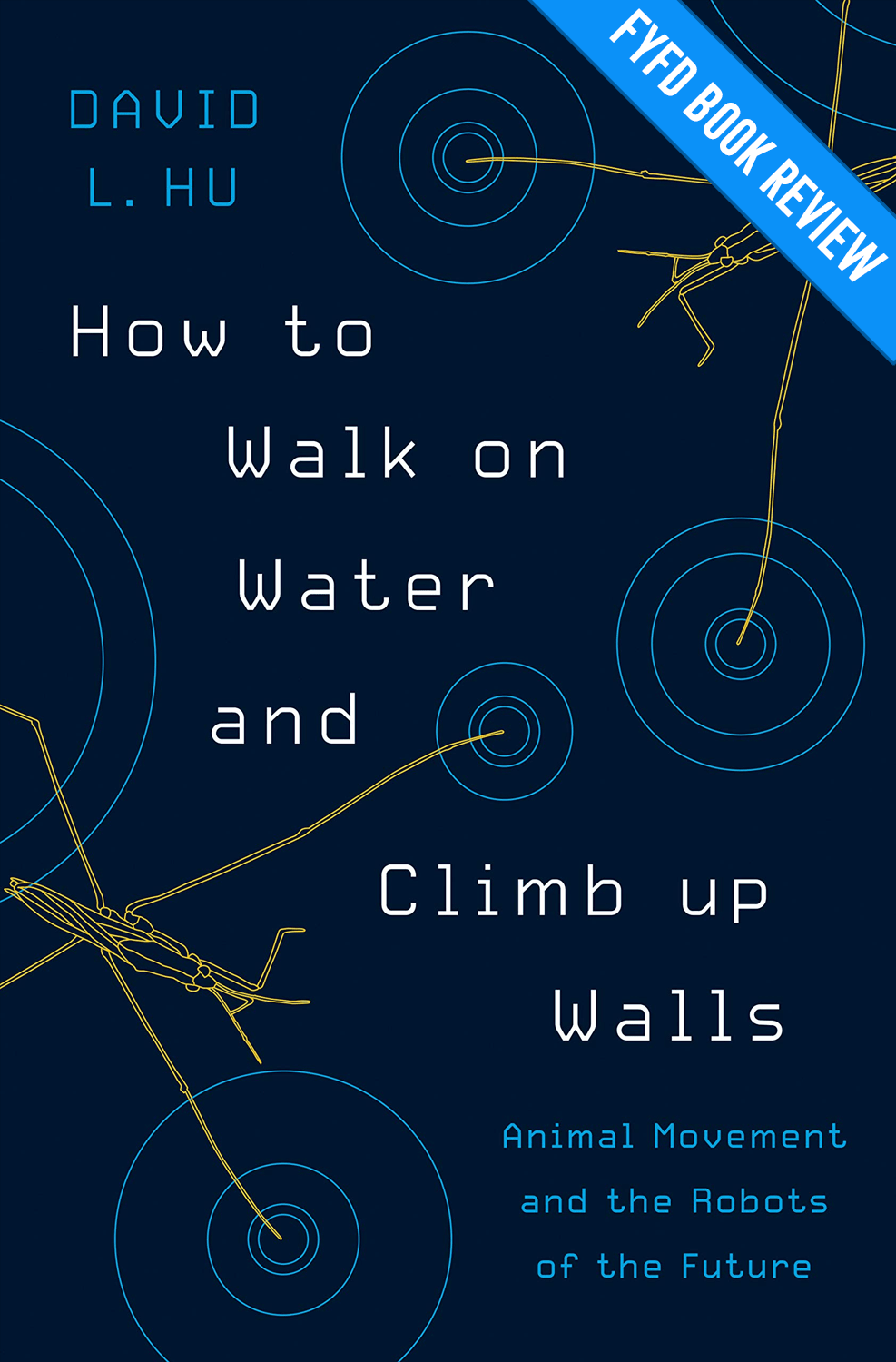
    So begins Chapter 2 of Dr. David Hu’s new book, How to Walk on Water and Climb Up Walls (*), a captivating and funny journey through animal locomotion and biorobotics. Don’t let that fool you, though; this book has plenty of fluid dynamics to it. Long-time FYFD readers will recognize some of the topics, such as the fluid-like behavior of fire ants, how eyelashes keep our eyes clean and moist, and why swimming behind an obstacle is so easy even a dead fish (like the one shown above) can do it.

    There are plenty of exciting, new stories as well, like how sandfish – a type of lizard – can swim under sand and why a lamprey’s nervous system may lead to better robots. The explanation of how cockroaches are virtually unsquishable and able to squeeze themselves into crevices a quarter of their height absolutely floored me. 

    Hu’s book offers a front-row seat to research at the cutting edge of biology, engineering, and physics, with anecdotes, explanations, and applications that will stick with you long after you put the book down. If you’re looking for a holiday gift for yourself or another science-lover, check this one out for certain (*).

    *Disclosures: I purchased my copy of this book using my own funds, and this review is not sponsored in any way. This post contains affiliate links – marked with (*); if you click on one of these links and purchase something, FYFD may receive a small commission at no additional cost to you.

    (Image credits: book – Princeton University Press; fish – D. Beal et al.; ants – Vox/Georgia Tech; eyelashes –  G. Diaz Fornaro; shark denticles – J. Oeffner and G. Lauder)

  • The Swimming of a Dead Fish

    The Swimming of a Dead Fish

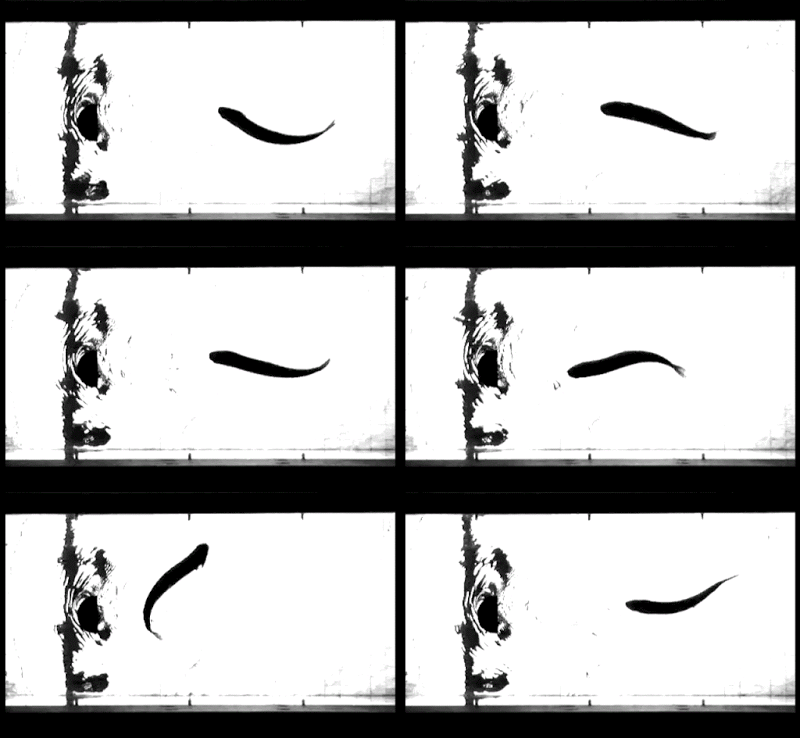
    When I was a child, my father would take me trout fishing, and I spent hours marveling from the riverbank at the trouts’ ability to, seemingly effortlessly, hold their position in the fast-moving water. As it turns out, those trout really were swimming effortlessly, in a manner demonstrated above. The fish you see here swimming behind the obstacle is dead. There’s nothing powering it, except the energy its flexible body can extract from the flow around it.

    The obstacle sheds a wake of alternating vortices into the flow, and when the fish is properly positioned in that wake, the vortices themselves flex the fish’s body such that its head and its tail point in different directions. Under just the right conditions, there’s actually a resonance between the vortices and the fish’s body that generates enough thrust to overcome the fish’s drag. This means the fish can actually swim upstream without expending any energy of its own! The researchers came across this entirely by accident, and one of the questions that remains is how the trout is able to sense its surroundings well enough to intentionally take advantage of the effect. (Image and research credit: D. Beal et al.; via PhysicsBuzz; submitted by Kam-Yung Soh)

  • Featured Video Play Icon

    The Many Shapes of Fish

    After visiting an aquarium or snorkeling near a reef, you may have wondered why fish come in so many different shapes. Given that all fish species need to get around underwater, why are some fish, like tuna, incredibly streamlined while others, like the box fish, are so, well, boxy? There are several major groupings for fish based on their shape and how they propel themselves, whether it’s by undulating their body and tail or primarily by flapping their fins. Which grouping a fish tends toward depends largely on its environment and needs. Open-water swimmers tend to use their bodies and tails. Their bodies are better streamlined, too, allowing them to outrace even some ships! Fish that live in more complicated environments, like along the seafloor or in a reef, tend to favor maneuverability over speed. These fish – which include rays, pufferfish, and surgeonfish – use their fins for their main propulsion. Many of these species are still faster swimmers than you or I, but their slower speeds have reduced their need for hydrodynamic streamlining, allowing these fish to evolve a wide variety of odd body shapes. (Video credit: TED-Ed)

  • Schooling Together

    Schooling Together

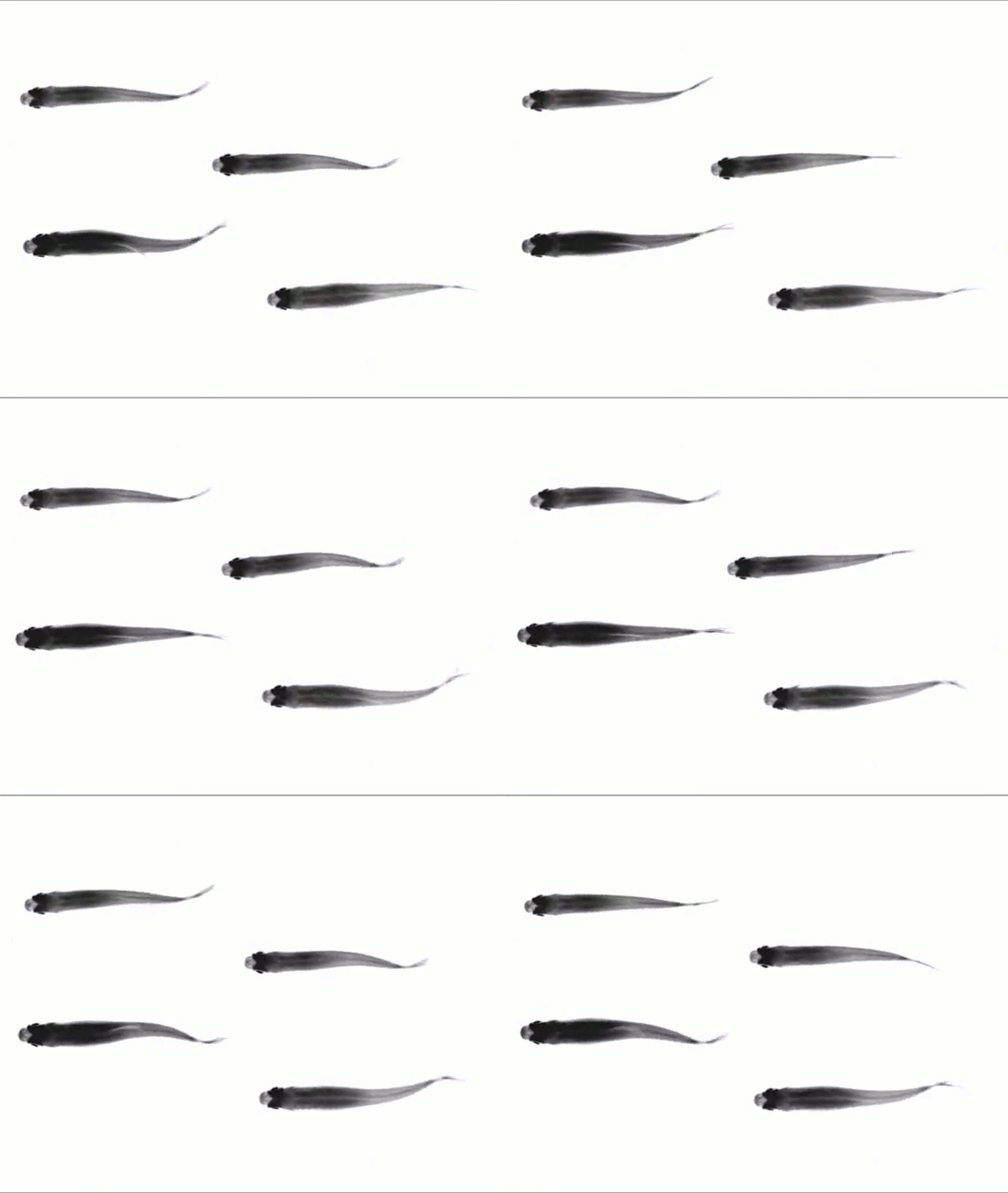
    Since the 1970s, fluid dynamicists have chased the idea that fish swim in schools for hydrodynamic advantage. The original 2D conception of the idea placed fish in a diamond pattern so that their wakes would constructively interfere and improve swimming efficiency. In nature, that exact pattern is rarely seen, possibly due to 3D effects or the difficulty of maintaining the exact orientation. Fish do, however, show signs of grouping themselves for efficiency – especially when they’re forced to swim quickly. 

    A recent study found that tetras, a type of small fish often used as pets, prefer a staggered diamond configuration (left) when free-swimming at low speeds around one body length per second. At higher speeds, around four body lengths per second, groups of tetras preferred a side-by-side or “phalanx” configuration (right). Here the fish tended to synchronize their tail-beat frequency with their neighbors, essentially working together for a mutually beneficial wake structure. The researchers found that this configuration was much more efficient than a lone swimmer or uncoordinated group, implying that fish do school for energy-savings when they’re swimming fast. (Image and research credit: I. Ashraf et al., source; via Hakai; submitted by Kam-Yung Soh)

  • Optimal Swimming

    Optimal Swimming

    What do trout, sharks, and whales have in common? All are fast swimmers and share remarkable similarities in their swimming dynamics despite different sizes, shapes, and environments. A new study analyzing aquatic locomotion examines the characteristics of these swimmers. The researchers found that a typical parameter for studying swimming fish – the Strouhal number, which relates swimming speed, body length, and tail-beat frequency – only tells part of the story. When cruising at minimum power input, a fish cannot choose its Strouhal number – that characteristic is completely determined by the fish’s shape, which determines its drag.

    Instead, researchers found that a second additional number – the ratio of the tail-beat amplitude to the body length – was also needed to describe optimal swimming. Taken together, their model predicts that optimal swimming performance lies within a narrow range of the two numbers. And when the researchers examined cruising behaviors of a diverse variety of fish and whales, they found that they did indeed swim in the ranges predicted by the model. Now that we better understand characteristics of efficient swimming, engineers can use the model to guide designs of new biologically-inspired robot swimmers.   (Image credit: N. Sharp, source; research credit: M. Saadat et al.)

  • Featured Video Play Icon

    The Hydraulics Behind a Tuna’s Turns

    Tuna are remarkably agile for their size. Many species reach lengths exceeding the height of a human adult, yet they can still make tight turns, especially when hunting. A recent study described one mechanism that aids the fish – a built-in hydraulic system for raising its second dorsal and anal fins. The tuna use fluid from their lymphatic system – which produces and transports white blood cells in both humans and tuna – to pressurize chambers at the base of some fins, causing the fin to rise. The extra support puts the fin in a hydrodynamically advantageous position and helps stabilize the fish when turning quickly, allowing them to change direction without slowing. (Video credit: Science; research credit: V. Pavlov et al.)

  • Featured Video Play Icon

    The Archer Fish’s Arrow

    Archer fish have a remarkable superpower. When hunting, they target insects above the water and knock them down with a precision strike from a jet of water they spit out. As previous research has shown, the archer fish packs an impressive punch by carefully modulating the water jet so that its tail travels faster and catches up to the front of the jet just as it strikes its target. Even more impressively, the archer fish can make this perfect strike on targets at different distances, which requires the fish to make significant adjustments to each jet. As this video from Deep Look discusses, the archer fish’s impressive hunting hints that it may have greater intelligence than we thought possible, given a comparison of its brain to ours. (Video credit: Deep Look)

  • Featured Video Play Icon

    Why Fishing with Dynamite is So Harmful

    In some countries, there are still people using dynamite to catch fish. This practice is incredibly destructive, not just to adult fish but to the entire marine ecosystem. A blast wave traveling through air loses some its energy to the compression of the gas. Water, on the other hand, is incompressible, so the blast wave’s energy just keeps going, expanding its destructive radius. Many fish contain swim bladders, gas-filled organs the fish use to regulate their depth. When a shock wave passes through the fish, the gas in the swim bladder will expand and contract violently, much like the balloons shown underwater in the animation below. This typically ruptures the swim bladder and surrounding tissues.

    Fish without swim bladders will often hemorrhage after being struck by a blast wave. The sudden changes in pressure create bubbles in the dissolved gases collected in their gills. Those bubbles tear apart the fish’s blood vessels.

    Blasting is effective but entirely indiscriminate. It kills adults and juveniles of all species, not just the ones a fisherman can sell. Simultaneously, it destroys the slow-growing coral reefs that are key habitats for these populations. It’s an incredibly short-sighted practice that guarantees there will be no fish to catch in years to come. (Video credit: National Geographic; image credit: M. Rober, source; research credit: K. Dunlap, pdf)

  • Featured Video Play Icon

    Seahorse Hunting

    Those who have observed the languid pace of seahorses or seadragons swimming might think these fish only hunt slow prey. In fact, the tiny crustaceans on which they feed are extremely quick, capable of velocities over 500 body lengths per second. Instead of speed, the seahorse relies on stealth to capture its prey, as shown in the holographic video above. Seahorses use a pivot method to feed, simultaneously shifting their snouts up and sucking water in to catch their target. But this method of feeding only works for distances of about 1 mm. To get that close in the first place, the seahorse must approach its prey without alerting it. Researchers found that both the seahorse’s head shape and its natural posture create a hydrodynamic quiet zone just off the seahorse’s snout, directly in its strike zone. Fluid velocity and deformation rates in this region are significantly lower than those around the rest of the seahorse’s face when it moves, allowing the fish to sneak up on its prey. These adaptations are remarkably effective, too; the researchers observed that the seahorses were able to position themselves within 1mm of their prey without alerting them 84% of the time. (Video credit: B. Gemmell et al.; via Discover)