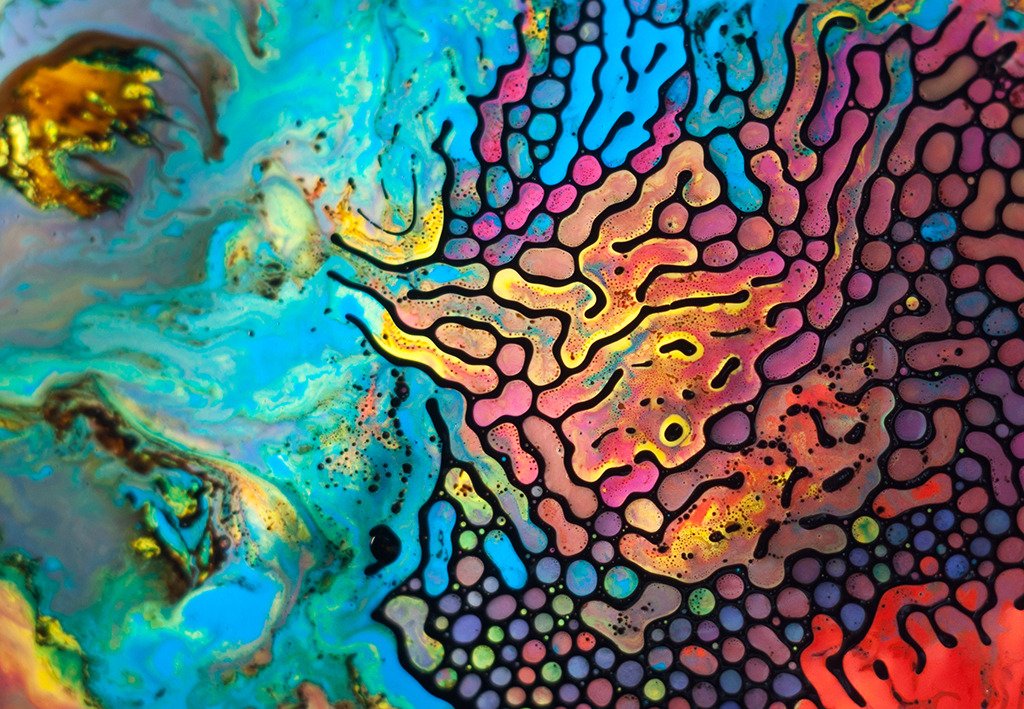
Artist Charles Sowers creates exhibits and public art focused on illuminating natural phenomenon that might otherwise go unnoticed, and much of his work features fluid dynamics directly or indirectly. “Windswept” and “Wave Wall” are both outdoor exhibits that show undulations and vortices corresponding to local wind flow. Other pieces explore ferrofluids through magnetic mazes or feature foggy turbulence. My own favorite, “Drip Chamber”, oozes with viscous fluids whose dripping forms patterns reminiscent of convection cells. Be sure to check out his website for videos of the exhibits in action. (Photo credits: Charles Sowers; submitted by rreis)
Tag: ferrofluid

“Millefiori”
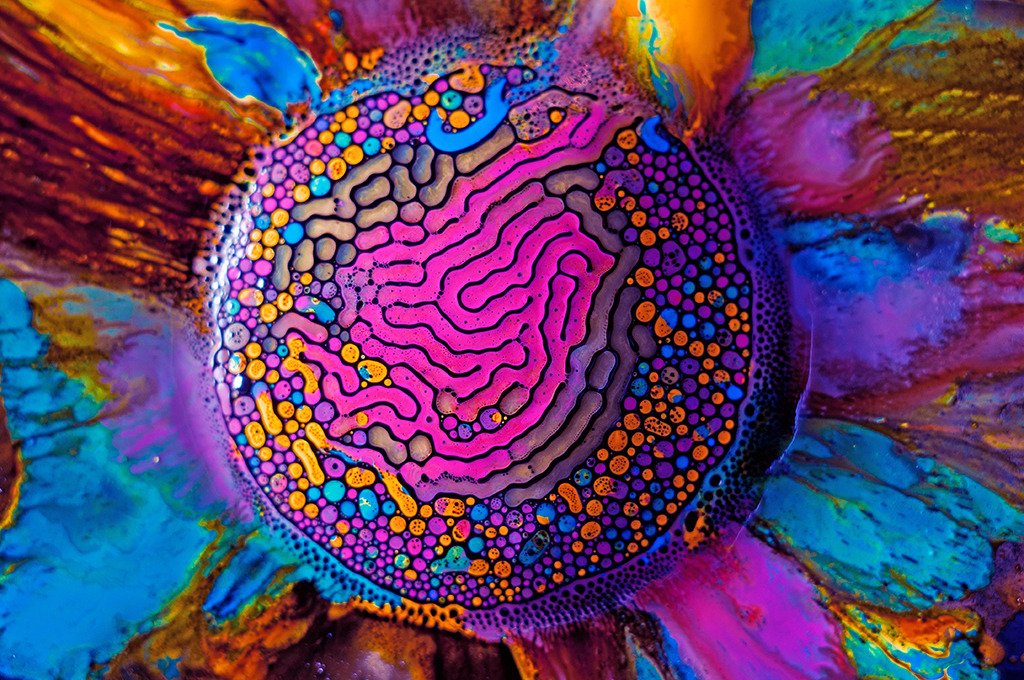
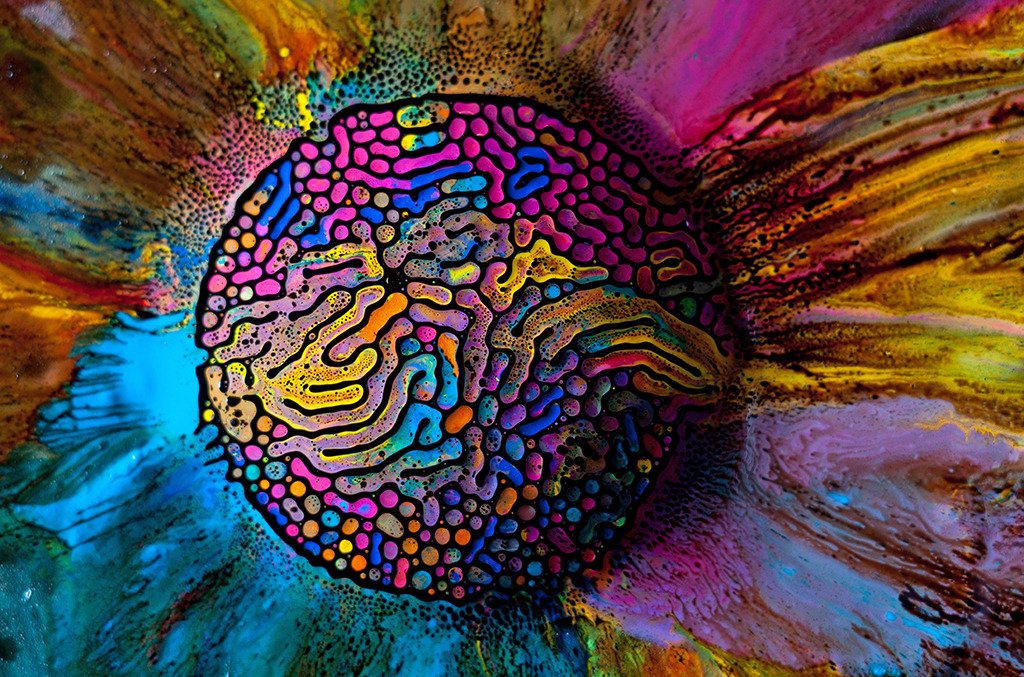
In “Millefiori” artist Fabian Oefner mixes watercolors with ferrofluids to create bright fluid microcosms. Each photograph represents an area about the size of a thumbnail. Ferrofluids contain iron-based nanoparticles suspended in a carrier fluid and thus respond to magnetic fields. They can form sharp points, labyrinthine mazes, or even brain-like patterns depending on the magnetic field and the substances surrounding them. For more on this art project, see this interview with the artist. (Photo credit: Fabian Oefner)

“Ferienne”
In “Ferienne” artist Afiq Omar utilizes ferrofluids, magnetism, and vibration to create analog visual effects. Most of the dot and labyrinthine patterns result from the reaction of a ferrofluid submerged in a nonmagnetic fluid to an external magnetic field. Diffusion effects and surface tension instabilities are also visible in the way the darker ferrofluid breaks down in the carrier fluid. Also be sure to check out Omar’s previously featured fluid film “Ferroux”. (Video credit: Afiq Omar)

Ferrofluid Drop
A drop of ferrofluid is shaped by seven small circular magnets sitting beneath the glass and paper. Ferrofluids are made up of nanoscale ferromagnetic particles suspended in a carrier liquid. Under the influence of magnetic fields, they can take on fantastic shapes, including sharp-tipped droplets and labyrinthine mazes. This image is taken from the National Academy of Science’s book Convergence, focused on the intersection between science and art. (Photo credit: Felice Frankel)

“Compressed” Outtakes
Bubbles, viscosity, diffusion, capillary action, and ferrofluids all feature in the artistic experiments of Kim Pimmel. Be sure to check out his previous film featured here. (Video credit: Kim Pimmel)

“Ferroux”
In this video, artist Afiq Omar mixes ferrofluid with soap, alcohol, milk, and other liquids to create a surrealistic fluidic dance. In addition to using different fluid mixtures, I suspect he accomplishes many effects using several different permanent magnets and electromagnets to vary the magnetic fields around the ferrofluid mixtures. (Video credit: Afiq Omar; via Wired)
Ferrofluid
[original media no longer available]
The motion of ferrofluids in magnetic fields is always mesmerizing. Here a ferrofluid has been submerged in a clear alcohol-based solution in a shallow dish while a permanent magnet is used to perturb the liquid. Instead of forming its distinctive spikes due to the normal-field instability, the fluid forms ribbons and mazes due to the shifting magnetic field and the surrounding fluid.

High-Speed Ferrofluid
High-speed video captures the behavior of a ferrofluid trapped between two magnets. Ferrofluids contain tiny ferromagnetic particles suspended in a carrier fluid like oil or water. The distinctive peaks and valleys of a ferrofluid subject to a strong magnetic field is due to the normal-field instability and is a result of the fluid minimizing its magnetic energy.

“Compressed 02”
This timelapse video shows the spreading of food coloring and a ferrofluid through soap suds surrounding a magnet. Capillary action, the same force that enables sap to flow up through a tree against gravity, helps draw the fluids through the interfaces between the soap bubbles without disturbing the suds. The magnet’s field provides a preferred direction for the ferrofluid flow. (via Gizmodo)

Spiky Ferrofluid
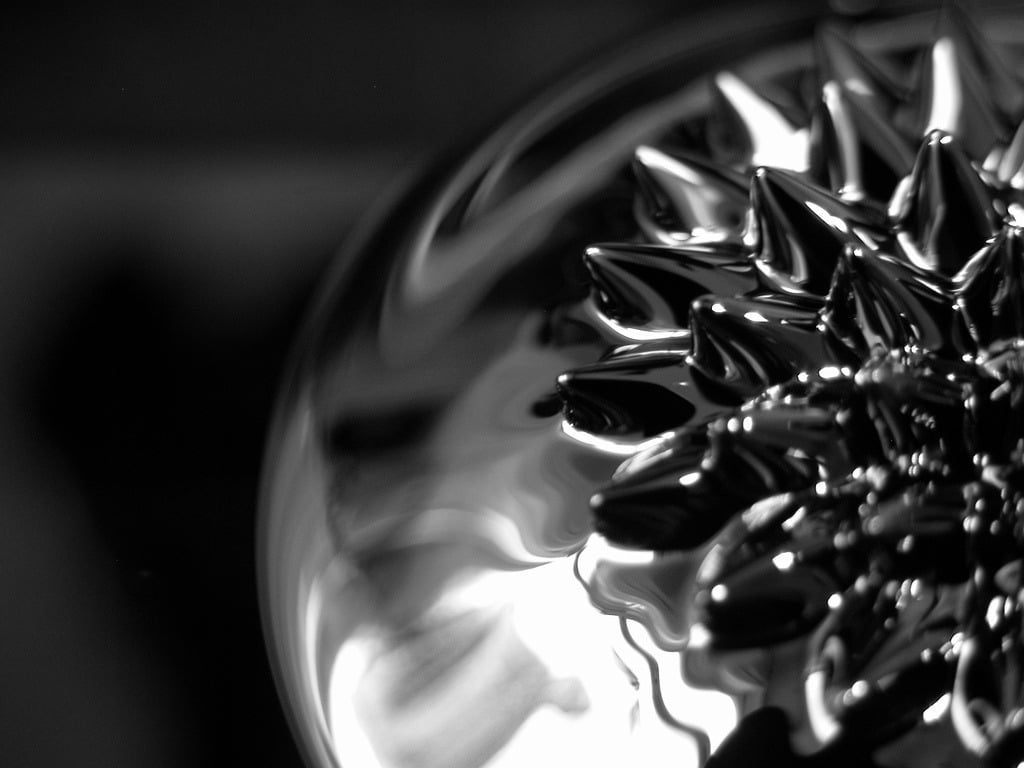
Ferrofluids consist of ferromagnetic nanoparticles suspended in a fluid. When subjected to strong magnetic fields, they develop a distinctive peak-and-valley formation due to the normal-field instability. The shape is a result of minimizing the magnetic energy of the fluid. Both gravity and surface tension resist the formation of these peaks. Ferrofluids, in addition to appearing in art exhibits, can be used as liquid seals, MRI contrast agents, and loudspeaker cooling fluids. (Photo credit: Maurizio Mucciola)