Tag: expansion fan

  • Inside a Champagne Pop

    Inside a Champagne Pop

    When the cork pops on a bottle of champagne, the physics is akin to that of a missile launch in more ways than one. In this study, researchers used computational fluid dynamics to closely examine the gases that escape behind the cork. They identified three phases to the flow. In the first, the exhaust gases form a crown-shaped expansion region, complete with shock diamonds. Once the cork has moved far enough downstream, the axial flow accelerates to supersonic speeds and a bow shock forms behind the cork. Finally, the pressure in the bottle drops low enough that supersonic conditions cannot be maintained and the flow becomes subsonic. (Image credit: top – Kindel Media, simulation – A. Benidar et al.; research credit: A. Benidar et al.; via Ars Technica; submitted by Kam-Yung Soh)

    A numerical simulation showing the ejection of a champagne cork from a bottle. The colors indicate the speed of gases escaping from the bottle.
    A numerical simulation showing the ejection of a champagne cork from a bottle. The colors indicate the speed of gases escaping from the bottle.
  • Bottle Rocket Shock Diamonds

    Bottle Rocket Shock Diamonds

    Mach diamonds or shock diamonds can often be seen in the exhaust of rocket engines. Here they’re shown in high-speed video of a bottle rocket’s launch. The rocket’s exhaust exits at a pressure that is higher than the surrounding atmosphere, which causes the exhaust to bulge outward and forms two expansion fans, seen in pink, to lower the pressure. The pressure actually drops too low, however, causing shock waves, seen in turquoise, to form in order to raise the exhaust’s pressure. This back-and-forth between shock waves and expansion fans continues, forming the diamond shapes we see. Each subsequent set gets weaker as the exhaust closes in on the right pressure, and ultimately the series of diamonds fades into turbulence. (Image credit: P. Peterson and P. Taylor, source)

  • Shock Diamonds

    Shock Diamonds

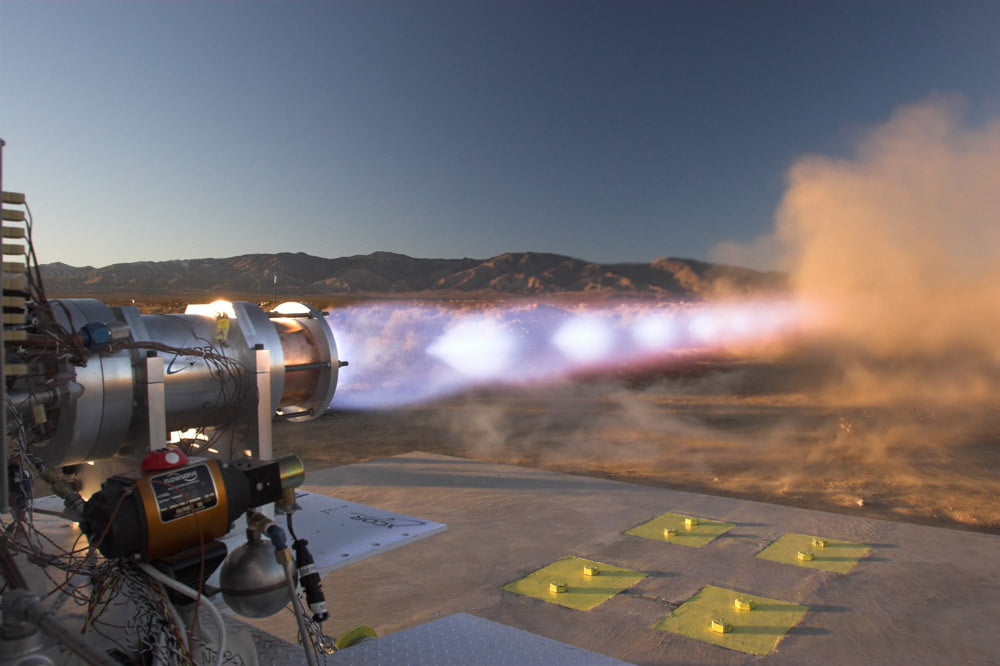
    Rocket engine exhaust often contains a distinctive pattern known as shock diamonds or Mach diamonds. These are a series of shock waves and expansion fans that increase and decrease, respectively, the supersonic exhaust gases’ pressure until it equalizes with atmospheric pressure. The bright glowing spots visible to the naked eye are caused by excess fuel in the exhaust igniting. As awesome as shock diamonds look, they’re actually an indication of inefficiencies in the rocket: first, because the exhaust is over- or underexpanded, and second, because combustion inside the engine is incomplete. Both factors reduce a rocket engine’s efficiency (and both are, to some extent, inescapable). (Photo credit: XCOR)

  • Shock Waves in Flight

    Shock Waves in Flight

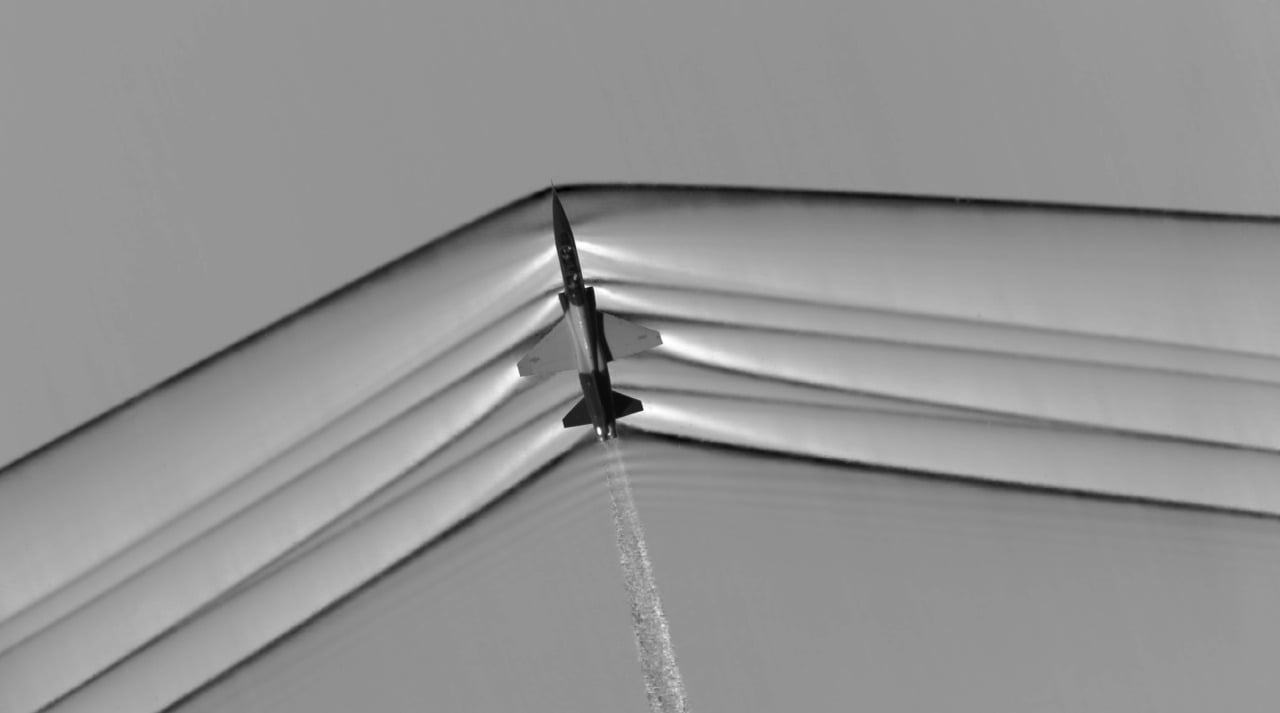
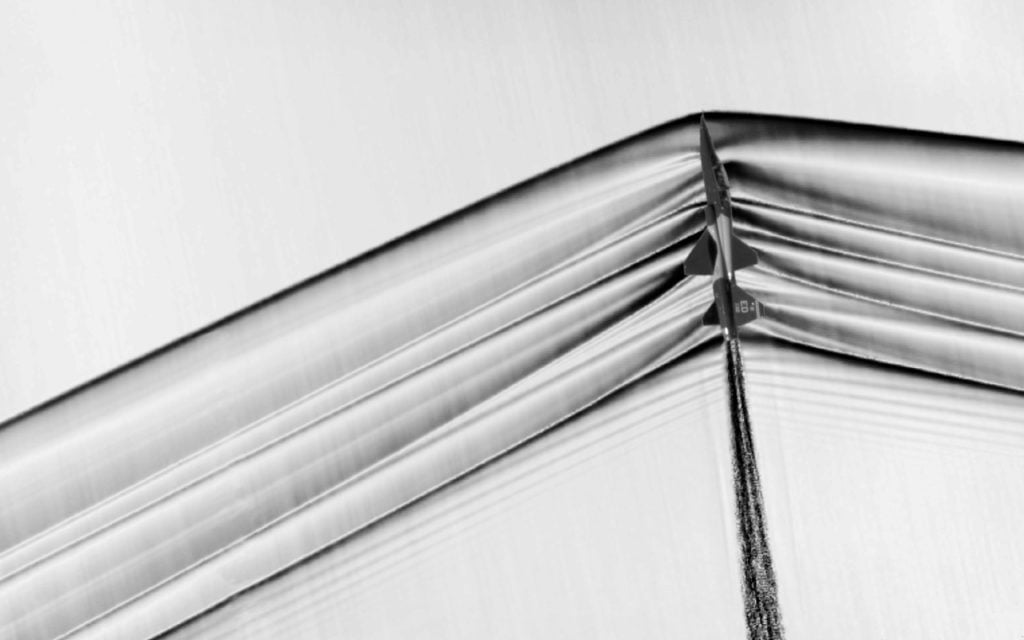
    Schlieren optical systems have been used to visualize shock waves in labs for more than a century, but the technique did not translate well to photographing shock structures outside the lab. But now NASA’s Armstrong Research Center and Ames Research Center have developed a method that allows them to capture highly-detailed images of the shock waves around airplanes while they are flying. This is incredible stuff. Be sure to check out the high-resolution versions on this page, along with more description of the coordination necessary to pull off the photos.

    The light and dark lines you see emanating from the airplane are places with strong density gradients. The dark lines are mostly shock waves, with the strongest shock waves appearing black due to the large change in air density. Many of the light streaks are expansion fans, areas where the density and pressure drop as air speeds up.

    The goal of this research is to better understand shock wave structures around supersonic planes in order to reduce the noise supersonic aircraft cause when flying overhead. As you can see in the photos, the shock waves at the nose and tail of the aircraft persist far away from the aircraft; these are what cause the twin sonic boom heard when the plane flies by. (Photo credit: NASA; via J. Hertzberg)

  • Featured Video Play Icon

    Shock Trains

    In compressible flows, shock waves are singularities, a tiny distance across which the density, temperature, and pressure of a fluid change suddenly and discontinuously. In this video, there is a wedge at the top and bottom of the frame and a Pitot probe roughly in the center. Flow is left to right and is initially subsonic. Once Mach 6 flow is established in the wind tunnel, a series of shock waves and expansion fans appear as light and dark lines in this schlieren video. Oblique shocks extend from the sharp tip of each wedge and interfere to create a normal shock in front of the Pitot probe. The air that passes through the normal shock is subsonic to the right of the shock, whereas air that goes through the oblique shocks remains supersonic. The fainter lines further to the right are weaker shock waves and expansion fans that reflect off the walls and probe. They exist to continue turning the airflow around the probe and to equalize conditions between different regions. (Video credit: C. Mai et al.)

  • SpaceShipTwo Lights It Up

    SpaceShipTwo Lights It Up

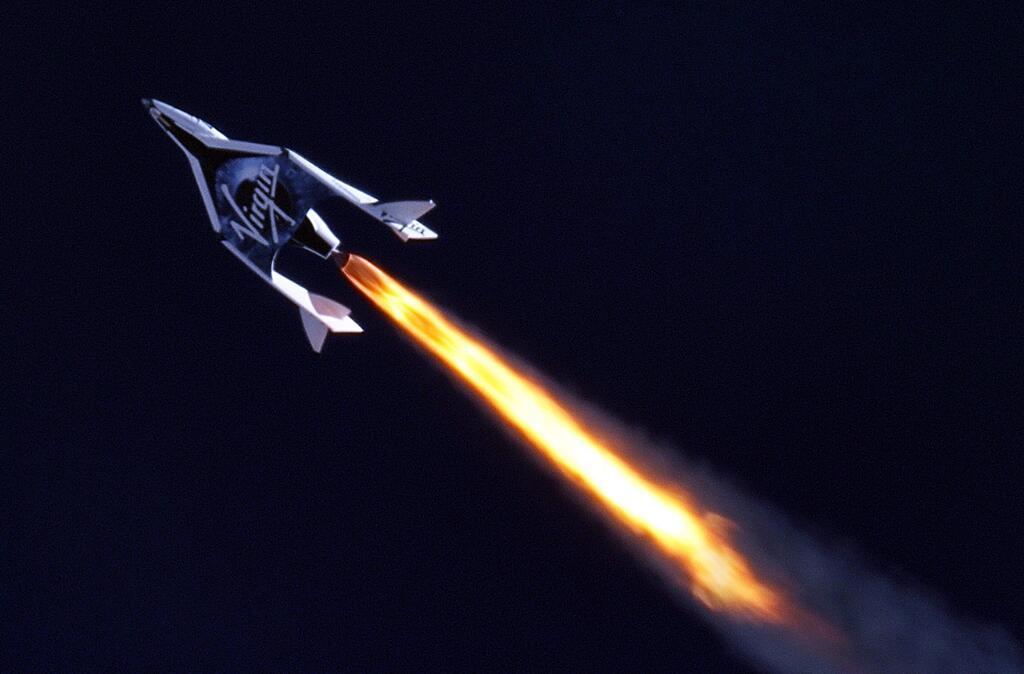
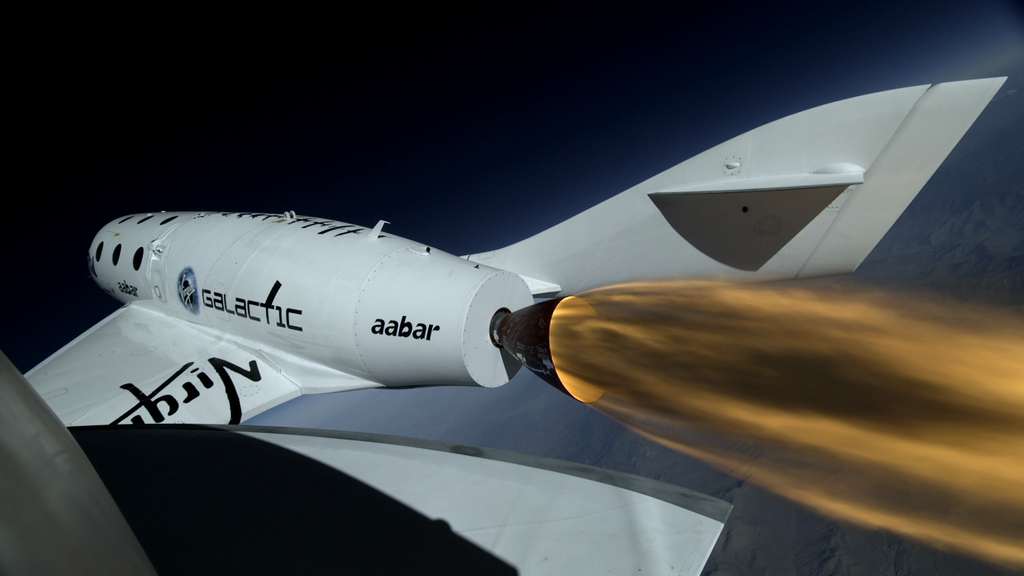
    Monday morning Virgin Galactic and their partners at Scaled Composites reached a new milestone in their commercial sub-orbital spaceflight program, firing SpaceShipTwo’s main engine for the first time and accelerating to supersonic speeds. The upper image shows hints of Mach diamonds, formed by a series of shock waves and expansions, in its exhaust. This is very common for rockets since most have a fixed geometry, and, by extension, a fixed Mach number and exhaust pressure. (Photo credits: Virgin Galactic and Mars Scientific)

  • Featured Video Play Icon

    Bottle Rocket Shock Waves

    This high speed video shows schlieren photography of a bottle rocket’s exhaust. The supersonic CO2 leaving the nozzle is underexpanded, meaning its pressure is still higher than the ambient atmosphere. As a result, a series of diamond-shaped shock waves and expansion fans appear in the exhaust jet. Each shock and expansion changes the pressure of the exhaust until it ultimately reaches the same pressure as the ambient air. This distinctive pattern, also known as Mach diamonds or shock diamonds, often occurs in wake of rockets. (Video credit: P. Peterson and P. Taylor)

  • Vapor Cone

    Vapor Cone

    This stunning National Geographic photo contest winner shows an F-15 banking at an airshow and a array of great fluid dynamics. A vapor cloud has formed over the wings of the plane due to the acceleration of air over the top of the plane. The acceleration has dropped the local pressure enough that the moisture of the air condenses.  Some of this condensation has been caught by the wingtip vortices, highlighting those as well. Finally, the twin exhausts have a wake full of shock diamonds, formed by a series of shock waves and expansion fans that adjust the exhaust’s pressure to match that of the ambient atmosphere. (Photo credit: Darryl Skinner/National Geographic; via In Focus; submitted by jshoer)

  • Rocket Engine Test

    [original media no longer available]

    In this static test of XCOR Aerospace’s Lynx rocket engine, Mach diamonds (shown at the top of the frame) are visible in the rocket exhaust. The distinctive pattern is a result of the over- or under-expansion of the exhaust jet with respect to the ambient air; in other words, the gases exiting the rocket are either too high or too low in pressure relative to the surrounding air. A series of shock waves and expansion fans forms in the exhaust jet until the pressure is equalized to ambient. It is these compressions and expansions that form the diamond pattern. (Video credit: XCOR Aerospace)

  • Featured Video Play Icon

    Rocket Engine Testing

    Rocket engine tests usually feature a distinct and steady pattern of Mach diamonds in their exhaust. This series of reflected shock waves and expansion fans forms as a result of the exhaust pressure of the rocket nozzle being lower or higher than ambient pressure. A rocket will be most efficient if its exhaust pressure matches the ambient pressure, but since atmospheric pressure decreases as the rocket gets higher, engines are usually designed with an optimal performance at one altitude.