Tag: education

  • Featured Video Play Icon

    Pop-Pop Boats

    I confess I’ve never heard of the pop-pop boat toys Steve Mould uses in this video. They feature a tank filled with water and a small source of heat in the form of a tea light candle. Together, these features generate propulsion and a distinctive popping sound from the toy. As he is wont to, Mould explains the physics behind the toy using a transparent version to show the water/steam oscillations that drive the boat. Having watched, I have to say that this set-up seems ready made for an undergrad fluids class and a control volume analysis! (Image and video credit: S. Mould)

  • Snowflake Velocimetry

    Snowflake Velocimetry

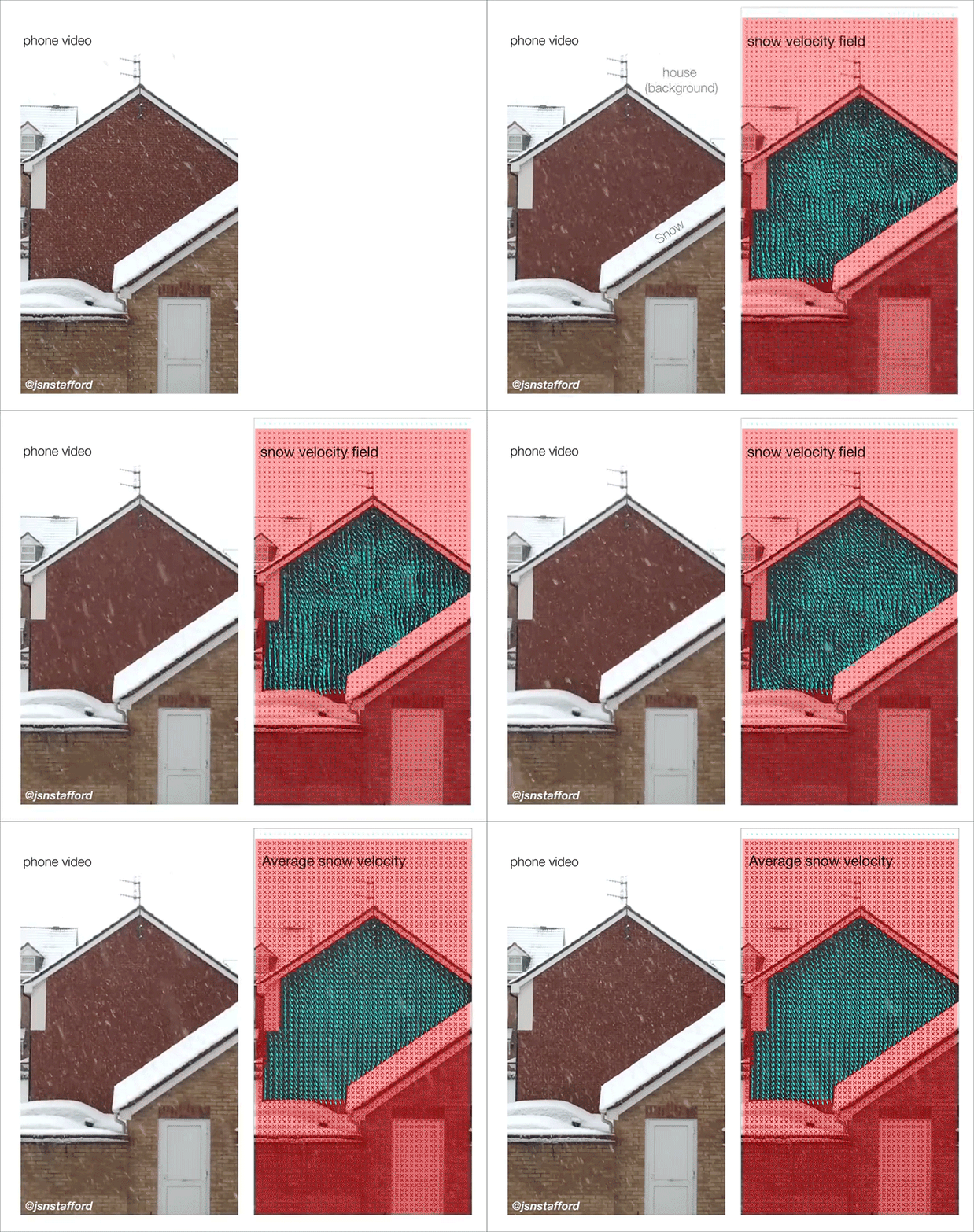
    In our era of remote learning, students don’t always have a chance to do hands-on lab experiments in the usual fashion. But that doesn’t mean they can’t explore important flow diagnostic techniques. Here a simple smartphone video of snow falling gets turned into a lesson on particle image velocimetry, or PIV, a major technique for measuring flow velocities.

    A nearby house acts as a fixed backdrop, and by comparing snowflake positions from one frame to the next, students can measure the instantaneous flow patterns in the snowfall. Of course, that’s a tedious task to do by hand, but luckily there are computer programs that do it automatically. Simply run the smartphone video through the software, and analyze the patterns it reveals!

    As a bonus, students don’t have to get distracted by the complexities of laser sheets and flow seeding that are normally a part of PIV. Instead, the flow and the lighting are already right outside their window, and they can concentrate instead on learning the principles of the technique and how to use the software. (Image and submission credit: J. Stafford)

  • Featured Video Play Icon

    Help FYFD Get to APS DFD 2013

    Readers, I need your help! Funding for my project got cancelled prematurely thanks to sequester-induced budget cuts and my research group no longer has the funds to send me to the American Physical Society’s Division of Fluid Dynamics meeting where I am scheduled to give two talks, one about FYFD and one about my research. APS’s DFD meeting is the big fluid dynamics conference of year, where thousands of researchers, professionals, and students come together to present their work. It’s always a major source of beautiful, interesting, and exciting photos and videos for FYFD. I’m asking you to help me raise the $2000 I need to attend. Watch the video, check out the perks available for donors over at IndieGoGo, and please help me spread the word by reblogging, retweeting, etc. Thank you!

  • Reader Question: How to Get Started in Fluid Dynamics

    unboundid-deactivated20131116 asks:

    Hi. I’m a freshman engineering student at UCSD, and I was hoping to get more into fluid dynamics. Could you possibly give a quick shake-down of what I should look into if I’m just kind of starting? I want to either work in studying specifically fluid dynamics or in studying interactions of oil and petroleum.

    Glad to hear that you’re interested in fluid mechanics!  I usually answer these kind of questions privately, but I’m going to go ahead and publish my answer here because I think the advice is useful for any undergraduates interested in fluids.

    First of all, most engineering courses of study won’t cover fluid mechanics–outside of pipe flow–until the junior or senior-level courses. This is because, unlike many other engineering topics, fluid mechanics relies heavily on foundational material in other subjects. Although fluid mechanics is still essentially F = ma, writing and manipulating the fundamental equations requires advanced calculus. So you will definitely benefit from paying a lot of attention in your math courses, especially vector calculus and differential equations. I also highly recommend learning to solve differential equations numerically using tools like Matlab or Mathematica. These are super useful skills for just about any form of engineering, but they can really pay off in fluid mechanics.

    Now, while this classroom work is very important, you don’t have to wait until you’ve finished four semesters of calculus and physics before getting into fluid mechanics. Look up the professors at your school and the research they do.  Find some topics/projects you want to learn more about, and go meet with those professors. In my experience, professors are willing to have undergraduates–yes, even freshmen–volunteer in their labs. I can’t guarantee that you’ll get paid, but I can tell you that you will learn a lot, especially from the graduate students you will probably be assisting. As you gain experience, you’ll gain responsibility. Right now, my research group has a sophomore preparing to be the lead on a new data collection campaign in one of our best research wind tunnels.

    Many professors recruit their future graduate students this way. And, if it turns out that you don’t want to work in that lab through graduate school, you will still have a leg up getting into grad school because you’ll have significant research experience and a professor who can write you a strong recommendation, having seen your work. You could even have co-authorship on a publication, and that sort of achievement is going to look good on your resume, whether you pursue graduate school or an industrial job.

    In short: talk to professors about their research and find a lab where you can become a part of that research. The earlier you do this, the more impressive the results by the time you graduate. Good luck!

  • Featured Video Play Icon

    Surface Tension Demo

    This simple demonstration shows the power of surface tension, especially at small lengthscales. Another way to break the surface tension holding the water in the sieve would be to spray the top of the jar with soapy water. The soap acts as surfactant, decreasing the surface tension such that the water is unable to counteract the force of gravity.

  • DIY Non-Newtonian Fluids

    [original media no longer available]

    We’ve featured the non-Newtonian fluid oobleck here before, but it bears repeating as a fun and easy exercise for anyone to do at home or at school, especially with kids. For extra fun, try vibrating it, using it as liquid armor, or filling a pool and walking on it.