We often think of raindrops as spherical or tear-shaped, but, in reality, a falling droplet’s shape can be much more complicated. Large drops are likely to break up into smaller droplets before reaching the ground. This process is shown in the collage above. The initially spherical drops on the left are exposed to a continuous horizontal jet of air, similar to the situation they would experience if falling at terminal velocity. The drops first flatten into a pancake, then billow into a shape called a bag. The bags consists of a thin liquid sheet with a thicker rim of fluid around the edge. Like a soap bubble, a bag’s surface sheet ruptures quickly, producing a spray of fine droplets as surface tension pulls the damaged sheet apart. The thicker rim survives slightly longer until the Plateau-Rayleigh instability breaks it into droplets as well. (Image credit: V. Kulkarni and P. Sojka)
Tag: droplet breakup

The March of Drops
I love science with a sense of humor. This video features a series of clips showing the behavior of droplets on what appears to be a superhydrophobic surface. In particular, there are some excellent examples of drops bouncing on an incline and droplets rebounding after impact. For droplets with enough momentum, impact flattens them like a pancake, with the rim sometimes forming a halo of droplets. If the momentum is high enough, these droplets can escape as satellite drops, but other times the rebound of the drop off the superhydrophobic surface is forceful enough to overcome the instability and draw the entire drop back off the surface. (Video credit: C. Antonini et al.)
Liquids Pinching Off
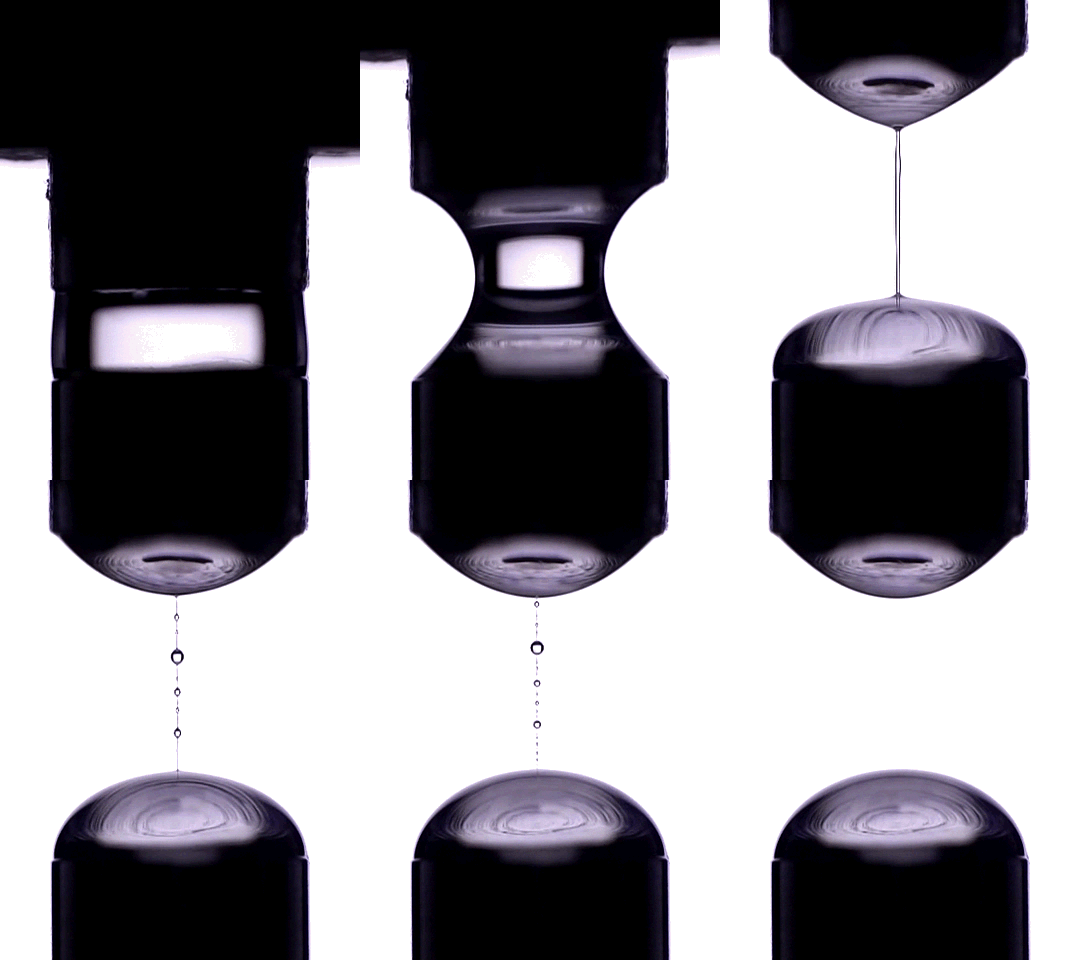
There is a surprising variety of forms in the pinch-off of a liquid drop. This short video shows three examples, and you’ll probably find yourself replaying it a few times to catch the details of each. On the left, a drop of water pinches off in air. As the neck between the nozzle and the drop elongates, the drop end of the neck thins to a point around which the drop’s surface dimples. This is called overturning. When the drop snaps off, the neck disconnects and rebounds into a smaller satellite droplet. The middle video shows a drop of glycerol, which is about 1000 times more viscous than water. This droplet stretches to hang by a thin neck that remains nearly symmetric on the nozzle end and the drop end. There is no satellite drop when it breaks. The rightmost video shows a polymer-infused viscoelastic liquid pinching off. This liquid forms a very long, thin thread with a fat satellite drop still attached. When gravity eventually becomes too great a force for the stresses generated by the polymers in the liquid, the drops break off. (Video credit: M. Roche)

Beads on a String
Adding just a small amount of polymers to a liquid can drastically change its behavior. The polymers make the liquid viscoelastic, meaning that, under deformation, the liquid shows behaviors that are both viscous (like all fluids) and elastic (i.e. able to resume its original shape, like a rubber band). These properties are particularly identifiable under extensional loading, like in the animation above. Under these loads, the polymers in the fluid stretch and rearrange, creating an internal compressive stress that acts opposite the imposed tensile stress. It’s this balance of forces, along with ever-present surface tension that creates the beads-on-a-string effect seen above. (Image credit: B. Keshavarz)
ETA: As usual, Tumblr gave me issues with an animated GIF. It should be fixed now. Sorry!
Breaking into Droplets
A falling column of liquid, like the water from your faucet, will tend to break up into a series of droplets due to the Plateau-Rayleigh instability. This instability is driven by surface tension. Small variations in the radius of the column occur naturally. Where the radius shrinks, the pressure due to surface tension increases, causing liquid to flow away, which shrinks the column’s radius even further. Eventually the column pinches off and breaks into droplets. What’s especially neat is that the size of the final droplets can be predicted based on the column’s initial radius and the wavelength of its disturbances. (Video credit: BYU Splash Lab)
Breaking Up a Ferrofluid
Ferrofluids are known for their fascinating behaviors when subjected to magnetic fields, especially for the distinctive peaks they can form. In this video, we see a very thin ferrofluid drop on a pre-wetted surface just as a uniform perpendicular magnetic field is applied. Immediately the droplet breaks up into tiny isolated peaks that migrate out to the circumference. The interface breaks down from center, where the drop height is largest, and moves outward. Simultaneously, the diffusion of ferrofluid from the circumferential droplets into the surrounding fluid lowers the magnetization of those droplets, making it more difficult for them to repel their neighbors. As a result, they drift outward more slowly and get caught by the faster-moving droplets from within. (Video credit: C. Chen)
Shocking Droplets
Typical liquid drops will break apart into long, stretched ligaments and a spray of tiny droplets when deformed. But with just a small addition of polymers, these same liquids become viscoelastic and capable of some pretty incredible behaviors. This video shows a viscoelastic drop being struck by a shock wave that passes from right to left. The droplet is smashed and deformed, then stretches into jellyfish-like sheet of liquid. But incredibly, the elastic forces in the droplet are enough to hold it together. Researchers are interested in understanding these behaviors for many applications, including preventing accidental explosions caused by explosive fuels atomizing in air. (Video credit: T. Theofanous et al.)

Stopping Jet Break-Up
When a stream of liquid falls, a surface tension effect called the Plateau-Rayleigh instability causes small variations in the jet’s radius to grow until the liquid breaks into droplets. For a kitchen faucet, this instability acts quickly, breaking the stream into drops within a few centimeters. But for more viscous fluids, like honey, jets can reach as many as ten meters in length before breaking up. New research shows that, while viscosity does not play a role in stretching and shaping the jet as it falls–that’s primarily gravity’s doing–it plays a key role in the way perturbations to the jet grow. Viscosity can delay or inhibit those small variations in the jet’s diameter, preventing their growth due to the Plateau-Rayleigh instability. In this respect, viscosity is a stabilizing influence on the flow. (Photo credit: Harsha K R; via Flow Visualization)
“Frozen” Water Stream
We saw previously how vibrating a falling stream of water and filming it with a matching camera frame rate appears to “freeze” the falling liquid. This video shows the same illusion, now with a 24 Hz sine wave, which the falling water mimics. Vibrating the speaker that drives the water stream slightly slower or slightly faster than the camera frame rate makes the water appear to slowly fall or rise relative to its “frozen” wave state. This is a beat effect caused by the slight difference in frequency between the water and the camera. (Video credit: brusspup; via BoingBoing; submitted by many readers)
Breaking Up Falling Beads
In a stream of falling liquid, surface tension instabilities cause the fluid to break up into droplets. This video shows a similar experiment with a stream of glass beads, a granular material. The whole system is housed under a vacuum to eliminate the effects of air drag on the stream, and a camera rides alongside the stream to track the evolution of the falling material in a Lagrangian fashion. As with a liquid stream, we see the granular flow develop undulations as it falls, ultimately breaking up into clusters of beads. The authors suggest that nanoscale surface roughness and van der Waals forces may be responsible for the clustering behavior in the absence of surface tension. (Video credit: J. Royer et al.)