In the collage above, successive frames showing the bouncing and break-up of liquid droplets impacting a solid inclined surface coated with a thin layer of high-viscosity fluid have been superposed. This allows one to see the trajectory and deformation of the original droplet as well as its daughter droplets. The impacts vary by Weber number, a dimensionless parameter used to compare the effects of a droplet’s inertia to its surface tension. A larger Weber number indicates inertial dominance, and the Weber number increases from 1.7 in (a) to 15.3 in (d). In the case of (a), the impact of the droplet is such that the droplet does not merge with the layer of fluid on the surface, so the complete droplet rebounds. In cases (b)-(d), there is partial merger between the initial droplet and the fluid layer. The impact flattens the original droplet into a pancake-like layer, which rebounds in a Worthington jet before ejecting several smaller droplets. For more, see Gilet and Bush 2012. (Photo credit: T. Gilet and J. W. M. Bush)
Tag: droplet breakup

Rebounding
A ping pong ball bounces off a puddle, drawing a liquid column upward behind it. This photo shows the instant after the fluid has disconnected from the ball, allowing it to rebound without further loss of momentum to the fluid. The fluid column begins to fall under gravity, the tiny undulations in its radius growing via the Rayleigh-Plateau instability and eventually causing the column to separate from the puddle. You can see the whole process in action in this high-speed video. (Photo credit: BYU Splash Lab)

Pinch-Off
This high-speed video reveals a fascinating bit of kitchen sink physics. When a water droplet pinches off from the nozzle, the thin filament of fluid that connected the droplet to the water on the nozzle often breaks off as well. Surface tension snaps the filament together into a sphere, causing wild oscillations and even ejection of microjets in the tiny satellite droplet. (Video from S. Thoroddsen et al. 2008’s Annual Review)
Frozen Fluid Illusion
This video creates the illusion of a jet of water frozen in mid-air. The effect is achieved by vibrating the water at the frequency of the speaker, then filming at a frame rate identical to the vibrational frequency. Thus the water pulses at the exact rate that the camera captures images, making the water appear stationary even though it is moving. (submitted by Simon H)

Colliding Jets


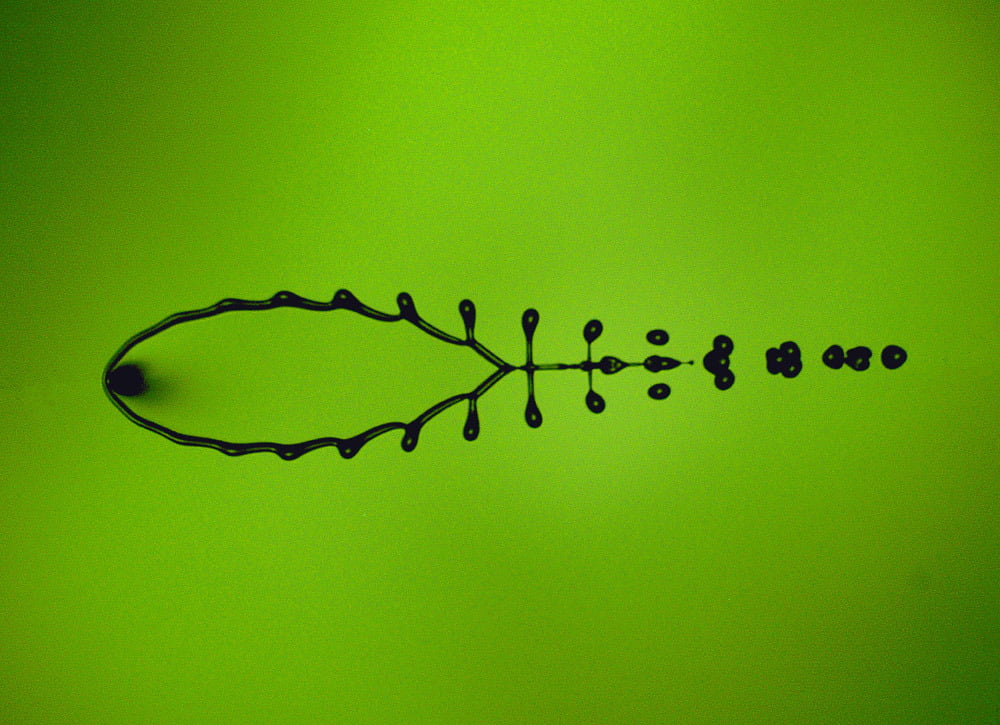
Two jets colliding can form a chain-like fluid structure. With increasing flow rate, the rim of the chains becomes wavy and unstable, forming a fishbone structure where droplets extend outward from the fluid sheet via tiny ligaments. Eventually, the droplets break off in a pattern as beautiful as it is consistent. (Photo credits: A. Hasha and J. Bush)
Fragmenting Raindrops
This numerical simulation demonstrates the fragmentation of droplets of water falling through a quiescent medium–essentially how a raindrop behaves. As the initial droplet falls, drag forces deform the droplet, contorting it until surface tension causes it to break into smaller droplets, which can themselves be broken up by the same mechanisms.

Water Spray from a Tire
The spray thrown up by a rolling tire is simulated in the lab by running a single-grooved tire (top) against a smooth tire (bottom) that simulates the road. A supply of water flows from the left at the speed of the rolling tires (6 m/s). The resultant sheet of water is a familiar site to motorists everywhere. Holes in the the sheet of water collide to form the smallest droplets, whose diameters are comparable to the thickness of the sheet, of the order of 100 microns. Thicker parts of the sheet form ligaments and break down into large droplets through the Plateau-Rayleigh instability. (Photo credit: Dennis Plocher, Fred Browand and Charles Radovich) #

Fishbone Jet Collision
The collision of two jets of radius 420 μm results in a fishbone-like structure. The fluid contains a dilute polymer mixture whose viscoelastic effects resist the tendency of the droplets to detach from the ligaments. The breakup of the jets into droplets is important for applications in inkjet printing. The photo has been rotated 90-degrees for effect. (Photo credit: Sungjune Jung)

Jet Breakup
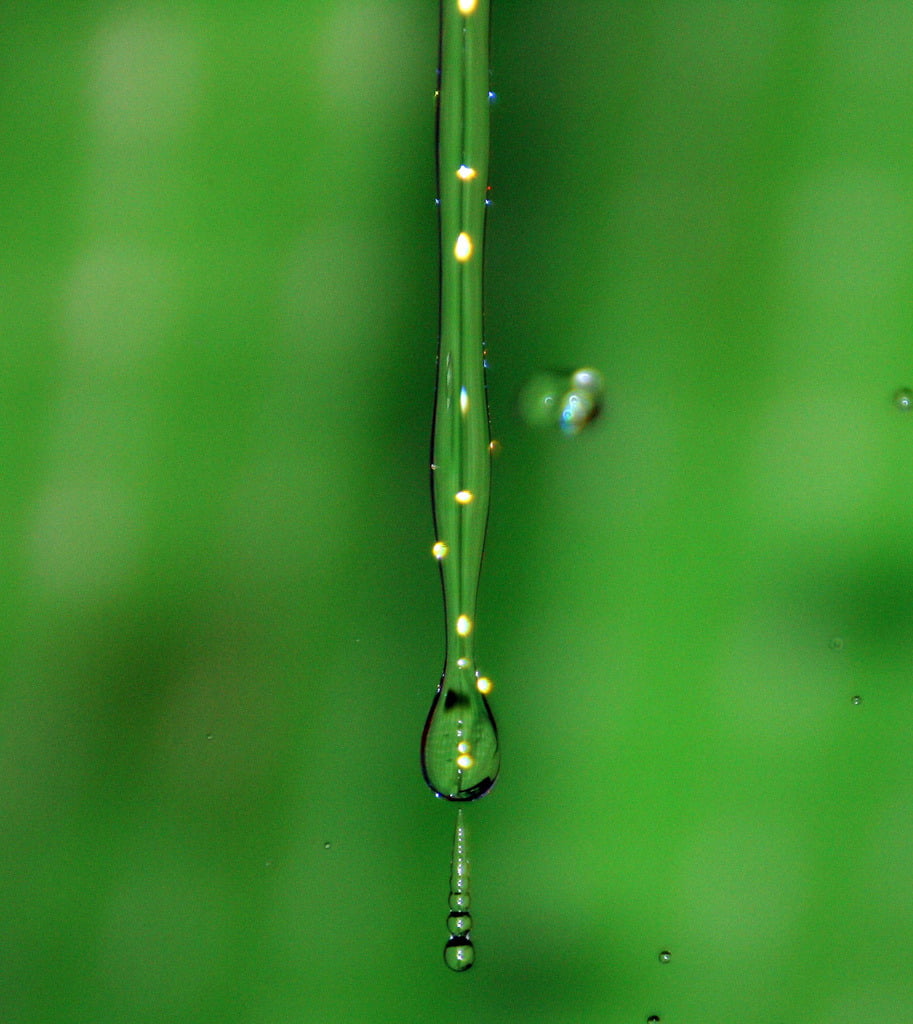
As a laminar column of water falls, slight perturbations cause waviness in the stream. Whenever the radius of the stream decreases, the pressure due to surface tension increases, causing fluid to flow away from the area of smaller radius. This outflow decreases the radius further and drives the stream to break into droplets. The mechanism is called the Plateau-Rayleigh instability. (Photo credit: Mahmoudreza Shirinsokhan)
Liquids Lens Breakup
A decane liquid lens floating on water (think drops of fat in chicken soup) displays different breakup and pinch-off than seen in three-dimensional droplet breakup. The pinch-off process in two dimensions relies on line tension rather than surface tension, and the quasi-2D liquid lens system is somewhere between these. The video above is a magnification of the filament connecting one liquid lens as it is broken into two smaller liquid lenses (the dark areas on the left and right of the screen). # (via scienceisbeauty)