Tag: DIY fluids

  • Featured Video Play Icon

    Fun From the Beach

    Here’s a neat bit of fluid dynamics derived from a day at the beach! Our experiment begins with well-mixed (and likely compacted) sand grains and sea water in a bottle. When flipped, the sand layer sits at the top of the bottle with the water layer beneath.

    Very quickly new layers establish themselves in the bottle. The lower half of the bottle turns into a turbulent churn of water and sand, topped by a thin air bubble, then the thick sand layer, and finally, a layer of filtered water. That air bubble beneath the sand means that the sand layer is compacted enough that surface tension keeps the air from being able to squeeze through the grains. On the other hand, water is able to filter through, eventually making it into that upper region. The compact layer of sand is supported in the bottle by force chains running through the largest grains, which is why only fine sediment settles down through the turbulent layer at this point.

    Eventually, the top sand layer erodes enough that it can no longer support its weight, and the sand collapses. As the grains settle out, we end up with fine sediment on the bottom (as previously discussed), followed by a layer of coarse sand from the erosion and collapse of the sand layer, topped with a layer of very fine grains that — due to their light weight — are the very last to settle out of the water. I love that such a simple seaside experiment contains such scientific depth! (Video and submission credit: M. Schich; special thanks to Nathalie V. for helpful input)

  • Featured Video Play Icon

    Building a Water-Based Computer

    Having previously tackled the “greedy” self-starting siphon, Steve Mould set out to build a water-based computer capable of adding simple numbers. To do this, he had to build logic gates capable of distinguishing concepts like AND and exclusive OR (XOR); the self-starting siphon was critical for this, diverting water down one output or another depending on the TRUE or FALSE result. With a series of water logic gates, he built a simple computer capable of adding numbers in binary. Check out the video to see it all in action! (Video and image credit: S. Mould)

  • Featured Video Play Icon

    Taylor Columns

    When rotating, fluids often act very differently than we expect. For example, an obstacle in a rotating flow will deflect flow around it at all heights. This is known as a Taylor column.

    In this video, we see the phenomenon recreated in a simple rotating tank (that’s easy to build yourself). Once all the water in the tank is rotating at the same rate, there is very little variation in flow with height. Food coloring dropped into the tank forms tight vertical columns. Even with a short obstacle in place and induced flow in the tank from a change in rotation rate, the dye continues to move uniformly in height. Because the dye cannot travel through the obstacle, it goes around and does so at every height, leaving the space above the obstacle dye-free.

    The same phenomenon occurs in planetary atmospheres; this rotating tank is basically a mini-version of our own atmosphere. Where there are obstacles — like mountains — on our planet, air has an easier time flowing around the mountain instead of over it! (Image and video credit: DIYnamics)

  • Snowflake Velocimetry

    Snowflake Velocimetry

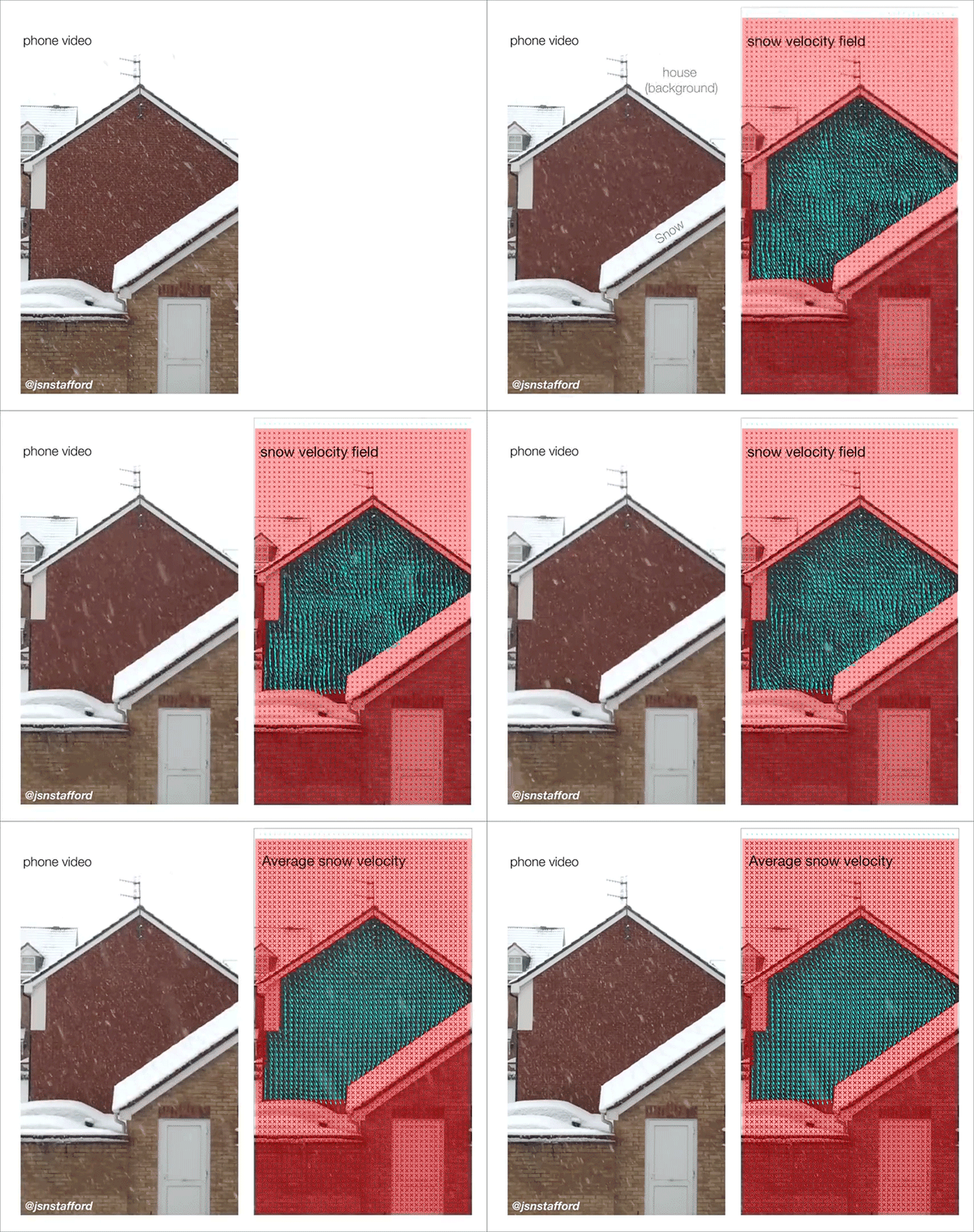
    In our era of remote learning, students don’t always have a chance to do hands-on lab experiments in the usual fashion. But that doesn’t mean they can’t explore important flow diagnostic techniques. Here a simple smartphone video of snow falling gets turned into a lesson on particle image velocimetry, or PIV, a major technique for measuring flow velocities.

    A nearby house acts as a fixed backdrop, and by comparing snowflake positions from one frame to the next, students can measure the instantaneous flow patterns in the snowfall. Of course, that’s a tedious task to do by hand, but luckily there are computer programs that do it automatically. Simply run the smartphone video through the software, and analyze the patterns it reveals!

    As a bonus, students don’t have to get distracted by the complexities of laser sheets and flow seeding that are normally a part of PIV. Instead, the flow and the lighting are already right outside their window, and they can concentrate instead on learning the principles of the technique and how to use the software. (Image and submission credit: J. Stafford)

  • Featured Video Play Icon

    Self-Started Siphoning

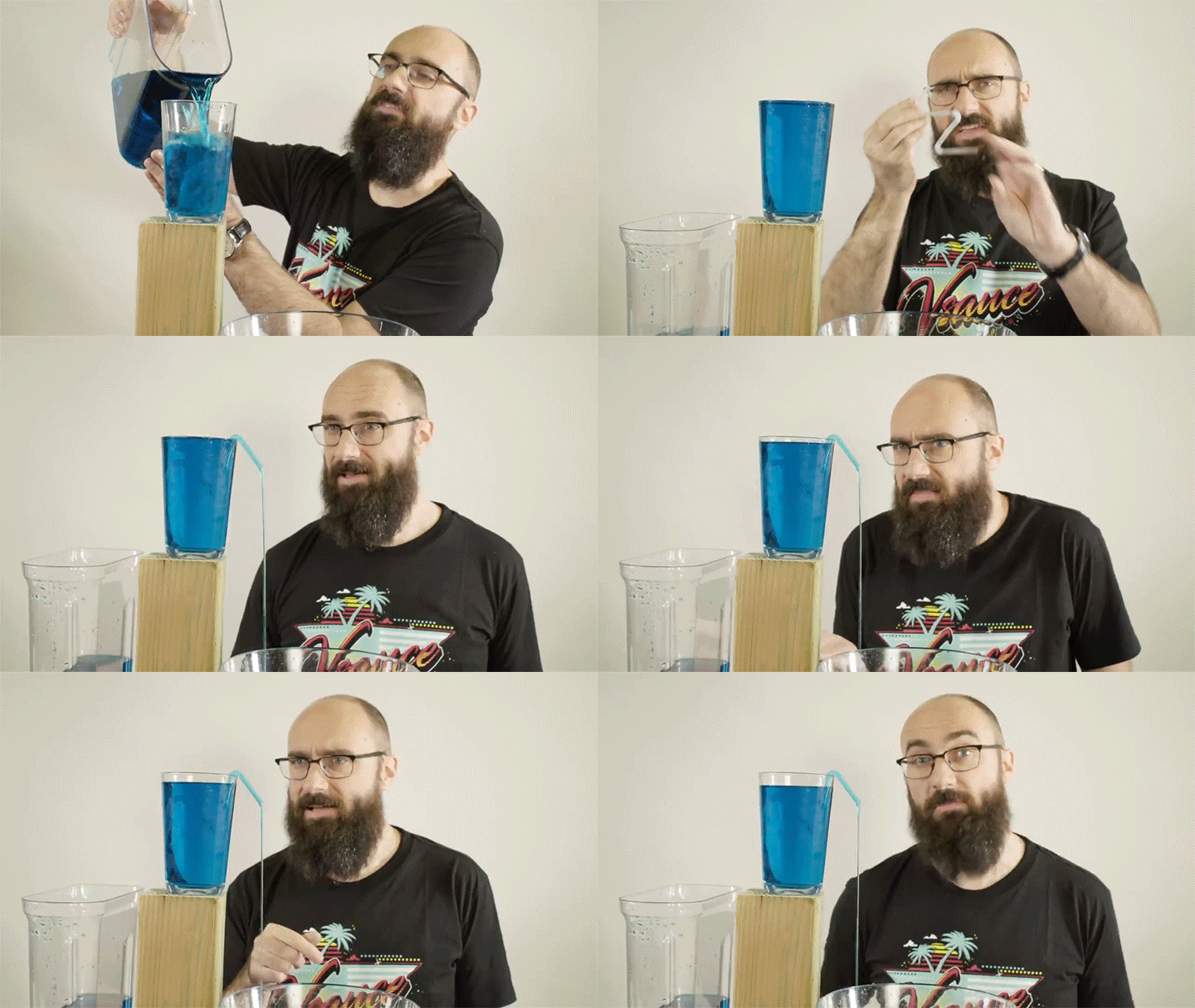
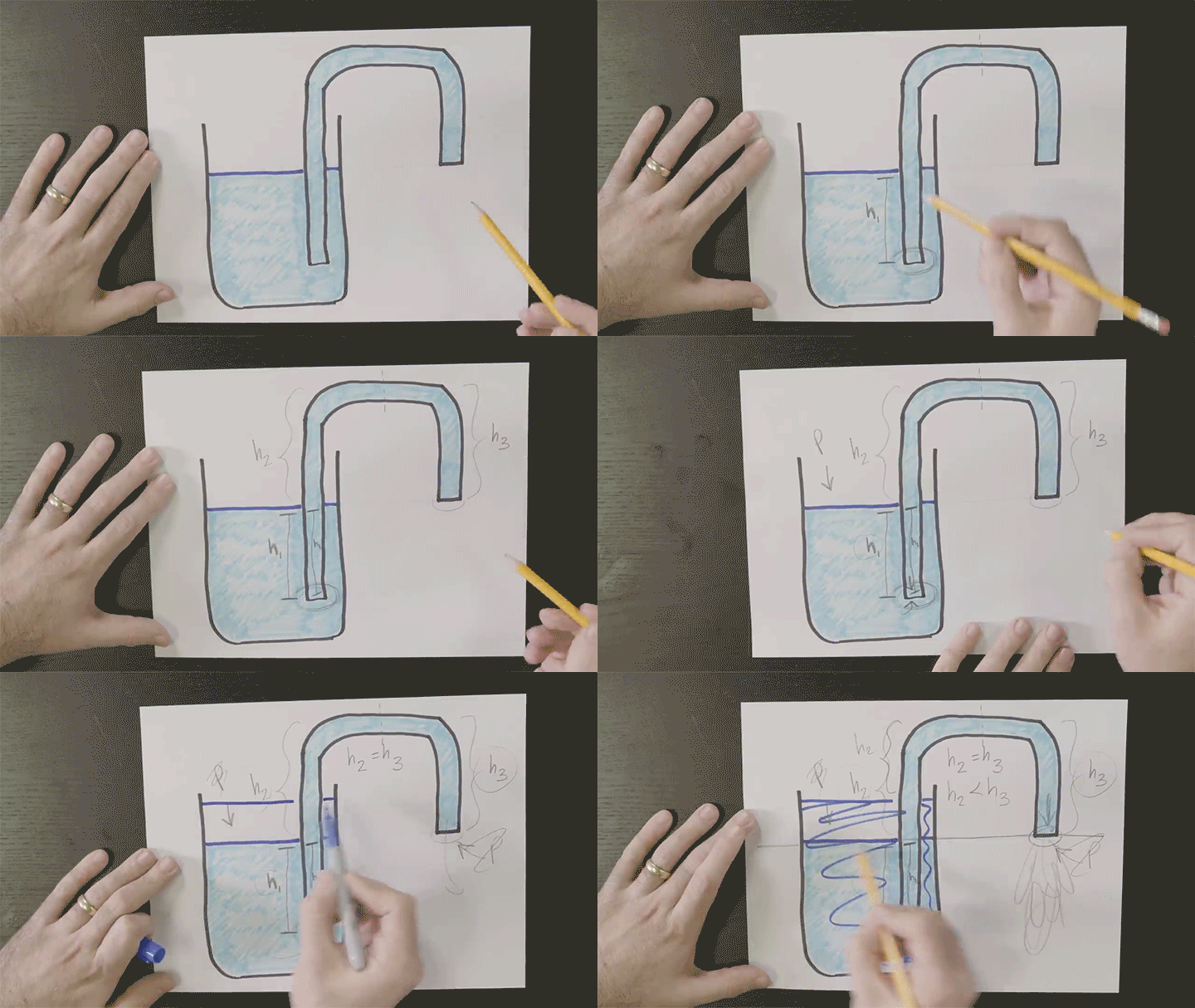
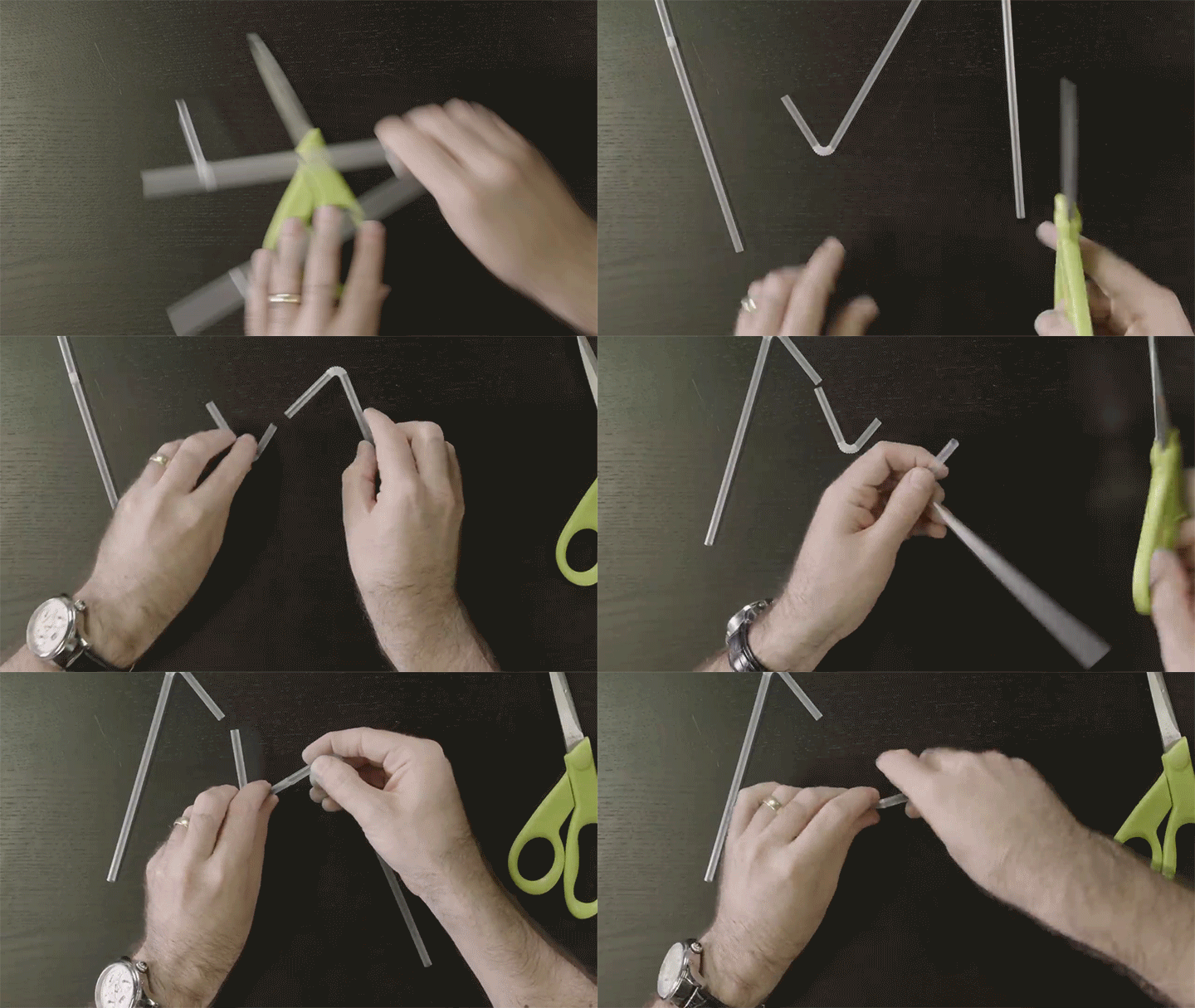
    Here’s a fun activity you can do while you #StayHome: build a self-starting siphon. Michael from VSauce explains how in this video. Moving fluids from one location to another is almost always about pressure, and a siphon is no different. To get the water to flow, there must be unequal pressures driving the liquid to move from high pressure to lower pressure. This is the basic physics behind any siphon; the fun of a self-starting siphon comes from generating enough pressure imbalance to start flow without applying suction. (Video credit: D!NG/M. Stevens)

  • Featured Video Play Icon

    The Magic* Cork

    *Spoiler alert: it’s not magic. It’s science!

    Just what makes this dropped cork float beneath the surface? Just like a normal cork, it’s buoyancy! But this seemingly straightforward video is hiding a few key elements. Firstly, the cork has been modified; it has a metal sphere inside it so that its effective density is higher than that of water.

    Secondly, that liquid is not pure water; notice the hazy swirls near the bottom of the flask when the cork drops in? This is tap water that’s had a layer of salt dissolving in the bottom of it for the last day. That creates a density gradient with denser, salty water at the bottom and lighter, fresh water at the top. In fluid dynamics, we’d say the fluid is stably stratified; “stratified” meaning that there are distinct layers (strata) of different density and “stably” because the heavier ones are at the bottom.

    When the cork is dropped in, it settles at the fluid layer that matches its density. Because the surrounding fluid is stably stratified, poking the cork makes it bounce slightly but return to its initial height. Our atmosphere behaves just like this when it’s stably stratified. If you displace a parcel of air, it will oscillate up and down before settling back to equilibrium. In fact, the cork and the air even bounce at the same frequency! (Video and submission credit: F. Croccolo)

  • Featured Video Play Icon

    Hot Ice, Buoyancy Tricks, and More DIY Fun

    Here’s a smorgasbord of DIY experiments from Dianna at Physics Girl. Some are fluidsy, some aren’t, but all of them give you a chance to stretch your science muscles at home. Personally, I think she saved the best for last with her laser-acoustics demo! (Video credit: Physics Girl)

  • Perfecting Giant Bubbles

    Perfecting Giant Bubbles

    Whether young or old, everyone enjoys blowing soap bubbles, and the bigger the bubble, the more impressive it is. Researchers have been on a quest to discover how bubbles can survive with volumes measured in the tens of meters and thicknesses of mere microns.

    The key to these behemoth bubbles are the polymer chains inside them. The long molecules of polymers get entangled with one another and resist further stretching, which strengthens the soap film. The researchers found that a mixture of polymer lengths are even better for long-lasting bubbles because they entangle more fully than polymers that are all the same size.

    But if what you really want are practical results, I have good news for you: the researchers have released their recommended recipe for making the best giant soap bubbles. It’s included in the video below, but I’ve also reproduced it in text for easier recreation (with thanks to Ars Technica):

    Giant Soap Bubble Solution
    From the Burton Lab, via Ars Technica

    Ingredients
    1 liter of water (about 2 pints)
    50 milliliters of Dawn Professional Detergent (a little over 3 TBSP)
    2-3 grams of guar powder, a food thickener (about 1/2 heaping TSP)
    50 milliliters of rubbing alcohol (a little more than 3 TBSP)
    2 grams of baking powder (about 1/2 TSP)

    Directions
    Mix the guar powder with the alcohol and stir until there are no clumps.

    Combine the alcohol/guar slurry with the water and mix gently for 10 minutes. Let it sit for a bit so the guar hydrates. Then mix again. The water should thicken slightly, like thin soup or unset gelatin.

    Add the baking powder and stir.

    Add the Dawn Professional Detergent and stir gently to avoid causing the mixture to foam.

    Dip a giant bubble wand with a fibrous string into the mixture until it isf fully immersed and slowly pull the string out. Wave the wand slowly or blow on it to create giant soap bubbles.

    Happy bubble making! (Image credit: Burton Lab; video credit: Emory University; research credit: S. Frazier et al.; via Ars Technica; submitted by Kam-Yung Soh)

  • Featured Video Play Icon

    Making a Square Vortex

    As someone who has played with her share of vortex cannons, I can assure you that messing around with smoke generators and vortex rings is a lot of fun. And in this video, Dianna gives things a little twist: she makes the vortex cannon’s mouth a square instead of a circle.

    Now, that doesn’t create a square vortex ring. (Vortex rings don’t really do 90-degree corners.) But it does make the vortex ring all neat and wobbly. Whenever you have two vortices near one another (or, in this case, two parts of a vortex line near one another), they interact. As Dianna shows with hurricanes, depending on the direction of rotation and their relative strength, nearby vortices can orbit one another or travel together in straight lines – or they can cause more complicated interactions, like in the case of the square-launched rings.

    I think there may also be some interesting effects here from vortex stretching, but that’s a topic for another day! (Video and image credit: D. Cowern/Physics Girl; see also: LIBLAB; submitted by Maria-Isabel C.)

  • Water Bottle Flipping Physics

    Water Bottle Flipping Physics

    In 2016, a senior talent show launched a new viral craze: water bottle flipping. As improbable as it seems at first glance, physics is actually on your side when it comes to pulling this trick off. As explained in this classroom-oriented paper and the video abstract below, the sloshing of the water in the bottle as it flips slows its rate of rotation, which creates the stable landing. You don’t even need water to make the trick possible. Using two tennis balls will also give a stable flip – provided they have room to spread out. When they fly apart, they change the bottle’s moment of inertia and that slows down the rotation rate. All in all, it’s a great lesson in conservation of angular momentum.

    And, in case you’re wondering whether the water helps with sticking that landing, we’ve got you covered there, too. (Image credit: A. Johnson, source; video and research credit: P. Dekker et al.)