Tag: aurora

  • Auroras

    Auroras

    Beautiful auroras are the result of ions in the solar wind exciting atoms in our atmosphere. This example of magnetohydrodynamics is typically only visible in the far northern and southern reaches of the globe. But in recent years, citizen scientists noticed a new aurora outside the polar regions. It looked like a narrow purple streak with occasional fingers of green. It got nicknamed Steve. Recent satellite measurements show that the aurora seems to be a visible emission from a known phenomenon, subauroral ion drift, which features a rapid flow of charged ions. In Steve’s case, this flow moves nearly 6 km/s and is around 6000 degrees Celsius. Scientists have dubbed the aurora S.T.E.V.E., Strong Thermal Emission Velocity Enhancement, to honor the original nickname. Learn more from NASA and Science magazine. (Image credit: K. Trinder; NASA GSFC/CIL/K. Kim, source)

  • Arriving at Jupiter

    Arriving at Jupiter

    Today all eyes turn to Jupiter where NASA’s Juno spacecraft will enter orbit around the gas giant. In preparation, Hubble and ground-based telescopes have been observing Jupiter in both the visible (upper right) and infrared (upper left) spectrum. The lower image shows a 1:5 scale model of Juno and a full-size replica of one of its solar panels; note the mannequin in the lower right corner for scale. 

    Juno is entering one of the harshest environments in the solar system with intense magnetic fields that trap lethal amounts of radiation around the planet. The lovely blue auroras Hubble sees around Jupiter’s poles are a never-ending hailstorm of solar wind particles hitting Jupiter’s atmosphere. Juno will be studying the structure of Jupiter’s magnetosphere, gravitational field, and its interior, hopefully helping scientists explain how the planet formed and the role it played in the formation of our solar system. (Image credits: infrared Jupiter – ESO/L. Fletcher; Jovian auroras – Hubble/ESA; Juno model and solar panel – N. Sharp)

  • Featured Video Play Icon

    Fluids Round-Up

    Time for another fluids round-up! Here are some of the best fluids-related links I’ve seen around:

    – Above The Brain Scoop tells us about beetles that spend their whole lives underwater. They carry a little bubble of air with them in order to breathe!

    – Microfluidics are helping reveal how cancer cells metastasize and spread through the bloodstream.

    – It’s official! NASA’s going to build X-planes again.

    – See how snake venom kills by changing the fluid properties of a victim’s blood. (via Gizmodo)

    Metallic foams can stop bullets and radiation, spawning many potential future uses here on Earth or in space.

    Why nature prefers hexagons, especially in honeycomb, bubbles, and foam.

    – Earth has beautiful auroras, but if you could look at Jupiter with x-ray vision, you’d see something even more spectacular – a non-stop aurora that brightens on a regular schedule.

    SciShow asks where the water goes in Minnesota’s Devil’s Kettle Falls. Conservation of mass says it has to go somewhere!

    And, in case you missed it, you can check out the latest FYFD video and learn more about the Brazil Nut effect over at Gizmodo.

    (Video credit: The Brain Scoop)

  • Featured Video Play Icon

    Auroras From Space

    NASA has released a jaw-dropping new compilation of Earth’s auroras viewed from the International Space Station. It’s available in up to 4K resolution, and I heartily recommend watching it fullscreen at the highest resolution you can comfortably manage. (To paraphrase: this is ultra high definition – it’s better resolution than real life!) I don’t think I’ve ever seen aurora footage that so clearly showed the fluid behavior of auroras when viewed from space. This flow-like quality is to be expected since the auroras occur due to ionized particles from the solar wind exciting atoms in our upper atmosphere in a magnetohydrodynamic dance that never gets too old to watch. (Video credit: NASA; via Gizmodo)

    Boston area FYFDers: I’m giving a talk at Harvard tomorrow afternoon on science communication – Wed. April 20th, 4pm, Maxwell Dworkin, G115.

  • Saturnian Auroras

    Saturnian Auroras

    Earth is not the only planet in our solar system with auroras. As the solar wind–a stream of rarefied plasma from our sun–blows through the solar system, it interacts with the magnetic fields of other planets as well as our own. Saturn’s magnetic field second only to Jupiter’s in strength. This strong magnetosphere deflects many of the solar wind’s energetic particles, but, as on Earth, some of the particles get drawn in along Saturn’s magnetic field lines. These lines converge at the poles, where the high-energy particles interact with the gases in the upper reaches of Saturn’s atmosphere. As a result, Saturn, like Earth, has impressive and colorful light displays around its poles. (Image credit: ESA/Hubble, M. Kornmesser & L. Calçada, source video; via spaceplasma)

  • Aurora From Space

    Aurora From Space

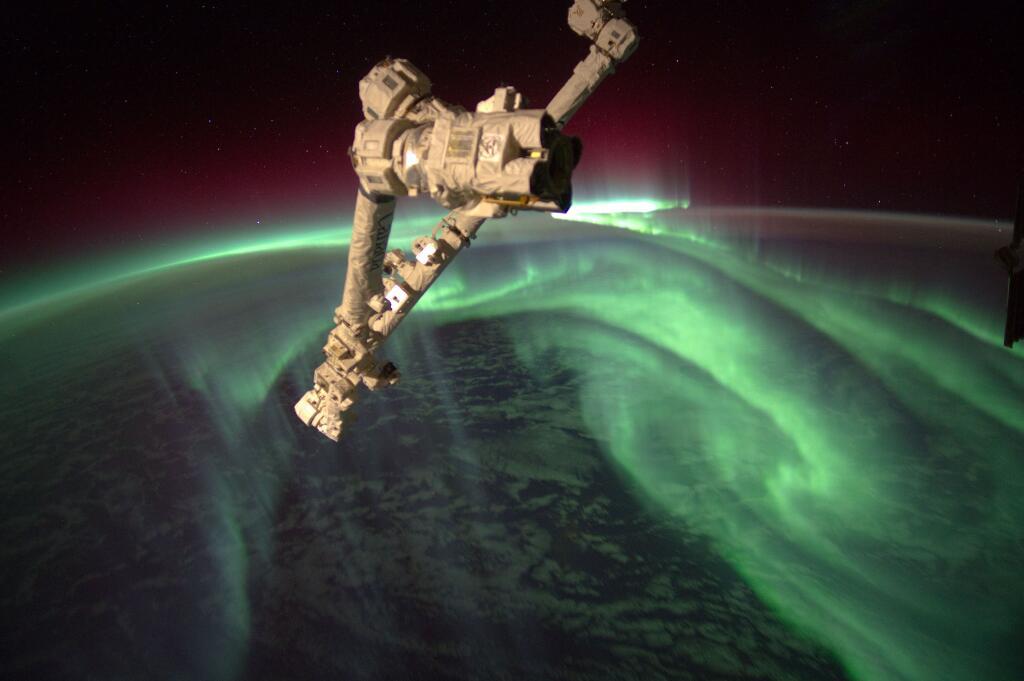
    An aurora, as seen from the International Space Station, glows in green and red waves over the polar regions of Earth. These lights are the result of interactions between the solar wind–a stream of hot, rarefied plasma from the sun–and our planet’s magnetic field. A bow shock forms where they meet, about 12,000-15,000 km from Earth. The planet’s magnetic field deflects much of the solar wind, but some plasma gets drawn in along field lines near the poles. When these energetic particles interact with nitrogen and oxygen atoms in the upper atmosphere, it can excite the atoms and generate photon emissions, creating the distinctive glow. Similar auroras have been observed on several other planets and moons in our solar system. (Photo credit: NASA)

  • Featured Video Play Icon

    Aurora from the ISS

    The solar wind, a rarefied stream of hot plasma ejected from the sun, constantly bombards Earth’s magnetic field. This results in the formation of the magnetosphere, which deflects most of these charged particles away from the earth. Some of them, however, are drawn toward the magnetic poles; when these charged particles strike the upper atmosphere, they cause the gases there to release photons, resulting in the lights we know as auroras. This animation shows the International Space Station flying through the aurora australis–the southern lights. The fluid-like motion of the aurora is no accident; though diffuse, the solar wind is still a fluid governed by magnetohydrodynamics.