Tag: asteroid impact

  • The Chicxulub Impact’s Tsunami

    The Chicxulub Impact’s Tsunami

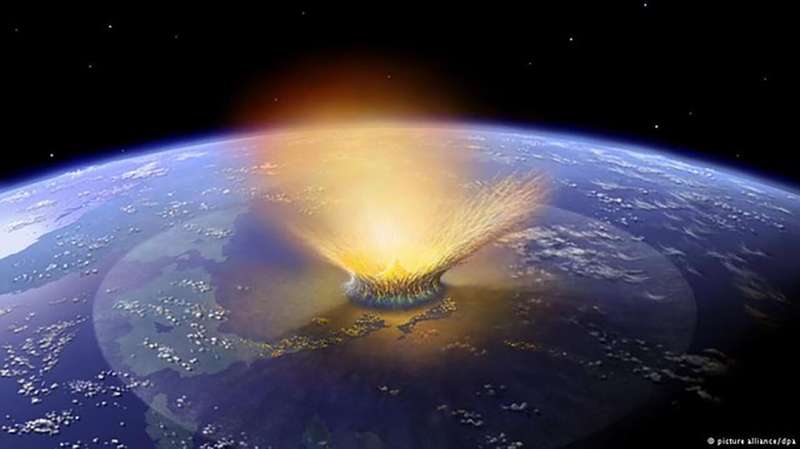
    66 million years ago an asteroid struck offshore of what is now Chicxulub near the Yucatán Peninsula in Mexico. The impact and its aftermath are widely credited with a mass extinction that wiped out 75% of plant and animal life on Earth, including non-avian dinosaurs. Since the impact occurred in shallow waters, it also generated a tsunami, one over 30,000 times bigger than any in recorded history.

    Snapshot showing the spreading tsunami after the asteroid's impact.
    Snapshot showing the spreading tsunami after the asteroid’s impact. Click on the image to go to NOAA’s website and watch the video.

    In this simulation, researchers show how that tsunami spread globally. The initial wave was about a mile high but stretched up to about 2.5 miles as it rushed ashore. Worldwide, every shoreline saw flows at 20 cm/s or higher as the wave hit. In the image above, black areas show the landmasses as they existed at the time, with modern borders shown in white outline. To watch the video, click on the image or head to NOAA’s visualization.

    You may wonder how scientists can validate a simulation like this one, which so wildly exceeds any recorded event. One way they judged these results is by looking at the sedimentary records of the seafloor. Their results show flows large enough to scour the seafloor and disrupt any sedimentary records in those areas, and, sure enough, those regions hold no records older than the asteroid’s impact. That alignment between the geological record and the simulation’s highest flow areas helps establish confidence in the results. (Image credit: illustration – SWRI/D. Davis, simulation – NOAA; research credit: M. Range et al.; submitted by Kam-Yung Soh)
  • Megaripples Beneath Louisiana

    Megaripples Beneath Louisiana

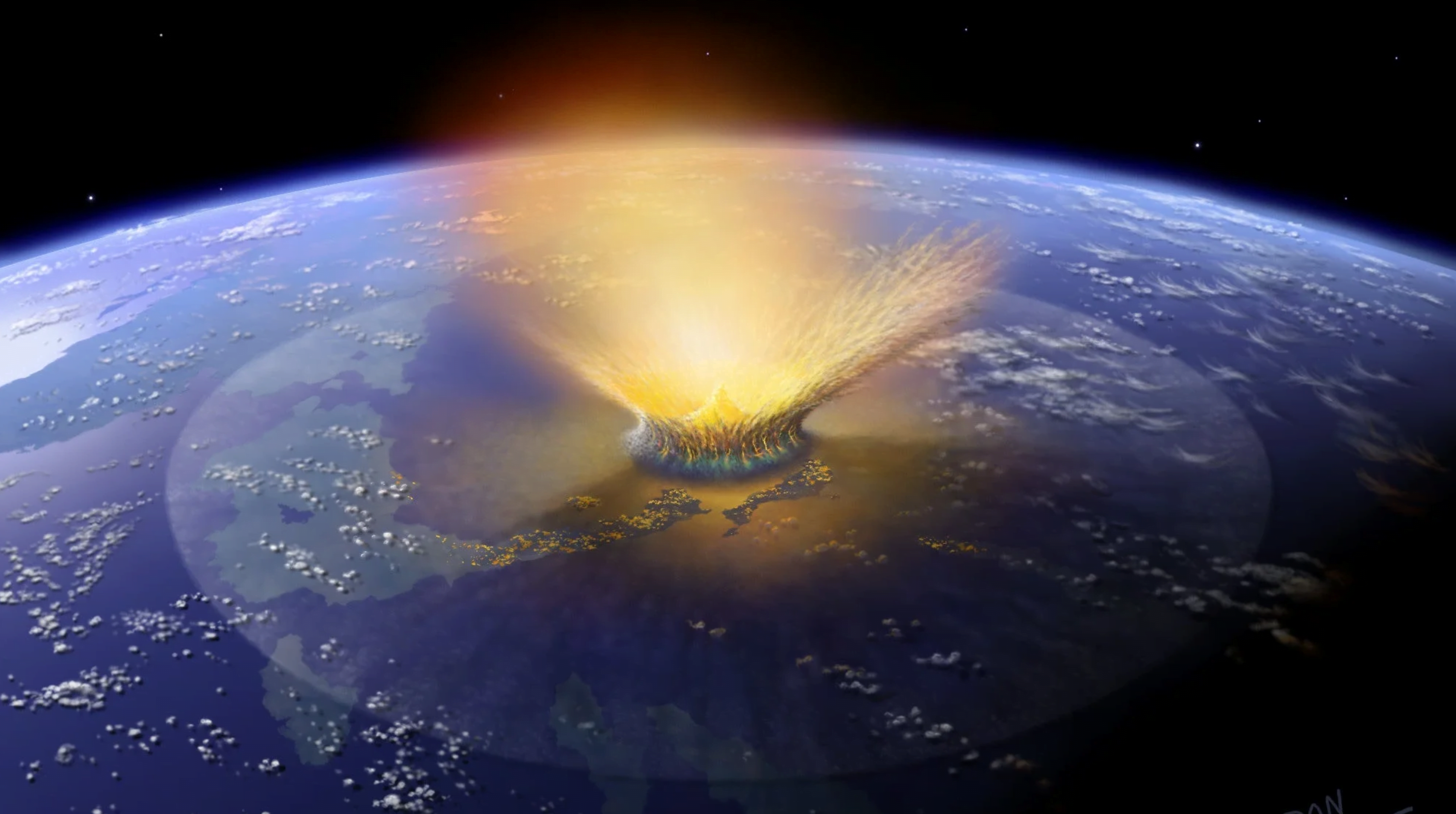
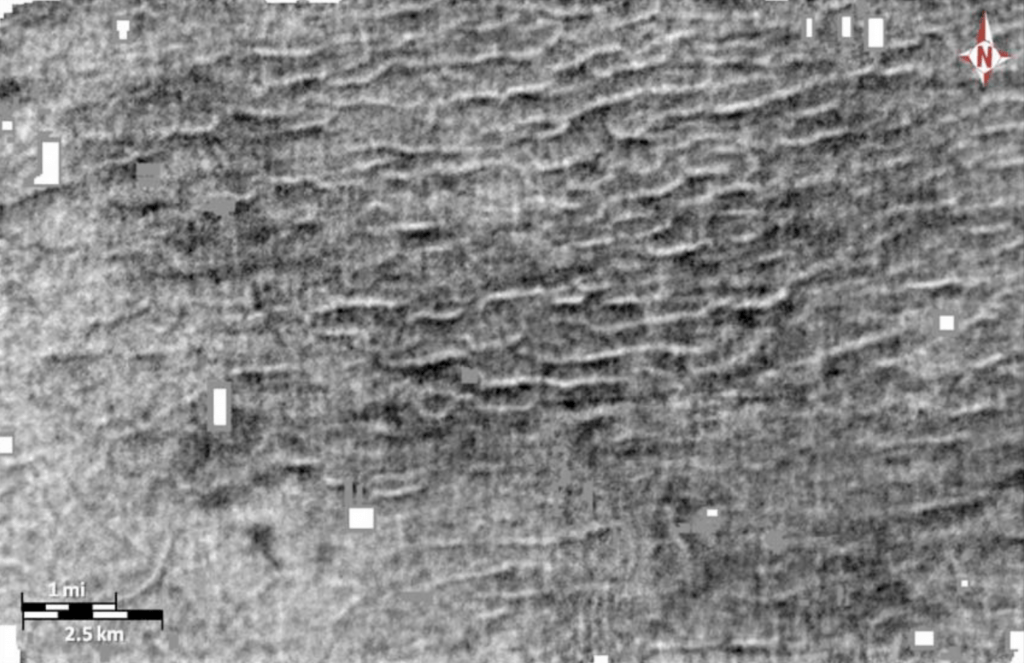
    Approximately 66 million years ago, a 10-km asteroid struck our planet near Chicxulub on the Yucatán Peninsula. The impact was globally catastrophic, causing tsunamis, wildfires, earthquakes, and so much atmosphere-clogging sediment that about 75% of all species on the planet — including the non-avian dinosaurs — died out. A new study points to another remnant of the impact: giant ripples buried in the sediment of Louisiana.

    Seismic data shows giant ripples left behind by the tsunami following the Chicxulub impact.

    Using seismic data collected by petroleum companies, the researchers describe the ripples as approximately 16 meters tall with a spacing around 600 meters, making them the largest known ripples on the planet. Currently, they are buried about 1500 meters underground, just below a layer of fine debris associated with the impact. The ripples show no evidence of erosion from storms or wind, leading the authors to conclude that they were deposited by an impact-associated tsunami and remained unaffected by smaller natural disasters before their burial. It’s very likely, according to the authors, that many other such megaripples exist, hidden away in proprietary petroleum data sets. (Image credits: top – D. Davis/SWRI, ripples – G. Kinsland et al.; research credit: G. Kinsland et al.; via Gizmodo)

  • Scaling High-Speed Impacts

    Scaling High-Speed Impacts

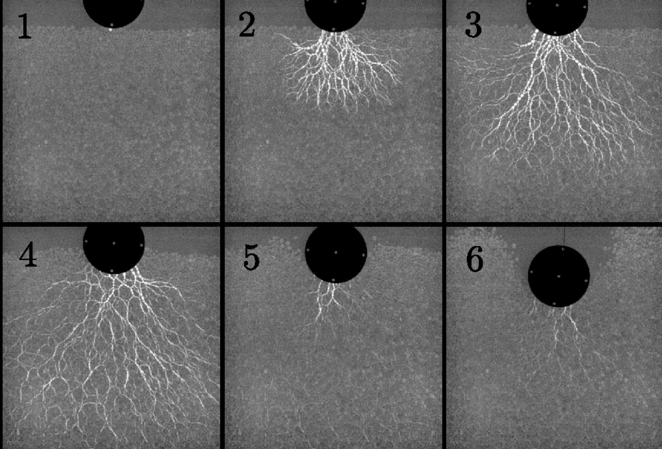
    The impact of a solid object into a bed of grains is a major topic in many fields from ballistics to astronomy. Researchers study these impacts experimentally using photoelastic disks, which display visible stress patterns when placed between polarizers. The lightning-like patterns you see above reveal how forces propagate inside the grains as the object hits.

    Researchers focused on the peak forces generated during high-speed impacts, an area that hasn’t been well-captured by existing impact models. They found that this peak force obeys its own scaling laws that depend on factors like impact speed, impacter size, grain stiffness, and grain density. (Image and research credit: N. Krizou and A. Clark)

  • Earth, Moon, and Magma Ocean

    Earth, Moon, and Magma Ocean

    Among objects in our solar system, the Moon is rather unusual. It’s the only large moon paired with a rocky planet, and only Pluto’s Charon boasts a larger size relative to its planet. Chemically speaking, the Moon is also extremely similar to the Earth, which is part of why scientists theorized that the moon coalesced after the proto-Earth collided with a Mars-sized object. But lingering questions remained, like why the Moon is rich in iron oxide compared to the Earth.

    A new study tweaks the idea of the giant impactor by adding a magma ocean to the proto-Earth. In the early days of the solar system, collisions were so common that larger bodies (> 2*Mars) probably maintained a molten ocean. By simulating collisions with and without a magma ocean and studying the final composition of these simulated Earth-Moon-systems, the researchers found that a molten ocean not only matches the expected size and orbital characteristics of the two bodies, but the results reflect the actual chemical make-up of the  real Earth and Moon, too! (Image credits: moon – N. Thomas, impact simulation – N. Hosono et al.; research credit: N. Hosono et al.; via Ars Technica; submitted by Kam-Yung Soh)

  • Rays in Craters

    Rays in Craters

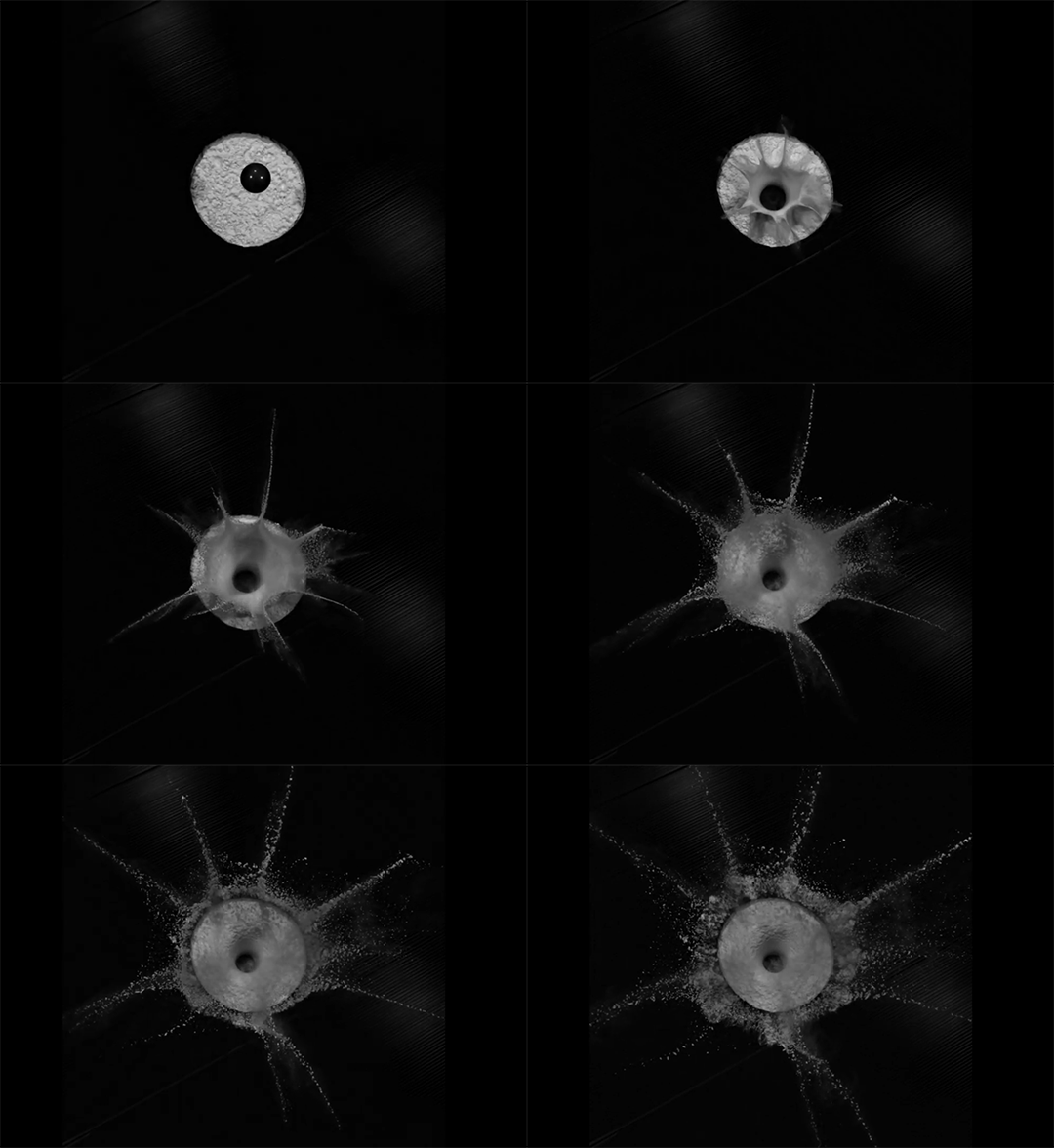
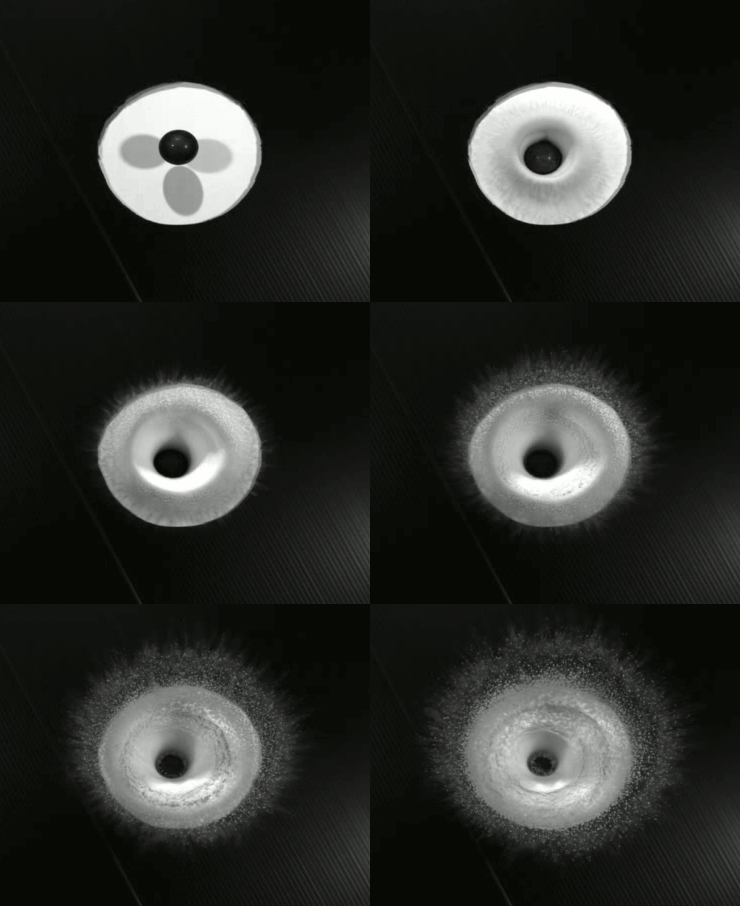
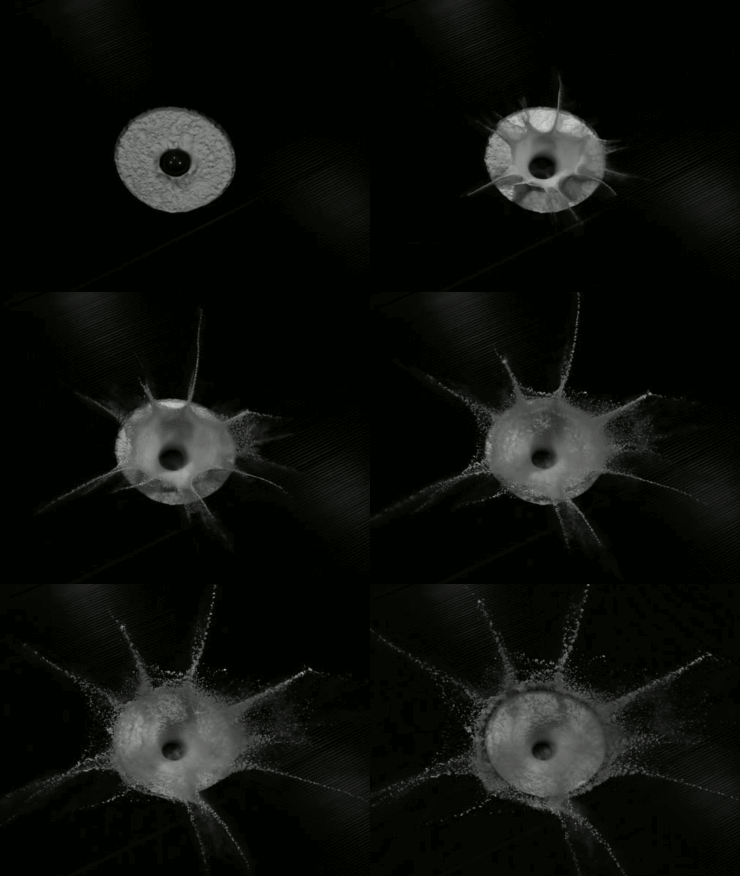
    On bodies around the solar system, there are craters marking billions of years’ worth of impacts. Many of these craters have rays–distinctive lines radiating out from the point of impact. But if you drop an object onto a smooth granular surface (upper left), the ejecta form a uniform splash with no rays. The impactor must hit a roughened surface (upper right) in order to leave rays. 

    Through experiment and simulation, researchers found that the rays emanate from valleys in the surface that come in contact with the impactor. Moreover, the number of rays that form depends only on the size of the impactor and the undulations of the surface. That means that, by knowing the topography of a planetary body and counting the number of rays left behind, scientists can now estimate what the size of the object that struck was! (Image, video, and research credit: T. Sabuwala et al.)

  • Prehistoric Seiche

    Prehistoric Seiche

    Sixty-six million years ago, a meteorite impact in modern-day Mexico wiped out the dinosaurs and most other living species of the time. To call the event catastrophic feels like an understatement. At the site of impact, rocks and animals were vaporized. Further away, molten rock condensed into glass beads that form a geological layer found around the world.

    Still further away, in what is now North Dakota and was then the bank of a freshwater river, scientists have discovered a deposit full of saltwater fish, sharks, and rays that would have lived in the vast inland sea (A) that stretched northward from Texas. The meteorite’s impact pushed these creatures kilometers upstream against the river’s natural flow.

    One possible explanation for the inundation is a tsunami. But geological evidence indicates the deposit took place within 15 minutes to two hours of the impact, when glass beads were still raining down. To travel the 3,000 km from the point of impact would take a tsunami on the order of 18 hours – far too long.

    Instead, the deposit is likely the result of a seiche (pronounced “saysh”) – a type of standing wave that occurs in an enclosed or partially enclosed body of water. If you imagine water sloshing in a cup or a tub, that’s essentially what a seiche is, but this was on a much larger scale. (For an example, check out this insane footage of an earthquake-induced seiche in a swimming pool.)

    What set the seiche to sloshing are the seismic waves triggered by the meteorite impact. They would have reached this site 6-13 minutes after the impact and triggered waves on the order of 10m. As the waves drove up the riverways, they carried dead and dying sea creatures with them, leaving them stranded on the riverbank until scientists uncovered them tens of millions of years later. (Image and research credit: R. DePalma et al.; via The Conversation; submitted by Kam-Yung Soh)

  • Craters and Rays

    Craters and Rays

    The history of our solar system is written in impact craters, but these craters have been remarkably mysterious for years. Scientists knew that you could recreate many of their features by dropping solid objects into granular materials like sand, but this did not produce the distinctive rays that we see around many real craters (bottom image, Mars). It was only by watching videos of schoolchildren recreating these experiments that scientists discovered what they’d been doing wrong: they’d smoothed the sand’s surface first. 

    It turns out that when you smooth the sand before impact (top left), you get an even ejecta curtain with no rays. But when the surface is uneven, as it is in kids’ experiments or on actual planetary bodies, suddenly rays form (top right). The object’s impact creates a shock wave in the granular medium, which becomes a rarefaction (i.e., expansion) wave when it reaches the surface. This is what actually ejects material. The uneven surface focuses those rarefaction waves, creating the distinctive ejecta rays. (Image credit: T. Sabawala et al., source; NASA; research credit: T. Sabawala et al.; via Jennifer O.)

  • Forming Craters

    Forming Craters

    Asteroid impacts are a major force in shaping planetary bodies over the course of their geological history. As such, they receive a great deal of attention and study, often in the form of simulations like the one above. This simulation shows an impact in the Orientale basin of the moon, and if it looks somewhat fluid-like, there’s good reason for that. Impacts like these carry enormous energy, about 97% of which is dissipated as heat. That means temperatures in impact zones can reach 2000 degrees Celsius. The rest of the energy goes into deforming the impacted material. In simulations, those materials – be they rock or exotic ices – are usually modeled as Bingham fluids, a type of non-Newtonian fluid that only deforms after a certain amount of force is applied. An everyday example of such a fluid is toothpaste, which won’t extrude from its tube until you squeeze it.

    The fluid dynamical similarities run more than skin-deep, though. For decades, researchers looked for ways to connect asteroid impacts with smaller scale ones, like solid impacts on granular materials or liquid-on-liquid impacts. Recently, though, a group found that liquid-on-granular impacts scale exactly the way that asteroid impacts do. Even the morphology of the craters mirror one another. The reason this works has to do with that energy dissipation mentioned above. As with asteroid impacts, most of the energy from a liquid drop impacting a granular material goes into something other than deforming the crater region. Instead of heat, the mechanism for dissipation here is the drop’s deformation. The results, however, are strikingly alike.  

    For more on how asteroid impacts affect the moon and other bodies, check out Emily Lakdawalla’s write-up, which also includes lots of amazing sketches by James Tuttle Keane, who illustrates the talks he hears at conferences! (Image credits: J. Keane and B. Johnson; via the Planetary Society; additional research and video credit: R. Zhao et al., source; submitted by jpshoer)