Tag: archaeology

  • The Puquios System of Nazca

    The Puquios System of Nazca

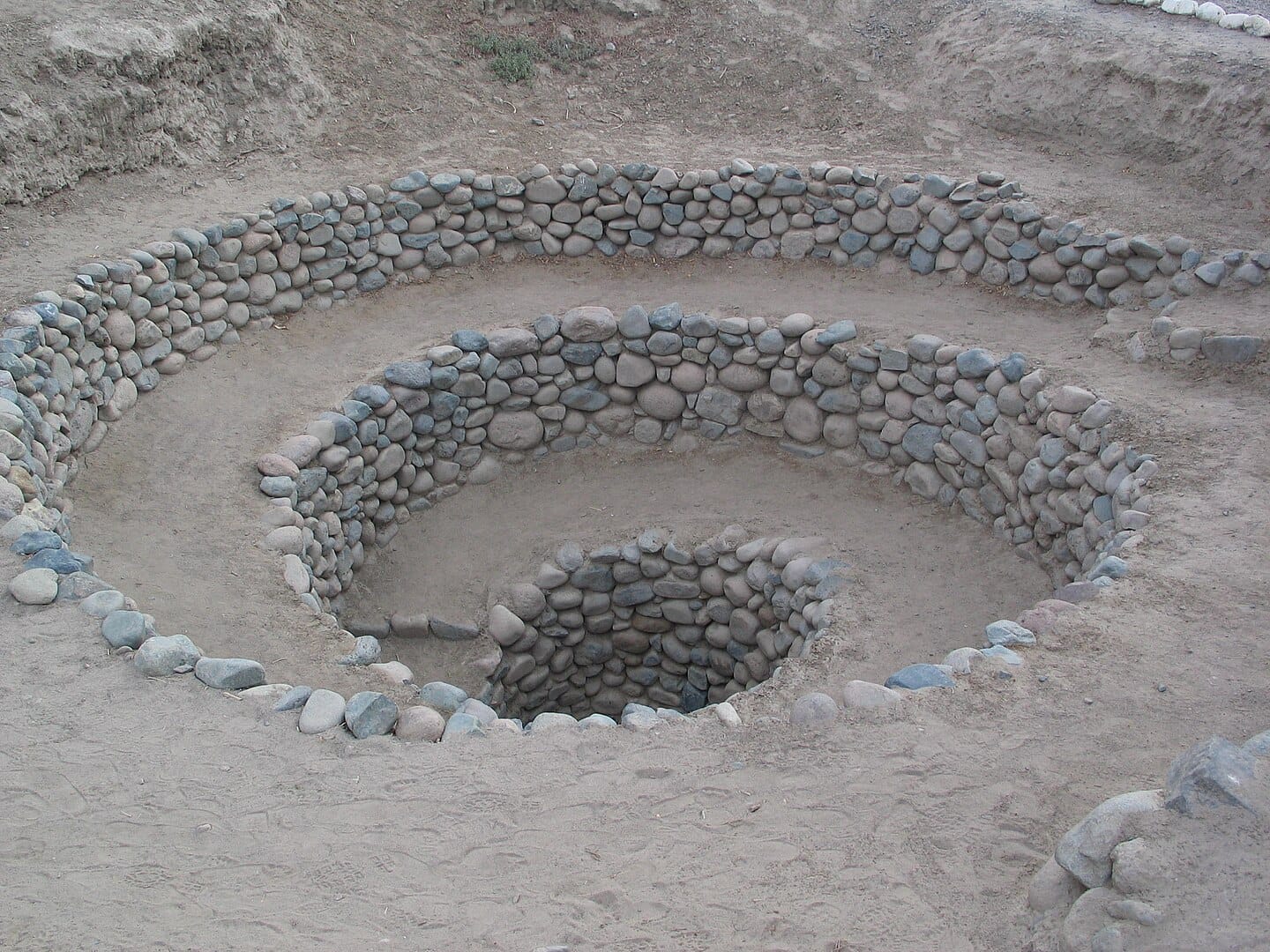
    The arid Nazca region of Peru is dotted with spiral-shaped indentations, part of an irrigation system that helped indigenous civilizations thrive here before European contact. Although the region’s rainfall varies year-to-year, it never amounts to much. So pre-Columbian Nazcans turned instead to underground aquifers to gather and transport water.
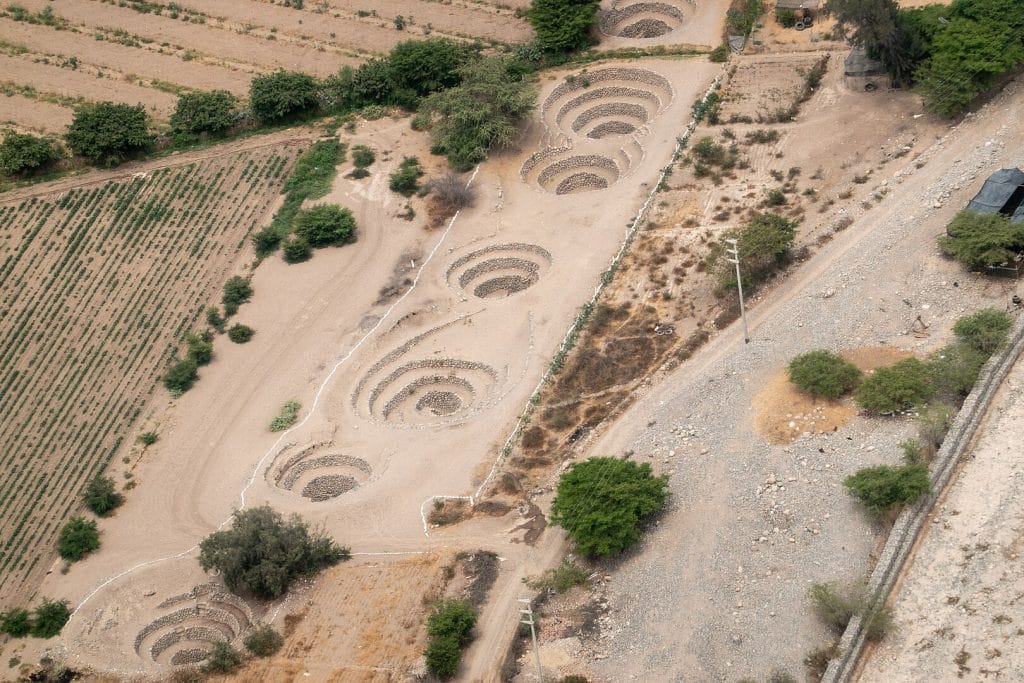
    Aerial view of multiple puquios chimneys, part of a pre-Columbian irrigation system.
    An aerial view of several puquois chimneys near Nazca, Peru.

    Aquifers in the region slope downward, following the local geology. Puquios builders began by digging a preliminary well in the highlands, tunneling down until they reached the aquifer. Then they built a horizontal tunnel underground, sloping gently downward, toward the location where water was needed. Along that roughly horizontal tunnel, they built additional chimneys, the spiraling mouths of which are seen above. These chimneys are thought to serve multiple purposes. They provide maintenance access to the aqueduct tunnel, and their shape may help funnel wind underground to oxygenate the water and help keep it flowing. Eventually, the underground tunnel would exit into an open trench and a reservoir, providing year-round water for irrigation and personal use.

    Illustration of a puquios system. Chimneys upstream provide access to an underground tunnel that delivers water from the aquifer to a reservoir.

    Although the puquios cannot themselves be dated through usual archaeological means, the current consensus is that they originate from around 500 C.E., with subsequent modifications by both indigenous and colonial inhabitants. Impressively, several dozen puquios are still providing water today. (Image credits: Ab5602/Wikimedia, PsamatheM/Wikimedia, and R. Lasaponara et al.; research credit: R. Lasaponara et al.; via Eleanor K.)

    Fediverse Reactions
  • Eroding the Sphinx

    Eroding the Sphinx

    One theory suggests that the Great Sphinx of Giza formed — in part — naturally as a result of erosion, and ancient Egyptians added features to the bedrock formation. To test the plausibility of the theory, researchers made a miniature sphinx, consisting of a clay mound with a single, harder inclusion to represent the Sphinx’s head, and placed their construction in a water tunnel. As the water eroded away the clay, the head appeared, and flow around this harder-to-erode region formed some of the body and paws of the reclining Sphinx.

    The experiment suggests that it is plausible for part of the Sphinx to have formed naturally, as a result of erosion. But plausibility is not proof, and given the lack of a contemporary inscription explaining the statue’s origin, the goals and methods of the people who built it around 2500 B.C.E. will remain a matter of archaeological debate. (Image credit: S. Boury et al.)

  • The Best of FYFD 2021

    The Best of FYFD 2021

    A year ago I observed what a strange year 2020 had been, and in many ways, I could say the same of 2021. Before the pandemic, I spent quite a lot of time traveling. In 2021, the only nights I slept outside my own bed came on a long weekend up to the mountains with my family. But 2021 also saw a bit of a return to normalcy – I was giving keynote addresses and workshops again, albeit virtually. What will 2022 hold? Who knows?!

    As per tradition, here are the top FYFD posts of 2021:

    1. A superior mirage leaves a ship floating in mid-air
    2. Drone videos of sheep herding are mesmerizing
    3. Permeable pavement allows water to drain
    4. The slow and dreamy fluid landscape of “Le Temps et l’Espace”
    5. What do you do when you’re an insect researcher with a high-speed camera?
    6. Satellite images… or paint?
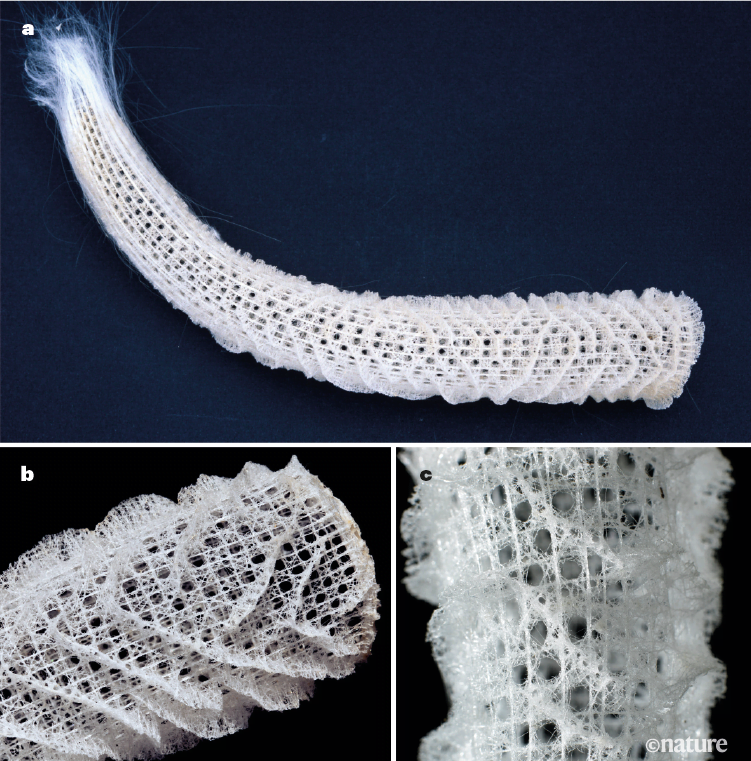
    7. The intricate lacework of the Venus’s flower basket sea sponge
    8. Building a Bluetooth speaker with ferrofluid music visualization
    9. Finding the acoustics of Stonehenge
    10. Making butter by traditional French methods

    It’s an eclectic mix of topics this year: bizarre phenomena, stunning art, archaeological exploration, and a touch of biophysics!

    If you enjoy FYFD, please remember that it’s primarily reader-supported. You can help support the site by becoming a patronmaking a one-time donationbuying some merch, or simply by sharing on social media. And if you find yourself struggling to remember to check the website, remember you can get FYFD in your inbox every two weeks with our newsletter. Happy New Year!

    (Image credits: mirage – D. Morris, sheep – L. Patel, pavement – Practical Engineering, Le Temps – T. Blanchard, insects – Ant Lab, Satellike – R. De Giuli, sea sponge – G. Falcucci et al., speaker – DAKD Jung, Stonehenge – T. Cox et al., butter – Art Insider)

  • The Acoustics of Stonehenge

    The Acoustics of Stonehenge

    Stonehenge has long been an astronomical wonder, but did you know it’s an aural wonder as well? A team of acoustic engineers and an archaeologist constructed and tested a 1:12 scale model of the monument as it existed around 2200 B.C. Their model included 157 3D-printed stones (which took about nine months to print!), carefully engineered to reflect ultrasonic frequencies the way the full-size Stonehenge reflects frequencies in our auditory range. (Using the higher frequency sound at a smaller physical scale allows engineers to match the physics of the real henge.)

    The team found that the stones of the henge amplified sound by about 4 decibels, enough to make a speaker’s voice easy to hear, even when facing a different direction. The structure also provided some reverberation that would enhance musical instruments or singing. Stonehenge had reverberation levels similar to a modern-day large movie theater, which is absolutely incredible for a prehistoric structure constructed in the open air.

    For more interesting details on the model’s construction and testing, check out this article at Physics Today. (Image and research credit: T. Cox et al.)