Tag: olympics

  • PyeongChang 2018: Curling

    PyeongChang 2018: Curling

    Curling is a deceptively engrossing sport with some unique physics among Winter Olympic events. Athletes slide 19kg granite stones at a target 28 meters away. Along the way, teammates sweep the pebbled ice with brooms, melting it with frictional heating to help the stone slide further. The underside of the stones is concave, so they only touch the ice along a narrow ring. Researchers think roughness in the leading edge of the sliding stone cuts into the ice, leaving scratches that the trailing edge tries to follow. This is what causes the stone’s trajectory to curl. By melting the ice, sweeping also prevents curling, so competitors must know exactly when and how much to sweep. Ice conditions shift throughout a match, and the best players can read the ice to keep their stones where they want them. (Image credit: AP; W. Zhao/GettyImages)

  • PyeongChang 2018: Cross-Country Skiing

    PyeongChang 2018: Cross-Country Skiing

    Cross-country skiing, also known as Nordic skiing, is a part of many longstanding disciplines in the Winter Games. Unlike downhill skiing, cross-country events typically involve mass starts, which allow athletes to interact, using one another for pacing and tactics. Drafting can be a valuable method to save energy and reduce drag. A following skier sees a 25% drag reduction while drafting; the lead skier gets about a 3% reduction in drag compared to skiing solo. Competitors usually wear tight-fitting suits to minimize drag, but unlike speedskating, for example, cross-country skiers don’t get much benefit from roughened surfaces and impermeable fabrics. Typical race speeds are 4 – 9 m/s, and most of these high-tech fabrics don’t provide tangible benefits until higher speeds. (Image credit: Reuters/S. Karpukhin, US Biathlon, GettyImages/Q. Rooney)

  • PyeongChang 2018: Ice-Making

    PyeongChang 2018: Ice-Making

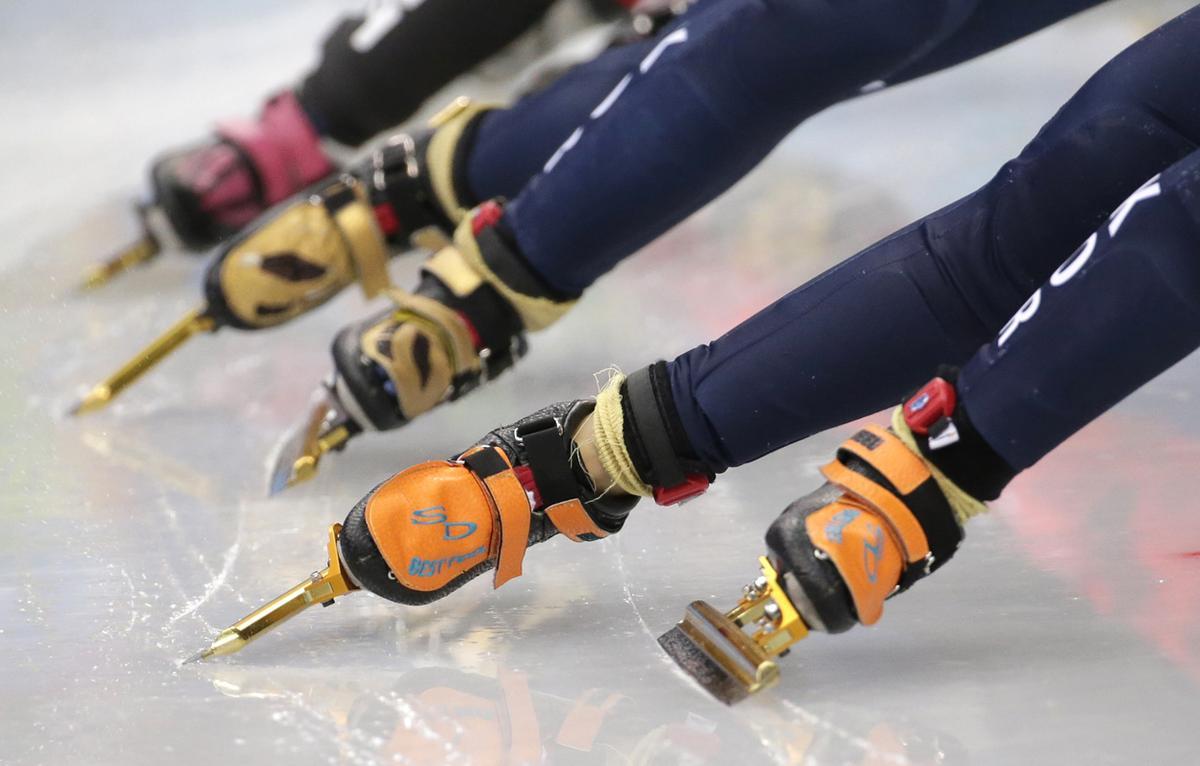
    When it comes to winter sports, not all ice is created equal. Every discipline has its own standards for the ideal temperature and density of ice, which makes venue construction and maintenance a special challenge. Figure skating, for example, requires softer ice to cushion athletes’ landings, whereas short-track speed skating values dense, smooth ice for racing. The Gangneung Ice Arena hosts both and can transition between them in under 3 hours. Gangneung Oval hosts long-track speed skating and makes its ice layer by layer, spraying hot, purified water onto the rink. This builds up a particularly dense and therefore smooth ice. 

    The toughest sport in terms of ice conditions is curling, which requires a finely pebbled ice surface for the stones to slide on. Forming those tiny crystals on the ice sheet can only be done at precise temperature and humidity conditions. This is a particular challenge for Gangneung Curling Center due to its coastal location. To keep the temperature and humidity under control at full crowd capacity, officials even went so far as to replace all the lighting at the facility with LEDs! (Image credit: Pyeongchang 2018, 1, 2, 3)

  • PyeongChang 2018: Bobsleigh

    PyeongChang 2018: Bobsleigh

    In bobsleigh, two- and four-person teams compete across four runs down an ice track. The shortest cumulative time wins, and since typical runs are separated by hundredths of a second, teams look for any advantage that helps them shave time. The size, weight, and components of a sled are restricted by federation rules; for example, teams cannot use vortex generators to improve their aerodynamics. Instead bobsledders work with companies like BMW, McLaren, and Ferrari to engineer their sleds. Both computational fluid dynamics and wind tunnel tests with the actual team in the sled are used to make each sled as aerodynamic as possible. (Image credit: IOC, Gillette World Sports, source)

  • Featured Video Play Icon

    PyeongChang 2018: Snow-Making

    These days artificial snow-making is a standard practice for ski resorts, allowing them to jump-start the early part of the season. Snow guns continuously spray a mixture of cold water and particulates 5 or more meters in the air to generate artificial snow. The tiny droplet size helps the water freeze faster and the particles provide nucleation sites for snow crystals to form. As with natural snow, the shape and consistency of the snow depends on humidity and temperature conditions. Pyeongchang is generally cold and dry, so even the artificial snow there tends to be similar to snow in the Colorado Rockies. Recreational skiers tend to look down on artificial snow, but Olympic course designers actually prefer it. With artificial snow, they can control every aspect of an alpine course. For them, natural snowfall is a disruption that puts their design at risk. (Video credit: Reactions/American Chemical Society)

  • PyeongChang 2018: Skeleton

    PyeongChang 2018: Skeleton

    Skeleton, the sliding event in which athletes race down an ice track head first, is a fast-paced and punishing sport. Skeleton racers can reach speeds of 125 kph (~80 mph) during their descents. This is a little slower than the feet-first luge, in part because the skeleton sled runs on circular bars rather than sharp runners. 

    Body positioning is key in the sport. It’s the athlete’s primary method of steering, and it controls how much drag slows them down. But skeleton runs are brutally taxing; athletes pull 4 or 5g in the turns – more than astronauts experience during a launch! All that jostling means athletes cannot stand more than about 3 trips down the track in a day. To practice positioning without the bone-jarring descent, athletes can work in a wind tunnel. While the wind tunnel provides the aerodynamic equivalent of their usual speed, athletes focus on holding their bodies in the most streamlined position. Some wind tunnels are even able to provide screens that let the athletes see their drag values in real-time, letting them adjust to learn what works best for them. (Image credit: N. Pisarenko/AP, Bromley Sports)

  • PyeongChang 2018: Ski Jumping

    PyeongChang 2018: Ski Jumping

    No winter sport is more aerodynamically demanding than ski jumping. A jump consists of four parts: the in-run, take-off, flight, and landing. The in-run is where an athlete gains her speed, and to keep drag from slowing her down, she descends in a streamlined tuck that minimizes frontal area. The biggest aerodynamic challenge comes during flight, when the jumper wants to maximize lift while minimizing drag. The athlete spreads her skis in a V-shape and flattens her body, using her hands to adjust her flight. Flying the farthest requires careful management of forces while in the air. Wind plays a major role as well, with headwinds helping athletes fly farther. To compensate, scoring includes a wind factor calculated based on conditions for each jump. (Image credit: B. Pieper, Reuters/K. Pfaffenbach, PyeongChang 2018)

  • PyeongChang 2018: Ice’s Watery Sublayer

    PyeongChang 2018: Ice’s Watery Sublayer

    The Olympic Charter declares that winter sports must be practiced on snow or ice. Both are frozen forms of water, which despite its ubiquity, is one of the strangest substances around. In addition to its tendency to expand as it freezes, ice is inherently slippery, and no one’s quite certain yet why.

    Most people have heard the theory that ice skating is possible due to high pressure melting the ice beneath the narrow blade. But realistically, pressure melting should only work for ice down to about -3.5 degrees Celsius. By contrast, the ideal temperatures for figure skating and ice hockey are -5.5 and -9 degrees Celsius, respectively. Melting due to friction might account for slipperiness a few more degrees below freezing, but it doesn’t explain why ice can be slippery when you’re just standing on it.

    When physicist Michael Faraday suggested in 1850 that ice has a thin liquid-like layer at its surface, many discounted the theory. But modern experimental techniques and computer simulations have shown that Faraday was right. Ice has a liquid-like layer some 1 to 100 nanometers thick at its surface, and this layer persists to temperatures below -30 degrees Celsius. The process is known as surface pre-melting and what causes it is an area of active research for physical chemists. Current theories include hydrogen bonding and even quantum mechanical effects. (Image credit: AP Photo/B. Armangue; research credit: R. Rosenberg; Y. Li and G. Somorjai; F. Paesani and G. Voth)

    This opens FYFD’s two-week series on the physics and fluid dynamics of the Winter Olympics. Stay tuned! – Nicole

  • Rio 2016: Diving

    Rio 2016: Diving

    Diving is a popular event for spectators, but it can also be rather confusing. We know that divers are rewarded for minimizing their splash, but what exactly does that mean and how do they do it?

    The ideal water entry, called a rip entry by divers, requires a diver to hit the water in a vertical orientation with their arms braced and palms held flat over their head. Striking the water tears open a cavity for the athlete’s body to enter. To minimize splash, the diver wants to fall into this expanding cavity without striking the sides, which would throw up an additional splash. This is the reason for vertical entry. Hand position is also important. If the athlete were to point their fingers, they would create a narrower cavity and larger splash.

    After the athlete enters the water, the cavity closes off under the surface and the water rebounds in a splashy Worthington jet. For the speed and size of human divers, this later splash is essentially unavoidable. What the commentators don’t really tell you, though, is that diving judges are only supposed to judge a diver’s entry up to the point that their feet go under the surface. They’re instructed to ignore everything that happens underwater and after entry. So that big rebound splash we all see isn’t meant to count! (Image credits: A. Pretty/GettyImages; kaorigoto, source)

    Previously: Minimizing splash by being hydrophilic; the physics of skipping rocks and avoiding splashback at the urinal

    Join us throughout the Rio Olympics for more fluid dynamics in sports. If you love FYFD, please help support the site!

  • Rio 2016: The Swimming Pool Controversy

    Rio 2016: The Swimming Pool Controversy

    Statistical analysis suggests possible current in the Rio Olympics swimming pool

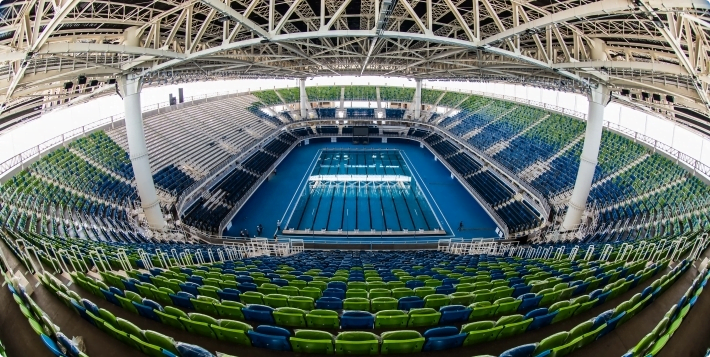
    Several news outlets, beginning with The Wall Street Journal, are reporting that the swimming pool in Rio may have had a current that biased athletes’ performances. This is based on a statistical analysis of athlete performances across the meet, conducted by Indiana University’s Joel Stager and his coworkers. According to WSJ, Stager et al. analyzed times of athletes in the preliminary, semifinal, and final races of the 50m, 800m, and 1500m events and found consistent evidence that swimmers in the higher numbered lanes swam faster when moving toward the starting block and swimmers in the lower numbered lanes swam faster when moving toward the turn end of the pool. A separate analysis by Barry Revzin at Swim Swam came to similar conclusions about the direction and magnitude of lane effect in Rio.

    Past questions about lane bias

    This is not the first time questions have been raised about a current-induced bias in competition pools. In fact, Stager and his colleagues published an analysis in 2014 that suggested a similar bias in the pool used for the 2013 World Championships in Barcelona. That pool was a temporary pool built specifically for the competition by Myrtha Pools and was disassembled immediately after, before Stager et al.’s analysis was published.

    A more recent paper by Stager and his colleagues found that lane bias seems to be more prevalent in temporary pools than in permanent ones. The Rio Olympics pool, like the 2013 Worlds pool, is a temporary pool also built by Myrtha Pools.

    Myrtha Pools responds to the criticism 

    Myrtha responded to both WSJ and Swim Swam by sharing videos (1, 2) of their current test, which was conducted before the competition and on Day 3 of competition. The videos show a floating object in one of the outside lanes; neither video shows any noticeable movement of the object.

    Fluid dynamics and swimming pool design

    Competitive swimming pools are complicated recirculating systems that can contain special structures intended to minimize interactions between competitors. Myrtha has built many special event pools in recent years, including ones where the results did not show a bias. According to their website, Myrtha has fluid dynamicists on staff and uses computational fluid dynamics (CFD) to analyze pool performance during design, although they only show examples of freeform pools – not competition pools.

    In fact, I have found remarkably few CFD analyses of swimming pools in the literature. Most papers seem to focus on distribution of disinfectants in pools or in predicting evaporation rates – both practical problems but ones with limited relevance to this particular question.

    So, is there a current in the Rio pool?

    It’s tough to say with certainty that there is a current in Rio’s pool. The performance analyses by Stager et al. and by Revzin do show anomalies in the times of athletes in Rio based on their swim lane, and they show that those anomalies do not exist in many other recent competitions.

    I also do not think Myrtha’s current test constitutes evidence of a lack of current. Their floating object is only indicative of conditions at the air-water interface. Swimmers ride lower in the water and spend significant time completely underwater. Lane markers may also damp any flow effects near the surface.

    I think introducing dye underwater in the pool would do more to reveal any flow that may exist, and this would be a worthwhile test to conduct prior to the deconstruction of the Rio Olympic pool. Additionally, it would be wonderful to see a CFD analysis of the swimming pool, but this would require significant detail about the pool’s design (inlet and outlet locations, etc.) some of which is likely proprietary information.

    Neither dye visualization nor CFD simulation will change the results of this competition, but it may help reveal underlying issues in temporary pool designs so that any bias can be avoided in future competitions.

    (Image credit: Rio City Government)

    Special thanks to @MicahJGreen for bringing this story to my attention and to Dave B. for his assistance.