
Space, as I’ve discussed previously, is surprisingly full of matter, especially clouds of dust. And yet the rate of star formation we observe is bizarrely low; the Milky Way, for example, produces only about one solar mass worth of new stars every year. If gravity were the sole force driving star formation, we’d see far more stars forming. Recent research suggests that turbulence plays a major role in regulating the star formation process, both by countering gravity’s attempts to collapse gases into a proto-star and by creating supersonic shocks that drive material together to jump-start star formation. There seem to be other important ingredients as well: young stars tend to form jets that blow material back into the interstellar clouds they’re forming in, feeding the turbulent background. For more, check out Physics Today. (Image credit: ESA/NASA/Hubble/ESO, via APOD; research credit: C. Federrath)
Search results for: “turbulence”
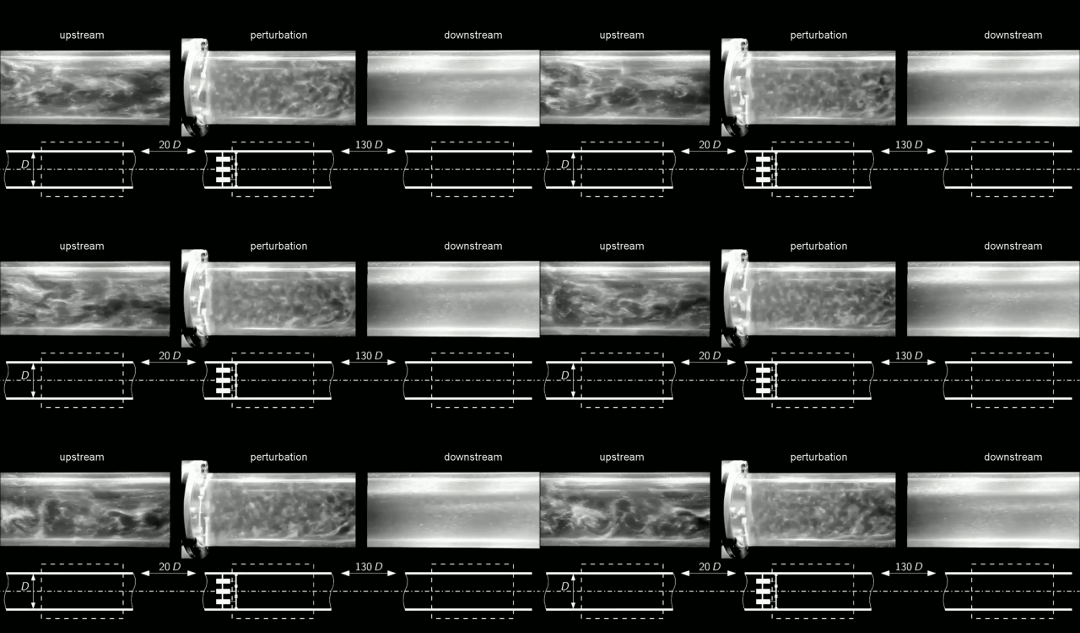
Breaking Up Turbulence
Under most circumstances, we think about flows changing from ordered and laminar to random and turbulent. But it’s actually possible for disordered flows to become laminar again. This is what we see happening in the clip above. Upstream, the flow in this pipe is turbulent (left). Then four rotors are used to perturb the flow (center). This disrupts the turbulence and causes the flow to become laminar again downstream (right). To understand how this works, we have to talk about one of the fundamental concepts in turbulence: the energy cascade.
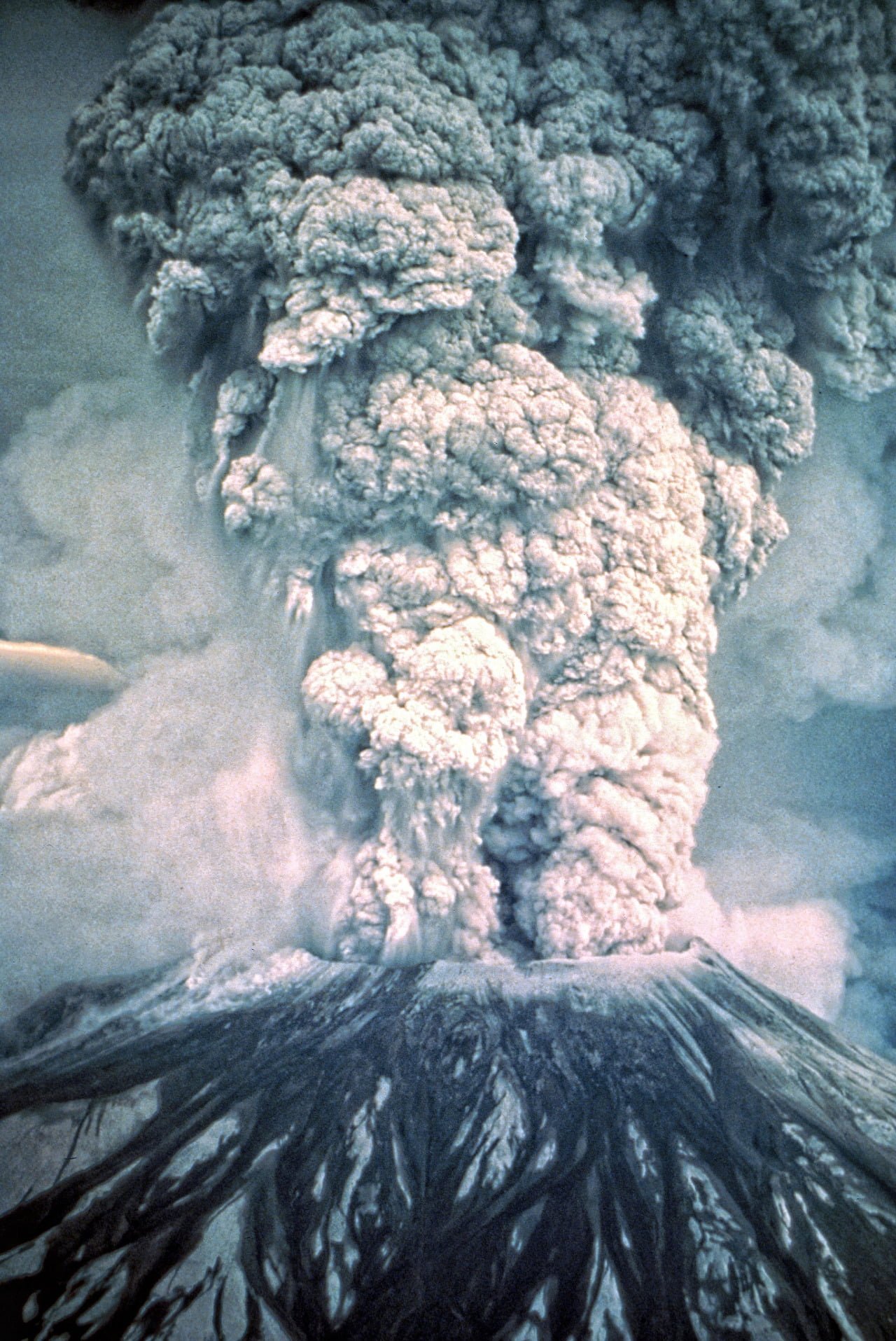
Turbulent flows are known for their large range of length scales. Think about a volcanic plume, for example. Some of the turbulent motions in the plume may be a hundred meters across, but there are a continuous range of smaller scales as well, all the way down to a centimeter or less in size. In a turbulent flow, energy starts at the largest scales and flows further and further down until it reaches scales small enough that viscosity can extinguish them.
That should offer a hint as to what’s happening here. The rotors are perturbing the flow, yes, but they’re also breaking the larger turbulent scales down into smaller ones. The smaller the largest lengthscales of the flow are, the more quickly their energy will decay to the smallest lengthscales where viscosity can damp them out. This is what we see here. Once the turbulent energy is concentrated at the smallest scales, viscosity damps them out and the flow returns to laminar. Check out the full video below for a cool sequence where the camera moves alongside the pipe so you can watch the turbulence fading as it moves downstream. (Image and video credit: J. Kühnen et al.)
ETA: As it turns out, there’s more going on here than I’d originally thought. Simulations show that breaking up length scales is not the primary cause of relaminarization in this case. Instead, the rotors are modifying the velocity profile across the pipe in such a way that it tends to cause the turbulence to die out. The full paper is now out in Nature Physics and on arXiv.

Spots of Turbulence
One of the enduring mysteries of fluid dynamics lies in the transition between smooth laminar flow and chaotic turbulent flow in the area near a wall. That region, known as the boundary layer, has a major impact on drag and other effects. The process begins with disturbances that are too tiny to see or measure, but eventually, those disturbances can grow large enough to generated an isolated turbulent spot, like the one imaged above. Flow in the photograph is from left to right. Turbulent spots have a distinctive wedge-like shape that expands as the spot grows and widens. These turbulent spots can merge together to create still larger spots, and when a surface eventually becomes completely covered in them, we call it fully-developed turbulent flow. (Image credit: M. Gad-El-Hak et al.)

Soap Film Turbulence
The brilliant colors of a soap film reveal the fluid’s thickness, thanks to a process known as thin film interference. The twisting flow of the film depends on many influences: gravity pulls down on the liquid and tends to make it drain away; evaporation steals fluid from the film; local air currents can push or pull the film; and the variation in the concentration of molecules – specifically the surfactants that stabilize the film – will change the local surface tension, causing flow via the Marangoni effect. Together these and other effects create the dancing turbulence captured above. (Video credit: A. Filipowicz)

Turbulence in the Solar Wind
One of the key features of turbulent flows is that they contain many different length scales. Look at the plume from an erupting volcano, and you’ll see eddies that are hundreds of meters across as well as tiny ones on the order of millimeters. This enormous difference in scale is one of the major challenges in simulating turbulent flows. Since energy enters at the large scale and is passed to smaller and smaller scales before being dissipated at the tiniest scales of the flow, properly simulating a turbulent flow requires resolving all of these length scales. This is especially challenging for applications like the solar wind – the stream of charged particles that flows from the sun and gets diverted around the Earth by our magnetic field. The image above shows some of the turbulence in our solar wind. The structures seen in the flow range from the size of the Earth all the way to the scale of electrons! (Image credit: B. Loring, Berkeley Lab)

Bumblebees in Turbulence

Bumblebees are small all-weather foragers, capable of flying despite tough conditions. Given the trouble that micro air vehicles have when flying in gusty winds, bumblebees can help engineers to understand how nature successfully deals with turbulence. Under smooth laminar conditions like those shown in the animation above, bumblebees stay aloft by beating their wings forward and backward in a figure-8-like motion. On both the forward downstroke and the backward upstroke, you’ll notice a blue bulge near the front of the bee’s wing. This is a leading-edge vortex, which provides much of the bee’s lift.
Researchers were curious how adding turbulence would affect their virtual bee’s flight. The still image above shows the bee in moderate freestream turbulence (shown in cyan). Surprisingly, this outside turbulence has very little effect on the flow generated by the bee, shown in pink. In fact, the researchers found that the bees could fly through turbulence without a significant increase in power. Too much turbulence does make it hard for the bee to control its flight, though. The bee’s shape makes it prone to rolling, and the researchers estimated, based on a bee’s 20 ms reaction time, that bumblebees can probably only correct that roll and maintain controlled flight at turbulence intensities less than 63% of the mean wind speed. (Image credits: T. Engels et al., source; via Physics Focus)
Van Gogh and Turbulence
Turbulence is one of the great unsolved mysteries of classical mechanics. Many physicists and engineers have spent their careers trying to further our understanding of the subject and find the mathematical pattern that underlies its complex motions. But understanding turbulence and representing it artistically may be two different things. This video discusses some neat research that found that some of Vincent van Gogh’s paintings, like “The Starry Night”, display mathematical patterns like those of turbulence. (Video credit: TED Ed)
Turbulence and Star Formation
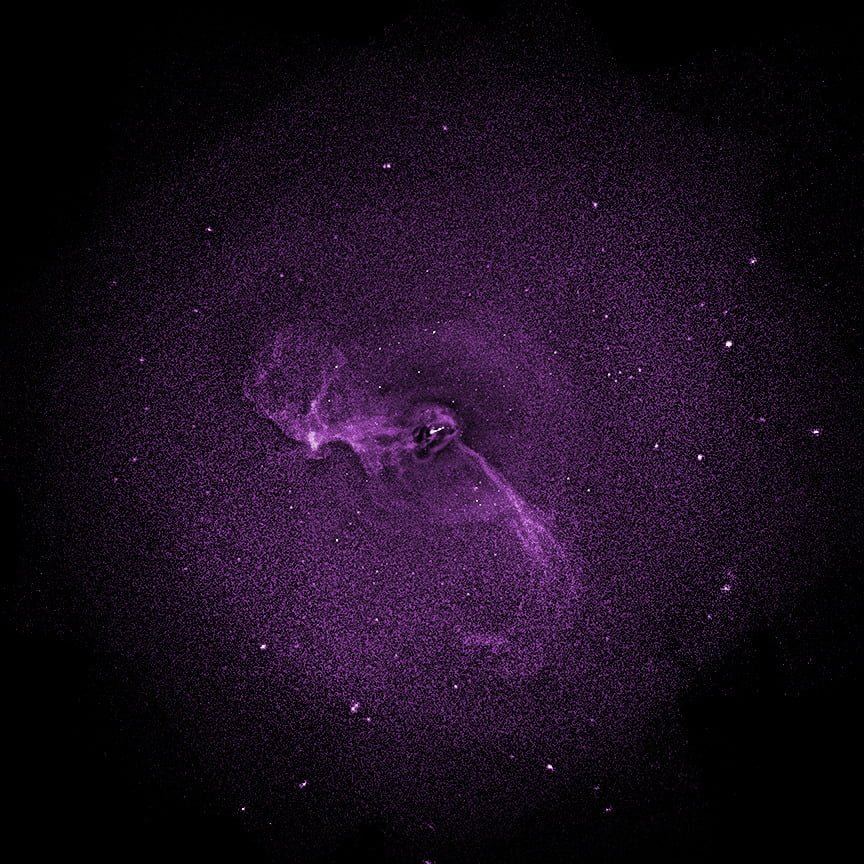
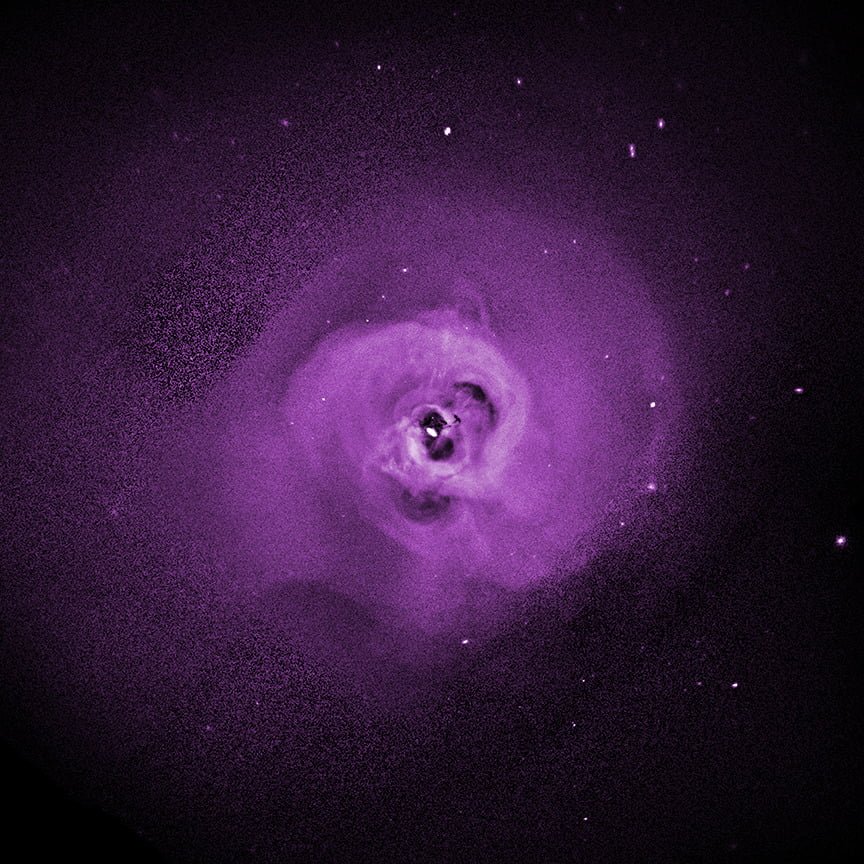
Galaxy clusters are objects containing hundreds or thousands of galaxies immersed in hot gas. This gas glows brightly in X-ray, as seen in the Perseus (top) and Virgo (bottom) clusters above. Over time, the gas near the center of the clusters should cool, generating many new stars, but this is not what astronomers observe. New research suggests turbulence may prevent this star formation. The supermassive black holes near the center of these galaxy clusters pump enormous amounts of energy into their surroundings through jets of particles. Those jets churn the gas of the cluster, generating turbulence, which ultimately dissipates as heat. It is this turbulent heating astronomers think counters the radiative cooling of the gas, thereby keeping the gas hot enough to prevent star formation. You can read more about the findings in the research paper. (Image credits: NASA/Chandra/I. Zhuravleva et al.; via io9)
Reader Question: Fractals and Turbulence
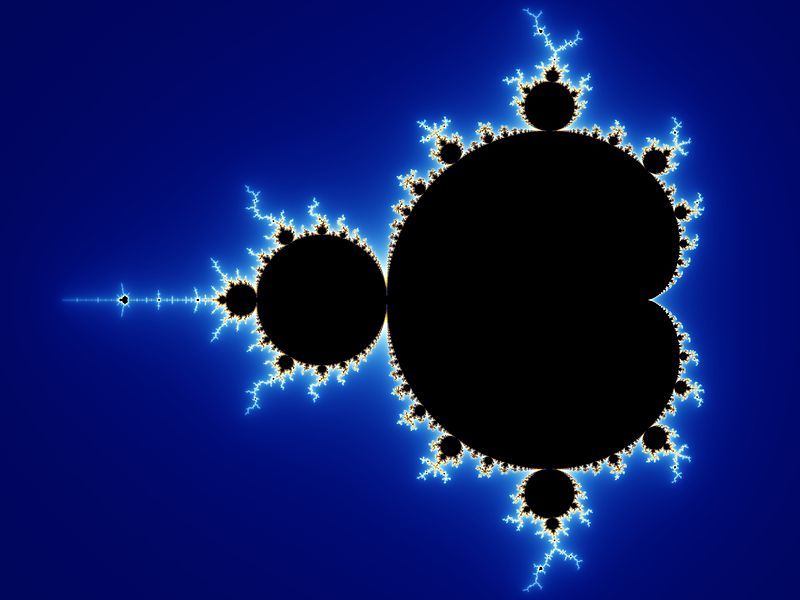
Reader 3d-time asks:
Hi, there is a guy, at my college, who is doing a master’s degree thesis in turbulence. He says he uses fractals and computational methods. Can you explain how fractals can be used in fluid dynamics?
That’s a good question! Fractals are a relatively recent mathematical development, and they have several features that make them an attractive tool, especially in the field of turbulence. Firstly, fractals, especially the Mandelbrot set shown above, demonstrate that great complexity can be generated out of simple rules or equations. Secondly, fractals have a feature known as self-similarity, meaning that they appear essentially the same regardless of scale. If you zoom in on the Mandelbrot set, you keep finding copy after copy of the same pattern. Nature, of course, doesn’t have this perfect infinite self-similarity; at some point things break down into atoms if you keep zooming in. But it is possible to have self-similarity across a large range of scales. This is where turbulence comes in. Take a look at the turbulent plume of the volcanic eruption in the photo above. Physically, it contains scales ranging from hundreds of meters to millimeters, and these scales are connected to one another by their motion and the energy being passed from one scale to another. There have been theories suggested to describe the relationship between these scales, but no one has yet found a theory truly capable of explaining turbulence as we observe it. Both the self-similarity and the complex nature of fractals suggest they could be useful tools in finally unraveling turbulence. In fact, Mandelbrot himself wrote several papers connecting the two concepts. Perhaps your friend will help find the next hints! (Image credit: U.S. Geological Survey, Wikimedia)

Growing Turbulence
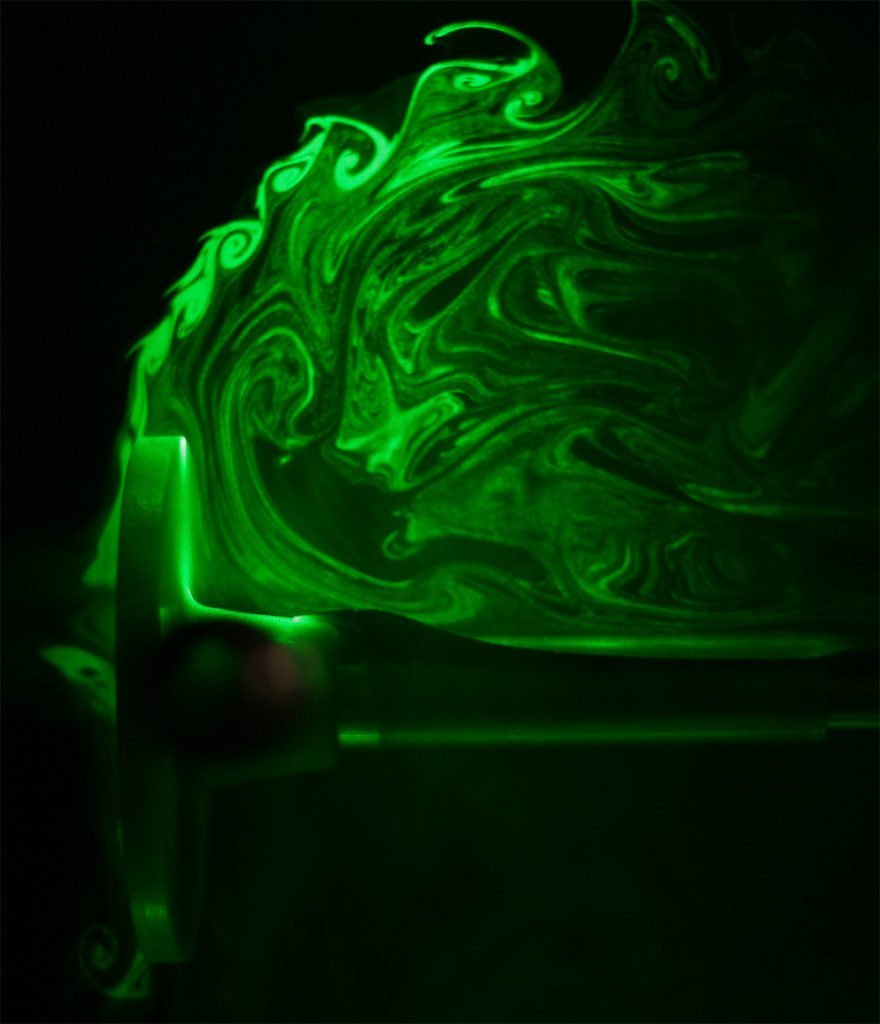
Flow patterns can change dramatically as fluid speed and Reynolds number increase. These visualizations show flow moving from left to right around a circular plunger. The lower Reynolds number flow is on the left, with a large, well-formed, singular vortex spinning off the plunger’s shoulder. The image on the right is from a higher Reynolds number and higher freestream speed. Now the instantaneous flow field is more complicated, with a string of small vortices extending from the plunger and a larger and messier area of recirculation behind the plunger. In general, increasing the Reynolds number of a flow makes it more turbulent, generating a larger range of length scales in the flow and increasing its complexity. (Image credit: S. O’Halloran)
#/media/File:Aileron_roll.gif)
