Search results for: “high-speed video”

  • Hovering Hummingbirds

    Hovering Hummingbirds

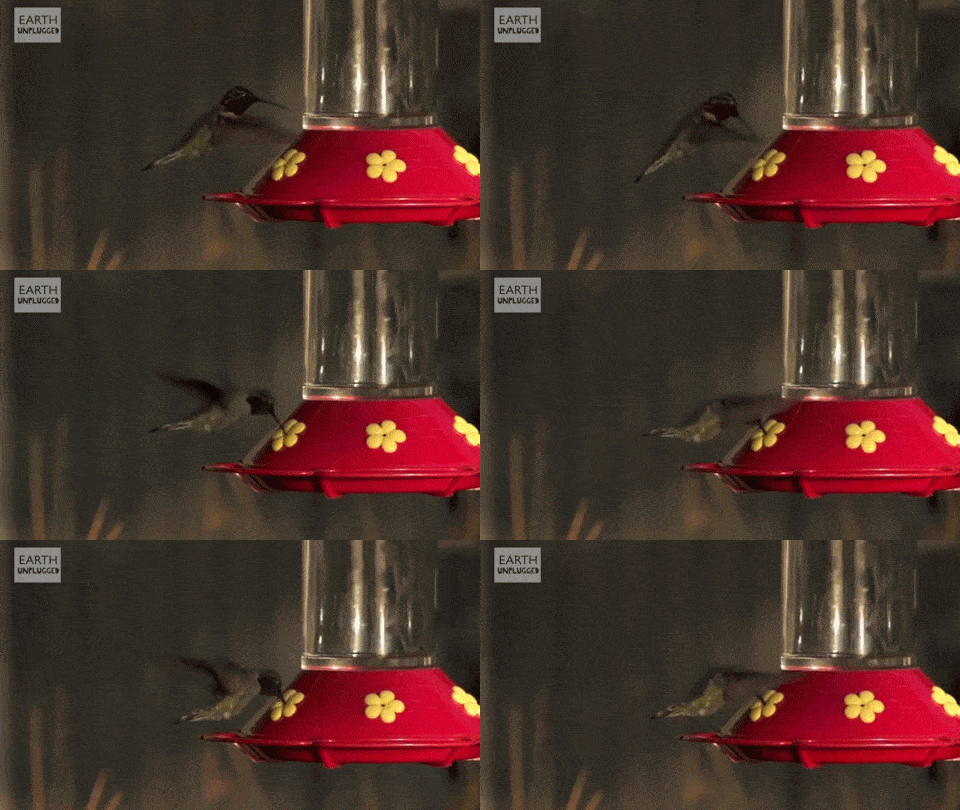
    Hummingbirds are incredible flyers, especially when it comes to hovering. To hover stationary and stable enough to feed, the hummingbird’s flapping pattern not only has to generate enough lift, or vertical force, to counteract their weight, but the bird must balance any forward or backward forces generated during flapping.

    As you can see in the animations above, when hovering the hummingbird’s wings move forward and back rather than up and down. When slowed down even further, the figure-8 motion of the wings becomes apparent. This careful motion is key to the hover; it allows the bird to generate about 70% of its lift on the downstroke when the wings move forward and creates the remainder of the lift needed on the upstroke. For much more high-speed footage of hummingbirds, check out the full BBC Earth Unplugged video, but be warned: you may experience a cuteness overdose! (Image credit: BBC Earth Unplugged, source)

  • Featured Video Play Icon

    Seeing Blast Waves

    With a large enough explosion, it’s actually possible to see shock waves. This high-speed camera footage shows the detonation of a car packed with explosives. After the initial flash, you can see the thin membrane of the blast wave expanding outward. This shock wave is a traveling discontinuity in the air’s properties–temperature, pressure, and density all change suddenly over an incredibly small distance. It’s this last variable–density–that enables us to see the effect. Density has a significant impact on air’s index of refraction (which also explains heat mirages). In this case, the shift in refractive index is large enough that we see the difference relative to the background, enabling our eyes to follow an otherwise invisible effect.  (Video credit: Mythbusters/Discovery Channel; via Gizmodo)

    If you enjoy FYFD, please help support me by becoming a patron!

  • Featured Video Play Icon

    Fire Tornado

    Fire tornadoes, despite their name, are more like dust devils than your typical tornado. In nature, they’ll often form in wildfires, but here the Slow Mo Guys simulate one for the high-speed cameras using a ring of box fans set up to provide rotational flow, or vorticity, around a kerosene fire. As the fire burns, the warm air over the flame moves upward due to buoyancy. This creates a low-pressure area around the fire that draws in the spinning air from further out. Like an ice skater who pulls her arms in when spinning, the rotating air spins faster as it moves in toward the fire, resulting in a swirling turbulent vortex of flame. Hopefully it goes without saying, but, seriously, don’t try this at home. (Video credit: Slow Mo Guys; submitted by Chris S.)

  • Ignition

    Ignition

    Shown here are the first instants after a bubble full of methane gas is ignited via laser. Using the schlieren optical method and a high-speed camera, scientists recorded the deflagration at 10,000 frames per second. Because schlieren imaging is very sensitive to small changes in density, we see not only the expanding flame front as the methane ignites but also the subtle waviness of the methane expanding into the surrounding air as the bubble bursts. (For comparison, check out what bursting a water balloon looks like at high-speed.) Be sure to head over to ScienceTake for the full schlieren video, and also check out this award-winning video of a match lighting made by the same researcher.  (Image credit: V. Miller et. al.; full video: The New York Times; submitted by Rebecca M.)

    ETA: An earlier version of this post mistakenly said the demo used a balloon full of methane rather than a bubble. Thanks to jump-first-think-later for the correction.

  • Featured Video Play Icon

    Rain-spread Pathogens

    Like humans, plants can spread pathogens to one another. Although scientists had observed correlations between rainfall and the spread of diseases among plants, this study is one of the first to look at the fluid dynamics of leaf and rainfall interaction. When a raindrop hits a leaf, it doesn’t simply splash as it would against an immobile surface. The impact of the drop deforms the leaf, and the plant’s rebound significantly affects the trajectory and size of the resulting droplets. Depending on factors like the leaf’s stiffness, a large drop, carrying many pathogens, may rebound and splatter onto a neighboring leaf. Other leaves tend to catapult out many smaller droplets, which may fly farther afield but carry fewer pathogens. For more, check out the press release or the original research paper. (Video credit: Massachusetts Institute of Technology; research credit: Bourouiba Research Group)

  • Coalescence Cascade

    Coalescence Cascade

    The simple coalescence of a drop with a pool is more complicated than the human eye can capture. Fortunately, we have high-speed cameras. Here a droplet coalesces by what is known as the coalescence cascade. Because it has been dropped with very little momentum, the droplet will initially bounce, then seem to settle like a bead on the surface. A tiny film of air separates the drop and the pool at this point. When that air drains away, the drop contacts the pool and part–but not all!–of it coalesces. Surface tension snaps the remainder into a smaller droplet which follows the same pattern: bounce, settle, drain, partially coalesce. This continues until the remaining droplet is so small that it can be coalesced completely. (Image credit: Laboratory of Porous Media and Thermophysical Properties, source video)

  • Featured Video Play Icon

    Re-lighting a Candle

    When you blow out a candle, you can re-light the wick using the smoke trail left behind. This is a topic we’ve discussed before, but I’m thrilled to finally see the process in true high-speed, thanks to the Slow Mo Guys. The plume that rises from the extinguished candle is an atomized mixture of fuel (wax) and air. When you bring a new combustion source–the match–close enough, that mixture ignites and the flame spreads downward back to the wick. (Video credit: The Slow Mo Guys)

  • Featured Video Play Icon

    Acoustic Levitation

    Destin from Smarter Every Day has a great new video exploring acoustic levitation. With carefully placed speakers, you can create a standing wave with sound that’s capable of levitating lightweight objects against the force of gravity. Around 4:00, Destin demonstrates this with colored water droplets, which is where the real fireworks start. As he turns up the volume on the speakers, the big droplets explode. This happens when surface tension can no longer hold the drop together. But the high-speed footage offers other clues about what’s going on. Notice how the drops flatten out as the sound volume increases. If you look back to the standing wave animation at 1:33, you’ll notice that just to either side of the nodes (the spots that don’t move), the wave is still oscillating back and forth a little bit. As you increase the sound volume, that standing wave gets stretched to a larger amplitude, which means that those little oscillations just to either side of the node get stronger (and steeper), too. This change in acoustic pressure squishes the drops into pancakes as the fluid tries to stay right at the node. Eventually the droplet is just too flattened for surface tension to keep it together and it bursts into smaller droplets. (Video credit: Smarter Every Day; submitted by Matthew P.)

  • Featured Video Play Icon

    Swimming Through Sand

    Shovel-nosed snakes and sandfish lizards both swim through granular materials like sand. Researchers at Georgia Tech used x-rays to observe their subsurface motions. Despite their different shapes, the long, slender snake and the shorter, wider lizard both move under the sand by projecting traveling waves along their bodies. The snake’s long, skinny body allows it to have more bends along its length, which increases its transport efficiency because it allows the snake to move mostly through the tunnel created by its head’s passage. In contrast, the sandfish’s motions fluidize the sand around it, enabling it to swim. Although the snake is faster, both animals have optimized their motions for fast, low-energy transit according to their body type.  (Video credit: Georgia Tech; research credit: S. Sharpe et al.; via io9)

  • Top 10 FYFD Posts of 2014

    Top 10 FYFD Posts of 2014

    It’s only fitting to take a moment to look back at 2014 as we step into the New Year. It was a big year in many respects – we hit 1000 posts and broke 200,000 followers; I started producing FYFD videos on our YouTube channel; and, on a personal note, I finished up my PhD. But since we’re all about the science around here, I will give you, without further ado, the top 10 FYFD posts of 2014:

    1. Bioluminescent crustaceans use light for defense
    2. What happens when you step on lava
    3. Flapping flight deconstructed
    4. Wingtip vortices demonstrated
    5. Saturn’s auroras
    6. Raindrops’ impact on sand
    7. Water spheres in microgravity
    8. The surreal undulatus asperatus cloud
    9. Inside a plunging breaker
    10. A simply DIY Marangoni effect demo

    I can’t help but notice that 9 out of the 10 posts feature animated GIFs. Oh, Tumblr, you rascals. Happy New Year! (Image credits: BBC; A. Rivest; E. Lutz; Nat. Geo/BBC2; ESA/Hubble; R. Zhao et al.; D. Petit; A. Schueth; B. Kueny and J. Florence; Flow Visualization at UC Boulder)