Search results for: “droplet”

  • Featured Video Play Icon

    Digging Droplets

    A droplet on a surface much hotter than its boiling point will skate on a layer of its own vapor, thanks to the Leidenfrost effect. But if that surface is, instead, a granular mixture like this glass powder, the droplet will dig itself a hole.

    As in the usual Leidenfrost situation, the heat of the powder causes part of the drop to vaporize. But as that vapor flows away, it carries powder with it. At the same time, the vaporization process causes the droplet to vibrate violently, which frees more powder and helps the drop dig deeper. Eventually, the drop will vaporize completely, leaving a volcano-like crater in the powder. (Image and video credit: C. Kalelkar and H. Sai)

    A water droplet falls on heated glass powder, which it then digs its way into.
  • Droplets From Jets

    Droplets From Jets

    On the ocean, countless crashing waves are creating bubbles. When they burst, those bubbles generate jets and droplets that spray into the sky, carrying sea salt, dust, and biological material into the atmosphere. Researchers know these droplets and their evaporation are important for understanding environmental processes, but figuring out how to capture that importance in models continues to be a challenge.

    In a new study, researchers concentrated on a simplified problem: the bursting of a single bubble in pure water. By studying a wide range of conditions, the team found that jets from these bubbles could eject as many as 14 droplets apiece. And though existing models have mostly ignored all but the first droplet, their work showed that all of the droplets should be accounted for in any evaporation models. (Image credit: C. Couto; research credit: A. Berny et al.)

  • Watching a Droplet Freeze

    Watching a Droplet Freeze

    Whether it’s rain hitting an airplane wing or droplet-based 3D printing, the dynamics of a droplet impacting and solidifying on a surface are important. This new study observes the process from below, tracking the progress of freezing on a scale of hundreds of nanoseconds.

    All three of the drops you see above are liquid hexadecane. Each droplet was the same size and impacted at the same velocity. What differs in each image is how much colder the surface was than hexadecane’s melting point. The leftmost image shows a droplet on a surface only a few degrees cooler than the melting point. The initial expanding ring shows the droplet’s contact line expanding as it impacts. Then frozen crystals appear and grow inside the drop until the entire thing freezes.

    With a slightly colder surface (middle image), frozen crystals form while the contact line is still expanding, and rather than form in distinctive spots, they form as a cloud that quickly expands throughout the drop.

    But with an even colder surface (right image), something entirely new happens. As the drop freezes, we see multiple dark rings expand through the drop. Each of these rings is made up of frozen crystals. The researchers argue that we’re seeing a combination of freezing and hydrodynamics here. Essentially, whenever the frozen crystals get large enough, the outward flow of the impacting drop sweeps them toward the contact line. As new crystals grow near the center of the drop, they’re dragged out in a subsequent wave. (Image, research, and submission credit: P. Kant et al.)

  • Kicking Droplets

    Kicking Droplets

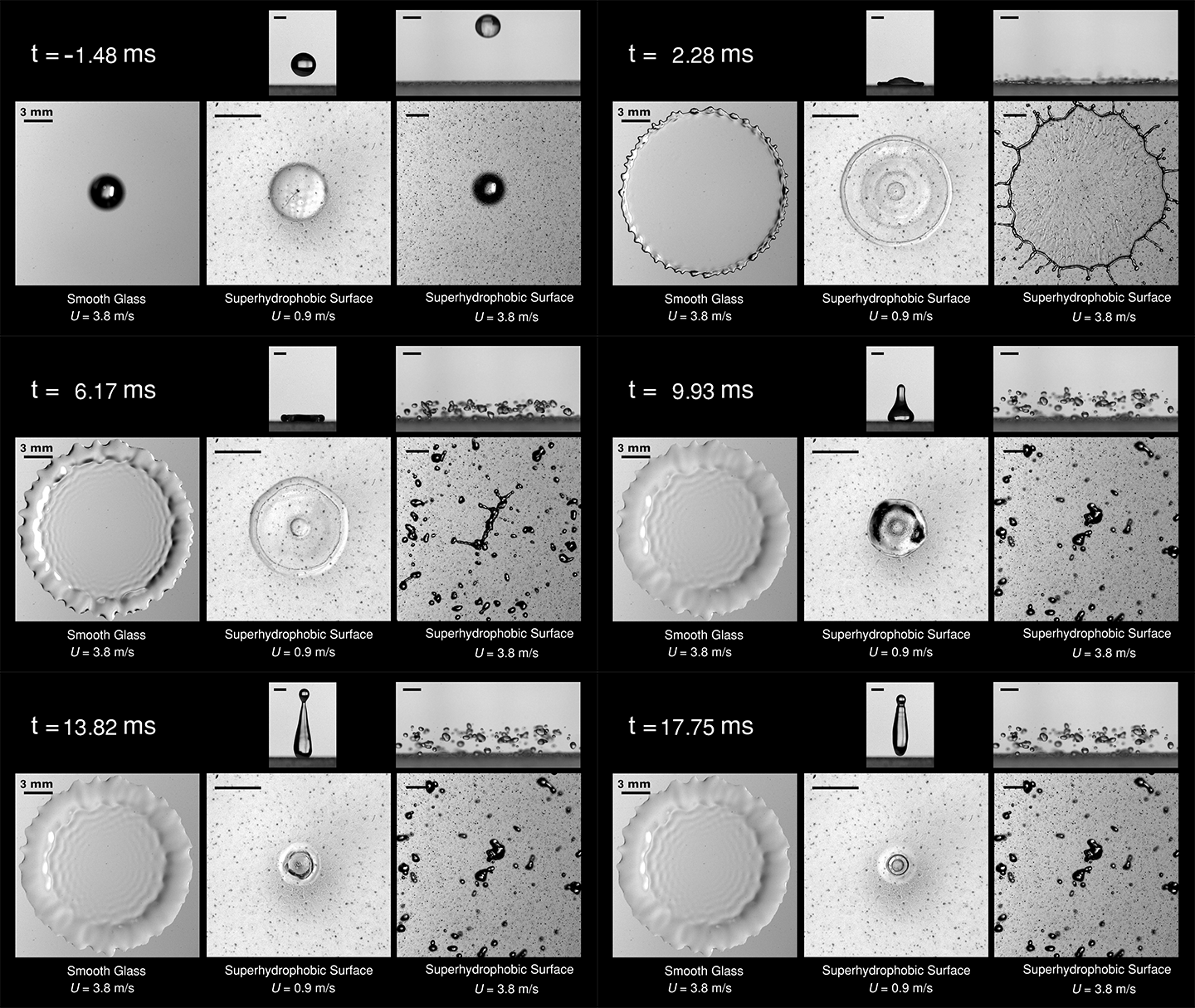
    Moving the surface a droplet sits on creates some interesting dynamics, especially if the surface is hydrophobic. That’s what we see here with these droplets launched off an impulsively-moved plate.

    On the left, the drop has some limited contact with the plate and it takes time for the droplet to completely detach. When accelerated, the droplet first flattens into a pancake, the rim of which quickly leaves the plate. The center of the droplet is slower to detach, stretching the drop into a vase-like shape. When the drop does finally lose contact, it creates a fast-moving jet that shoots upward at several meters per second!

    In contrast the image on the left shows a levitating Leidenfrost droplet. Since this drop has no physical contact with the plate, the kick makes it leave the surface all at once, launching a pancake-like drop that quickly forms unstable lobes. (Image and research credit: M. Coux et al.)

  • Surface Jets in Coalescing Droplets

    Surface Jets in Coalescing Droplets

    What goes on when droplets merge is tough to observe, even with a high-speed camera. There are many factors at play: any momentum in the droplets, surface tension, gravity, and Marangoni forces, to name a few. A new study that simultaneously records multiple views of coalescence is shedding some light on these dynamics.

    The results are particularly interesting for droplets that are somewhat physically separated so that they only coalesce after one drop impacts near the other. In this situation, with droplets of equal surface tension, researchers observed a jet that forms after impact (Image 1) and runs along the top surface of the coalescing drops (Image 2). That location is a strong indication that the jet is created by surface tension and not other forces.

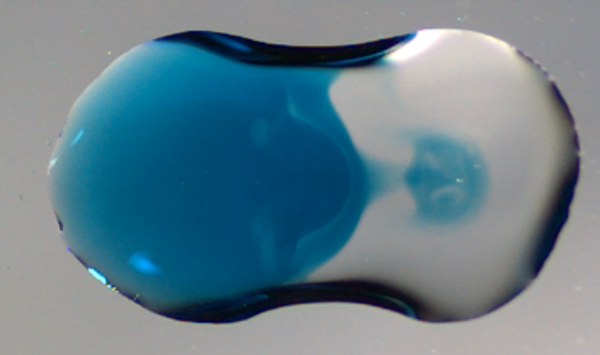
    To test that further, the researchers repeated the experiment but with droplets of unequal surface tension. They found that when the undyed droplet’s surface tension was higher (Image 3), Marangoni forces enhanced the surface jet, as one would expect for a surface-tension-driven phenomenon. But if the dyed droplet had the higher surface tension (Image 4), it was possible to completely suppress the jet’s formation. (Image, research, and submission credit: T. Sykes et al., arXiv)

  • Featured Video Play Icon

    The World in a Droplet

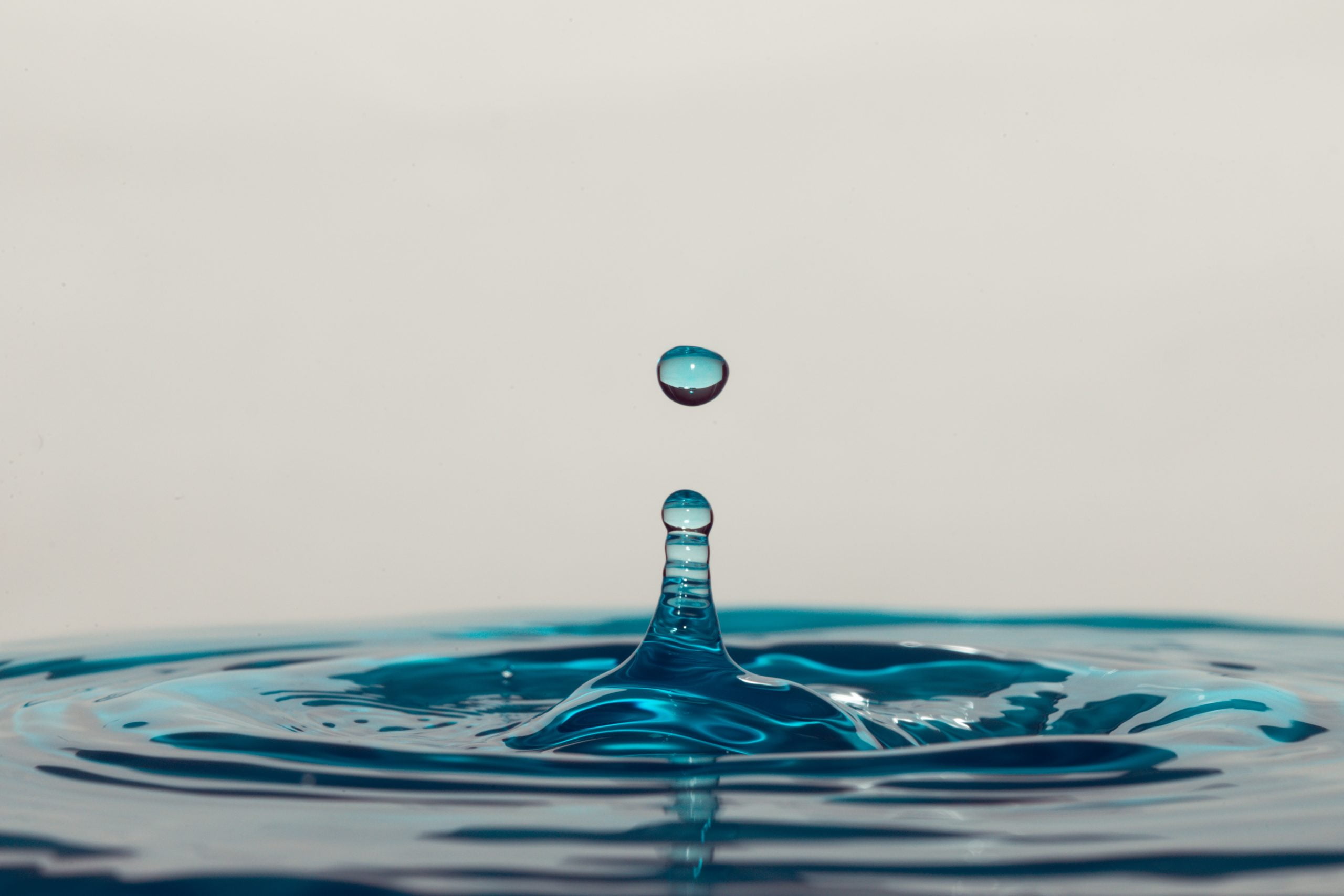
    Capturing refracted images in a droplet is a popular pastime among high-speed photographers, and in this solo Slow Mo Guy outing, we get to see that process in video. Physically, the subject is a simple drop of water, which on impact with a pool, rebounds into a Worthington jet and ejects one or more droplets from its tip. Despite hundreds of years of study, it’s still a joy to watch, especially at 12,000 frames per second.

    It’s also not the easiest image to capture, and one thing I rather enjoy about this video is how it gives you a sense of the trial and error involved in capturing just the right view. Even without having to worry about the timing issues, there is a lot of fiddling with lenses, focus, lights, and positioning — something familiar not just to photographers and videographers but to many researchers as well! (Image and video credit: The Slow Mo Guys)