Search results for: “droplet”

  • Marangoni Bursting

    Marangoni Bursting

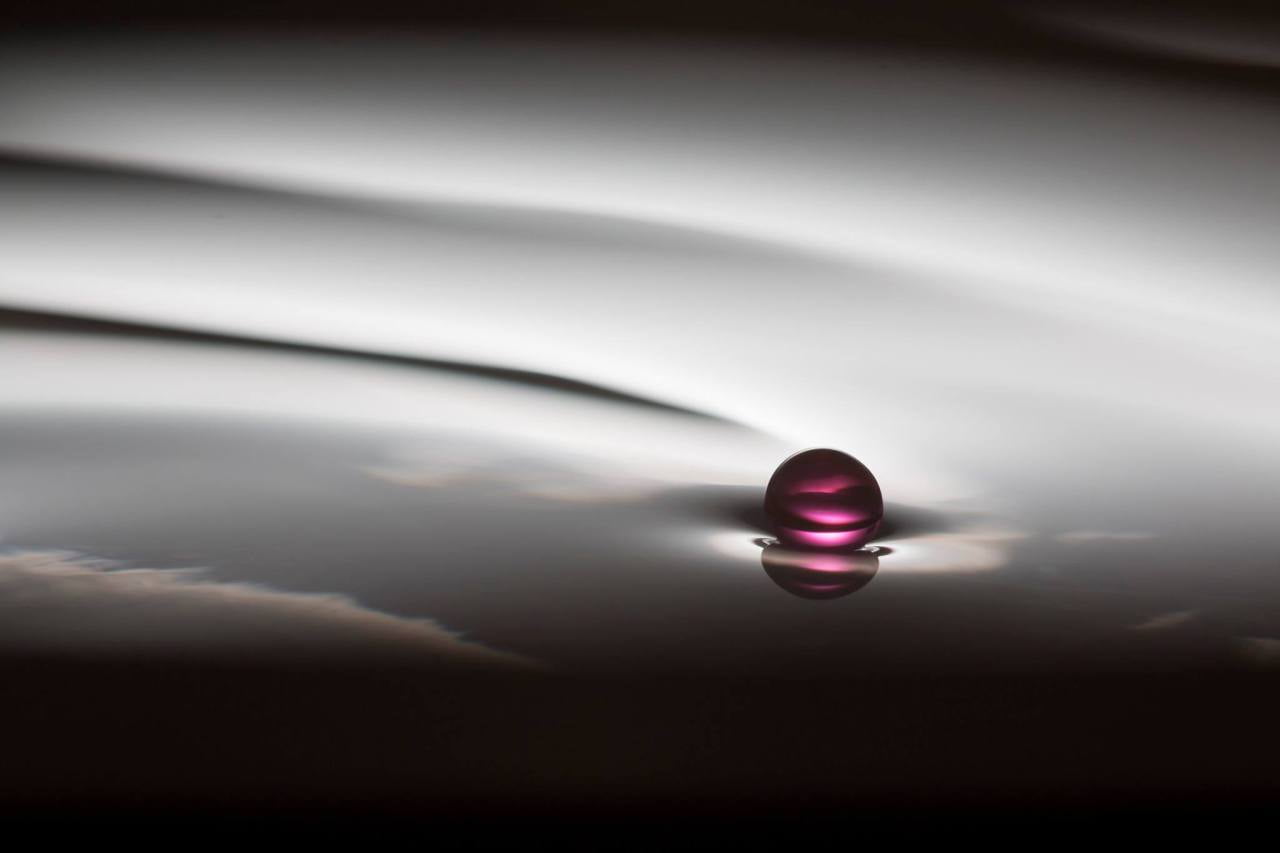
    Placing a mixture of alcohol and water atop a pool of oil creates a stunning effect that pulls droplets apart. The action is driven by the Marangoni effect, where variations in surface tension (caused in this case by the relative evaporation rates of alcohol and water) create flow. David Naylor captures some great stills of the flow, including the only example of a double burst I’ve seen so far. For more on the science behind the effect, check out this previous post or the original research paper. (Image credit: D. Naylor; see also this previous post)

  • A Lenticular Cloud With a Curl

    A Lenticular Cloud With a Curl

    Lens-shaped lenticular clouds are not terribly rare in mountainous areas, but observers at Mount Washington caught a very unusual cloud near sunrise in late February. This lenticular cloud had an added curl on top thanks to the Kelvin-Helmholtz instability!

    Lenticular clouds form when air is forced to flow up over a mountain in such a way that its temperature and pressure drop and water vapor in the air condenses. The resulting water droplets form a cloud that appears stationary over the mountain, even though the air continues to flow.

    To get that added wave-like curl, there needs to be another, faster-moving layer of air just above the cloud. As that air flows past, it shears the cloud layer, causing the interface to curl. Neither of these cloud types is long-lived — Kelvin-Helmholtz formations often last only a few minutes — so catching such a great dual example is lucky, indeed! (Image credit: Mount Washington Observatory; via Smithsonian Magazine; submitted by Kam-Yung Soh)

  • Particle-filled Splashes

    Particle-filled Splashes

    Adding particles to a liquid can significantly alter its splash dynamics, as shown in this new study. In the first image, a purely-liquid droplet spreads on impact into a thin liquid sheet that destabilizes from the rim inward, ripping itself into a spray of droplets. At first glance, the particle-filled droplet in the second image behaves similarly; it, too, spreads and then disintegrates. But there are distinctive differences.

    During expansion, the particles increase the drop’s effective viscosity, meaning that the splash sheet does not expand as far. That apparent viscosity increase is also part of why the drops the splash sheds are bigger than those without particles. The other part of that story comes from the retraction, where the variations in thickness caused by the particles and their menisci create preferential paths for the flow. As a result, the particle-filled splash breaks up faster and into larger droplets compared to its purely-liquid counterpart. (Image and research credit: P. Raux et al.)

  • Capsule Impact and Bursting

    Capsule Impact and Bursting

    Nature and industry are full of elastic membranes filled with a fluid, from red blood cells to water balloons. A new study looks at how these capsules deform — and sometimes burst — on impact. The researchers created custom elastic shells that they filled with various fluids like water, glycerol, and honey, then used the impacts to build a model of capsule deformation.

    They found that there’s significant overlap between droplet impacts and capsule impacts, with a few key differences; instead of surface tension, capsules resist deformation through their elastic shell’s surface modulus — a combination of its elasticity and thickness. Capsules, unlike droplets, can also burst. To study this, the researchers used water balloons, which they were able to pre-stretch more easily than their custom shells. They found that their model could accurately predict the conditions under which the balloons burst.

    The authors hope the model will be helpful both in designing capsules intended to burst — like a fire-fighting projectile — and in creating safety measures to prevent capsule burst — like car-crash standards that protect from organ damage. (Image and research credit: E. Jambon-Puillet et al.; via Physics World; submitted by Kam-Yung Soh)

  • Featured Video Play Icon

    Mixing Leidenfrost Drops

    When placed on a very hot, patterned surface, droplets will self-propel on a layer of their own vapor. Here, researchers use this to drive droplets to coalesce so that they can observe how well they mix. After their head-on collision, the merged droplets have two major forces fighting in them: surface tension, which tries to minimize the overall surface area; and gravity, which tries to flatten the large droplet. Together, these forces drive the large oscillations we see in the merged drop, and those oscillations help mix the liquid from the two original drops together. (Image, video, and research credit: Y. Chiu and C. Sun)

  • COVID-19 and Outdoor Exercise

    COVID-19 and Outdoor Exercise

    By now you’ve probably come across some blog posts and news articles about a new pre-print study looking at the aerodynamics of running and the potential exposure to exhaled droplets. And you may also have seen articles questioning the accuracy and validity of such simulations. I’ve had several readers submit questions about this, so I dug into both the research and the criticisms, and here are my thoughts:

    Is this study scientifically valid?

    I’ve seen a number of complaints that since this paper hasn’t been peer-reviewed, we shouldn’t trust anything about it. That seems like an unreasonable overreaction to me considering how many studies receive press attention prior to their actual peer-reviewed publication. This is not a random CFD simulation produced by someone who just downloaded a copy of ANSYS Fluent. This work comes from a well-established group of engineers specializing in sports aerodynamics, and long-time readers will no doubt recognize some of their previous publications. Over the past decade, Blocken and his colleagues have become well-known for detailed experimental and simulation work that indicates larger aerodynamic effects in slipstreams than what we generally recognize.

    In this paper, they lay out previous (biological) studies related to SARS and droplet exhalation; they use those papers and several wind tunnel studies to validate computational models of droplet evaporation and runner aerodynamics; and then they use those inputs to simulate how a cloud of exhaled droplets from one runner affects someone running alongside, behind, or in a staggered position relative to the first runner.

    In other words, their work includes all the components one would expect of a scientific study, and it makes scientifically justifiable assumptions with regard to its methods. (That’s not, mind you, to say that no one can disagree with some of those choices, but that’s true of plenty of peer-reviewed work as well.) All in all, yes, this is a scientifically valid study, even if it has not yet undergone formal peer-review*.

    Can simulations actually tell us anything about virus transmission?

    One complaint I’ve seen from both biologists and engineers is that simulations like these don’t actually capture the full physics and biology involved in virus transmission. While I agree with that general sentiment, I would point out two important facts:

    1) Blocken et al. acknowledge that this is not a virology study and confine their scientific results to looking at what happens physically to droplets when two people are moving relative to one another. Whether those droplets can transmit disease or not is a question left to biological researchers.

    2) Most medical and biological research also does not account for the physics of droplet transmission and transport. For the past century, this research has focused almost exclusively on droplet sizes, with the assumption that large droplets fall quickly and small droplets persist a little longer. To my knowledge, some of the only work done on the actual physics of the turbulent cloud produced by coughing or sneezing comes from Lydia Bourouiba’s lab at MIT. And, to me, one of the fundamental conclusions from her work is that droplets (especially small ones) can persist a lot longer and farther than previously assumed. Can those droplets facilitate transmission of COVID-19? The general consensus I’ve seen expressed by medical experts is no, but, to my knowledge, that is based on opinion and assumption, not on an actual scientific study.

    The bottom line

    In my opinion, there’s a big disconnect right now between the medical/biological community and the engineering community. To truly capture the physics and biology of COVID-19 transmission requires the expertise and cooperation of both. Right now both sides are making potentially dangerous assertions.

    Honestly, based on what I know about aerodynamics, I am personally skeptical as to whether 6 ft of physical separation is truly enough; whether it is or not seems to depend on how transmissible the novel coronavirus is through small droplets, which, again, to my knowledge, is unestablished.

    Should we leave more distance than 6ft between us when exercising outdoors? Absolutely. Aerodynamically, it makes perfect sense that following in someone’s slipstream would put you inside their droplet cloud, which needs time and space to disperse. Personally, I’ve sidestepped the question entirely by doing all my cycling indoors while quarantined.

    tl;dr: There are a lot of open questions right now about COVID-19 transmission and what qualifies as safe distancing, but it’s smarter to err on the side of more distancing. Don’t hang close to others when running or cycling outdoors.

    (Image and research credit: B. Blocken et al.; submitted by Corky W. and Wendy H.)

    *I will add that, with my training, I have and do occasionally peer-review studies such as this one, and I read the full paper with the same sort of critical eye I would turn to a paper I was asked to review.

  • Featured Video Play Icon

    Tektites and Spinning Fluids

    Tektites, like obsidian, are a naturally-occurring glass formed from molten rock. But tektites are often dumbbell or figure-8-shaped because they form in midair from spinning bits of fluid sent skyward after the crash of a meteor. In this video, Steve Mould takes us through the process and discusses some recent work by scientists who’ve created artificial tektites in the lab by levitating and spinning candle wax and other fluids. (Video and image credit: S. Mould; research credit: K. Baldwin et al.)

  • Featured Video Play Icon

    “Focus, Vol. 1”

    In “Focus, Vol. 1,” photographer Roman De Giuli follows colorful droplets as they roll along, chase one another, and burst. You may notice that many of the drops seem attracted to one another. This is actually a surface tension effect caused by the dimples the droplets create on the surface; it’s the same effect responsible for Cheerios clumping together in your milk. Interestingly, though, the oil coating the drops doesn’t seem to drain quickly enough for the clumping drops to actually coalesce. (Image and video credit: R. De Giuli)

  • Bouncing Off Hydrophilic Surfaces

    Bouncing Off Hydrophilic Surfaces

    Droplets typically bounce off hydrophobic surfaces due to air trapped beneath the liquid that prevents contact between the drop and surface. But even extremely smooth, hydrophilic surfaces can elicit a bounce under the right circumstances, as shown in a new study.

    The key is that the droplet must bounce at exactly the right speed. If the bounce has too much momentum, it will squeeze the nanometer-sized air cushion too thin, allowing contact. Too slow and the Van der Waals attraction between the droplet molecules and wall molecules will have time to act. But between those lies a sweet spot where the dimple and cushion of air beneath the drop keep it from impacting. (Image credit: droplets – klickblick, drop bounce – J. Kolinski, bounce sim – J. Sprittles et al.; research credit: M. Chubynsky et al.; submitted by James S.)

  • Featured Video Play Icon

    The Birth of a Liquor

    A water droplet immersed in a mixture of anise oil and ethanol displays some pretty complicated dynamics. Its behavior is driven, in part, by the variable miscibility of the three liquids. Water and ethanol are fully miscible, anise oil and ethanol are only partially miscible, and anise oil and water are completely immiscible. These varying levels of miscibility set up a lot of variations in surface tension along and around the droplet, which drives its stretching and eventual jump.

    Once detached, the droplet takes on a flattened, lens-like shape that continues to spread. That spreading is driven by the mixing of ethanol and water, which generates heat and, thus, convection around the drop. This not only spreads the droplet, it causes turbulent behavior along the drop’s interface. (Image and video credit: S. Yamanidouzisorkhabi et al.)