Search results for: “drag”

  • Fluids Round-up – 11 January 2014

    Fluids Round-up – 11 January 2014

    It’s a big fluids round-up today, so let’s get right to it.

    (Photo credit: Think Elephants International/R. Shoer)

  • Featured Video Play Icon

    What Makes Squids Fast

    Cephalopods like the octopus or squid are some of the fastest marine creatures, able to accelerate to many body lengths per second by jetting water behind them. Part of what makes its high speed achievable, though, is the way the animal changes its shape. In general, drag forces are proportional to the square of velocity, meaning that doubling the velocity increases the drag by a factor of four. The energy necessary to overcome such large drag increases generally prevents marine animals from going very fast (compared to those of us used to moving through air!) But drag is also proportional to frontal area. Like the bio-inspired rocket in the video above, jetting cephalopods begin their acceleration from a bulbous shape and then shrink their exposed area as they accelerate. Not only does this shape change help mitigate increases in drag due to velocity, it prevents flow from separating around the animal, shielding it from more drag. The result is incredible acceleration using only a simple jet for thrust. For example, the octopus-like rocket in the video above reaches velocities of more than ten body lengths per second in less than a second. (Video credit: G. Weymouth et al.)

  • Featured Video Play Icon

    Holiday Fluids: Santa’s Aerodynamics

    Today we have some holiday-themed fluid dynamics: visualization of flow around Santa’s sleigh! This is a flowing soap film visualization at a low speed (author Nick Moore has some other speeds as well). Santa’s sleigh is what aerodynamicists call a bluff body–a shape that is not streamlined or aerodynamic–and sheds a complicated wake of vortices. Like any object moving through a fluid, Santa’s sleigh generates drag forces made up of several components. There is viscous drag, which comes from friction between the sleigh’s surface and the fluid, and form drag (or pressure drag), which comes from the shape of the sleigh. That wake full of complicated vortices significantly increases the sleigh’s pressure drag, requiring Rudolph and the other reindeer to provide more thrust to counter the sleigh’s drag. Speaking thereof, the visualization does not take into account the aerodynamics of the reindeer, who, in addition to providing the sleigh’s thrust, would also affect the flowfield upstream of the sleigh. This post is part of this week’s holiday-themed post series. (Video credit: N. Moore)

  • Reader Question: What is Viscosity?

    Reader Question: What is Viscosity?

    Reader thesnazz asks:

    Is there a difference between surface tension and viscosity, or are they two manifestations of the same process and/or principles? If you know a given fluid’s surface tension, can you predict its viscosity, and vice versa?

    This is a good question! To answer it, let’s think about where surface tension and viscosity come from. Like many concepts in fluid dynamics, these quantities describe for a whole fluid the properties that arise from interactions between molecules.

    To prevent this becoming overly long, I’m going to tackle this over a couple posts. Today, I’ll talk about viscosity.

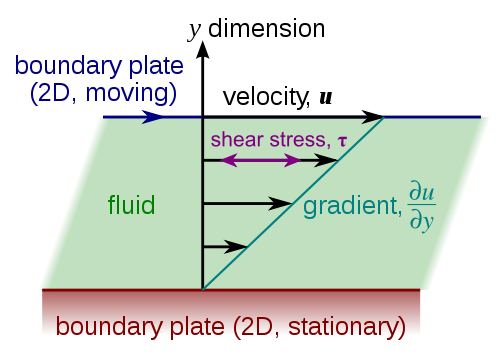
    One way to describe a fluid’s viscosity is as a measure of its resistance to deformation. Another way to think of it is how easily momentum is transmitted from one part of the fluid to another. The diagram above is the classic representation. A layer of fluid is sandwiched between two flat plates. If the top plate moves, friction requires that the fluid particles in contact with the plate get dragged along. This shears the fluid just below that and drags it along, but not quite as much. Those fluid particles do the same to their neighbors and so on down to the stationary second plate, where the fluid is at rest.

    Viscosity is the property that determines how much those neighboring fluid particles move; the more viscous the fluid, the more the neighboring bits of fluid resist getting pulled along. This is a property that’s inherent to a fluid. It comes from how the molecules of the fluid interact with one another, but there are no simple expressions to calculate the viscosity of a liquid or a gas from the individual interactions of its molecules. Instead we experimentally measure viscosity values and use empirical formulas to approximate how viscosity changes with temperature and other effects. (Image credit: Wikimedia)

  • Making Better Tags for Tracking Turtles

    Making Better Tags for Tracking Turtles

    Tagging equipment is used on all manner of aerial and marine creatures to gather data about animal behavior in their natural environments. It can be difficult, though, for researchers to gauge what effects the tags have on an animal. A recent study by T. T. Jones et al. used drag measurements on marine turtle casts to estimate the effects of common tagging equipment. They found that, on large turtles, the equipment increases a turtle’s drag by as little as 5%, but for smaller species or juvenile turtles, the drag cost can be much larger – in some cases doubling a turtle’s drag when swimming. Such large increases in drag may significantly change a tagged turtle’s behavior and skew results or even endanger the animal. The researchers suggest a model that allows others to estimate a tag’s drag effects across species. (Image credits: T. Gray and M. Carey; research credit: T. T. Jones et al.; via PopSci; submitted by Chi M.)

  • Fluids Round-up – 21 September 2013

    Fluids Round-up – 21 September 2013

    First off, I’d like to give a special shout-out to FYFD’s friends at Pointwise, who were kind enough to invite me for a visit this week. For any readers looking for CFD grid-generation software, check them out; they are a fantastic bunch and very good at what they do.

    My thanks again to everyone who donated this week to help get me to the APS conference. The campaign is still open if anyone wants to get in on the FYFD wallpapers and stickers on offer to donors. As a reminder, any funds beyond conference costs will go toward improving FYFD, including getting equipment to make FYFD videos. On to the fluids round-up!

    (Photo credit: L. Gilman)

  • Featured Video Play Icon

    Wind Tunnel Testing

    Wind tunnel testing is an important step in designing new aircraft. This video shows footage of visualization tests of the 21-ft wingspan Boeing X-48C model in NASA Langley’s Full-Scale Tunnel. The X-48C is a blended wing body design capable of higher lift-to-drag ratios than conventional aircraft, which should lead to a higher range and greater fuel economy. The video shows some smoke visualization that illustrates airflow around the airfoil-shaped craft. The long probe sticking forward from the starboard wing is used to measure air pressure, angle of attack, and sideslip angle of the model. Notice how smoke from the wand is pulled from below the leading edge of the wing up and over the top of the wing. This is because there is lower pressure over the top of the wing than the bottom, and, like an electrical charge seeking the path of least resistance, fluids flow preferentially toward lower pressures. (Video credit: NASA Langley)

  • Featured Video Play Icon

    Stingray Wakes

    This numerical simulation shows a swimming stingray and the vorticity generated by its motion. Stingrays are undulatory swimmers, meaning that the wavelength of their motion is much shorter than their body length. Manta rays, in contrast, move their fins through a wavelength longer than their body length, making them oscillatory swimmers. Observe the difference in this video. To swim faster, stingrays increase the frequency of their undulation, not the amplitude. This is quite common among swimmers because increasing the amplitude also increases projected frontal area, which causes additional drag. Increasing the frequency of motion does not affect the projected area, making it the more efficient locomotive choice. (Video credit: G. Weymouth; additional research credit: E. Blevins; submitted by L. Buss)

    Also, FYFD now has a Google+ page for those who prefer to follow along and share that way. – Nicole

  • Featured Video Play Icon

    Ski Jumping Aerodynamics

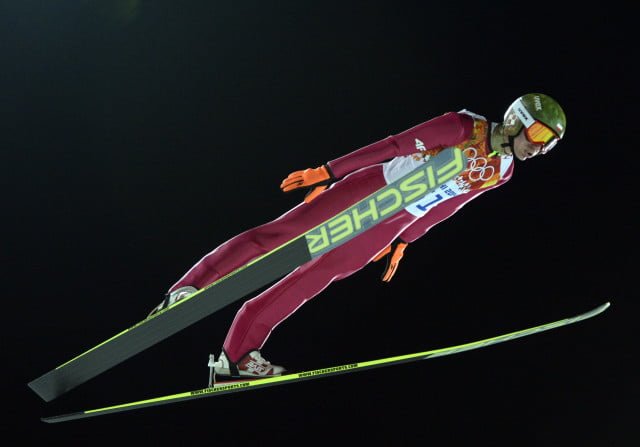
    Last summer we featured fluid dynamics in the Summer Olympics and there’s more to come for Sochi. Winter athletes like ski jumper Sarah Hendrickson are hard at work preparing, which can include time in wind tunnels, as shown here. There are two main diagnostics in tests like these: drag measurements and smoke visualization. The board Hendrickson stands on is connected to the tunnel’s force balance, which allows engineers to measure the differences in drag on her as she adjusts equipment and positions. This gives a macroscopic measure of drag reduction, and reduced drag makes the skier faster on the snow and lets her fly longer in the jump. The smoke wand provides a way to visualize local flow conditions to ensure flow remains attached around the athlete, which also reduces drag.  (Video credit: Red Bull/Outside Magazine; submitted by @YvesDubief)

  • Featured Video Play Icon

    Falcon vs. Raven

    Earth Unplugged has posted some great high-speed footage of a peregrine falcon and a raven in flight. Notice how both birds draw their wings inward and back on the upstroke. By doing so, they decrease their drag and thus the energy necessary for flapping. On the downstroke, they extend their wings fully and increase their angle of attack, creating not only lift but thrust. The falcon boasts an incredibly streamlined shape, not only along its body but also along its wings. In contrast, the raven has broader wings with large primary feathers that fan out near the tips. Splaying these large feathers out decreases the strength of the bird’s wingtip vortices, thereby reducing downwash and increasing lift, much the same way winglets do on planes. That extra lift and control the big primaries provide is important for the raven’s acrobatic skill. (Video credit: Earth Unplugged; via io9)