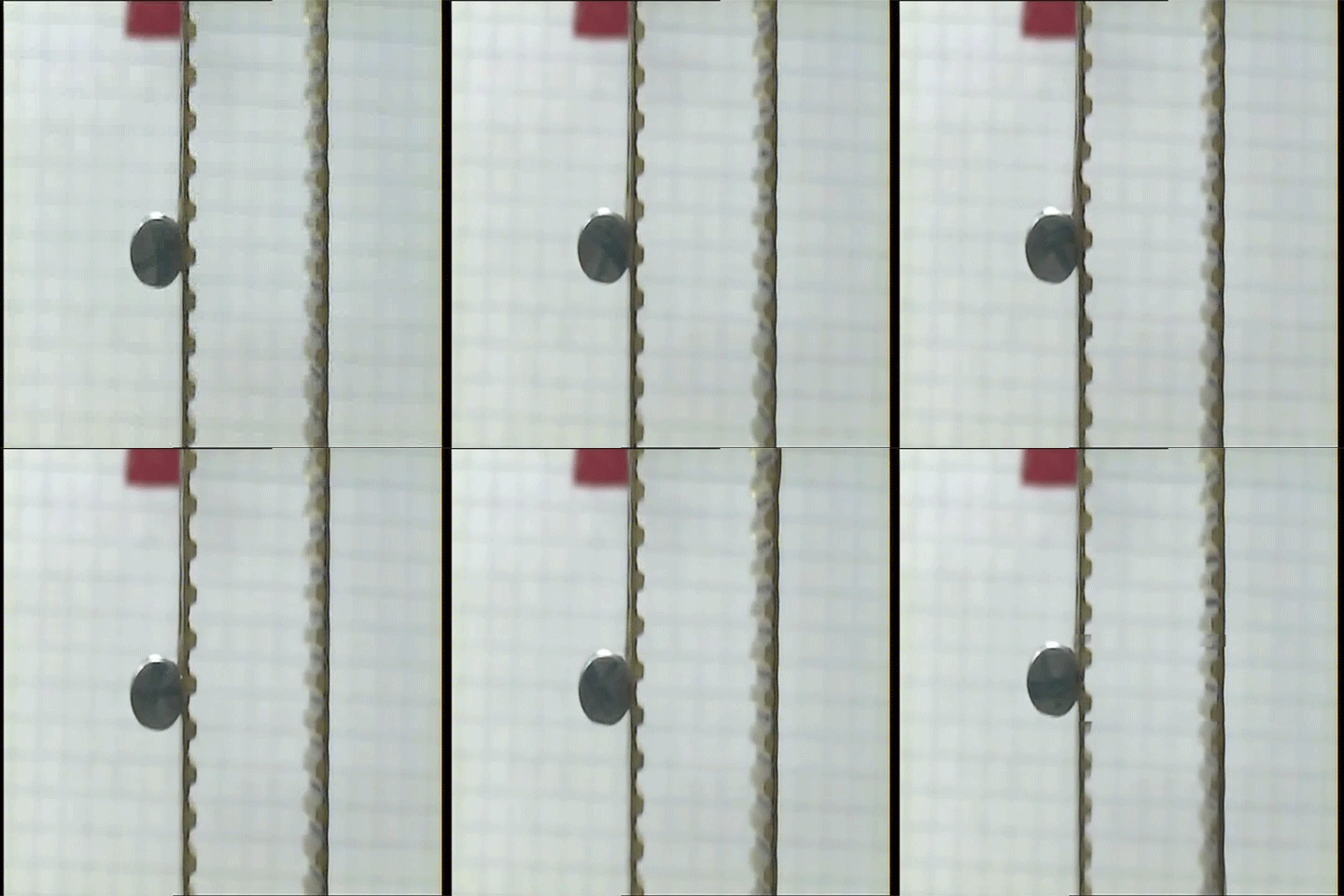
On a hot surface, droplets can float on a layer of their own vapor and vibrate in star-like shapes. These so-called Leidenfrost stars also make noise, with distinct beats that match the oscillations of the vapor layer beneath them. Researchers found that the frequency of the sound shifts with droplet size, increasing as the drop size decreases. Physically, the droplets act much like a wind instrument! (Image and research credit: T. Singla and M. Rivera; via APS Physics)
Search results for: “art”

Blue Jets
Blue jets are a mysterious form of lightning that shoots upward from intense thunderstorms. The image above comes from one of the first color videos of blue jets, taken by an astronaut aboard the International Space Station. Scientist think blue jets form during an electric breakdown between the positively-charged upper region of a cloud and the negative charge at its boundary. Once the discharge starts, it can shoot to the stratopause in less than a second, forming a glowing, blue, nitrogen-based plasma. (Image credit: ESA/NASA/DTU Space; via NASA Earth Observatory)

Spiderwebs and Stratocumulus Clouds
Stratocumulus clouds cover about 20% of Earth’s surface at any given time, and they form distinctive patterns of lumpy cells separated by thin slits. Because of their interconnectedness, researchers nicknamed these narrow regions spiderwebs. New simulations show that evaporative cooling along the cloud tops drives the formation of these spiderwebs (Image 2). Without it (Image 3), the cloud pattern looks very different. (Image credits: featured image – L. Dauphin/MODIS, others – UConn ME 3250; research credit: G. Matheou et al.)

The Unsinkable Pygmy Gecko
The Brazilian pygmy gecko is a tiny inhabitant of the Amazon rainforest, growing to no longer than 24 mm. But these tiny lizards have some incredible superpowers when it comes to surviving the rainforest’s deluges. The gecko’s surface is superhydrophobic — water repellent — thanks to millions of tiny hairs that create air pockets between water and the gecko’s skin. This superhydrophobic surface, combined with the gecko’s tiny stature, allow it to sit atop water, supported entirely by surface tension. (Image and video credit: BBC Earth)

Gathering Droplets
In deserts around the world, plants have adapted to collect as much moisture as they can. Geometry aids them in this endeavor because droplets on the tip of a cone will move toward its thicker base. The motion takes place due to a imbalance in surface tension forces on either end of the droplet.
As the droplet moves up a cone, it changes shape from a barrel-like drop that fully covers the conical surface to a clamshell-shaped droplet that hangs only from the bottom of the cone. (Image and research credit: J. Van Hulle et al.)

Jellyfish Make Their Own Walls
When we walk, the ground’s resistance helps propel us. Similarly, flying or swimming near a surface is easier due to ground effect. Most of the time swimmers don’t get that extra help, but a new study shows that jellyfish create their own walls to get that boost.
Of course, these walls aren’t literal, but fluid dynamically speaking, they are equivalent. Over the course of its stroke, the jellyfish creates two vortices, each with opposite rotation. One of these, the stopping vortex, lingers beneath the jellyfish until the next stroke’s starting vortex collides with it. When two vortices of equal strength and opposite rotation meet, the flow between them stagnates — it comes to halt — just as if a wall were there.
In fact, mathematically, this is how scientists represent a wall: as the stagnation line between a real vortex and a virtual one of equal strength and opposite rotation. It just turns out that jellyfish use the same trick to make virtual walls they can push off! (Image and research credit: B. Gemmell et al.; via NYTimes; submitted by Kam-Yung Soh)

Coastal Erosion
The same dynamic forces that make coastlines fascinating create perennial headaches for engineers trying to maintain coastlines against erosion. This Practical Engineering video discusses some of the challenges of coastal erosion and how engineers counter them.
In a completely undeveloped coastline, waves and storms erode the shoreline while rivers and currents replenish sand through sedimentation. Manmade structures tend to strengthen erosion processes while disrupting the sedimentation that would normally counter it. Beach nourishment — where sand gets dredged up and deposited on a beach — is an engineered attempt to replace natural sedimentation.
Dunes, mangrove forests, and wetlands are all nature’s way of protecting and maintaining coastlines. We engineers are still learning how to both utilize and protect shorelines. (Image and video credit: Practical Engineering)

“Satellike”
When watching Roman De Giuli’s “Satellike,” you may think you’re looking at satellite imagery of Earth. In reality, each sequence is a combination of watery ink and dried paint on paper. You can see some behind-the-scenes glimpses of the process and the artworks that inspired the work here. (Image and video credit: R. De Giuli; submitted by Mark S.)

Microfluidic Pac-Man
Researchers are using coalescence to guide microdroplets through a miniature maze, a la Pac-Man. To steer the main droplet, they place a smaller droplet nearby in the direction they want to move. When the drops coalesce, it moves the main droplet in the target direction. By repeating the process, researchers can drive the drop through a maze or perform tasks like cleaning or transporting particles by picking them up. Learn more over at APS Physics. (Image and research credit: J. Chaaban et al.; via APS Physics)

Snowflake Velocimetry
In our era of remote learning, students don’t always have a chance to do hands-on lab experiments in the usual fashion. But that doesn’t mean they can’t explore important flow diagnostic techniques. Here a simple smartphone video of snow falling gets turned into a lesson on particle image velocimetry, or PIV, a major technique for measuring flow velocities.
A nearby house acts as a fixed backdrop, and by comparing snowflake positions from one frame to the next, students can measure the instantaneous flow patterns in the snowfall. Of course, that’s a tedious task to do by hand, but luckily there are computer programs that do it automatically. Simply run the smartphone video through the software, and analyze the patterns it reveals!
As a bonus, students don’t have to get distracted by the complexities of laser sheets and flow seeding that are normally a part of PIV. Instead, the flow and the lighting are already right outside their window, and they can concentrate instead on learning the principles of the technique and how to use the software. (Image and submission credit: J. Stafford)