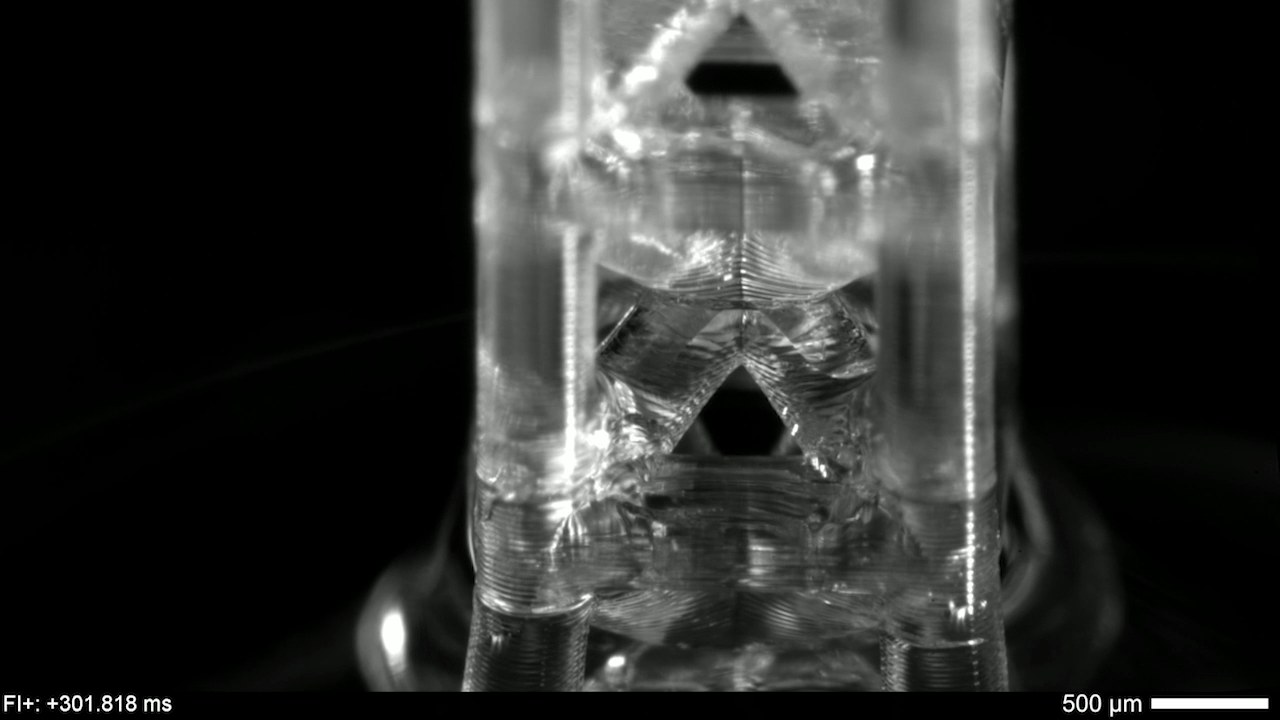
In the early days of submarines, it did not take physicists and engineers long to discover how destructive underwater explosions can be. In this Slow Mo Guys video, Gav gives us a glimpse of that destruction using a model submarine in a fish tank and several small explosives. You’ll have to be quick to notice the initial shock waves that ripple through the tank, but the footage captures spectacular detail on some of the slower-moving phenomena. You can see the uneven ripples of the explosion bubble’s surface as it expands. There are some great shots from the front and side showing the bubbly vortex ring that forms when the explosion hits the side of the tank wall (something that wouldn’t happen out in the ocean, of course). You can even catch a glimpse of some unexploded powder streaking out of the explosion. (Image and video credit: The Slow Mo Guys)
Search results for: “art”

Loopy Networks and Bird Lungs
When mammals breathe, air flows back and forth inside our lungs. But in birds that inhale and exhale get transformed into one-directional flow inside their lungs. To figure out how, researchers built loopy networks of pipes that turn oscillating flow into unidirectional flow.
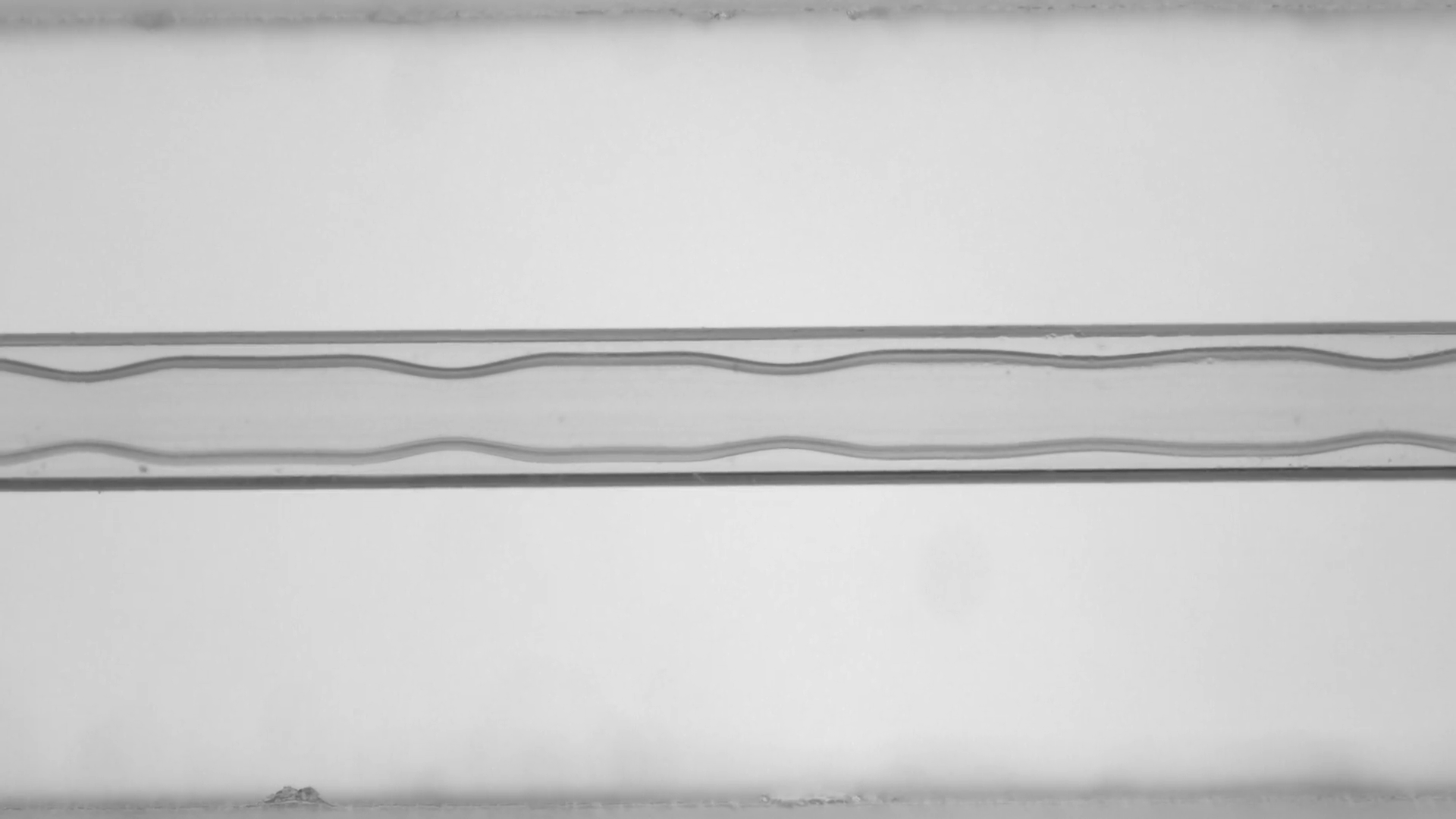
The simplest structure that does this is shown above. The main loop is driven by a pump that oscillates back and forth. A second loop connects through two T-junctions, oriented at 90-degrees to one another. Watch the particles in each loop carefully. Those in the bottom loop move back and forth, driven by the oscillating pump. But the particles in the upper loop only move in one direction! The key to this, the researchers found, are vortices that form at the T-junctions (last image). When the flow in the main loop changes direction, it creates vortices that block flow along one arm of the T-junction, thereby isolating the upper loop. (Image credit: bird – A. Mckie, others – Q. Nguyen et al.; research credit: Q. Nguyen et al.; via APS Physics; submitted by Kam-Yung Soh)

Viscoelastic Coiling
Drizzle honey or syrup from high enough, and you’ll see it coil like a liquid rope. This feature of viscous fluids also extends to polymer-filled viscoelastic fluids. But recent work shows that the elasticity of these fluids delays the onset of coiling; put differently, if you pour two fluids of comparable viscosity, the viscoelastic one will have to fall farther before it will start coiling. The authors also found that the coiling frequency for a viscoelastic fluid is smaller than a viscous one, given the same experimental conditions. (Image credit: flo222; research credit: Y. Su et al.)

Sea Swirls by the Shore
Water and sediments swirl in these enhanced satellite photos of China’s Leizhou Peninsula. Color-filtering algorithms have drawn out the details of the flows, but the patterns themselves are real. Tides, currents, sediment, and human activity combine to form these complex flows along the peninsula’s shores. The straight parallel lines seen off Liusha Bay, for example, are likely the result of a traditional fishing method using nets suspended off poles anchored into the seabed. (Image credit: N. Kuring; via NASA Earth Observatory)

Iceberg Melting Depends on Shape
Not all icebergs melt equally. Through a combination of experiment and numerical simulation, researchers have shown that an iceberg’s shape underwater strongly affects how it melts. Specifically, icebergs in a flow melt more quickly on the front and side surfaces and slower on the underside. This means that narrow icebergs that project deep into the water will melt faster than wider, shallow ones. Currently, climate models don’t account for this variation, but the researchers hope their work will help build more accurate models for future studies. (Image credit: iceberg – C. Matias, experiment – E. Hester et al.; research credit: E. Hester et al.; see also APS Physics)


Lava and Life
Kilauea’s 2018 eruption gave us some of the most stunning volcanic footage ever seen, a tradition carried on in this BBC footage. As powerful and destructive as lava is, it’s also critical to life as we know it here on Earth. Volcanoes are a piece of the tectonic activity on our planet that drives the carbon cycle, without which we’d have no oceans or breathable atmosphere. It’s tough to imagine the geological scales over which these cycles act, but fortunately, there are numerical simulations to help! (Image and video credit: BBC Earth)

Inside Hydroplaning
When a tire spins over a wet roadway, pressure at the front of the tire generates a lifting force; if that lift exceeds the weight of the car, it will start hydroplaning. To prevent this, the grooves of a tire’s tread are designed to redirect the water. Now researchers have visualized flow inside these grooves for the first time, using a version of particle image velocimetry (PIV). PIV techniques use fluorescent particles to track the flow.
The results reveal a complicated, two-phase flow inside the tire grooves. As seen in the images above, bubble columns form inside the tire grooves. The team’s results suggest that the bubble columns depended on groove width, spacing, and intersections with other grooves. They also saw evidence of vortices inside some grooves. (Image credit: tires – S. Warid, others – D. Cabut et al.; research credit: D. Cabut et al.; via Physics World; submitted by Kam-Yung Soh)

“Geodaehan”
In “Geodaehan” Roman De Giuli’s macro fluid art mimics massive landscapes. The film takes us over deltas, rivers, glaciers, and landslides. Some look like earthbound locations, others look like something from Mars or Titan. All are, in fact, paint, ink, and glitter on paper! It’s truly incredible how artists capture large-scale fluid physics on such a tiny canvas. (Image and video credit: R. De Giuli)

An Oasis Among Dunes
The Saudi Arabian oasis of Jubbah sits in the bed of an ancient lake. It’s protected from the westerly winds that sculpt the surrounding dunes by the wind shadow of the mountain Jabel Umm Sinman. The long, skinny shape of the settlement reveals the shape of the mountain’s wake! (Image credit: NASA; via NASA Earth Observatory)

Swapping Emulsions
Chemically speaking, oil and water don’t mix. But with a little fluid mechanical effort, it’s possible to make them an emulsion — a mixture of oil droplets in water or water droplets in oil. Researchers in the Netherlands discovered that the viscosity of these emulsions depends critically on which of those mixtures you have.
To create their emulsions, the team used a tank consisting of two concentric cylinders. When the inner cylinder spins, it creates a well-understood flow field between the inner and outer cylinder. By varying the ratio of oil to water in the tank, they could explore a wide range of emulsions. They found that the emulsion’s viscosity changed dramatically when the emulsion shifted from oil droplets in water to water droplets in oil, something known as a catastrophic phase inversion. During this switch the viscosity dropped from 3 times higher than pure water to 2 times lower! (Image credit: A_Different_Perspective; research credit: D. Bakhuis et al.; via APS Physics; submitted by Kam-Yung Soh)