Search results for: “art”

  • Artificial Microswimmers

    Artificial Microswimmers

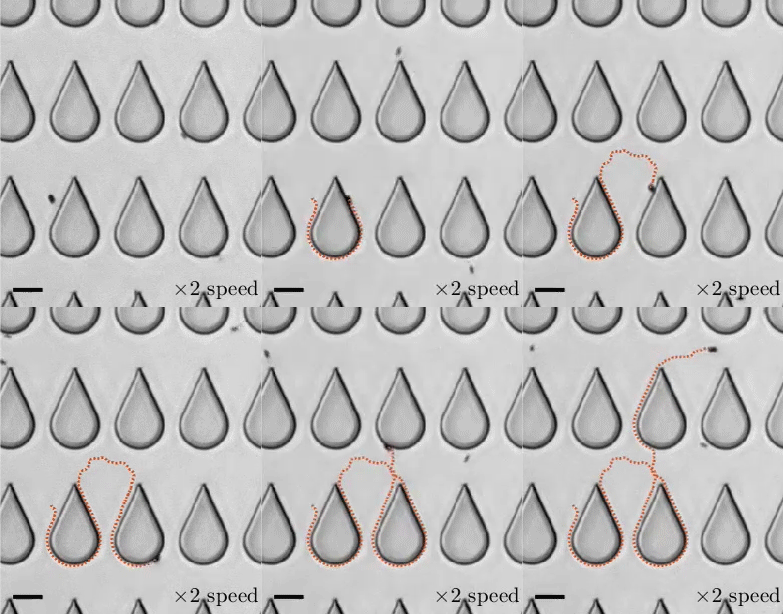
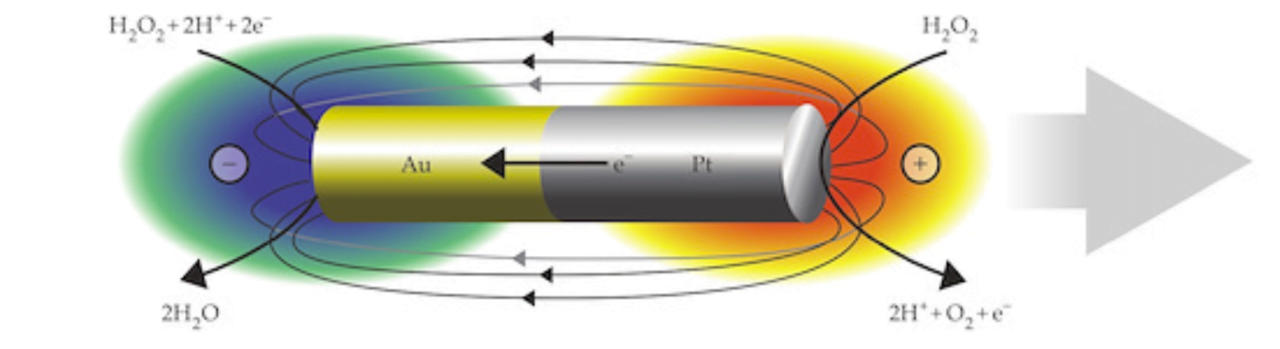
    In a 1959 lecture entitled “There’s Plenty of Room at the Bottom”, Richard Feynman challenged scientists to create a tiny motor capable of propelling itself. Although artificial microswimmers took several more decades to develop, there are now a dozen or so successful designs being researched. The one shown above swims with no moving parts at all.

    These microswimmers are simple cylindrical rods, only a few microns long, made of platinum (Pt) on one side and gold (Au) on the other. They swim in a solution of hydrogen peroxide, which reacts with the two metals to generate a positively-charged liquid at the platinum end and a negatively-charged one at the gold end. This electric field, combined with the overall negative charge of the rod, causes the microswimmer to move in the direction of its platinum end. 

    Depending on the hydrogen peroxide concentration, the microswimmers can move as quickly as 100 body lengths per second, and they’re capable of hauling cargo particles with them. One planned application for artificial microswimmers is drug delivery, though this particular variety is not well-suited to that since the salty environment of a human body disrupts the mechanism behind its motion. (Image credits: swimmers – M. Ward, source; diagram – J. Moran and J. Posner; see also Physics Today)

  • Floccing Particles

    Floccing Particles

    Adding particles to a viscous fluid can create unexpected complications, thanks to the interplay of fluid and solid interactions. Here we see a dilute mixture of dark spherical particles suspended in a layer of fluid cushioned between the walls of an inner and outer cylinder. Initially, the particles are evenly distributed, but when the inner cylinder begins to rotate, it shears the fluid layer. Hydrodynamic forces assemble the particles together into loose conglomerates known as flocs. Once the particles form these log-like shapes, they remain stable thanks to the balance between viscous drag on particles and the attractive forces that pull particles toward one another. (Image and research credit: Z. Varga et al.; submitted by Thibaut D.)

  • Guiding Particles with Chladni Patterns

    Guiding Particles with Chladni Patterns

    During the 19th century, Ernst Chladni and Michael Faraday independently explored the patterns formed by particles of different sizes placed on a vibrating plate. Faraday found that large particles accumulated at nodes of the plate, where there was no vertical vibration, whereas smaller particles moved toward anti-nodes, where air currents caused by the large vibration amplitude lifted them up.

    The situation becomes a little different if you submerge the vibrating plate in water. Then large, heavy particles gather at the anti-nodes. Drag keeps the particles on the plate, while acoustic forces and gravity conspire to move the particles horizontally toward the anti-nodes (top). Because anti-node patterns change with frequency, this actually provides a way to manipulate particle’s trajectories. The researchers demonstrated this by steering a particle through a maze (bottom) as well as by manipulating an entire swarm of beads. (Image and research credit: K. Latifi et al.; via Physics World; submitted by Kam-Yung Soh)

  • Earth, Moon, and Magma Ocean

    Earth, Moon, and Magma Ocean

    Among objects in our solar system, the Moon is rather unusual. It’s the only large moon paired with a rocky planet, and only Pluto’s Charon boasts a larger size relative to its planet. Chemically speaking, the Moon is also extremely similar to the Earth, which is part of why scientists theorized that the moon coalesced after the proto-Earth collided with a Mars-sized object. But lingering questions remained, like why the Moon is rich in iron oxide compared to the Earth.

    A new study tweaks the idea of the giant impactor by adding a magma ocean to the proto-Earth. In the early days of the solar system, collisions were so common that larger bodies (> 2*Mars) probably maintained a molten ocean. By simulating collisions with and without a magma ocean and studying the final composition of these simulated Earth-Moon-systems, the researchers found that a molten ocean not only matches the expected size and orbital characteristics of the two bodies, but the results reflect the actual chemical make-up of the  real Earth and Moon, too! (Image credits: moon – N. Thomas, impact simulation – N. Hosono et al.; research credit: N. Hosono et al.; via Ars Technica; submitted by Kam-Yung Soh)

  • Featured Video Play Icon

    The Art of Paper Marbling

    Known as ebru in Turkey and suminagashi in Japan, the art of paper marbling has flourished in cultures around the world since medieval times. The details of methods vary, but in general, the technique uses a base of oily water to float various dyes and pigments. Artists then use brushes, wires, and other tools to manipulate the dyes into the desired pattern. Paper is spread over the top to soak up the color pattern before being hung to dry. Every print made in this manner is a unique result of buoyancy, surface tension variation, and viscous manipulation. Check out the video above to watch a timelapse video showing the technique in action. (Video and image credit: Royal Hali)

  • Flow in the Heart

    Flow in the Heart

    Few flows are more integral to our well-being than blood flow through the heart. Over the course of our lives, our hearts develop from a few cells pushing viscous blood through tiny arteries to the muscular center of a vast circulatory network, capable of powering us through incredible physical feats. What’s most astonishing about all this is that the heart goes through all these changes and adaptations without ever pausing. 

    Peering into the heart to see it in action is difficult, but researchers today are combining imaging techniques like CT and MRI with computational fluid dynamics to build patient-specific heart models. Not only does this help us understand hearts in general; it’s paving the way toward predicting how a specific treatment may affect a patient. Imagine, for example, being able to simulate and compare different models of an artificial heart valve to see which will work best for a particular patient. We’re not to the point of doing so yet, but it’s a very real possibility in the future. 

    To see some examples of predicted and measured heart flows, check out this video by J. Lantz. In the meantime, happy Valentine’s Day! (Image credits: Linköping University Cardiovascular Magnetic Resonance Group, video source; via Another Fine Mesh)

  • Inside a Heart

    Inside a Heart

    You may not give it much thought, but there is important fluid dynamics happening inside you every moment of every day, especially inside your heart. Of the four chambers of the heart, the left ventricle has the thickest walls, reflecting its important task: pumping oxygenated blood throughout the body. In a healthy heart (top of poster; click here for the full-size version), a vortex ring and trailing jet fill the ventricle when the mitral valve opens. Then the ventricle contracts and pumps blood out the aortic valve and into the rest of the body.

    But for individuals with a leaking aortic valve (bottom of poster), things look different. Blood leaks back through the aortic valve at the same time that the mitral valve opens to allow freshly oxygenated blood back in. The two inflows disrupt mixing in the chamber, and, instead of pumping fully-oxygenated blood into the body, the left ventricle has to struggle to pump a less-oxygenated mixture into the body. (Image credit: G. Di Labbio et al.)

    ETA: (Research paper: G. Di Labbio et al., arXiv)