Search results for: “art”

  • Soaring Pelicans

    Soaring Pelicans

    Earlier this summer, I looked up on a bright, sunny day and saw a quartet of black and white figures soaring overhead. Initially, I thought it might be a formation of kites or unmanned aerial vehicles (UAVs) because I saw no flapping as the group wheeled about. With the help of the Cornell Lab of Ornithology’s awesome Merlin app, I was able to identify the soarers as American white pelicans – not a species I’d expected to find flying along the Front Range of the Rocky Mountains! (Turns out, they breed on lakes around here.)

    The reason I saw so little flapping is that the birds were riding thermals. As the sun heats the ground, air near the surface warms up and begins to rise due to its buoyancy. Pelicans interested in flying between breeding and foraging grounds will start testing the thermals early in the day, as soon as they begin to form. As the heating continues, the intensity of thermals strengthens and they extend higher into the atmosphere. This is where the birds can really excel at using atmospheric energy for their flight. Pelicans will circle within a thermal until they reach roughly the middle of its height. Then they will glide, gradually losing altitude until they reach another thermal where they can climb without expending their own energy. With a 2.7 meter wingspan and a relatively low drag coefficient, the pelicans can glide and soar remarkably well. Researchers have even suggested using them as a sort of biological UAV for studying atmospheric dynamics! (Image credits: D. Henise, M. Stratmoen; research credit: H. Shannon et al., pdfs – 1, 2)

  • Review: “ABCs From Space”

    Review: “ABCs From Space”

    For me, one of the most fun aspects of studying science is seeking out examples of it in the world around us. Adam Voiland – who writes for NASA Earth Observatory, one of FYFD’s favorite sources for excellent fluids in action – takes this a step further with his children’s book “ABCs From Space: A Discovered Alphabet”. Voiland has sought out satellite imagery from around the world to illustrate all twenty-six letters, creating a lovely book for budding scientists of all sorts.

    Each letter has its own full-page image with no added text, like the G and H shown above. Younger children will have fun identifying and tracing out each letter. The back of the book provides more detail for older kids and adults, including brief descriptions of where and what each image shows, a map of all image locations, and some FAQs about satellite imagery and the geology, meteorology, and earth science on display. There are enough specifics to satisfy casual interest, but I suspect that science-inclined adults will find the book a fun springboard for more in-depth discussions with curious kids.

    Fluid dynamics itself makes a solid showing in the book. Several letters are formed by vortices (like G above) and various types of clouds, including the ship track clouds (like H) that form when water condenses on aerosols released by ship exhaust. There are also meandering rivers, creeping glaciers, and erosion features among the letters.

    I’m often asked about resources for teaching kids about fluid dynamics, and Voiland’s book is a great option for introducing that subject, as well as many other fields of science. (Image credits: A. Voiland/Simon & Schuster)

    Disclosure: I received a review copy of this book but was not otherwise compensated by the author or publisher. All opinions are my own. Additionally, this post contains affiliate links. Purchases made using these links do not cost you anything extra but may provide FYFD with a commission. Thanks!

  • Optimal Swimming

    Optimal Swimming

    What do trout, sharks, and whales have in common? All are fast swimmers and share remarkable similarities in their swimming dynamics despite different sizes, shapes, and environments. A new study analyzing aquatic locomotion examines the characteristics of these swimmers. The researchers found that a typical parameter for studying swimming fish – the Strouhal number, which relates swimming speed, body length, and tail-beat frequency – only tells part of the story. When cruising at minimum power input, a fish cannot choose its Strouhal number – that characteristic is completely determined by the fish’s shape, which determines its drag.

    Instead, researchers found that a second additional number – the ratio of the tail-beat amplitude to the body length – was also needed to describe optimal swimming. Taken together, their model predicts that optimal swimming performance lies within a narrow range of the two numbers. And when the researchers examined cruising behaviors of a diverse variety of fish and whales, they found that they did indeed swim in the ranges predicted by the model. Now that we better understand characteristics of efficient swimming, engineers can use the model to guide designs of new biologically-inspired robot swimmers.   (Image credit: N. Sharp, source; research credit: M. Saadat et al.)

  • Hair in the Flow

    Hair in the Flow

    Humans are hairy on the inside. Not in the way that we are on the outside, but in the sense that many interior surfaces of our bodies are covered in small, flexible, hair-like protrusions like the papillae on our tongues or the cilia in our intestines. Many of these fibers are immersed in fluids, raising the question of how the flow and the hairs interact. An elastic fiber immersed in a flow will bend in the direction of the flow (bottom); this helps reduce the drag and widens the channel flow goes through compared to a stiff, upright fiber. 

    But what happens when the fibers are all mounted at an angle? In this case, researchers found an asymmetric response. If flow moves in the direction of the fibers’ bend, the hairs don’t impend the flow at all. If flow moves against that direction, however, the hairs start to stand upright, blocking the flow channel and increasing the drag. The researchers suggest this sort of mechanism could be use in micro-hydraulic devices in the same way as a diode in a circuit – allowing flow in only one direction. For another biological example of flow control, check out how a shark’s denticles can prevent flow separation. (Image credits: hairy surface – J. Alvarado et al., flow around a hair – J. Wexler et al.; research credit: J. Alvarado et al.)

  • Fluid Black Holes

    Fluid Black Holes

    Fluid systems can sometimes serve as analogs for other physical phenomena. For example, bouncing droplets can recreate quantum effects and a hydraulic jump can act like a white hole. In this work, a bathtub vortex serves as an analog for a rotating black hole, a system that’s extremely difficult to study under normal circumstances. In theory, the property of superradiance makes it possible for gravitational waves to extract energy from a rotating black hole, but this has not yet been observed. A recent study has, however, observed superradiance for the first time in this fluid analog.

    To do this, the researchers set up a vortex draining in the center of a tank. (Water was added back at the edges to keep the depth constant.) This served as their rotating black hole. Then they generated waves from one side of the tank and observed how those waves scattered off the vortex. The pattern you see on the water surface in the top image is part of a technique used to measure the 3D surface of the water in detail, which allowed the researchers to measure incoming and scattered waves around the vortex. For superradiance to occur, scattered waves had to be more energetic after interacting with the vortex than they were before, which is exactly what the researchers found. Now that they’ve observed superradiance in the laboratory, scientists hope to probe the process in greater detail, which will hopefully help them observe it in nature as well. For more on the experimental set-up, see Sixty Symbols, Tech Insider UK, and the original paper. (Image credit: Sixty Symbols, source; research credit: T. Torres et al., pdf; via Tech Insider UK)

  • Surge Flows

    Surge Flows

    Sandy beaches can be a great place to play with neat flows. In a recent video, Frank Howarth describes playing with beach rivers on the Oregon coast and observing a surge flow there. Under the right conditions, a current flowing over sand will build up sand ripples large enough that they form miniature dams in the flow. This traps additional water, which eventually collapses the sand ripples, releasing a surge of water. The surge tends to smooth out the sand and cause the ripple-making process to start over. It’s a fairly unusual phenomenon, but it’s one known to happen seasonally in a few specific places, like at Medano Creek in Colorado’s Great Sand Dunes National Park. There the snowmelt-fed creek surges during the late spring and early summer, releasing a fresh wave every 20 seconds or so. (Image credit: F. Howarth, source; h/t to Sebastian E.)

  • Solar Eclipses and Coronal Mass Ejections

    Solar Eclipses and Coronal Mass Ejections

    Observations of many solar phenomena have only become accessible to humans relatively recently with the advent of satellites. Prior to that, it simply wasn’t feasible to observe dynamics in the sun’s atmosphere, like solar prominences or coronal mass ejections – the sun was simply too bright to see them – except during the occasional total solar eclipse!

    In the 1970s, scientists identified massive bursts of solar plasma as coronal mass ejections. These solar storms are responsible for so-called space weather and, when directed toward Earth, can pose a hazard to technologies on the ground and astronauts in orbit. Scientists initially thought this was the first time such storms had been observed, but they later recognized that photographs and sketches of an 1860 total eclipse revealed that humanity had seen a coronal mass ejection more than 100 years before! Check out the NASA video below for the full story. You can also learn about some of the science that will be going on in today’s eclipse. And, for those in the U.S. today, have a fun and safe time viewing the ecliipse!  (Image credit: S. Habbal, M. Druckmüller and P. Aniol, source; video credit: NASA Goddard)

  • Oreo Dunking Physics

    Oreo Dunking Physics

    As most people know, cookie dunking is serious business. Everyone has their own preference for cookie saturation and stiffness. Happily, scientists have examined this problem and have advice to offer those seeking cookie dunk perfection. Previously, we discussed Len Fisher’s Ig Nobel Prize-winning work on the physics of cookie dunking. In that work, Fisher found that Washburn’s equation for flow through cylindrical pores worked well to describe the uptake of tea or milk into a cookie.

    More recently, Splash Lab researchers have investigated just how much milk several common American cookies – including Oreos – take up in a given dunk. Because these cookies are quite dry, they take up liquid quickly, soaking in about 80 percent of the liquid weight within the first 2 seconds when dipped in 2% milk. Within five seconds, the cookies take on 99% of their liquid weight capacity, so there’s no point to a longer dunk – unless you like your cookie to disintegrate into the milk. The fat and sugar content of the dunking liquid does affect how quickly capillary action can whisk fluid into the cookie’s pores, but, overall, the research shows that milk users should be well-served by a three second dunk. If you like your cookie softer than that, simply pull it out of milk and let it sit for a bit while the milk soaks in. That way, your cookie doesn’t crumble! (Image credits: A. Melton; research credit: R. Hurd et al.; h/t to Randy H. and Mental Floss)

  • Featured Video Play Icon

    Chinese Spouting Bowl Physics

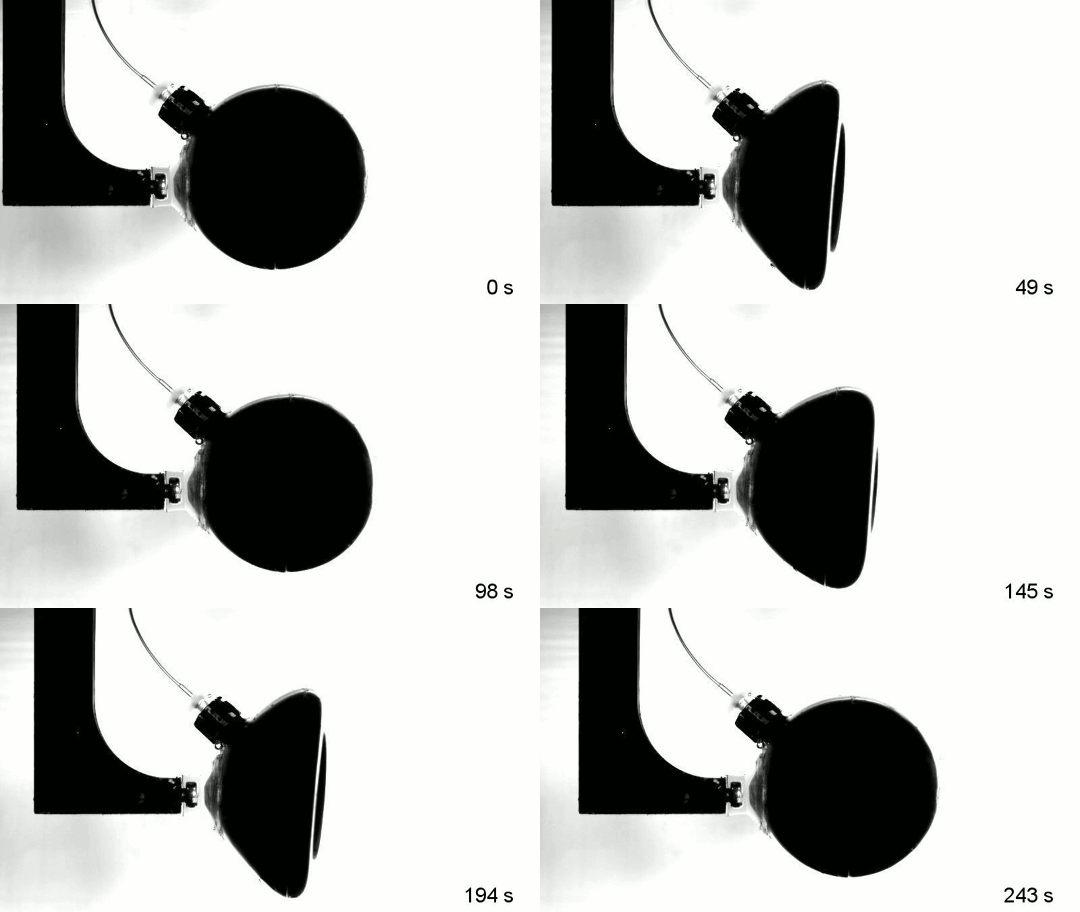
    In their newest video, the Slow Mo Guys recreated one of my favorite effects: vibration-driven droplet ejection. For this, they use a Chinese spouting bowl, which has handles that the player rubs after partially filling the bowl with water. By rubbing, a user excites a vibrational mode in the bowl. Watch the GIFs above and you can actually see the bowl deforming steadily back and forth. This is the fundamental mode, and it’s the same kind of vibration you’d get from, say, ringing a bell. 

    Without a high-speed camera, the bowl’s vibration is pretty hard to see, but it’s readily apparent from the water’s behavior in the bowl. In the video, Gav and Dan comment that the ripples (actually Faraday waves) on the water always start from the same four spots. That’s a direct result of the bowl’s movement; we see the waves starting from the points where the bowl is moving the most, the antinodes. In theory, at least, you could see different generation points if you manage to excite one of the bowl’s higher harmonics. The best part, of course, is that, once the vibration has reached a high enough amplitude, the droplets spontaneously start jumping from the water surface! (Video and image credits: The Slow Mo Guys; submitted by effyeah-artandfilm)

  • Featured Video Play Icon

    When Fire Ants are a Fluid

    Substances don’t have to be a liquid or a gas to behave like a fluid. Swarms of fire ants display viscoelastic properties, meaning they can act like both a liquid and a solid. Like a spring, a ball of fire ants is elastic, bouncing back after being squished (top image). But the group can also act like a viscous liquid. A ball of ants can flow and diffuse outward (middle image). The ants are excellent at linking with one another, which allows them to survive floods by forming rafts and to escape containers by building towers. 

    Researchers found the key characteristic is that ants will only maintain links with nearby ants as long as they themselves experience no more than 3 times their own weight in load. In practice, the ants can easily withstand 100 times that load without injury, but that lower threshold describes the transition point between ants as a solid and ants as a fluid. If an ant in a structure is loaded with more force, she’ll let go of her neighbors and start moving around.

    When they’re linked, the fire ants are close enough together to be water-repellent. Even if an ant raft gets submerged (bottom image), the space between ants is small enough that water can’t get in and the air around them can’t get out. This coats the submerged ants in their own little bubble, which the ants use to breathe while they float out a flood. For more, check out the video below and the full (fun and readable!) research paper linked in the credits. (Video and image credits: Vox/Georgia Tech; research credit: S. Phonekeo et al., pdf; submitted by Joyce S., Rebecca S., and possibly others)

    ETA: Updated after senoritafish rightfully pointed out that worker ants are females, not males.