Category: Research

  • Avoiding Droplet Contact

    Avoiding Droplet Contact

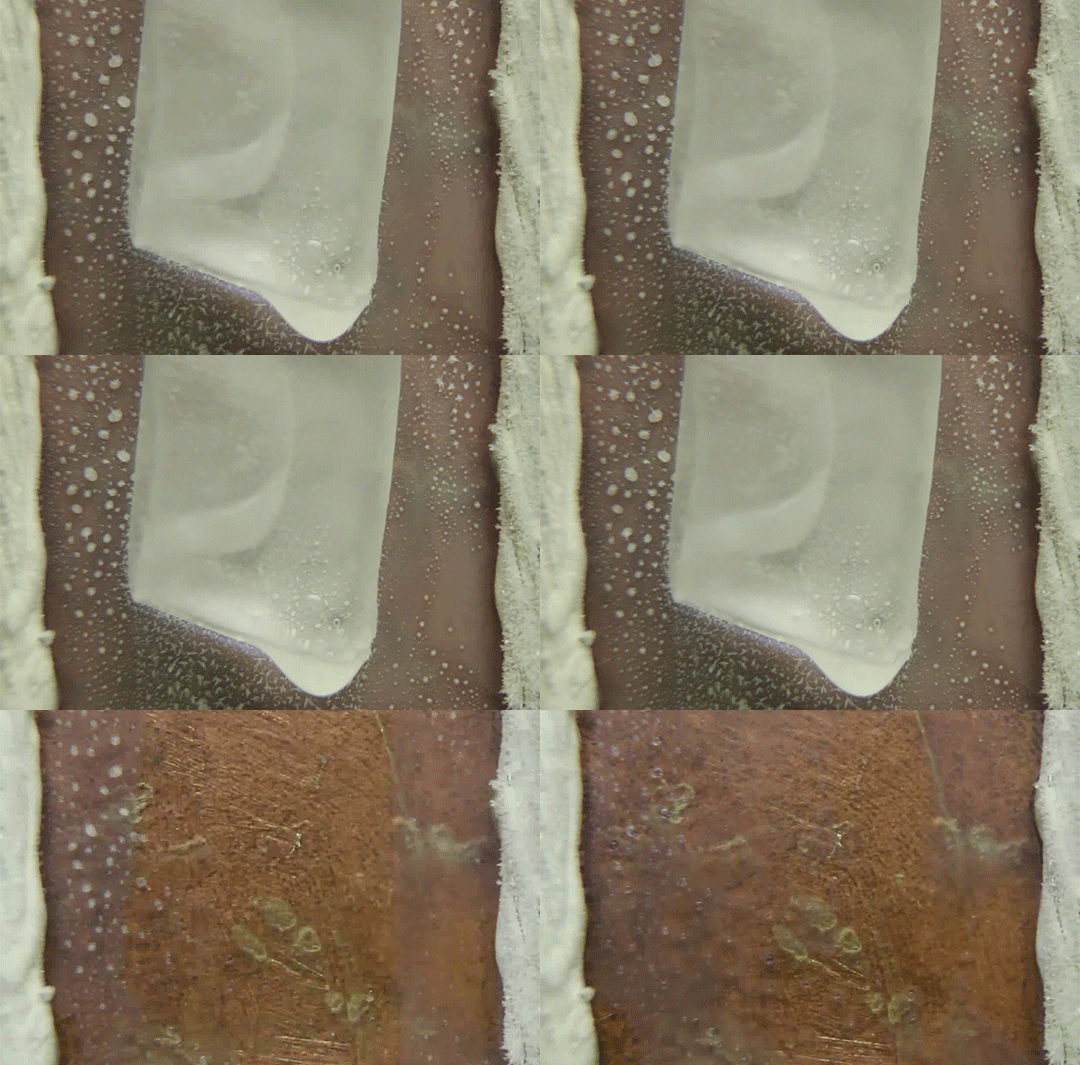
    Cold rain splashing on airplane wings can freeze in instants. To prevent that, researchers look for ways to minimize the time and area of contact a drop has. Hydrophobic coatings and textures can do some of the work, but they are easily damaged and don’t always work well when it comes to freezing.

    The new technique shown here uses ring-shaped “waterbowls” to help deflect drops. As the drop impacts and spreads, the walls of the ring texture force the lamella up and off the surface. This reduces both the time and area of contact and, under the right circumstances, cuts the heat transfer between the fluid and surface in half. The technique is useful for more than just preventing freezing, though; it would also be helpful for waterproofing breathable fabrics, where shedding moisture quickly without clogging pores is key to keeping the wearer dry. (Image and research credit: H. Girard et al.; via MIT News and Gizmodo)

  • Featured Video Play Icon

    Understanding Meteorite Geometry

    Back in February 2013, the skies over Russia were lit by the fall and explosion of a large meteor. The scavenger hunt for meteorite pieces that followed turned up lots of conically-shaped chunks of rock, consistent with other meteors. Why do so many meteorites end up in this shape? There are a couple factors influencing it.

    The first is that erosion during flight tends to shape initially spherical meteor chunks into broad cones. And that shape, it turns out, is remarkably stable in flight. By dropping cones of various geometries, researchers can test how stable they are in flight: do they change orientation, flutter back and forth, or drop straight down? Slender cones (below) tend to invert and tumble. Very broad cones flutter back and forth as they fall. But for an intermediate cone angle – similar to the one found in meteorites – the cones stay perfectly oriented, so once the rock erodes into that cone, it will keep that shape. (Image and video credit: K. Amin et al.)

  • Featured Video Play Icon

    Reducing the Force of Water Entry

    As anyone who’s jumped off the high board can tell you, hitting the water involves a lot of force. That’s because any solid object entering the water has to accelerate water out of its way. This is why gannets and other diving birds streamline themselves before entering the water. But even for non-streamlined objects, like a sphere, there are ways to reduce the force of impact.

    This video explores three such techniques, all of which involve disturbing the water before the sphere enters. In the first, the sphere is dropped inside a jet of fluid. Since the jet is already forcing water down and aside when the sphere enters, the acceleration provided by the sphere is less and so is the force it experiences.

    The second and third techniques both rely on dropping a solid object ahead of the one we care about. In the second case, a smaller sphere breaks the surface ahead of the larger one, allowing the big sphere to hit a cavity rather than an undisturbed surface. Like with the jet, the first sphere’s entry has already accelerated fluid downward, so there’s less mass that the bigger sphere has to accelerate, thereby reducing its impact force.

    In the third case, the first sphere is dropped well ahead of the second, creating an upward-moving Worthington jet that the second sphere hits. In this case, there’s water moving upward into the sphere, so how could this possibly reduce the force of entry? The key here is that the water of the jet wets the sphere before it enters the pool. Notice how very little air accompanies the second sphere compared to the first one. That’s because the second sphere is already wet. It’s also been slowed down by the jet so that it enters the water at a lower speed, all of which adds up to a lower force of entry. (Image and research credit: N. Speirs et al.)

  • Storing Memory in Bubbles

    Storing Memory in Bubbles

    Soft systems like this bubble raft can retain memory of how they reached their current configuration. Because the bubbles are different sizes, they cannot pack into a crystalline structure, and because they’re too close together to move easily, they cannot reconfigure into their most efficient packing. This leaves the system out of equilibrium, which is key to its memory. 

    By shearing the bubbles between a spinning inner ring (left in image) and a stationary outer one (not shown) several times, researchers found they they could coax the bubbles into a configuration that was unresponsive to further shearing at that amplitude. 

    Once the bubbles were configured, the scientists could sweep through many shear amplitudes and look for the one with the smallest response. This was always the “remembered” shear amplitude. Effectively, the system can record and read out values similar to the way a computer bit does. Bubbles are no replacement for silicon, though. In this case, scientists are more interested in what memory in these systems can teach us about other, similar mechanical systems and how they respond to forces. (Image and research credit: S. Mukherji et al.; via Physics Today; submitted by Kam-Yung Soh)

  • Condensing Halos

    Condensing Halos

    Drops that impact a very hot surface will surf on their own vapor, and ones that hit a very cold surface will freeze almost immediately. But what happens when the temperature differences aren’t so extreme? Scientists explored this (above) by dropping room-temperature water droplets onto a cool surface – one warmer than the freezing point but cooler than the dew point at which water condenses. 

    They found that impacting drops formed a triple halo of condensate (right).  The first and brightest ring forms at the radius of the drop’s maximum extent during impact. The second band forms from water vapor that leaves the droplet at impact. As that vapor cools, it condenses into a second band. The final, dimmest band forms as the droplet stabilizes and cools. It’s the result of water vapor near the droplet continuing to cool and condense. (Image and research credit: Y. Zhao et al.; via Nature News; submitted by Kam-Yung Soh)

  • Dandelion Flight, Continued

    Dandelion Flight, Continued

    Not long ago, we learned for the first time that dandelion seeds fly thanks to a stable separated vortex ring that sits behind their bristly pappus. Building on that work, researchers have now published a mathematical analysis of flow around a simplified dandelion pappus. Despite their simplifications, the model captures the flow observed in the previous experiments (bottom image: experiments on left; model on right). 

    The model also allowed researchers to test various features – like the number of filaments in the pappus – and see how they affected the flow. Interestingly, they found that dandelion flight was most stable with about 100 filaments, which is right around the number of a typical pappus! (Image credits: dandelion – Pixabay, figure – P. Ledda et al.; research credit: P. Ledda et al.; via APS Physics; submitted by Kam-Yung Soh and Marc A.)

  • Prehistoric Filter Feeders

    Prehistoric Filter Feeders

    Earth’s earlier ages are filled with enduring mysteries about the plants and creatures that lived and died long before humanity. Many of these organisms, like the aquatic Ernietta shown above, are known only from scattered fossil remains. Yet fluid dynamics is helping us understand how Ernietta lived and fed some 545 million years ago.

    Ernietta were sack-like organisms consisting of stitched-together tubular elements. They had no way to move around and no obvious method for transporting nutrients into their bodies. Scientists hypothesized that they likely used one of two feeding methods: either Ernietta relied on its surface area to extract nutrients directly from the water or its shape enabled it to trap larger particles to feed on from the flow. To decide between these modes, scientists turned to computational fluid dynamics.

    By modelling both single Ernietta and small groups, they found that the shape of the organism generates a rotating current inside the bag that pulls flow down along one side and back up the other. Moreover, being near one another enhanced this effect, helping downstream Ernietta catch more particles than they otherwise would. All in all, the results suggest not only Ernietta’s likely feeding method but also that they lived in colonies and practiced one of the earliest known examples of communal feeding! (Image credit: D. Mazierski, source; research credit: B. Gibson et al.; via ArsTechnica; submitted by Kam-Yung Soh)

  • Urban Centers During Hurricanes

    Urban Centers During Hurricanes

    As the climate warms, many urban centers are facing stronger and more frequent storms. Some, like New York City, are using numerical simulations to better understand the interactions of their complicated urban geometries with hurricane force winds. 

    Above you see a simulation showing predicted wind speeds in a Lower Eastside neighborhood. The incoming wind speed (from the left) is roughly 60 m/s (~134 mph), but the speeds around and between buildings are as much as 2 times higher than that. That means that, even if a storm is Category 3 or 4, there will be areas of a neighborhood that receive sustained winds well beyond the range of a Category 5 hurricane. Urban planners need this sort of data both for devising building requirements and for understanding what storm conditions warrant mandatory evacuations for residents. (Video and image credit: X. Jiang et al.)

  • Transporting Droplets

    Transporting Droplets

    Transporting droplets easily and reliably is important in many microfluidic applications. While this can be done using electric fields, those fields can impact biological characteristics researchers are trying to measure. As an alternative, a group of researchers have developed the concept of “mechanowetting,” a technique that uses surface tension forces to hold droplets on a traveling wave.

    Now visually, it’s a bit tough to see what’s going on here. In the animations, it looks like the droplets are just sticking to a moving surface, but that’s an illusion. The surface the droplet is sitting on is fixed and unmoving. It’s a thin silicone film that covers a ridged conveyor belt. The belt underneath can (and does) move. This creates a traveling wave. Instead of that wave simply passing beneath the droplet, it triggers an internal flow and restoring force that helps the drop follow the wave. The effect is strong enough that small droplets are even able to climb up vertical walls or stick upside-down. (Image, research, and submission credit: E. de Jong et al.)

  • Oil-on-Water Impact

    Oil-on-Water Impact

    Although many people have studied droplet impacts over the years, there’s been remarkably little work done with oil-on-water impacts. One of the things that makes this situation different is that the oil and water are completely immiscible, which means we can see aspects of the impact process that are invisible with, say, water-on-water impacts.

    The animation above shows an underwater view of the oil droplet’s impact. The energy of the initial impact creates an expanding crater and an unstable crown splash. That crown splash contains both water and oil. After it ejects some droplets, the rim stabilizes, but we can still see small perturbations along its edge as it starts to retract. In the water, high surface tension damps out these perturbations. Not so for the oil! As the crater retracts, the small disturbances along the rim get stretched into mushroom-shaped fingers that point inward toward the impact site. Because the index of refraction is different between oil and water, we can see the fingers clearly near the end of the animation. (Image and research credit: U. Jain et al.; submitted by Utkarsh J.)