Category: Research

  • Featured Video Play Icon

    Coalescence in Heavy Metal Droplets

    When a drop of water falls into a pool, it doesn’t always coalesce immediately. Instead, it can go through a coalescence cascade in which the drop partially coalesces, a daughter drop bounces off the surface, settles, and itself partially coalesces. We’ve seen this many times before, but today’s video shows something a little different: here the drop and pool in question are made of a gallium alloy immersed in a background of sodium hydroxide. This means that the drop has very high surface tension (and density) but does not form an oxidation layer on its surface that could inhibit coalescence. And just like the water droplet, the gallium alloy undergoes a series of partial coalescences.

    A heavy metal droplet undergoes partial coalescence with a pool of the same liquid.

    There’s one key difference, though. Did you notice that the water droplets bounce higher as the drops get smaller, but the gallium droplets do the opposite? Previous research suggested that the droplet rebound height is driven by capillary forces, but the high surface tension of both of these liquids means that capillary forces should be large for both of them. Perhaps there’s much more viscous drag in the gallium and sodium hydroxide case? (Image, video, and research credit: R. McGuan et al.)

  • Holding Fast in the Flow

    Holding Fast in the Flow

    Many tiny creatures in the natural world face living in fast flows. The larvae of the net-winged midge, for example, forage their way through fast-flowing Alpine springs with speeds of 3 m/s or more. You or I would find standing in such water a challenge, but these larvae are unbothered, thanks to the clever suction-cup-like appendages that help anchor them to rough rocks.

    The larvae generate their strong attachment with an outer rim flexible enough to conform to uneven surfaces. When they activate the central piston of the suction cup, this creates a seal strong enough to withstand forces up to 600 times the larvae’s body weight. But holding on to one spot forever is hardly useful, so the larvae also have a V-shaped notch in the cup controlled by dedicated muscles. When activated, this quickly breaks the seal, allowing the larvae to relocate. (Image and research credit: V. Kang et al.; via The Engineer; submitted by Marc A.)

  • Featured Video Play Icon

    Superwalking Droplets

    Vibrate a pool of silicone oil and you can generate walking droplets. Drive the vibration at two simultaneous frequencies and you can support much larger droplets, known as superwalkers. These superwalkers have their own intriguing dynamics, a few of which are featured in this video.

    Superwalkers can create promenading pairs, chase one another, orbit, and even form ordered and disordered crystals. They can even generate stop-and-go traffic patterns. As with regular walkers, these complex behaviors come from the interaction of bouncing droplets with their ripples and those of their neighbors. (Image, video, and research credit: R. Valani et al.)

  • Morphing Wings Using Real Feathers

    Morphing Wings Using Real Feathers

    Although humanity has long been inspired by bird flight, most of our flying machines are nothing like birds. Engineers have struggled to recreate the ease with which birds are able to morph their wings’ characteristics as they change from one shape to another. Now researchers have built a biohybrid robot, PigeonBot, that uses actual pigeon feathers as part of its morphing design.

    Many species of birds, including pigeons, have Velcro-like hooks in the microstructure of their feathers. These hooks help the flight feathers stick to one another and create a continuous wing surface that air cannot easily slip through, even as the wing drastically changes shape. By using actual feathers, PigeonBot shares this advantage.

    PigeonBot also has a somewhat minimalist design in its articulation, using only a wrist and finger joint in each wing to control shape. The feathers are connected through an elastic ligament, which — along with their microstructure — allows them to smoothly change shape under aerodynamic loads. The end result is a remarkably capable and agile biorobot researchers can use to better understand how birds control their flight. (Image and research credit: L. Matloff et al. and E. Chang et al.; via NPR and Gizmodo)

  • Featured Video Play Icon

    Rattlesnakes Sip Rain From Their Scales

    Getting enough water in arid climates can be tough, but Western diamondback rattlesnakes have a secret weapon: their scales. During rain, sleet, and even snow, these rattlesnakes venture out of their dens to catch precipitation on their flattened backs, which they then sip off their scales.

    Researchers found that impacting water droplets tend to bead up on rattlesnake scales, forming spherical drops that the snake can then drink. Compared to other desert-dwelling snakes, Western diamondbacks have a far more complicated microstructure to their scales, with labyrinthine microchannels that provide a sticky, hydrophobic surface for impacting drops. (Video and image credit: ACS; research credit: A. Phadnis et al.; via The Kid Should See This)

  • Tapping a Can Won’t Save Your Beer

    Tapping a Can Won’t Save Your Beer

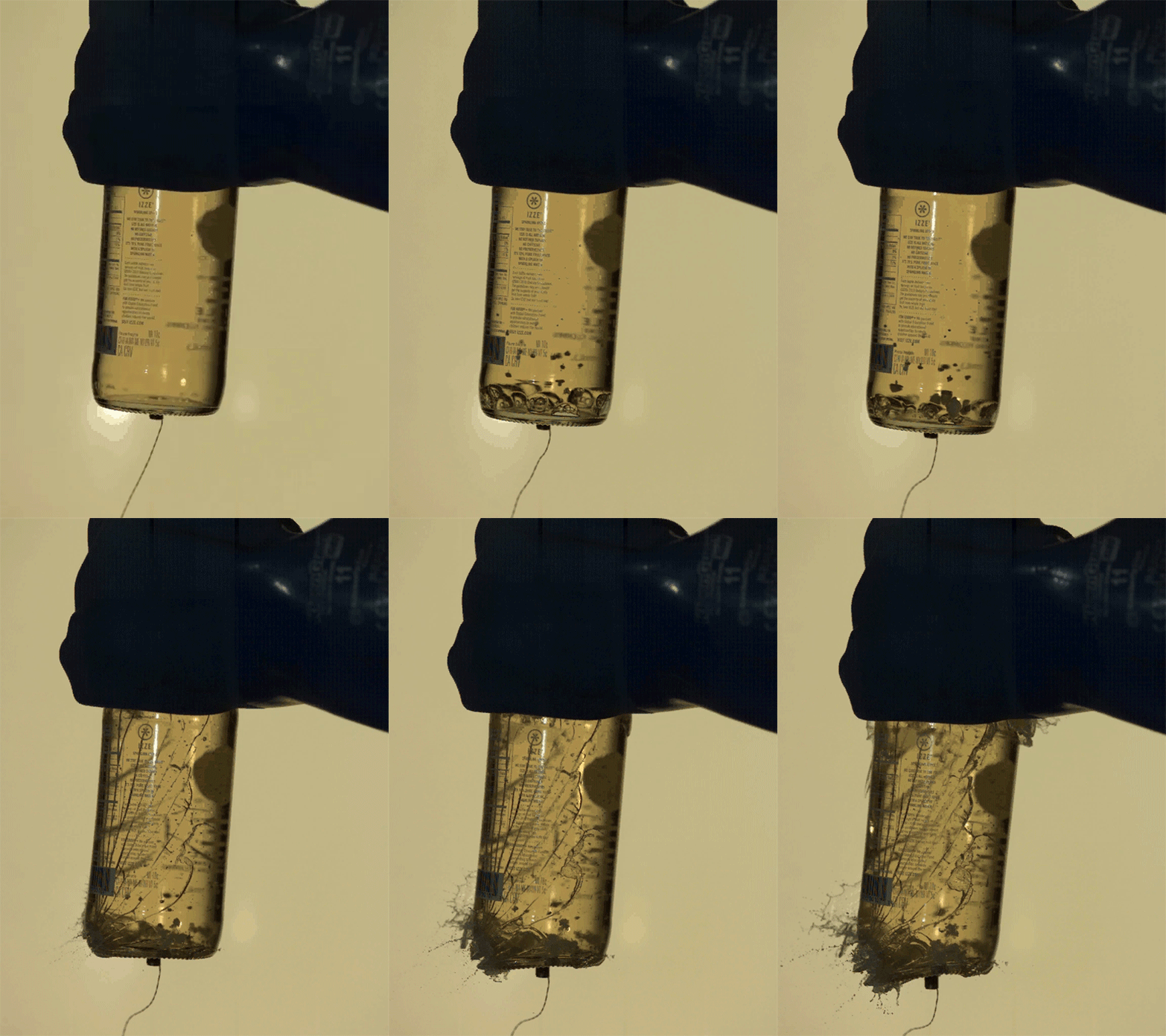
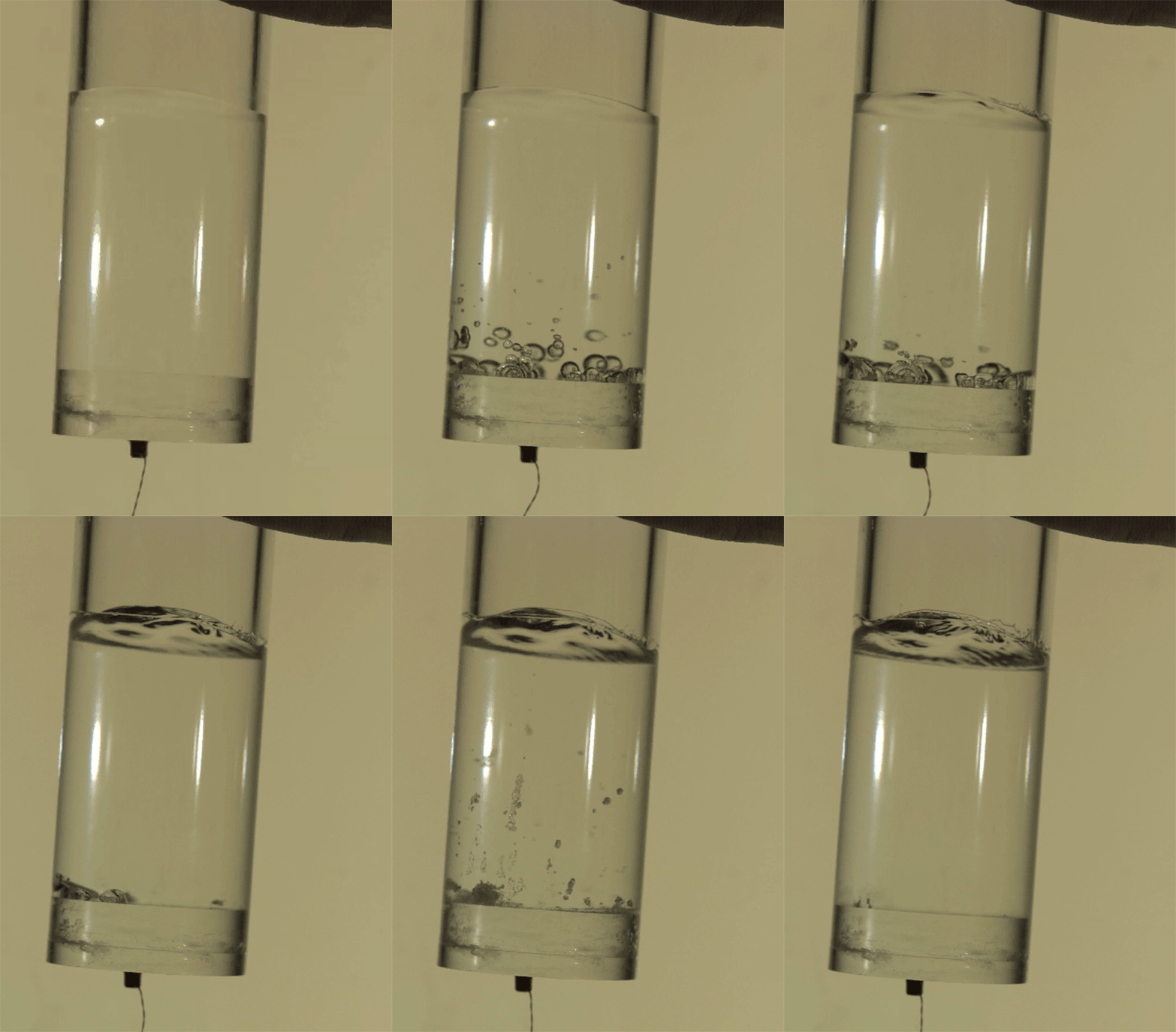
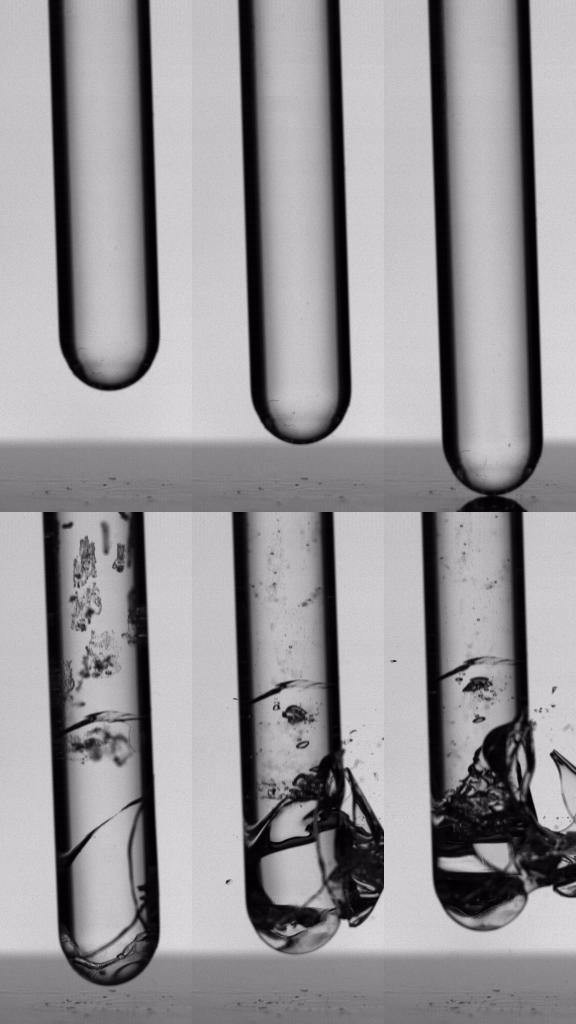
    It happens to the best of us: sometimes our beer gets shaken up during transit. One common reaction to this is to tap the side of the can repeatedly before opening, but a new scientific study shows that tapping doesn’t affect the volume of beer lost. Danish scientists tested over 1,000 cans of beer in randomized combinations of shaken, unshaken, tapped, and untapped, and observed no difference between tapped and untapped cans.

    The foam-up upon opening takes place in shaken beer because carbon dioxide bubbles form in the pressurized beer, especially along defects in the wall where bubbles can nucleate. When the pressure is released, the carbon dioxide becomes supersaturated and comes out of solution, especially into the pre-formed bubbles, which rapidly grow and overflow. In theory, tapping could disturb those bubbles before opening, but in practice, it makes no difference. Your best bet? Give the beer time to settle before you open it. (Image credit: Q. Dombrowski; research credit: E. Sopina et al.; via Ars Technica)

  • The Physics of Al Dente

    The Physics of Al Dente

    It’s a simple weeknight routine: toss a handful of spaghetti noodles in boiling water, wait a few minutes, and enjoy with the sauce of your choice. But there’s a surprising amount of physics in the humble strand of spaghetti, and a new model focuses on the way spaghetti sags and curls as it cooks.

    Spaghetti, like most pastas, is made of semolina flour mixed with water, extruded (in commercially produced spaghetti), and then dried. Once immersed in water, the rod of pasta begins to swell and soften as water works its way slowly inward. At the same time, it will lose some of its starches to the surrounding water. If the water is hot enough, the pasta undergoes an additional process, starch gelatinization, which is responsible for cooked pasta’s characteristic texture. That perfect al dente condition occurs right as the hydration front reaches the pasta’s core.

    As all of this happens, the initially straight spaghetti strand sags, settles, and curls. Researchers found that, even with a relatively simple model that assumes spaghetti doesn’t stick to the pot, they could capture shape change of individual spaghetti strands, suggesting it’s possible to identify perfectly cooked pasta by shape alone. (Image credit: Pixabay; research credit: N. Goldberg and O. O’Reilly; via Ars Technica)

  • Featured Video Play Icon

    Swinging Jets

    In the tiny realm of microfluidics, flows are, in general, completely laminar. That makes mixing a challenge. But it turns out that pumping water steadily into multiple inlets can spontaneously generate oscillations between the jets, allowing dramatic mixing even at low Reynolds numbers. Two inlets in a parallel channel (first image) oscillate steadily over a small range of conditions, but widening the channels (second image) allows the jets to switch back and forth over a larger range. And adding additional inlets (third image) can create even more complex fluid oscillators! (Image, video, and research credit: A. Bertsch et al.)

  • Flowery Splashes

    Flowery Splashes

    Plunge a disk into water and you’ll get a dome-like splash that closes back on itself. But what happens when that disk has a patterned surface? In this video, researchers added a wedge-like surface pattern to the disk, creating a splash with petals like a flower. Just as the surface of disk is about to submerge completely, a jet of the remaining air spurts out the trough of each wedge. This air jet breaks up the tip of the triangular splashes focused by the wedge. (Image, research, and video credit: H. Kim et al.)

  • Testing Waves in High Gravity

    Testing Waves in High Gravity

    Where waves crash and meet, turbulence is inevitable. But exactly how large waves interact — whether in the ocean, in plasma, or the atmosphere — is far from understood. A new experiment is teasing out a better physical understanding by tweaking a variable that’s been hard to change: gravity.

    To do so, the researchers conduct their experiments in a large-diameter centrifuge (shown above) where they can create effective gravitational forces as high as 20 times Earth’s gravity. This increases the range of frequencies where gravity-dominated waves occur by an order of magnitude.

    By studying this extended frequency range, the authors found something unexpected: the timescales of wave interactions did not depend on wave frequency, as predicted by theory. Instead, those interactions were dictated by the longest available wavelength in the system, a parameter set by the size of the container. It will be interesting to see if future work can confirm that result with even larger containers. (Image credit: ocean waves – M. Power, others – A. Cazaubiel et al.; research credit: A. Cazaubiel et al.; via APS Physics; submitted by Kam-Yung Soh)