Category: Phenomena

  • Featured Video Play Icon

    Seeing with Sound

    Sound carries rich information about the environment through which it’s traveled. And while many sighted people never take the time to notice this, using sound to build a mental picture of the surrounding world is something many blind people do constantly, either by studying how sounds produced by others change (passive echolocation) or by using their own sounds to pinpoint what’s around them (active echolocation). 

    In the latest It’s Okay to Be Smart video, you have a chance to learn some of the basics of active echolocation and how you can train your brain to recognize and process this extra environmental information. 

    Personally, I am not very good at this. I can hear edges but it turns out I’m very bad at figuring out where they are. That said, having spent time recently in a few anechoic chambers – where sound reflection is almost completely damped out – I’ve come to realize that even as a sighted person, I rely on sound a lot more than I think I do! (Video and image credit: It’s Okay to Be Smart)

  • Featured Video Play Icon

    Lensing in a Straw

    While doing the sort of experiment only a kid or a scientist would pursue – namely, staring down a straw – Dianna noticed that water in a straw creates a lens-like magnification effect as the straw moves or down. This happens thanks to the curvature of the air-water-straw interface. Because water has strong surface tension, it curves dramatically as it meets the wall of the straw, and moving the straw up or down will drag some of the fluid with it, enhancing the curvature. When light refracts across that interface, it gets bent the same way it would through a lens, thereby shrinking or magnifying the objects beneath. (Video credit: D. Cowern/Physics Girl)

  • Volcanic Plume

    Volcanic Plume

    Astronauts aboard the International Space Station captured this dramatic image of Raikoke Volcano’s eruption in late June. This uninhabited Pacific Island is part of the Kuril Islands off mainland Russia. The hot plume of ash and volcanic gas rose until its density matched that of the surrounding air, at which point it could only expand horizontally. This is why the plume appears to have such a flat top. It’s similar to the cumulonimbus clouds we associate with severe thunderstorms. Scientists speculate that the white ring around the plume’s base might be water vapor condensed from ambient air pulled in to the plume’s base or a side-effect of magma flowing into the surrounding sea. (Image credit: NASA; via NASA Earth Observatory)

  • Featured Video Play Icon

    Pouring a Liquid Mirror

    In this video, the Slow Mo Guys play with liquid gallium, giving us a chance to see how molten metals behave (outside of, say, the Terminator movies). Near its melting point, gallium is about six times denser than water, with a viscosity three times higher, and a surface tension about ten times greater. So how do those properties affect its behavior?

    You may be surprised that when watching the gallium vibrate on a speaker or get poured into a pan, it doesn’t look all that different from water. Yes, it’s highly reflective, but, on the whole it doesn’t look radically different from a distance. We can use the Reynolds number to quantify what’s going on here. It’s a dimensionless number that compares the fluid’s inertial force to the viscous force. Imagine we have two versions of an experiment, one where we pour gallium at a given speed and one pouring at the same volume and speed but with water. If we compared the Reynolds numbers of the water and the gallium, they only differ by a factor of two. Overall, that’s not very much. That’s why the two pours look similar.

    The story is different, though, if we look at individual drops of gallium and water, like when the first few drops of our pour hit the surface. Check out the gallium drops below. They’re conical on either end! This looks very different from what we expect with water droplets. You might think that’s because the metal is more viscous, but if we compare a water drop with a gallium drop of the same characteristic size and impact speed, we find a different story. For this, we’ll use the Ohnesorge number, which compares the viscous forces to a combination of inertia and surface tension. In this case, we find that the gallium drop’s Ohnesorge number is almost an order of magnitude smaller than the water droplet’s. That means that viscosity isn’t a major factor for our gallium drop. Both surface tension and inertia are more important.

    But if the surface tension is so high, then why aren’t the droplets spherical? Mostly because they don’t have time to form spheres before they hit. Their shape suggests that they’ve only just broken into droplets, which makes sense if the pour is fast and the surface tension is strong. (Video and image credit: The Slow Mo Guys)

  • Featured Video Play Icon

    Dissolving Pills

    This short film from Macro Room shows how pills dissolve in timelapseDissolution is a complex process driven both by flow and chemical concentration. Any small motion in the water helps erode the surface, and as the chemicals dissolve, the subsequent variations in the concentration drive additional flow. This is why we often see a turning point in how quickly the pills come apart. The initial breakdown is slow, but once enough of the pill dissolves, it enhances the surrounding flow, which increases erosion. Notice how many of the pills – liquid-filled capsules, especially – have a point where fluid begins streaming away from them. Unlike the capsules, the solid pills seem to get an extra boost from bubbles that form and then pull away material. (Image and video credit: Macro Room; submitted by clogwog)

  • Phytoplankton Swirls

    Phytoplankton Swirls

    A winter bloom of phytoplankton appears as green and teal swirls in this false-color satellite image of the Gulf of Aden. Although phytoplankton can be an important food source for fish and other marine animals, in recent years we’ve observed more frequent toxic blooms. Currently, physical sampling of the phytoplankton is necessary to determine what type they are, but scientists are working to use multi-spectral imaging to identify different species remotely. As harmful as they can be, blooms like these help visualize the flow and mixing in different coastal regions. Here, for example, we can see distinctive turbulent eddies in the Gulf that are tens of kilometers across. (Image credit: N. Kuring/NASA; via NASA Earth Observatory)

  • Catching Fire

    Catching Fire

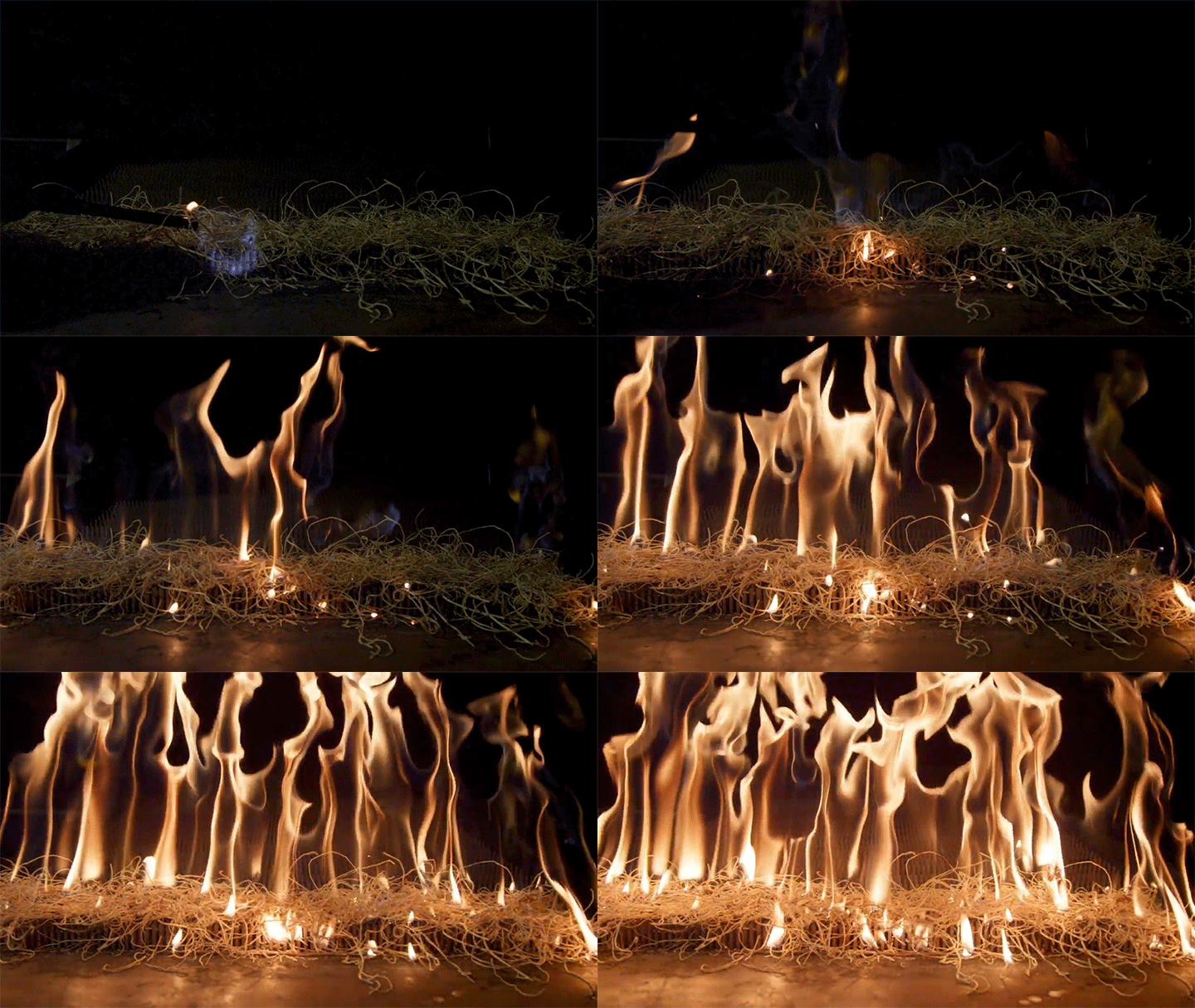
    Citrus fruits like oranges house tiny pockets of oil in their peels. When squeezed, the oils jet out in tiny micro-jets that are about the width of a human hair. Despite their small size, the jets reach speeds of about 30 m/s and quickly break into a stream of droplets. When exposed to the flame of a lighter, like in the animation above, those microdroplets combust easily, creating a momentary fireball used to augment some cocktails. For more on how the citrus peel generates these jets, check out this previous post. (Image credit: Warped Perceptionsource; research credit: N. Smith et al.)

  • Featured Video Play Icon

    Doing the Wave

    Not everything that behaves like a fluid is a liquid or a gas. In particular, groups of organisms can behave in a collective manner that is remarkably flow-like. From schools of fish to fire-ant rafts, nature is full of examples of groups with fluid-like properties. 

    One of the most mesmerizing examples are these giant honeybee colonies, which essentially do “the wave” to frighten away predators like wasps. Researchers are still trying to understand and mimic the way these groups coordinate such behaviors. Can even complicated patterns be generated by a simple set of rules an individual animal follows? That’s the sort of question active matter researchers investigate. Check out the video above to see a whole cliff’s worth of bee colonies shimmering. (Image and video credit: BBC Earth)

  • Striped Clouds

    Striped Clouds

    Living near the Rocky Mountains, it’s not unusual to look up and find the sky striped with lines of clouds. Such wave clouds are often formed on the lee side of mountains and other topography. But even in the flattest plains, you can find clouds like these at times. That’s because the internal waves necessary to create the clouds can be generated by weather fronts, too.

    Imagine a bit of atmosphere sitting between a low-pressure zone and a high-pressure zone. This will be an area of convergence, where winds flow inward and squeeze the fluid parcel in one direction before turning 90 degrees and stretching it in the perpendicular direction. The result is a sharpening of any temperature gradient along the interface. This is the weather front that moves in and causes massive and sudden shifts in temperature. 

    On one side of the front, warm air rises. Then, as it loses heat and cools, it sinks down the cold side of the front. The sharper the temperature differences become, the stronger this circulation gets. If the air is vertically displaced quickly enough, it will spontaneously generate waves in the atmosphere. With the right moisture conditions, those waves create visible clouds at their crests, as seen here. For more on the process, check out this article over at Physics Today. (Image credit: W. Velasquez; via Physics Today)

  • Underwater Optical Illusions

    Underwater Optical Illusions

    On a hot day, it’s not unusual to catch a glimpse of a shimmering optical illusion over a hot road, but you probably wouldn’t expect to see the same thing 2,000 meters under the ocean. Yet that’s exactly what a team of scientists saw through the cameras of their unmanned submersible as it explored hydrothermal vents deep in the Pacific Ocean.

    At these depths, the pressure is high enough that water can reach more than 350 degrees Celsius without boiling. The hot fluid from the vents rises and gets caught beneath mineral overhangs, forming a sort of upside-down pool. Since the index of refraction of the hot water is different than that of the colder surrounding water, we see a mirror-like surface at some viewing angles. Be sure to check out the whole video for more examples of the illusion. (Image and video credit: Schmidt Ocean; via Smithsonian; submitted by Kam-Yung Soh)