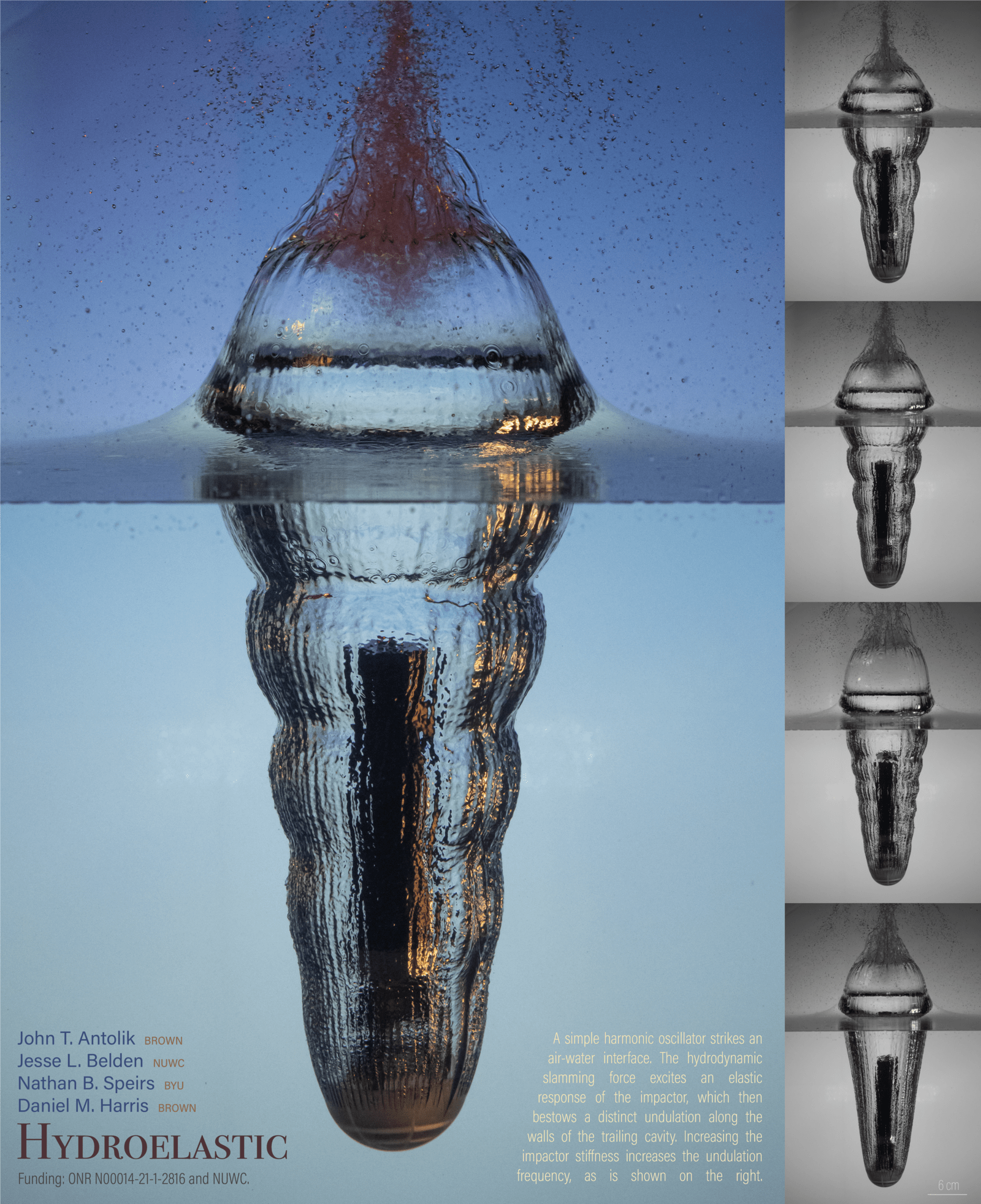
When objects impact water with enough speed, they create a smooth-walled, air-filled cavity around and behind them. Here, the impacting object is one with some give, like a spring. The initial impact squishes the object, setting it to oscillating along its length. The result is a wavy cavity. The stiffer the object, the more frequent the waves. (Image credit: J. Antolik et al.)
Category: Phenomena

Flipping Ice
In nature ice is ever-changing — growing, shrinking, and shifting. This poster illustrates that with a cylinder of ice floating in room temperature water. As the ice melts, it flips over into a new orientation, stays that way for a time, and then shifts again, as seen in the series of blue images. This flipping results from the melting flows around the ice, illustrated in the colorful central photo. This color schlieren image shows dense plumes of cold meltwater sinking beneath the ice. As that cold water drips down the sides of the ice, it leaves behind a wavy, patterned surface. Eventually, melting from the bottom of the ice leaves the remaining ice top-heavy, which triggers a flip into a more stable orientation. (Image and research credit: B. Johnson et al.)

Can Explosions Deflect Bullets?


In one of their most Mythbusters-like videos ever, the Slow Mo Guys ask: can an explosion deflect a bullet? To find out, they built out a system to trigger a C4 explosive using a 9mm bullet, all while watching with a series of high-speed cameras. As you’d expect, there are lots of blast waves and neat flame propagation to watch. As for the fundamental question, well, you’ll have to watch to find out! (Video and image credit: The Slow Mo Guys)

Droplet Medusa
Vibration is one method for breaking a drop into smaller droplets, a process known as atomization. Here, researchers simulate this break-up process for a drop in microgravity. Waves crisscrossing the surface create localized craters and jets, making the drop resemble the Greek mythological figure of Medusa. With enough vibrational amplitude, the jets stretch to point of breaking, releasing daughter droplets. (Image and research credit: D. Panda et al.)

Ciliary Pathlines
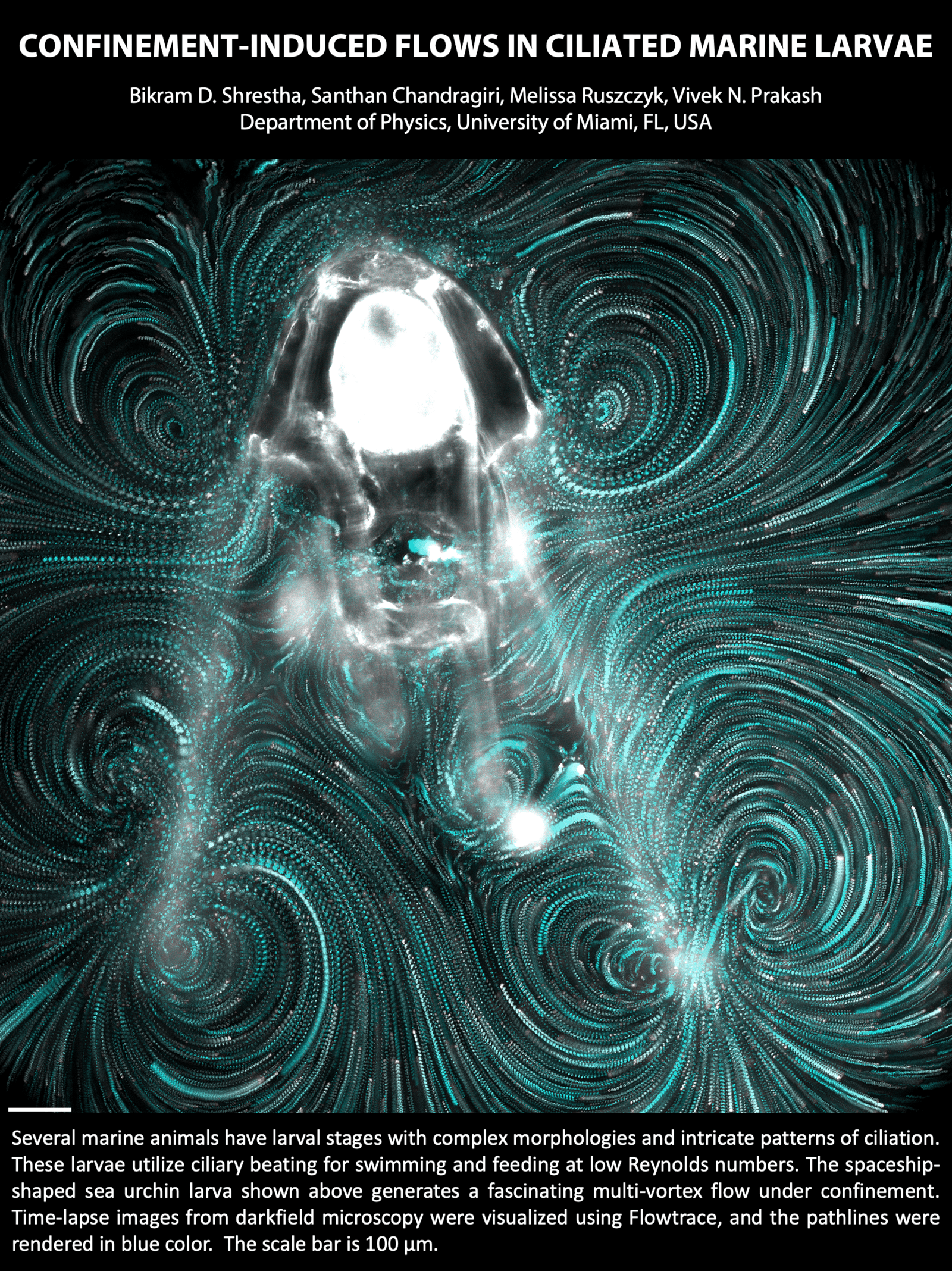
For tiny creatures, swimming through water requires techniques very different than ours. Many, like this sea urchin larva, use hair-like cilia that they beat to push fluid near their bodies. The flows generated this way are beautiful and complex, as shown above. Importantly for the larva, the flows are asymmetric; that’s critical at these scales since any symmetric back-and-forth motion will keep the larva stuck in place. (Image credit: B. Shrestha et al.)
Inside a Zebrafish Heart
This glimpse inside a 5-day-old zebrafish’s heart shows why they’re often used as a model organism in cardiac studies. The fish’s heart rate is similar to humans and its two-chamber heart — one atrium and one ventricle, both seen here — serves as a simplified version of ours. Check out the slowed-down section of the video to clearly see blood filling and expanding one chamber before it’s pumped onward. Perhaps the most unusual feature of the zebrafish’s heart is its ability to regenerate; after amputation of up to 20% of its ventricle, the fish can fully regenerate its heart. That’s a pretty incredible recovery, especially when you consider that the heart has to keep pumping the entire time! (Video credit: M. Weber/2023 Nikon Small World in Motion Competition)
Test Firing a Rocket Engine


Watching a rocket engine start up in slow motion is always fun. This Slow Mo Guys video shows a test fire of one of Firefly’s engines, which is capable of 45,000 pounds of thrust. Gav walks us through the process of preparing to film the test as well as what his footage shows.
Green flames mark ignition of the initial fuel, and bursts of flame jerk back and forth as shock waves pass through the engine. That’s a necessary part of establishing supersonic flow through the bell-shaped diffuser at the end of the engine. Once the exhaust reaches supersonic speeds, expelling it creates a diamond-like pattern of standing shock waves and expansion fans that ultimately equalize the exhaust jet’s pressure to that of the surrounding atmosphere. (Video and image credit: The Slow Mo Guys)

Swedish Egg Coffee
In the mid-1800s, Scandinavian immigrants settling in the Midwest had no filters, no percolators, and no drip coffee makers to aid their quest for a cup of coffee. Instead, they used eggs to boil a smooth, grit-free cup. Mixing the coffee grounds with egg — sometimes with the shell and all — creates a protein-packed raft that floats when the coffee’s done boiling. Adding cold water sinks the raft of ground coffee, giving a clean final pour with no filter necessary. I’m not a coffee drinker, but for those of you who are, I’m curious: would you drink an egg coffee? (Image credit: K. Tomlinson; via Atlas Obscura; submitted by Richard B.)
A Working Wirtz Pump


In the mid-eighteenth century, pewterer Andreas Wirtz invented a spiral pump. Even today, his design is useful for small-scale, low-power pumping, as seen in this Steve Mould video. The design relies on a series of air and water plugs to build up pressure that’s then used to lift the fluids higher. In the video, Mould visits a stream-powered, home version of a Wirtz pump that regularly delivers water over eight meters in elevation. See it in action in the full video! (Video and image credit: S. Mould)

Swirling Sea Ice
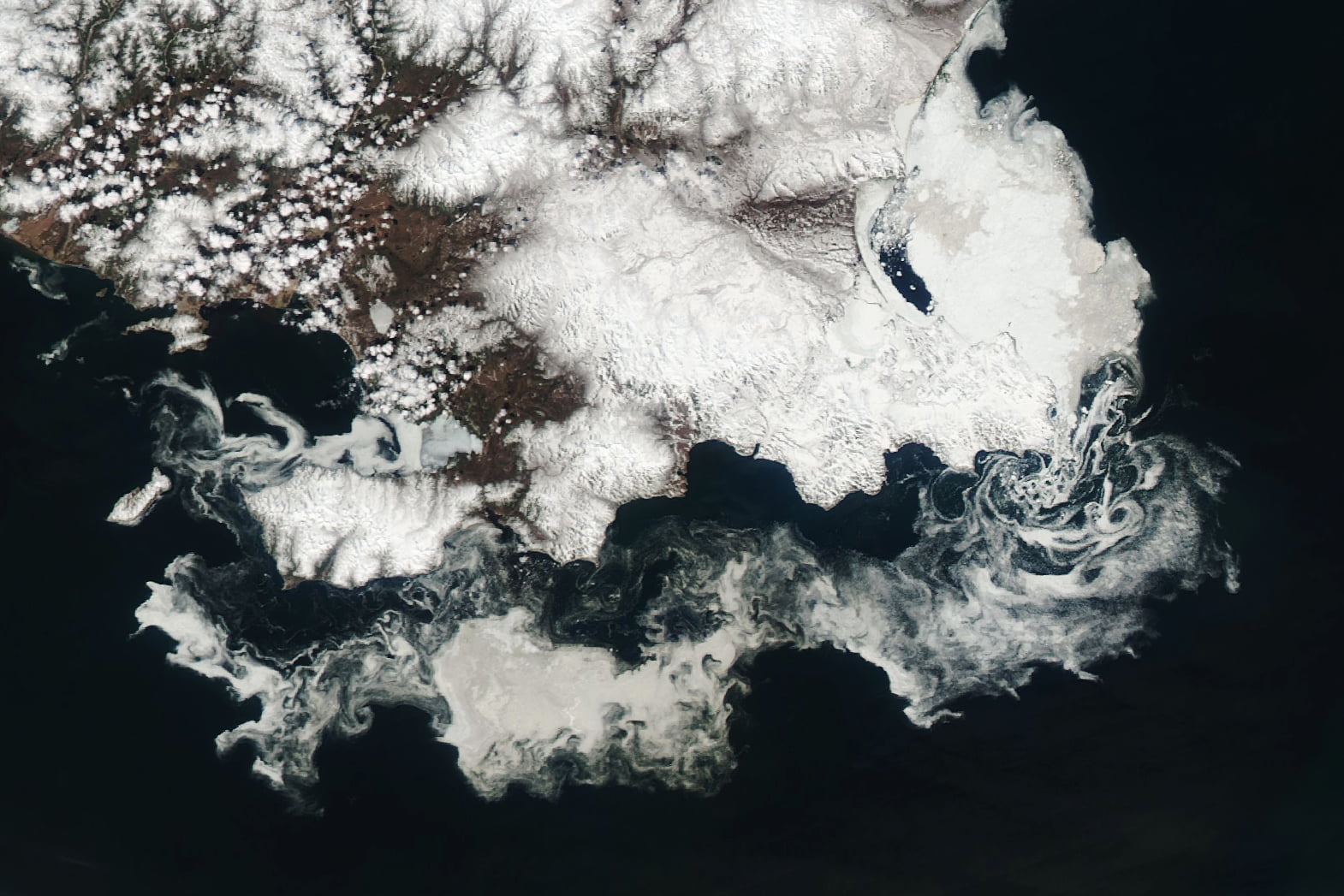
The Sea of Okhotsk is the northern hemisphere’s southernmost sea that seasonally freezes. Caught between the Siberian coast and the Kamchatka Peninsula, cold air from Siberia helps freeze water kept at lower salinity due to freshwater run-off. This image, taken in May 2023, shows free-floating sea ice forming spirals driven by wind and waves. Small islands off the eastern coast (right side in image) are likely responsible for the swirling eddies seen there. Like phytoplankton blooms and sediment swirls in warmer seasons, the sea ice acts as a tracer to reveal flow. (Image credit: W. Liang; via NASA Earth Observatory)