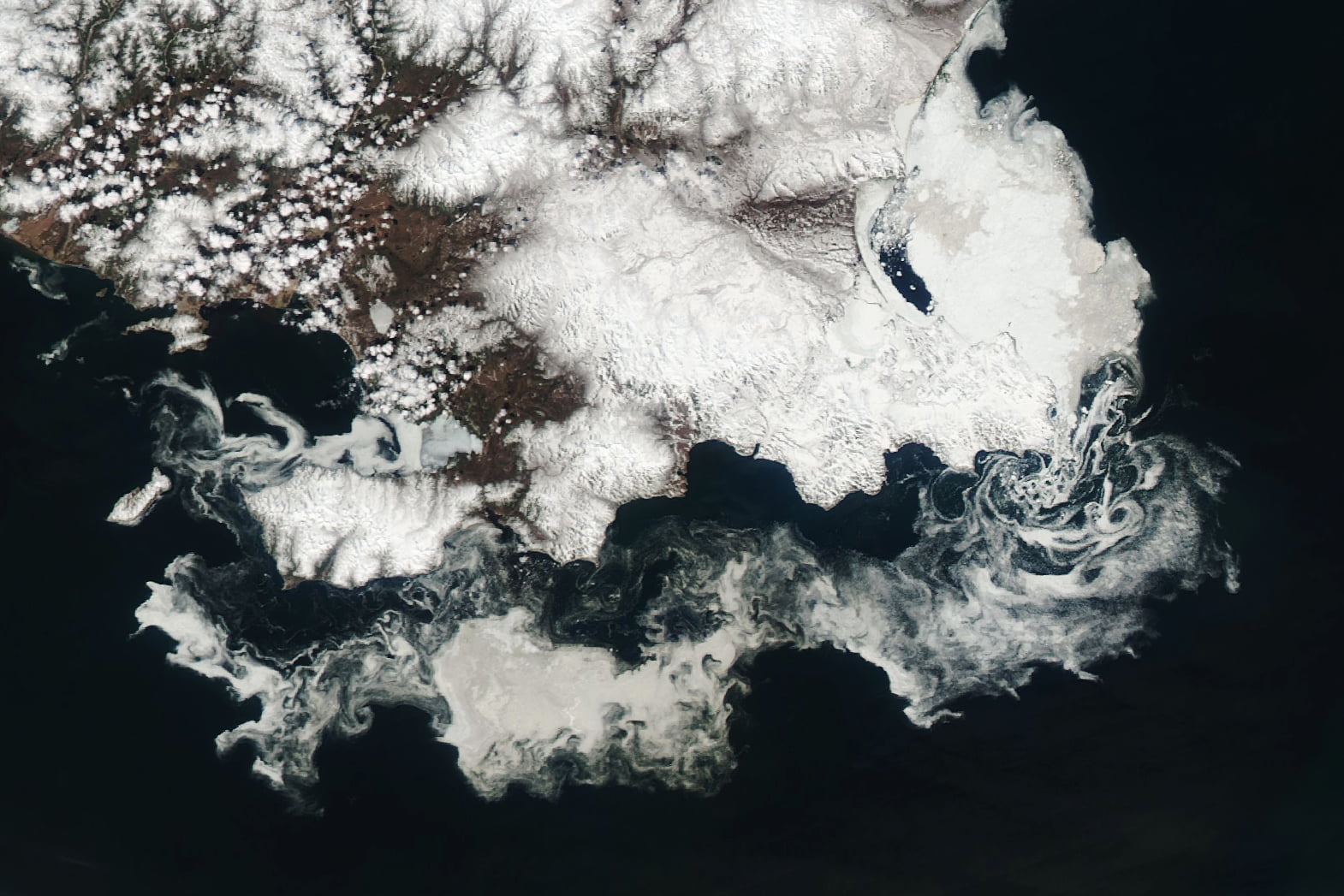
The Sea of Okhotsk is the northern hemisphere’s southernmost sea that seasonally freezes. Caught between the Siberian coast and the Kamchatka Peninsula, cold air from Siberia helps freeze water kept at lower salinity due to freshwater run-off. This image, taken in May 2023, shows free-floating sea ice forming spirals driven by wind and waves. Small islands off the eastern coast (right side in image) are likely responsible for the swirling eddies seen there. Like phytoplankton blooms and sediment swirls in warmer seasons, the sea ice acts as a tracer to reveal flow. (Image credit: W. Liang; via NASA Earth Observatory)
Category: Phenomena

Do Droughts Worsen Floods?


In recent years many areas have seen record droughts followed by sudden, massive rainfalls. Such wild swings raise the question: does drought-parched soil make flooding worse? That’s the question Grady tackles in this Practical Engineering video, and, as is often the cause in real-world engineering, the answer is complicated.
How quickly water soaks into the spaces between soil particles depends on many factors, including soil type, vegetation, and how much moisture is in the soil already. In general, dry soils initially soak water in more quickly than pre-moistened soil – except when the surface soil is hydrophobic and water-repellent. Check out the full video to learn more! (Video and image credit: Practical Engineering)
Filling Space


While not directly fluid dynamical, this video from Steve Mould uses water to illustrate mathematical concepts like fractals and space-filling curves. Water, it turns out, does a great job of drawing our eyes to the way these one-dimensional curves fill up two- and three-dimensional space. Check out the full video for a mathematical dive into the concepts. (Video and image credit: S. Mould)

An August Arc
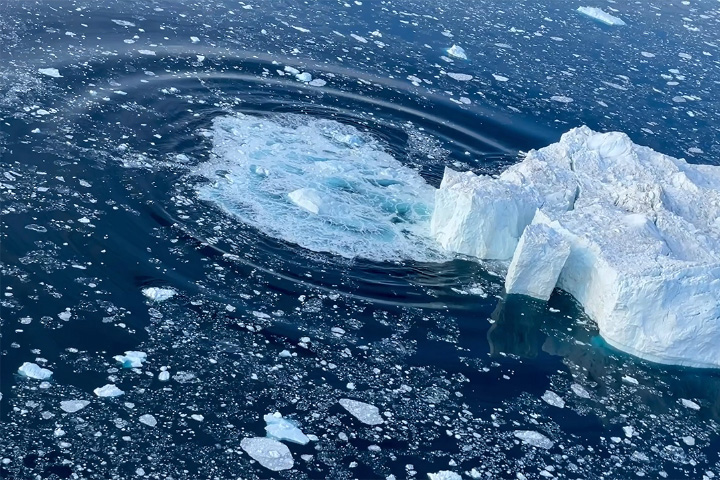
In summer, the fjords of Greenland are littered with ice, but in August 2023, satellites caught an odd interloper. See the thin white arc spanning the fjord in the photo above? Scientists suspect this ephemeral feature was a wave caused by a large iceberg calving off the glacier on the right. When large chunks of ice fall into the water, they can cause distinctive waves that travel out from the point of impact.
Another possible mechanism is an underwater plume. In Greenland’s fjords, such plumes are sometimes formed from freshwater melting below the glacier. When that water rises to the surface, it can push ice. (Image credit: W. Liang; via NASA Earth Observatory)
Desalination in Action
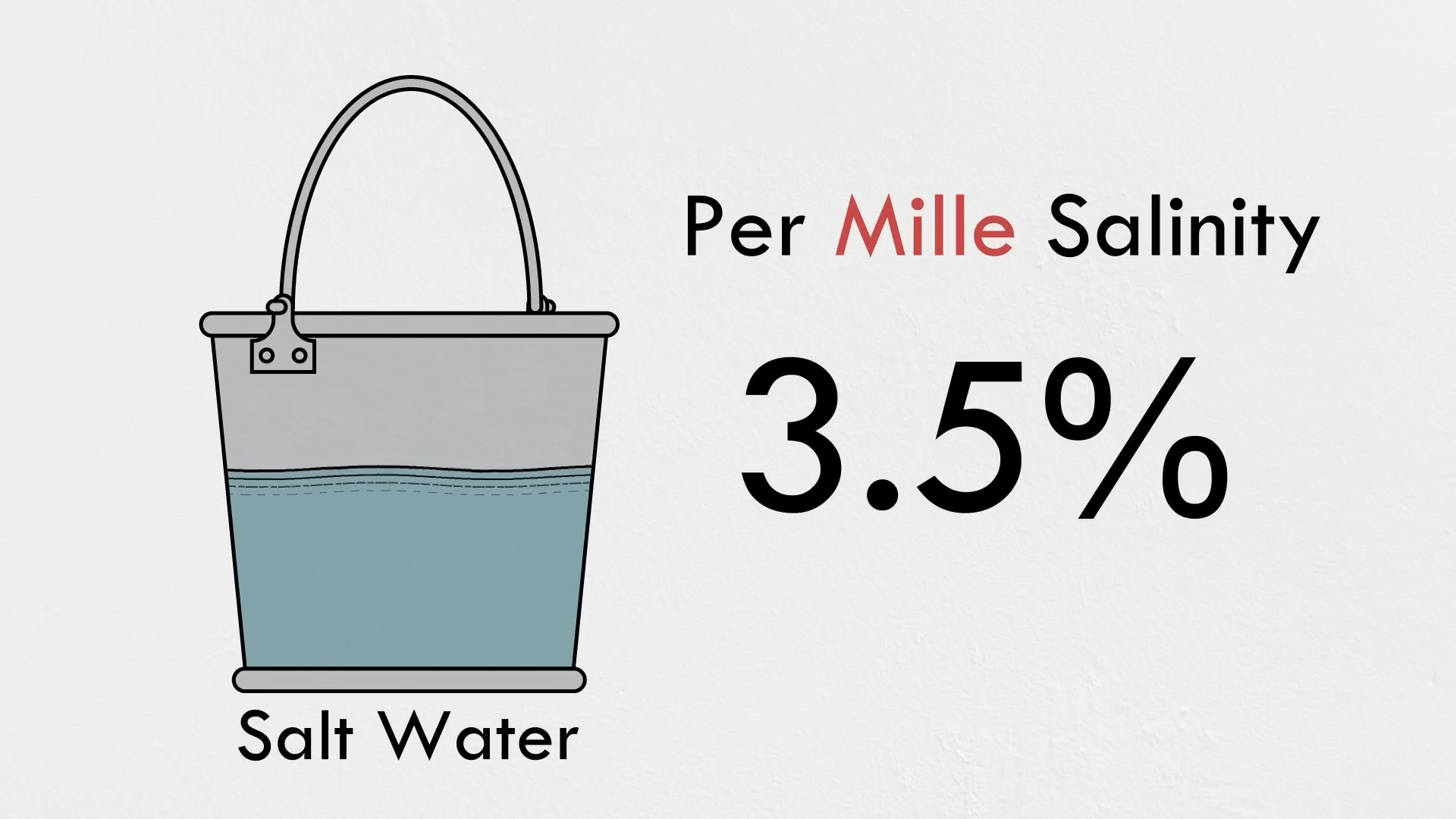
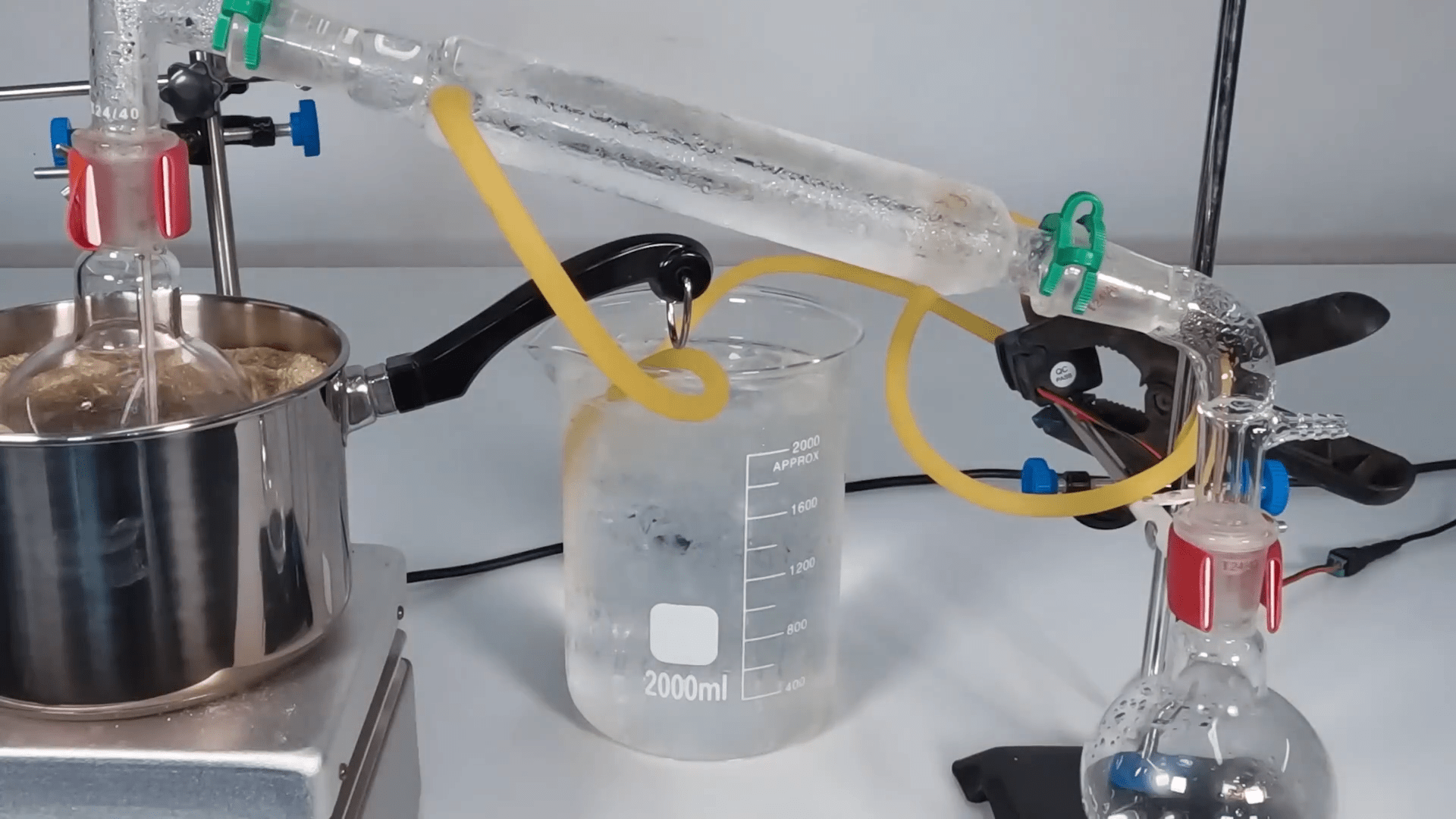
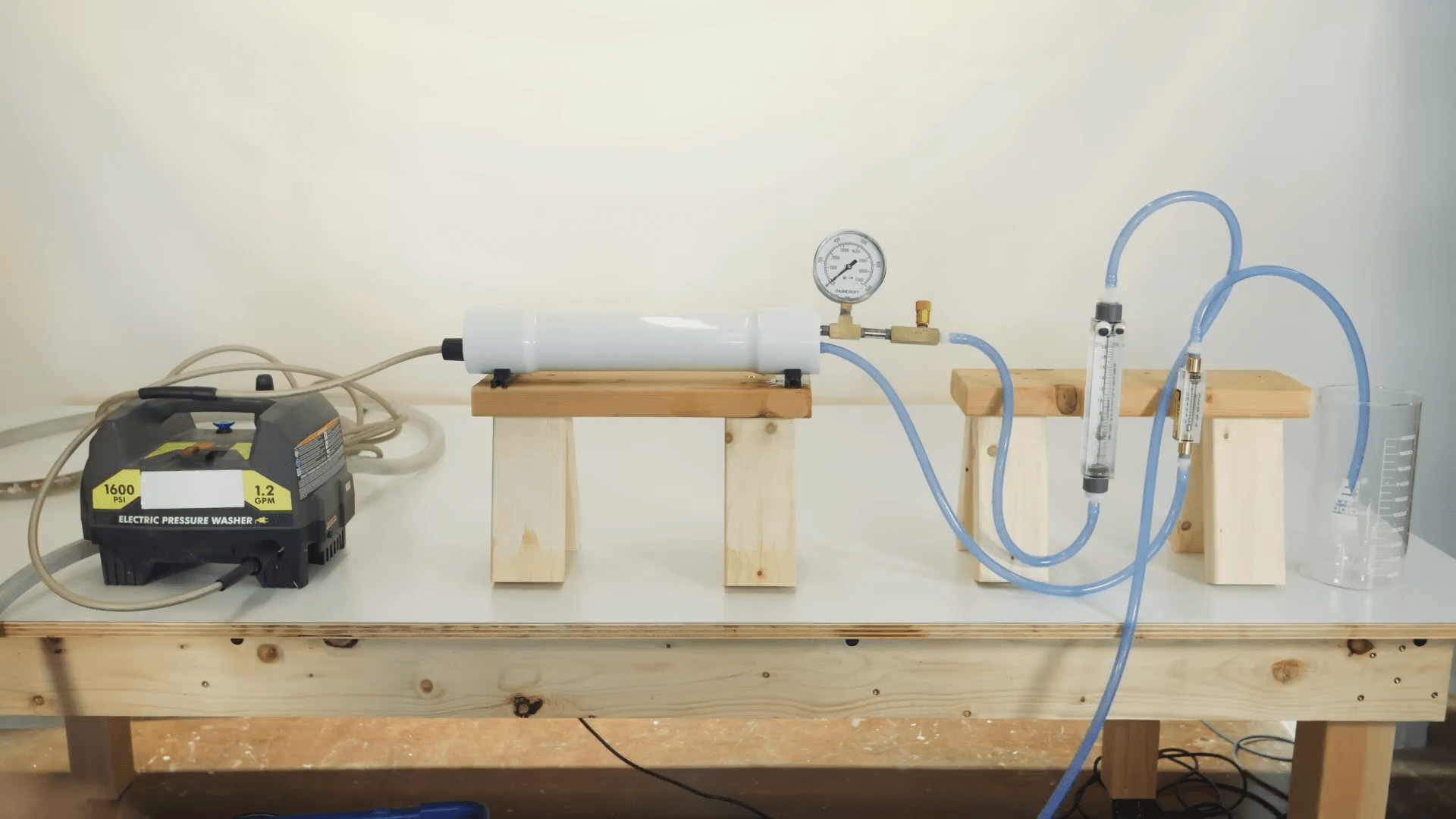
Desalination — the removal of salt from water — is an important process for providing the fresh water we need, but it’s quite expensive in terms of energy. In this Practical Engineering video, Grady demonstrates small-scale versions of the two most common methods for purifying water: distillation and reverse osmosis.
In distillation, salt water is boiled to separate the water into vapor that’s then condensed into freshwater. As straightforward as that sounds, though, the process is expensive, requiring a lot of energy for relatively little (albeit extremely pure) water. In contrast, reverse osmosis produces a somewhat less pure product at a lower energy cost. But it also produces brine, an even-saltier water that must be disposed of. (Video and image credit: Practical Engineering)

Shifting Sands
Qinghai Lake sits in western China, where a warmer and wetter climate has been raising the lake’s water level in recent years. These two satellite images, from 2010 and 2022, show the effects of those changes. Sand spits that once separated the smaller Shadao Lake from the surrounding lake have worn away and sunk, rejoining the two bodies of water.
Why is the area’s warmer climate also wetter? The lake has risen due to increased precipitation and river run-off feeding it, but it’s also seen less evaporation. So far the area’s temperature increases have been most notable in winter months, when the lake is covered in ice. In contrast, the summers have been wetter, which means more cloudy days and less chance for evaporation. (Image credit: A. Nussbaum, modified by N. Sharp; via NASA Earth Observatory)
Withstanding Rocket Launches


It takes a lot of power to lift a giant rocket‘s payload all the way to orbit, and in the first moments of a rocket launch, all that energy is directed downward at a concrete pad. How do engineers design and protect launch pads? In this Practical Engineering video, Grady tackles just that question through a comparison of SpaceX’s Stage Zero and NASA’s Launch Pad 39A.
SpaceX notoriously chose to build Stage Zero without a trench or water sprayer system like the ones NASA use. Trenches deflect the rocket exhaust to reduce the impact on infrastructure beneath the engines. And water sprayers reduce the temperatures the pad experiences and disrupt shock waves that otherwise hammer the pad. Without those precautions, even special heavy-duty concretes have a hard time holding together against a launch. (Video and image credit: Practical Engineering)

Lagoon Nebula
Some 4,100 light years away in the Sagittarius constellation, a stellar nursery births new stars. Known as Messier 8, or the Lagoon Nebula, this region is one of the most visible nebulas from Earth. It is filled with turbulent gases and dark strands of dust. Near the centerline of the image is the bright, hourglass shape of the NGC 6530 star cluster. Its intense ultraviolet light ionizes surrounding gases, creating the distinctive red glow surrounding the nebula. (Image credit: J. Drudis and C. Sasse; via APOD)
Blood Flow in a Fin
This award-winning video shows blood flowing through the tail fin of a small fish. Cells flow outward in a central vessel, then split to either side for the return journey. In this microscopic video, the speed of individual cells seems quite fast, even though the vessels themselves are only wide enough for the blood cells to move in single file. Flow at the microscale can be counterintuitive like that. (Video and image credit: F. Weston for the 2023 Nikon Small World in Motion Competition; via Colossal)


“Shaken, Not Stirred”


James Bond notoriously orders his martinis “shaken, not stirred,” a request bartenders fulfill by shaking the cocktail over ice in a separate shaker. But what if you shake the martini glass itself? That’s the question that inspired this lovely mixology.
By shaking the martini glass gently back and forth (along the directions shown by the arrows in each image), the team created different mixing patterns within the glass. With a little food dye and pearl dust, they visualized the flows they found. By changing the viscosity of the cocktail and the speed of the swish, they made everything from a four-leaf clover to a cadre of ghosts. It seems that martini glasses hold a flow for every occasion! (Image and research credit: X. Song et al.; submitted by Zhao P.)

GFM poster, describing the experiments used to create these picturesque martinis.