Sprites, or red sprites, are high-altitude electrical discharges in the atmosphere. Although sometimes called upper-atmospheric lightning, sprites are a cold plasma phenomenon. They often occur in clusters, as in this photo by Angel An, which won in the Skyscapes category of the 2023 Astronomy Photographer of the Year competition. Sprites, which last only a millisecond or so, take place during intense thunderstorms, but, unlike our more familiar lightning, sprites move upward from the storm toward the ionosphere. They can occur on Venus, Saturn, and Jupiter as well, although sprites have only been observed directly on Earth and Jupiter. (Image credit: A. An; via Colossal)
Category: Phenomena

Snake Tracks
Moving across sand is quite challenging for bipedal creatures like us, but other animals have their ways. Photographer Paul Lennart Schmid caught this snake on the move, with impressions of its passage still in the sand. X-ray observations of snakes moving in sand show that they swim through the granular medium. Snakes are quite efficient in their swimming, moving most of their body through the tunnel created by their head, thereby reducing their overall effort. (Image credit: P. Schmid; via Nature TTL POTY)

Frozen Ripples
Normally, freezing is a slow enough process that transient phenomena like ripples get smoothed out. But with the right conditions, even ripples can get frozen in time. This picture shows a backyard bird bath after a frigid winter storm passed overnight. For much of that time, the wind was active enough to keep the bath’s water from freezing. But when freezing did start, it happened so rapidly that the wavelets generated by the wind got frozen in place, too. Here’s a similar-looking effect (also in Colorado, ironically) that’s thought to have formed entirely differently. (Image credit: K. Farrell; via EPOD; submitted by Kam-Yung Soh)

Dust Storms
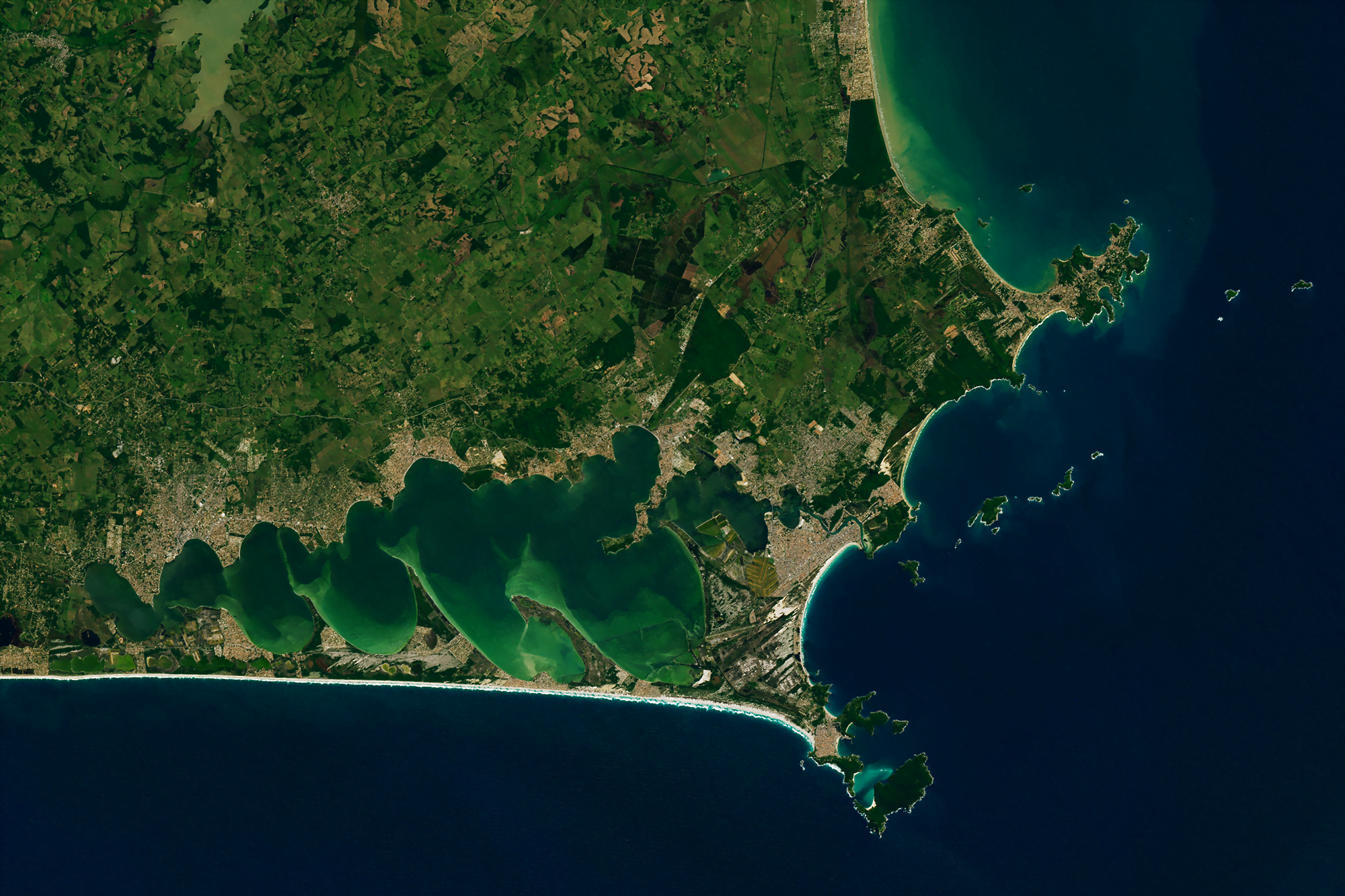
Hot, dry berg winds swept down from the Namibian highlands and sent these plumes of dust flying out to the Atlantic coast. Another plume — white instead of brown — marks salt dust from the Etosha Pan salt flat. The dust and salt become aerosol particles in the atmosphere — seeds for raindrops to form. Coastal towns sometimes need construction equipment to deal with the drifting sand from these storms, but these storms are small compared to Saharan dust storms. Those storms are so large that their dust influences the weather on the other side of the Atlantic. (Image credit: W. Liang; via NASA Earth Observatory)

Scuba-Diving Fly
Mono Lake, three times saltier than the ocean, is an extreme environment by any measure. But for the alkali fly, it’s home. This extremophile insect dives into the lake, protected by a bubble sheath, to eat and lay eggs. The fly’s wings and body are covered in tiny, waxed hairs that repel water. That traps a bubble of air around the insect, allowing it to breathe. Fresh oxygen can diffuse into the bubble from the water, replenishing the supply. (Image and video credit: Deep Look)

Star YY Hya
A team of professional and amateur astronomers discovered and then imaged this previously undiscovered galactic nebula. At the heart of the stellar remnant is a binary star pair. Shock waves of the gas and dust twist and spread in the surrounding space, the remains of an earlier star’s violent eruption. (Image credit: M. Drechsler et al.; via 2023 Astronomy POTY)

Capturing the Tides
Twice a day the tides rise and fall along coastlines. Increasingly, engineers are trying to harness these regular currents for clean energy. Tidal turbines spin during the fastest flows, turning a rotor that powers an electrical generator. Compared to wind and solar energy, tidal energy is expensive, but it’s also predictable — a feature wind and solar lack.
Previous investments in clean energy have reduced costs as technologies mature, and proponents expect this will hold true for tidal turbines, as well. The machines face difficult conditions: salt and water are notoriously tough on equipment. Right now that makes large-scale facilities impractical. Instead, most projects are on a smaller scale, often focusing on powering remote rural coastal communities that currently rely on diesel for their electricity. These projects provide immediate benefits to the community while serving as a proving ground for the technology as a whole. For more, see this Physics Today article. (Image credit: Nova Innovation; see also Physics Today)

Mitigating Urban Floods
For densely-populated urban areas, floods are one of the most damaging and expensive natural disasters. We can’t control the amount of rain that falls, so engineers need other ways to mitigate damage. It’s not usually possible to remove people and property from floodplains, so instead civil engineers look below the surface, building flood tunnel networks to alleviate floodwaters. In this Practical Engineering video, Grady demonstrates how these systems work and what some of their challenges are. (Video and image credit: Practical Engineering)

Rolling Over Wisconsin
Although they may look sinister, roll clouds like this one are no tornado. These unusual clouds form near advancing cold fronts when downdrafts cause warm, moist air to rise, cool below the dew point, and condense into a cloud. Air in the cloud can circulate around its long horizontal axis, but the clouds won’t transform into a tornado. Roll clouds are also known as Morning Glory clouds because they often form early in the day along the Queensland coast, where springtime breezes off the water promote their growth. The clouds do form elsewhere, though; this example is from Wisconsin in 2007. (Image credit: M. Hanrahan; via APOD)