When I started FYFD, volcano footage was far rarer. These days the affordability and durability of drones and action cameras — along with the relative accessibility of eruptions in places like Iceland and Hawaii — means we get to see volcanic flows in glorious high definition. This footage comes from the recent Icelandic eruption on the Reykjanes peninsula. Lava fountains line the four-kilometer lava vent seen here, and flows from the vent spread into a delta-like fan in the field below. I never get tired of staring at molten rock that flows like water. (Video and image credit: I. Finnbogason; via Colossal)
Category: Phenomena

Visualizing Changes
This rather mesmerizing video by Michiel de Boer uses a video editing technique to highlight movement and changes in video clips. From falling rain to rising mist to passing footsteps, the relatively simple technique visualizes all kinds of motion. De Boer calls it “motion extraction,” but it’s essentially a way to play with autocorrelation, a mathematical technique often used in fluid dynamics. It’s especially prevalent in turbulence, where it helps researchers identify parts of the flow that are closely related to one another. (Video and image credit: M. de Boer; via Colossal)

Upwelling at Cabo Frio
The shores of the Brazilian state of Rio de Janeiro boast turquoise waters, white sands, and green lagoons, but European explorers discovered the waters around one promontory were unusually cold, leading to the name Cabo Frio. The chilly waters can be 8 degrees Celsius cooler than nearby surface temperatures, thanks to cold water upwelling near the coast. The upwelling is wind-driven; the dominant northeasterly winds push water out to sea, allowing colder waters to rise from the deep. (Image credit: L. Dauphin; via NASA Earth Observatory)

A map of sea surface temperatures near Cabo Frio in Brazil. 
Parting a Flame
A sheet of flame splits around a cylinder in this Gallery of Fluid Motion poster. Looking at the image sequences, you can see how the flames lift up as they flow around the cylinder, following the arms of a horseshoe vortex. Researchers study situations like this one to better understand how wildfires move as they encounter obstacles. Understanding and predicting how fires flow is increasingly important with more wildfires encountering human-built infrastructure. (Image credit: L. Shannon et al.)

Fire in Ice
This false-color satellite image of Malaspina Glacier (Sít’ Tlein) is a riot of color. Composed of coastal/aerosol, near infrared, and shortwave infrared bands from Landsat 9, the colors highlight features otherwise hard to identify. Watery features appear in reds, oranges, and yellows; vegetation is green and rock appears in blue. The glacier covers more than 4000 square kilometers, an area larger than the state of Rhode Island. The dark lines atop the glacier are moraines, where rock, soil, and other debris has been scraped up along the glacier’s edge. Over time, changes in the glacier’s velocity cause the moraines to fold and shear, creating the zigzag pattern seen here. (Image credit: W. Liang; via NASA Earth Observatory)

Corralling Corals
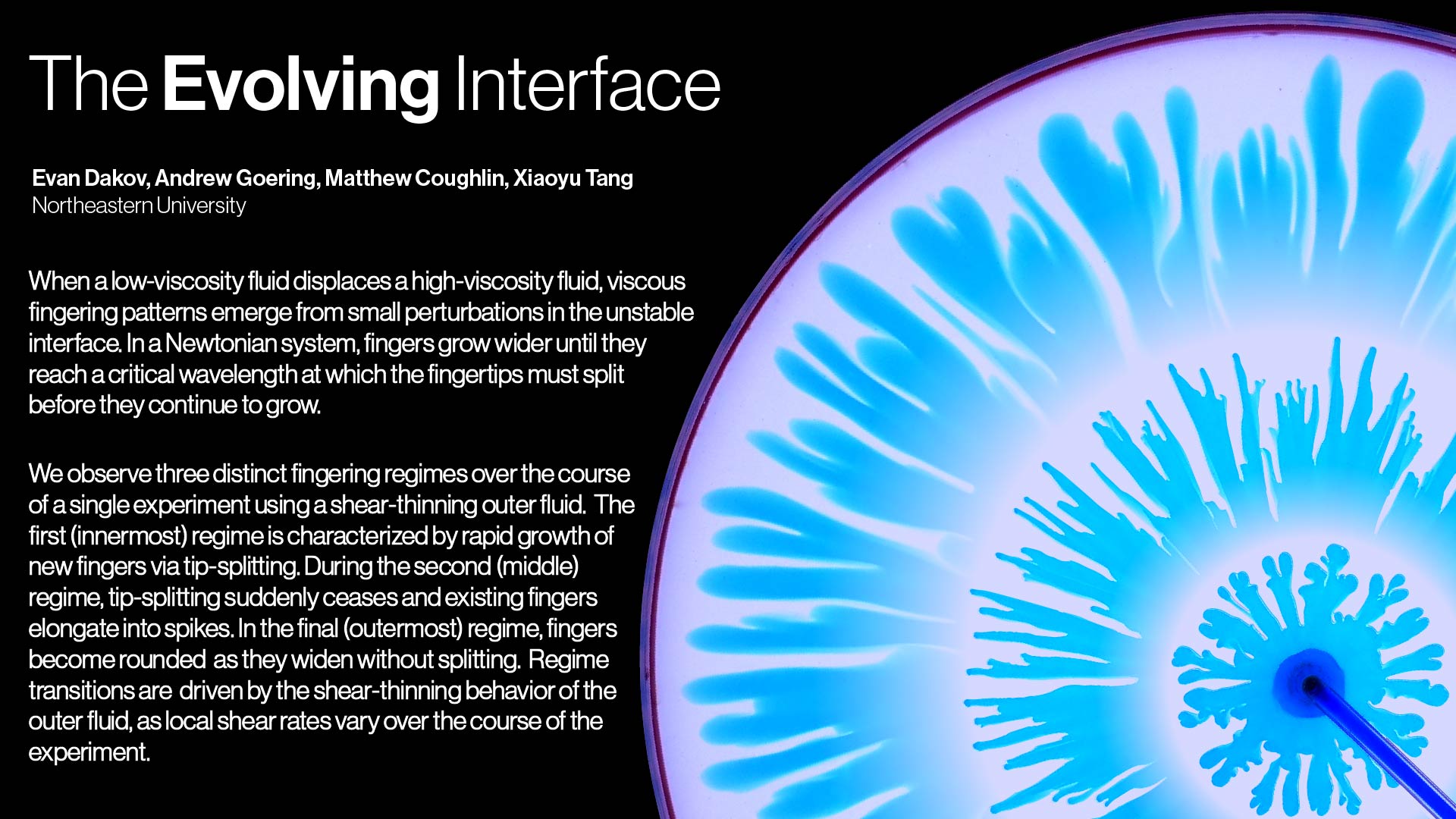
So much of fluid dynamics is seeking patterns. Shown here are two sets of patterns, each created by a different species of coral larvae. These tiny creatures form a streaming flow (orange inset) around them as they swim. Combined together in a petri dish, the larvae follow winding paths, shown in white. The overall pattern is distinctly different for the two species. One shows a clear preference for paths near the wall of the dish (left), while the other corkscrews through open spaces (right). This difference raises questions researchers can explore: do the larvae differ in their propulsion methods or in their collective behavior? (Image credit: G. Juarez and D. Gysbers)

Liquid Lace
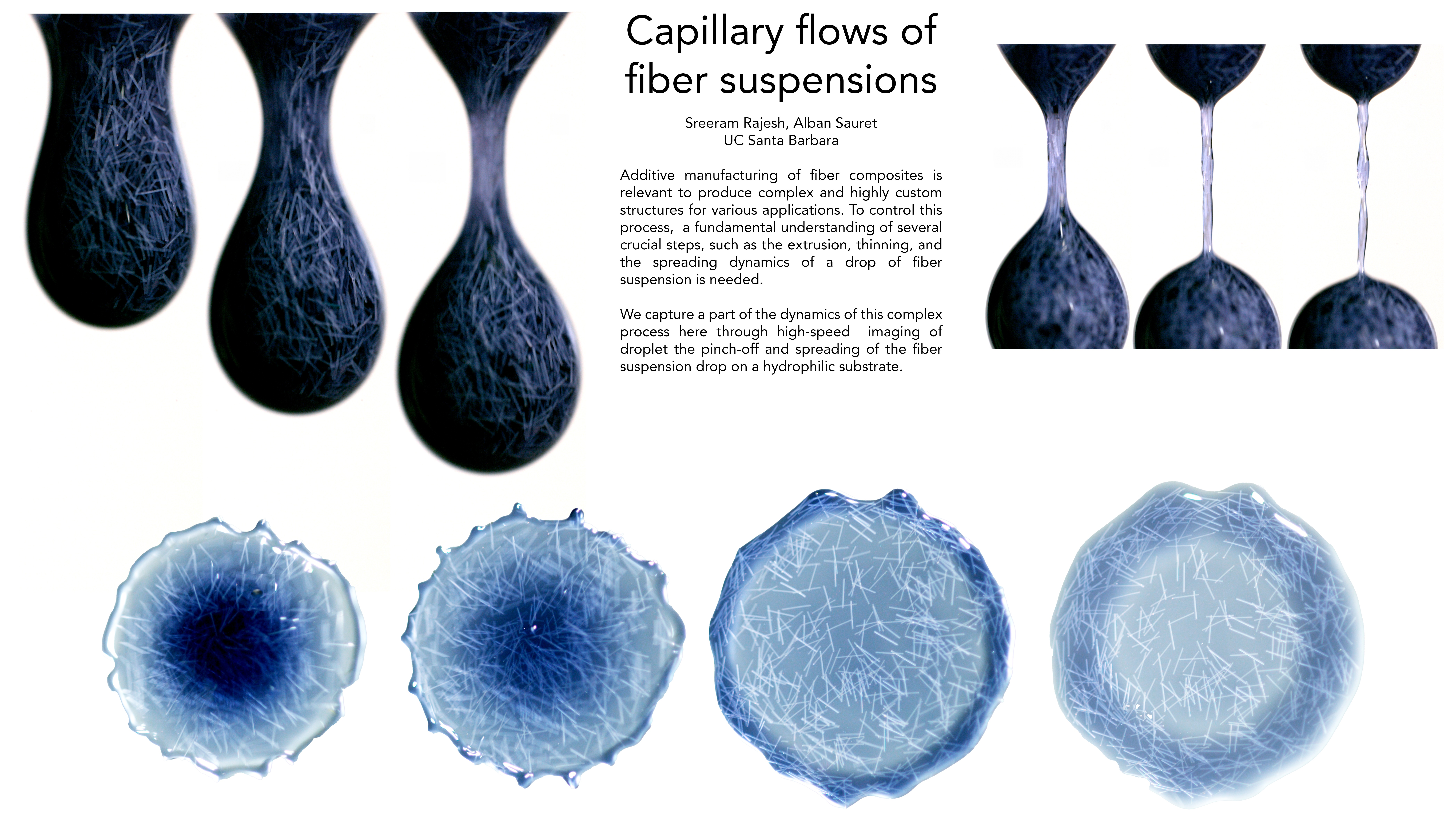
3D printers are a neat apparatus for exploring flow instabilities. If too much material is extruded compared to the speed of the printer head, coiling takes place. But under-extrusion creates patterns, too. Here, researchers show how under-extrusion can create a stable lace-like pattern. Once dried, the material can stretch, but only in certain directions, a bit like many textiles. (Video and image credit: L. Dreier et al.)

Miniature Ice Stupas
Ice stupas are conical artificial glaciers built with snow cannons; they’re used to store water for spring irrigation. Here, researchers explore a miniaturized lab-grown version made from atomized water droplets. The growing drop breaks and spills, forming frozen fingers in all directions. Further drops flow and freeze as rivulets atop the stupa — or they destabilize and rotate toward another finger, leaving behind a wrinkling shape. Although the formation works very differently (and the scales are completely different) these tiny ice stupas remind me of volcanic flows. (Image credit: D. Papa et al.)

“Coat or Collapse?”
Imagine a layer of particles sitting at the interface between oil and water. Known as a granular raft, these particles can interact in interesting ways with other objects. Here, researchers experiment with allowing different shapes to fall through the raft. At slow speeds, the raft deforms to coat the object, even if it has a complex shape (top images). At higher insertion speeds, however, the granular raft can break up around the object. The lower sequence of images show a cylinder interacting with the raft. Moving from left to right, each image shows a larger cylinder diameter and an increasingly complex break-up of the raft. (Image credit: C. Gabbard et al.)

Beneath the Surface
Signs of a ship’s passage can persist long after it’s gone. The churn of its propellers and the oil leaked from its engines leave a mark on the water’s surface that, in some cases, is visible even from orbit. But the frothy wake of a ship is no easy place to measure; there are simply too many bubbles. To reveal the physics behind that froth, these researchers turned to direct numerical simulation, a type of computational fluid dynamics that calculates the full details of a flow, typically using a supercomputer to do so.
In their poster, the blue field of wavy lines shows turbulence under the water’s surface. For (relative) simplicity, the turbulence is statistically uniform — as opposed to matching a particular ship’s wake. The interface between air and water is shown in red. The water surface is complex and undulating, spotted with bubbles trapped below the water and droplets flying through the air. Simulations like these help scientists focus on the detailed mechanisms that connect the turbulent water to the complex air-water surface. Once those are understood, researchers can develop models that approximate the physics for more specific situations, like the passage of a cargo ship. (Image credit: A. Calado and E. Balaras)