High-speed video of a soap bubble being popped reveals the directionality of the process. Like a the rubber of a bursting balloon, the soap film rushes away from the point of rupture, disintegrating as the information about a sudden lack of surface tension is propagated across the remaining film surface. In this regard, it is much like what happens when you drop a slinky toy.
Category: Phenomena

Solar Flare
An M-class solar flare with a towering prominence erupted from the Sun over the course of three hours in late September. Notice how the plasma does not fall straight back to the surface but flows back down following the Sun’s magnetic field lines. As an rarefied ionized gas, plasma follows coupled laws of electromagnetism and fluid dynamics. #

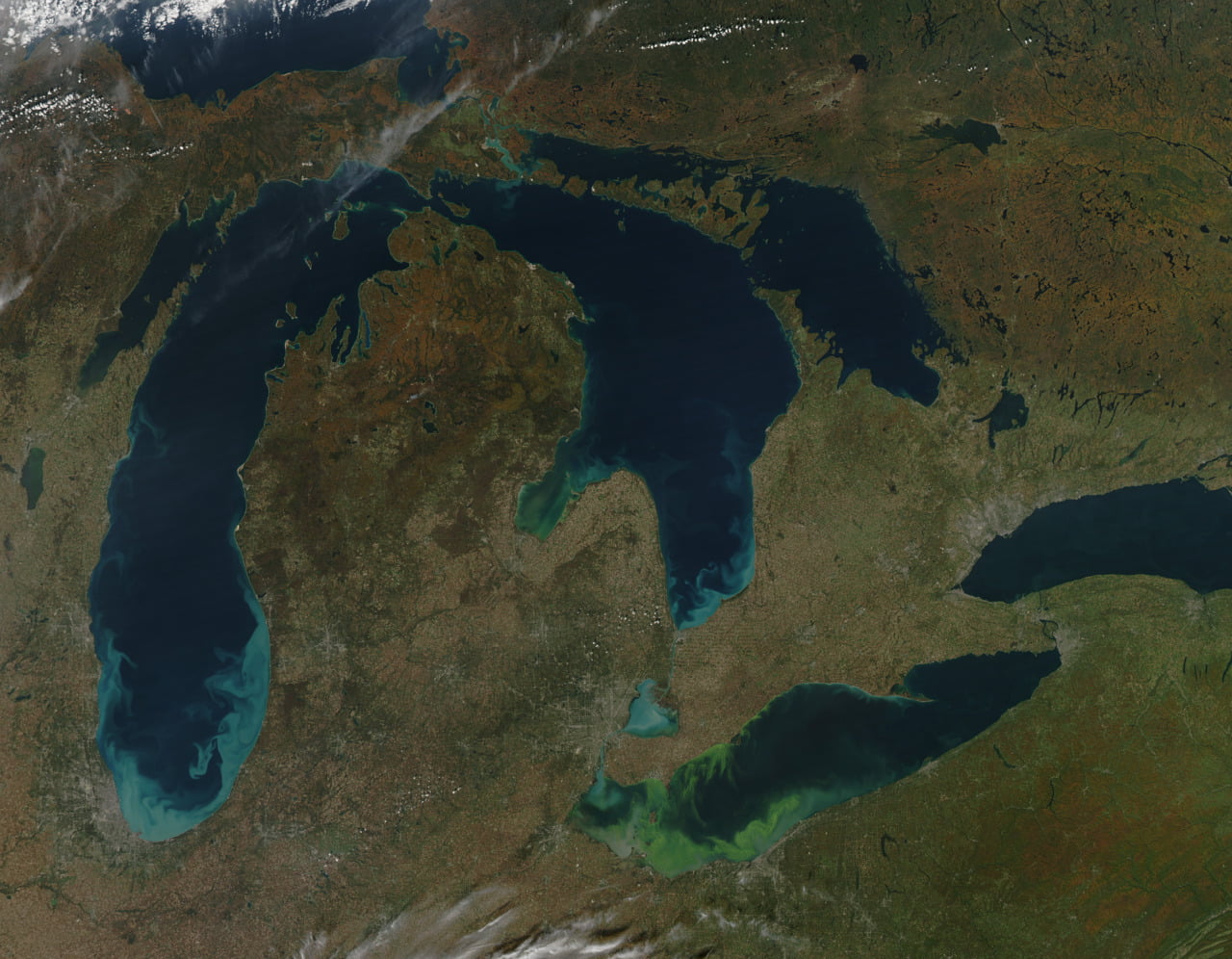
Stirred Up Sediment
Swirls of blue in the Great Lakes mark locations of recent autumn storms whose winds have stirred up sediment in the lakes. The silt and quartz sand acts as a tracer particle, making visible the circulation patterns of the lakes. In contrast, the green streaks mark locations of calmer winds and warmer temperatures where algae blooms have grown. Note the fundamental dissimilarity in their structures. Blue eddies turn over and mix in a fashion reminiscent of convective instabilities while the green blooms are far more uniform in structure. #
The Coalescence Cascade
When a droplet impacts a pool at low speed, a layer of air trapped beneath the droplet can often prevent it from immediately coalescing into the pool. As that air layer drains away, surface tension pulls some of the droplet’s mass into the pool while a smaller droplet is ejected. When it bounces off the surface of the water, the process is repeated and the droplet grows smaller and smaller until surface tension is able to completely absorb it into the pool. This process is called the coalescence cascade.

High-Altitude Balloon Flight


Tangentially fluids-related, but SpaceWeather has a fun video of a high-altitude helium balloon bursting. Although this balloon carried a space-related payload, it’s the same type of set-up used for weather balloons. With only a few basic assumptions, it’s possible to do some neat calculations on the buoyancy, loading capacity, and behavior of such balloons.
Vortex Street Sim
This numerical simulation shows a von Karman vortex street in the wake of a bluff body. As flow moves over the object, vortices are periodically shed off the object’s upper and lower surfaces at a steady frequency related to the velocity of the flow. The simulation takes place in a channel; note how the thickness of the boundary layers on the walls increases with downstream distance, forcing a slight constriction on the vortex street in the freestream.
Aurora from the ISS
The solar wind, a rarefied stream of hot plasma ejected from the sun, constantly bombards Earth’s magnetic field. This results in the formation of the magnetosphere, which deflects most of these charged particles away from the earth. Some of them, however, are drawn toward the magnetic poles; when these charged particles strike the upper atmosphere, they cause the gases there to release photons, resulting in the lights we know as auroras. This animation shows the International Space Station flying through the aurora australis–the southern lights. The fluid-like motion of the aurora is no accident; though diffuse, the solar wind is still a fluid governed by magnetohydrodynamics.
Sharkskin-Style Swimsuits
Fans of swimming will recall the controversies of the now-banned sharkskin-style swimsuits that helped break so many records in the past few years. The suits decrease drag on a swimmer both by making them more hydrodynamic in form and by drastically reducing skin friction where the water meets the swimmer’s body. In addition to decreasing the two major sources of drag on a swimmer, the compression provided by the material can help increase blood flow to muscles. These improvements came at a high material cost, though, and, since the technology was not viable for all athletes, it has since been banned.
Mixing in Space
Living here on earth, we are so accustomed to gravity’s effects on fluid behaviors that it’s not always obvious how microgravity will affect them. Here astronaut Richard Garriott demonstrates mixing and separating immiscible liquids in space.
Surface Tension Demo
This simple demonstration shows the power of surface tension, especially at small lengthscales. Another way to break the surface tension holding the water in the sieve would be to spray the top of the jar with soapy water. The soap acts as surfactant, decreasing the surface tension such that the water is unable to counteract the force of gravity.