Category: Art

  • Ghosts of Rivers Past

    Ghosts of Rivers Past

    Artist Dan Coe uses lidar data to create portraits of rivers and their past meanders. Used aerially, lidar produces high-resolution elevation data that provides a glimpse of features that are currently hidden beneath vegetation. With rivers, this means unearthing some of their previous paths. Secondary flows in a river bend erode the bed so that the bend gets more and more strongly curved. Eventually, the river can double back on itself and cut off the long curve. Repeat that process over millennia and you wind up with the complex paths in Coe’s images. (Image credit: D. Coe; via Colossal)

  • Slumping Ceramics

    Slumping Ceramics

    Dripping, drooping pottery is artist Philip Kupferschmidt’s specialty. Covered in drips and drops, slumping as if half-melted, Kupferschmidt’s ceramics seem partially liquid. With their colorful glazes, these pieces ooze personality. (Image credit: P. Kupferschmidt; via Colossal)

  • Melting Ice Cap

    Melting Ice Cap

    This award-winning photo by Thomas Vijayan shows waterfalls of ice melt off the Austfonna ice cap. The third-largest glacier in Europe, Austfonna is located in Norway’s Svalbard archipelago. Like other glaciers, it sees rising temperatures and increased melting due to climate change. Vijayan highlights that melting with his focus on the many waterfalls slicing through the ice. All that meltwater contributes to changes in local salinity as well as rising sea levels worldwide. (Image credit: T. Vijayan; via Nature TTL POTY)

  • Featured Video Play Icon

    “Animaris Rex”

    Eighteen meters long and powered only by the wind, artist Theo Jansen’s latest Strandbeest strolls the sand in this short video. Its complex movements — a swinging gait in some places and a caterpillar-like wave in others — are mesmerizing and life-like enough to almost make you wonder if the contraption truly is alive. See some of Jansen’s previous creations here. (Video and image credit: T. Jansen et al.; via Colossal)
  • “Chaosmosis”

    “Chaosmosis”

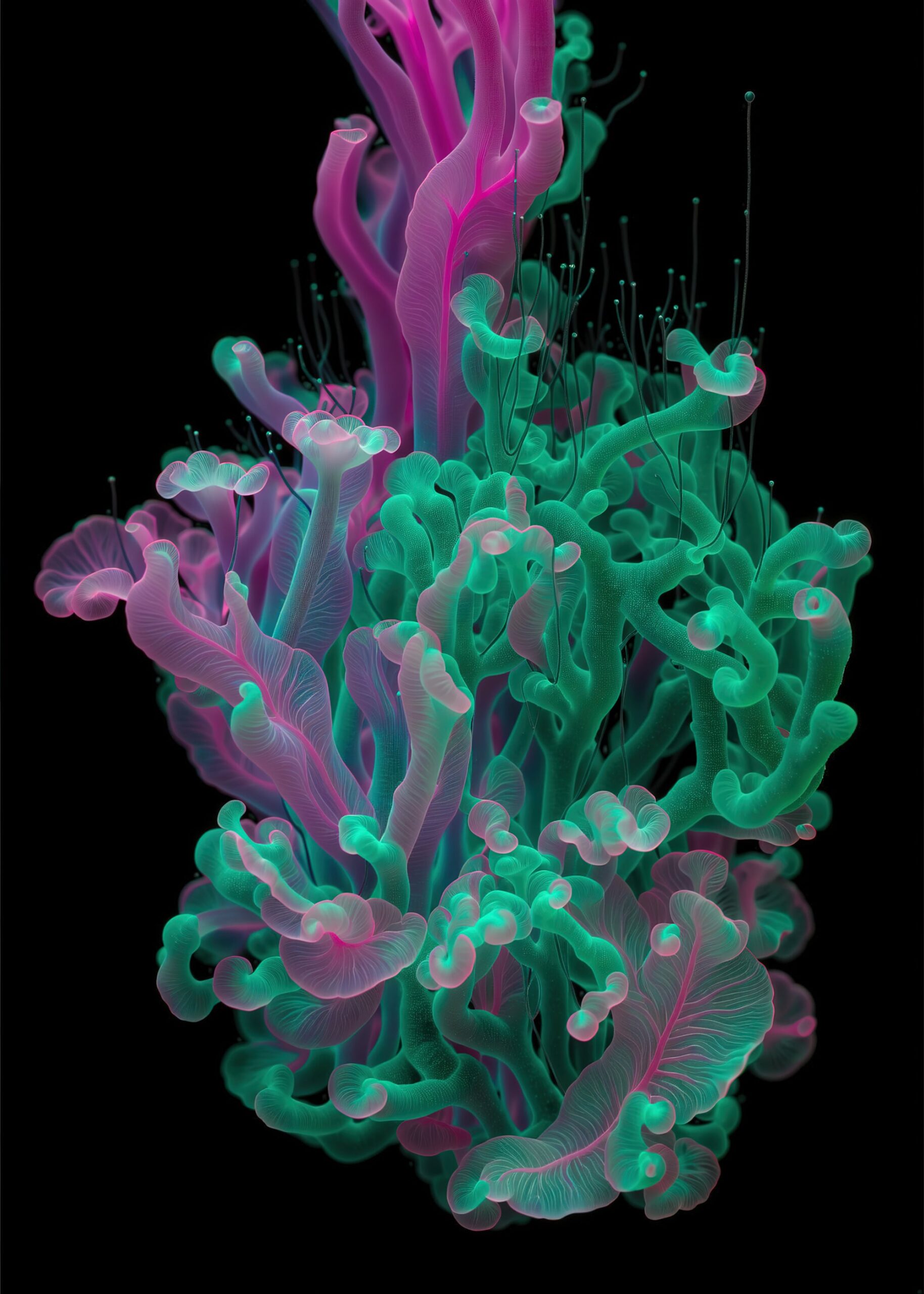
    After many years of featuring work from the Gallery of Fluid Motion, I’m excited to announce a new public exhibition of art drawn from the competition: “Chaosmosis: Assigning Rhythm to the Turbulent.” Works in the exhibit come from both scientists and artists; each piece makes visible the fluid motions that surround us.

    The exhibit is located at the National Academy of Sciences in Washington, DC through February 23, 2024. Entry is free, but only available between 9 a.m. and 5 p.m. on weekdays. For more, check out the exhibit’s webpage and press release (pdf) and the Instagram accounts for CPNAS and the exhibit.

    I’m looking forward to seeing the exhibit when I’m at the APS DFD meeting next month, but if you can’t make it to DC before the exhibit ends, don’t worry! This is just the first stop for the new traveling GFM exhibit. (Image credits: various, see individual images’ titles)

  • Spreading Spores

    Spreading Spores

    Mushrooms are the fruiting bodies of much bigger, largely underground fungi. Being fruit, mushrooms have the job of spreading spores so that the fungus can reproduce. Some mushrooms rely on the wind; others create their own wind. Still others use vortex rings to carry their spores higher. Who knew such fascinating and beautiful physics lies along the forest floor? (Image credit: top – A. Papatsanis, bottom – I. Potyó; via Wildlife POTY)

    Photo by Imre Potyó.
  • Black Hole Signature

    Black Hole Signature

    240 million years ago, pressure waves emanated from a black hole inside the Perseus Galaxy Cluster. Much later, NASA’s Chandra X-Ray Observatory intercepted those waves. Scientists raised the frequency of the signal until it fell within the range of human hearing. And then photographer John White played that sound through a petri dish of water sitting on a speaker. The result is above: a watery glimpse of a long ago black hole’s signature. Within these Faraday waves is the echo of a stellar phenomenon that took place when the very first dinosaurs walked our planet. (Image credit: J. White; via the 2023 Astronomy POTY)

  • Vivid Auroras Over Iceland

    Vivid Auroras Over Iceland

    When solar storms in late February sent energetic particles toward Earth, photographer Cari Letelier ventured to the remote northern edge of Iceland to capture the resulting auroras. When fast-moving, high-energy particles from the solar wind meet Earth’s magnetosphere, they’re directed toward the poles. There the particles slam into Earth’s upper atmosphere, exciting atoms that glow in greens, reds, and pinks. Curtains of light dance across the sky as a result. February’s show was particularly stunning, as captured by Letelier at Arctic Henge. (Image credit: C. Letelier; via Colossal)

  • Featured Video Play Icon

    “Aquakosmos”

    Colorful chandeliers, passing spirits, sprouting mushrooms, and fountains of falling ink appear in Christopher Dormoy’s “Aquakosmos.” Driven by the slight density difference between ink and water, many of these elaborate shapes result from the Rayleigh-Taylor instability. Anytime you see mushroom-like plumes and chandelier-like splitting vortex rings, there’s probably a Rayleigh-Taylor instability behind it. Check out the full video above, and, if you want to give this kind of flow visualization a try yourself, a glass of water and vial of food coloring is a great place to start. (Video and image credit: C. Dormoy)

  • Diving From Above

    Diving From Above

    Blue-footed boobies, like many other seabirds, climb to a particular altitude before folding their wings and diving head-first into the water. This acrobatic feat balances the bird’s force of impact and the depth it can reach to ensnare fish swimming there. It’s an incredible process to watch, a fascinating one to study, and, here, a beautiful glimpse of the natural world from a perspective we don’t typically see. (Image credit: H. Spiers, Bird POTY; via Colossal)