Tag: carbon dioxide

  • Featured Video Play Icon

    How CO2 Gets Into the Ocean

    Our oceans absorb large amounts of atmospheric carbon dioxide. Liquid water is quite good at dissolving carbon dioxide gas, which is why we have seltzer, beer, sodas, and other carbonated drinks. The larger the surface area between the atmosphere and the ocean, the more quickly carbon dioxide gets dissolved. So breaking waves — which trap lots of bubbles — are a major factor in this carbon exchange.

    This video shows off numerical simulations exploring how breaking waves and bubbly turbulence affect carbon getting into the ocean. The visualizations are gorgeous, and you can follow the problem from the large-scale (breaking waves) all the way down to the smallest scales (bubbles coalescing). (Video and image credit: S. Pirozzoli et al.)


    Fediverse Reactions
  • Dancing Peanuts

    Dancing Peanuts

    Bartenders in Argentina sometimes entertain patrons by tossing a few peanuts into their beer. Initially, the peanuts sink, but after a few seconds they rise, wreathed in bubbles. Once on the surface, they roll, causing the bubbles to pop, and the peanut sinks once again. The cycle repeats, sometimes for as long as a couple hours.

    There are a couple physical processes governing this dance. The first is bubble nucleation. Most beers are carbonated; they contain dissolved carbon dioxide gas that remains in solution while the beer is under pressure. Once poured, that storage pressure is gone and bubbles start to form in the liquid. The shape of the peanut means that bubbles form more easily on it than on the glass walls or in the liquid. And once the peanut is covered in bubbles, buoyancy comes into play. The bubbles attached to the peanut reduce its density relative to the surrounding fluid, enabling the peanut to rise up and float.

    This same process is seen with other objects in carbonated fluids, too, such as blueberries in beer and lemon seeds in carbonated water. But it’s also reflected elsewhere in nature. For example, magnetite crystals are thought to float in magma due to a similar nucleation of dissolved gases on their surface. (Image and research credit: L. Pereira et al.; via APS Physics)

  • Behind the Bubbly

    Behind the Bubbly

    Carbonation and the fizzy bubbles that come with it are surprisingly popular among humans. Through fermentation or artificial introduction, carbon dioxide gas gets dissolved into a liquid under high pressure. Then, when the pressure is released to atmospheric levels, that gas comes out of solution, forming tiny bubbles that eventually grow large enough to rise buoyantly to the surface. There they will either pop – releasing carbon dioxide gas and aromatics – or form a layer of foam – like in beer – that insulates the liquid and makes it harder to spill. (Image credit: D. Cook; see also R. Zenit and J. RodríguezRodríguez; via Jennifer O.)

  • Carbonation in Microgravity

    Carbonation in Microgravity

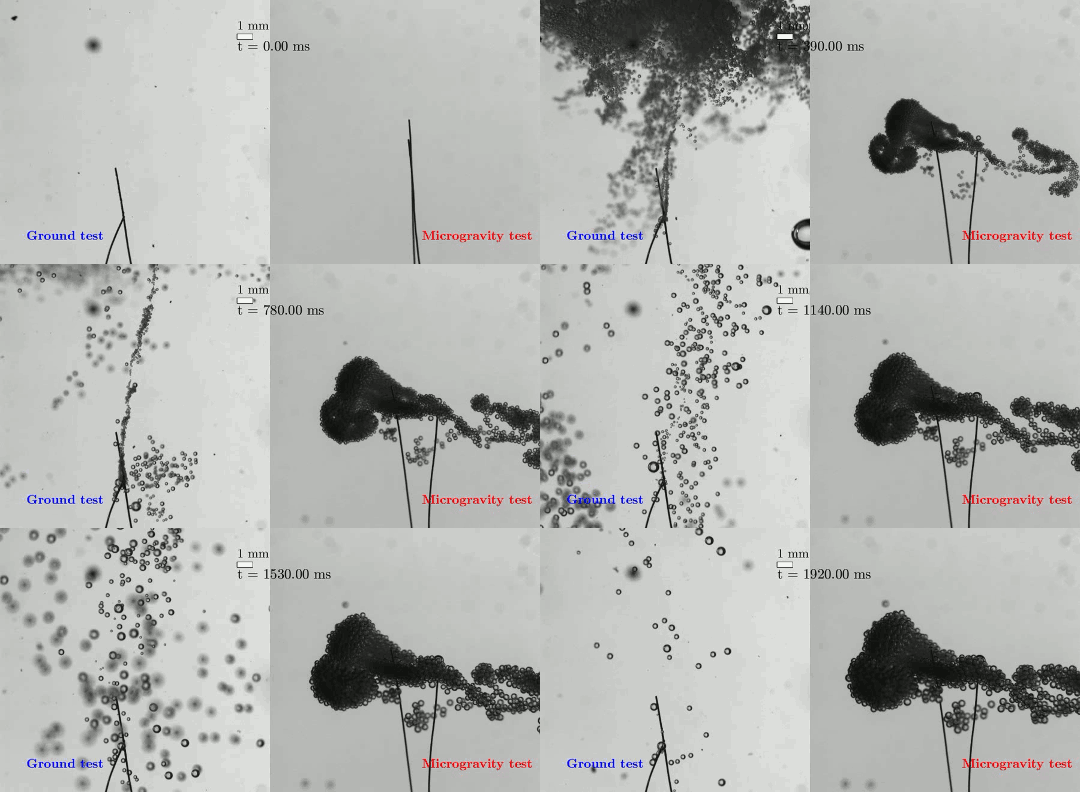
    Bubbly beverages are popular among humans, but there’s surprising complexity underlying their seemingly simply carbonation, as explored in a new Physics Today article. Most drinks get their bubbles from carbon dioxide, which at higher than atmospheric pressures, can stay dissolved inside water and other liquids. When that pressure gets released, any carbon-dioxide-filled gas cavity in the liquid adopts the allowable saturation concentration for the ambient pressure, which sets up a concentration gradient of carbon dioxide  between the liquid and the bubble. That causes carbon dioxide gas to diffuse into the bubbles, making them grow. 

    Here on Earth, those growing bubbles are buoyant, and they form rising plumes of bubbles. They continue gathering carbon dioxide as they rise, making them grow ever larger (lower left). In microgravity, on the other hand, the bubbles congregate where they form and continue growing through diffusion (lower right). This is one reason carbonated beverages are unpopular in space – instead of rising to the surface and escaping, all the carbon dioxide in a drink gets consumed, leaving astronauts with no way to expel it aside from burping!

    For lots more fascinating facts about bubbly drinks – including how they relate to geology! – check out the full Physics Today article. (Image credits: beer – rawpixel; bubbles – P. Vega-Martínez et al.; see also: R. Zenit and J. Rodríguez-Rodríguez)

  • Featured Video Play Icon

    Simulating the Earth

    Computational fluid dynamics and supercomputing are increasingly powerful tools for tracking and understanding the complex dynamics of our planet. The videos above and below are NASA visualizations of carbon dioxide in Earth’s atmosphere over the course of a full year. They are constructed by taking real-world measurements of atmospheric conditions and carbon emissions and feeding them into a computational model that simulates the physics of our planet’s oceans and atmosphere. The result is a visualization of where and how carbon dioxide moves around our planet.

    There are distinctive patterns that emerge in a visualization like this. Because the Northern Hemisphere contains more landmass and more countries emitting carbon, it contains the highest concentrations of carbon dioxide, but winds move those emissions far from their source. As seasons change and plants begin photosynthesizing in the Northern Hemisphere, concentrations of carbon dioxide decrease as plants take it up. When the seasons change again, that carbon is re-released.

    These visualizations underscore the fact that these carbon emissions impact everyone on our planet–nature does not recognize political borders–and so we share a joint responsibility in whatever actions we take. (Video credit: NASA Goddard; h/t to Chris for the second vid)

  • Featured Video Play Icon

    Supercritical Fluids

    Supercritical fluids live in the region of a phase diagram beyond the critical point. At these temperatures and pressures, a substance is neither strictly liquid nor a gas but exhibits behaviors from both. A supercritical fluid can effuse through a solid like a gas does but can also dissolve substrates like a liquid. As noted in the video above, supercritical fluids are useful substitutes for organic solvents in many industrial applications. Carbon dioxide, for example, is used as a supercritical fluid in the decaffeination process.

    It’s Tuesday again! If you enjoy this blog, please take a moment to recommend us in the Tumblr directory. Thanks!