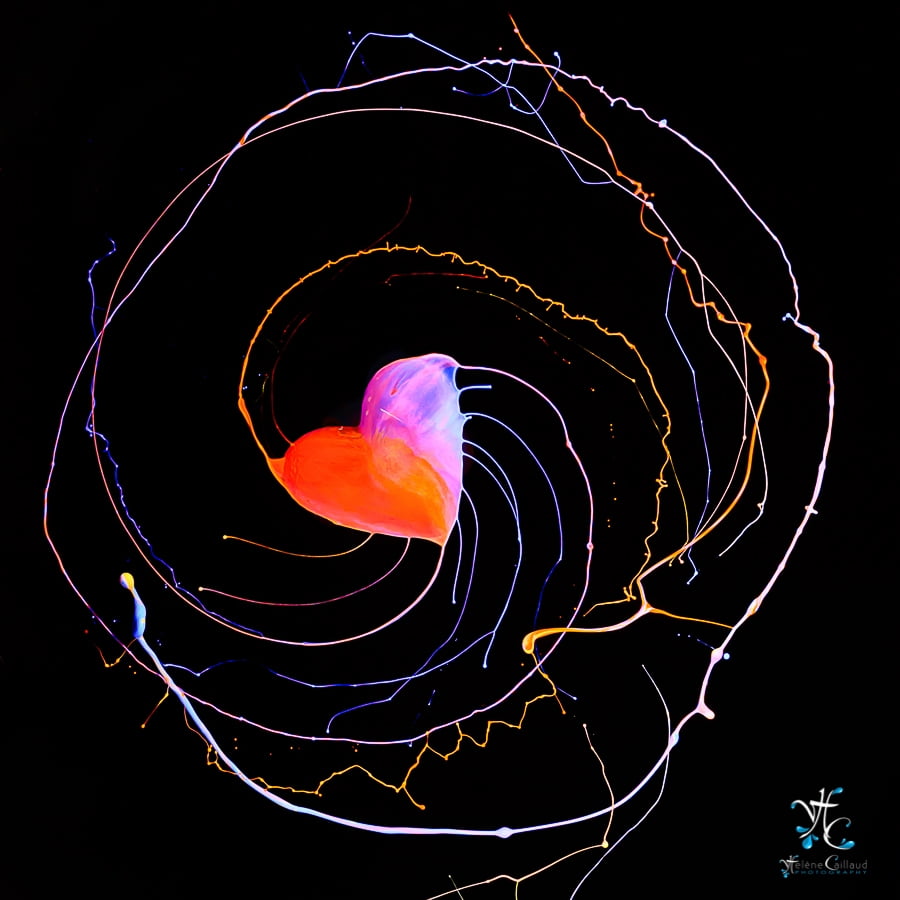
To make this heart, photographer Helene Caillaud flung paint off a tool attached to a drill bit, much like Fabian Oefner did in his “Black Hole” series. Caillaud, however, tweaked the set-up to create distinctive shapes at the center of her images, with centrifugal force creating the beautiful filaments spiraling outward. It’s a neat effect and a fitting way to celebrate Valentine’s Day here on FYFD! (Image credit: H. Caillaud)
Tag: Valentine’s Day

Flow in the Heart


Few flows are more integral to our well-being than blood flow through the heart. Over the course of our lives, our hearts develop from a few cells pushing viscous blood through tiny arteries to the muscular center of a vast circulatory network, capable of powering us through incredible physical feats. What’s most astonishing about all this is that the heart goes through all these changes and adaptations without ever pausing.
Peering into the heart to see it in action is difficult, but researchers today are combining imaging techniques like CT and MRI with computational fluid dynamics to build patient-specific heart models. Not only does this help us understand hearts in general; it’s paving the way toward predicting how a specific treatment may affect a patient. Imagine, for example, being able to simulate and compare different models of an artificial heart valve to see which will work best for a particular patient. We’re not to the point of doing so yet, but it’s a very real possibility in the future.
To see some examples of predicted and measured heart flows, check out this video by J. Lantz. In the meantime, happy Valentine’s Day! (Image credits: Linköping University Cardiovascular Magnetic Resonance Group, video source; via Another Fine Mesh)

Happy Valentine’s Day
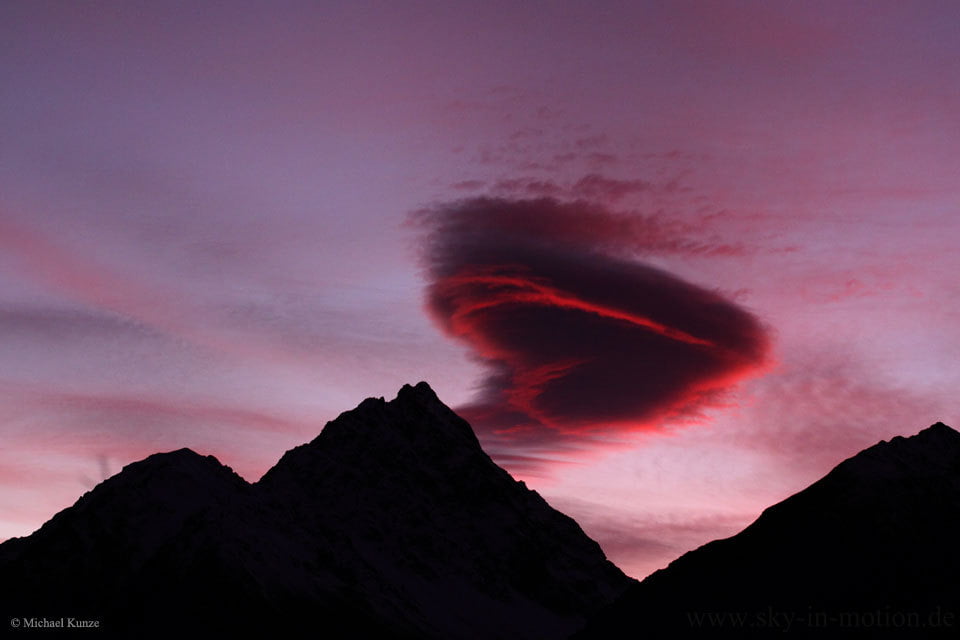
This heart-shaped atmospheric apparition is a lenticular cloud captured over the mountains of New Zealand. As you can see in the companion video, the cloud itself remains stationary over the mountain. This is a key feature of lenticular clouds, which form when air flowing over/around an obstacle drops below the dew point. This causes moisture in the air to condense for a time before it descends and warms once more. Thus, even though air is continuously flowing past, what we see is a stationary, lens-shaped cloud. Happy Valentine’s Day from FYFD! (Image credit: M. Kunze, video; via APOD)

Happy Valentine’s Day!
What can you do with a 7 x 7 grid of miniature vortex cannons? Why, make floating vortex hearts, of course. Happy Valentine’s Day from FYFD! (Video credit: D. Schulze/bitsbeauty; via Colossal)

Happy Valentine’s Day!
Here’s a potential flow field with heart-shaped streamlines, made just for you. Thank you to everyone for having helped made FYFD such a success over these 700 posts, whether by liking, reblogging, tweeting, or telling a friend. Happy Valentine’s Day!
For the curious among you, the flow is a superposition of uniform flow, two sources, and two sinks. The Matlab code is here. Have fun!