Tag: noise reduction

  • Noisy Jets

    Noisy Jets

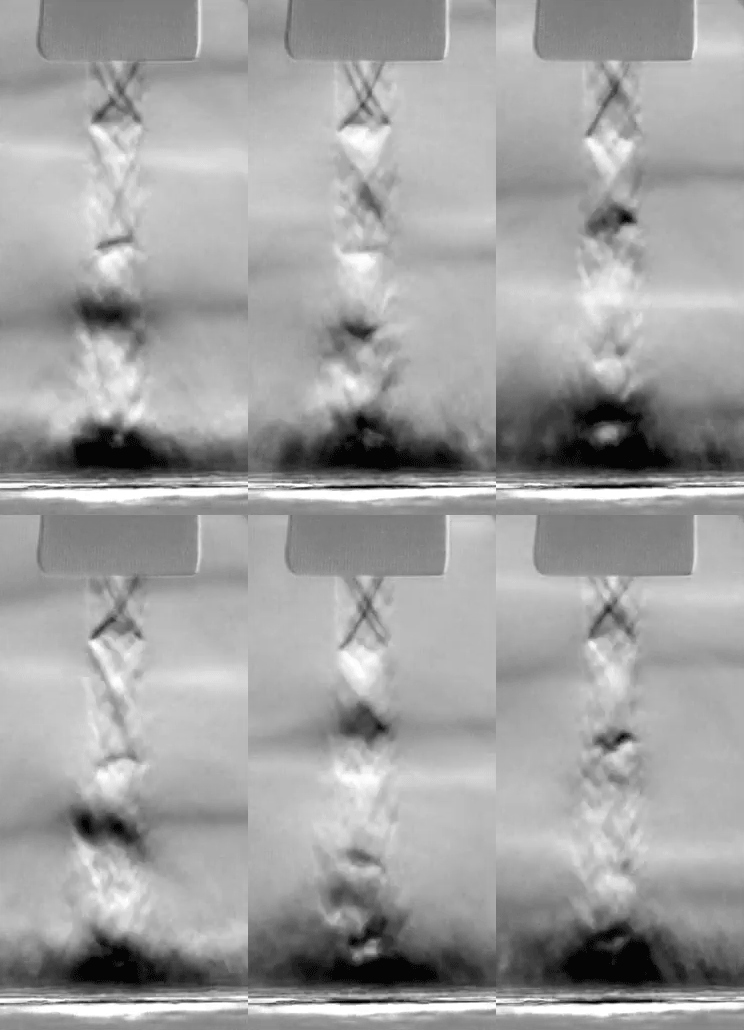
    One major problem that has plagued supersonic aircraft is their noise. The Concorde – thus far the only supersonic commercial airliner – was plagued with noise complaints that ultimately restricted its usability. Noise reduction is a major area of inquiry in aerospace, and the video below shows one experiment trying to understand the connections between supersonic flow and noise.

    Above you see a supersonic, Mach 1.5 microjet emanating from a nozzle at the top of the image. The jet is hitting a flat plate at the bottom of the image. Just beyond nozzle’s exit, you can see the X-shape of shock waves inside the jet. The position of that X is oscillating up and down.

    In the background, you can see horizontal light and dark lines traveling up and down. Those horizontal lines in the background are acoustic waves. When they hit the bottom plate, they reflect and travel upward until they hit another surface (outside the picture) and reflect back down. As they travel, they interact with the jet, causing those X-shaped shock waves to move up and down. This coupling between flow and acoustic waves makes the jet much louder – up to 140 dB – than it would be otherwise.

    Researchers hope that unraveling the physics of simpler systems like this one will help them quiet more complicated aircraft. (Image and video credit: F. Zigunov et al.)

  • Featured Video Play Icon

    Silent Flying

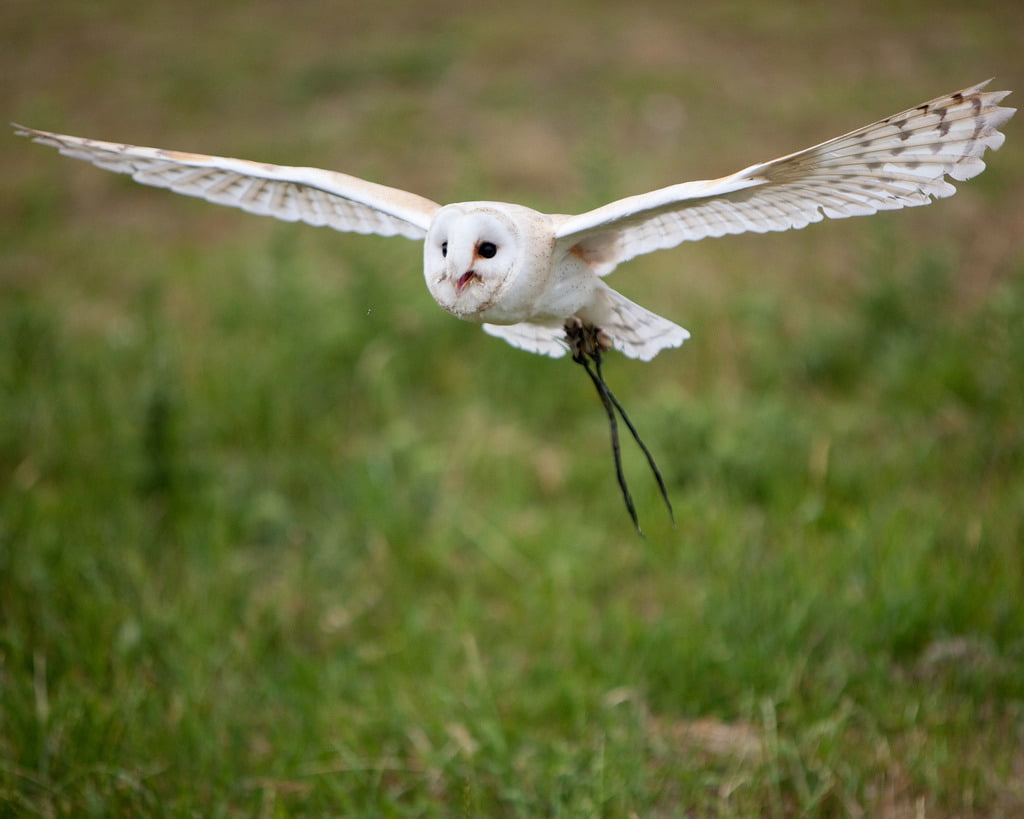
    As nocturnal hunters, owls are aerodynamically optimized for stealthy flying. This clip from BBC Earth demonstrates just how quiet a barn owl is in flight compared to a pigeon or a peregrine falcon. The owl’s large wingspan relative to its body size gives it enough lift that it does not have to flap often, allowing it to glide instead, but this is far from its only stealthy adaptation. Owl feathers feature a serrated leading edge that helps break flow over the wing into smaller, quieter vortices. Their fringe-like trailing edge breaks flow up even further and acts to damp noise from airflow. The downy feathers of the owl’s body also help muffle any noise from the bird’s movement, allowing the barn owl to fly almost silently. (Video credit: BBC Earth; via Gizmodo)

  • The Silence of Owls

    The Silence of Owls

    Owls are nearly silent hunters, able to swoop down on their prey without the rush of air over their wings giving away their approach, thanks to several key features of their feathers. The trailing edge of their feathers–or any lifting body, like an airplane wing–are a particular source of acoustic noise due to the interaction of turbulence near the surface with the edge. Since owls are especially good at eliminating self-produced noise in a frequency range that overlaps human hearing, investigators want to learn what works for owls and apply to it aircraft. A recent theoretical analysis uses a simplified model of the feather as a porous, elastic plate. The researchers found that the combination of porosity with the elasticity of the trailing edge significantly reduced noise relative to a rigid edge. (Photo credit: N. Jewell; research credit: J. Jaworski and N. Peake)