Tag: dolphins

  • On Dolphin Turbulence

    On Dolphin Turbulence

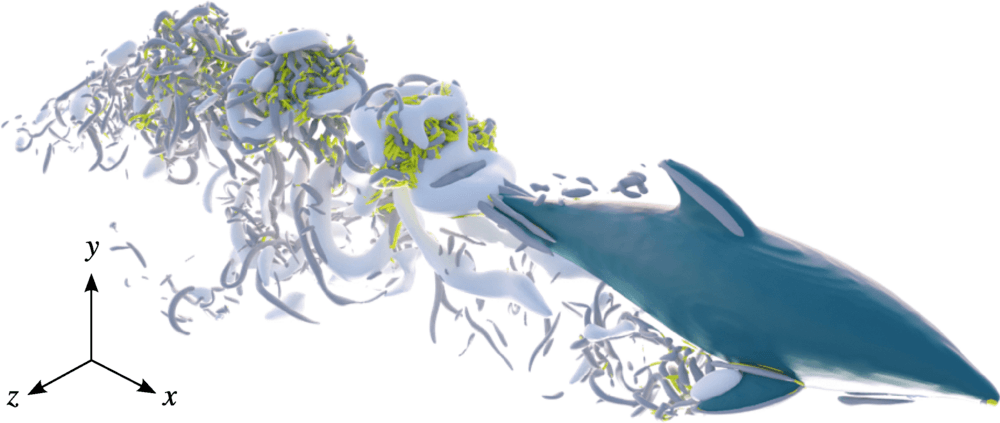
    Dolphins are such fast and agile swimmers that, naturally, scientists have long wanted to understand how they swim so well. A recent study draws on numerical simulation to analyze the flow a dolphin creates when flapping its tail.

    The resulting flow is highly turbulent–researchers were only able to simulate up to a fraction of a dolphin’s actual Reynolds number–with both large-scale vortices and a cascade of smaller ones. The largest vortices, shown here in white, form on the upper and lower surface of the dolphin’s tail, then slide off the tail in a vortex ring. It’s these vortex rings, the researchers found, that provide the bulk of a dolphin’s thrust.

    The smaller-scale vortices, in contrast, get formed by the large vortices, and they make little to no contribution to the dolphin’s propulsion. Interestingly, these results suggest that we might be able to describe the propulsion of dolphins and other highly turbulent swimmers by focusing only on the largest scales in the flow. (Video, image, and research credit: Y. Motoori et al.; via Ars Technica)
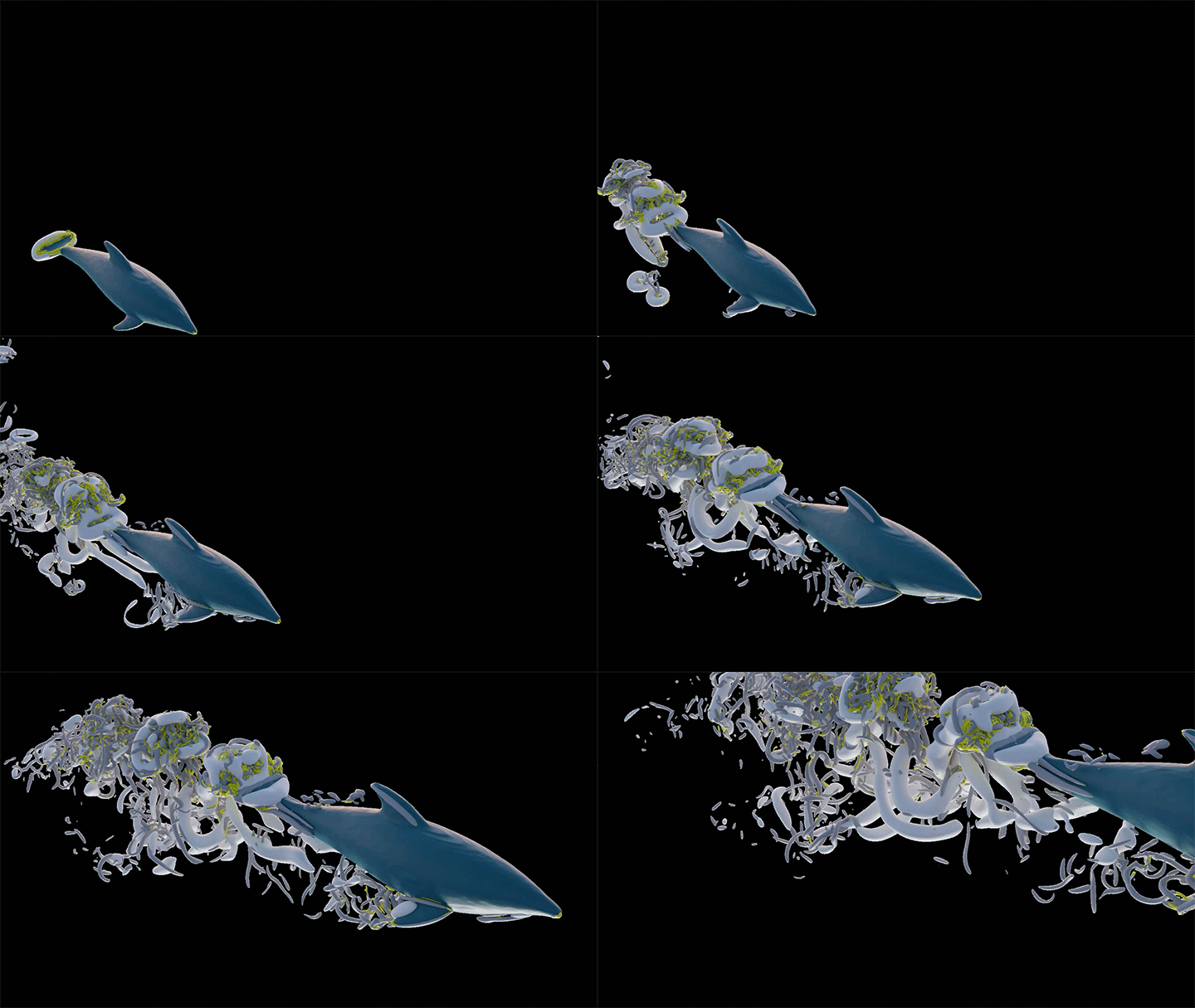

    Animation of the simulated flow from a swimming dolphin.
    Animation of the simulated flow from a swimming dolphin.
    Fediverse Reactions
  • Featured Video Play Icon

    Dolphins Playing With Bubble Rings

    Blow a jet of air underwater and you can make a bubble ring. It takes some practice for humans, or you can use a device. In this video, a team introduced wild dolphins to a bubble-ring-making machine and observed how the dolphins reacted. After some initial wariness, the animals played with them for hours, creating games and having fun. Note that there are some dolphins who create their own bubble rings to play with, so it’s hard to say that these particular dolphins have never seen a bubble ring before. But even if they have seen the bubbles, they wouldn’t have seen a machine making them. (Image and video credit: BBC Earth)

  • Forming a Vortex

    [original media no longer available]

    Vortex rings show up remarkably often in nature. In addition to being the playthings of dolphins, whales, scuba divers, humans, and swimmers, vortex rings appear in volcanic outburstsĀ andĀ spore-spreading peat mosses. Vortex ringsĀ even occur in blood flow through the human left ventricle in the heart. In each of these cases, the vortex ring is formed by impulsively accelerating fluid through a narrow opening, like the dolphin’s blowhole. The fluid at the edge of injected jet is slowed by friction with the quiescent surrounding fluid. The fluid at the edge of the jet then slips around the sides and into the wake of the faster-moving fluid, where it’s accelerated through the middle of the forming vortex ring. This spinning from the inside-out and back-in persists as long as the vortex is intact, and is part of what keeps the ring from dissipating. (Video credit: SeaWorld; submitted by John C.)

  • Featured Video Play Icon

    Dolphin Bubble Rings

    Dolphins create vortex rings to play with by exhaling through their blowholes. Ā The sharp impulse of air, combined with the round shape, creates a vortex ring of bubbles. Humans can do this underwater, too, but dolphins aren’t content to lie at the bottom of the pool. Ā Because smaller vortex rings are more coherent and last longer, they will break the growing vortex so that the vortex fragment rejoins as a smaller vortex ring. They also spin the water nearby to cause wave instabilities in the ring.

  • Featured Video Play Icon

    Water-Walking Basilisks

    Some animals, like the common basilisk (a.k.a. the Jesus Christ lizard) are capable of running across water for short distances. The basilisk accomplishes this feat by slapping the water with sufficient force and speed to keep its body above the surface. This slap also creates a pocket of air around its foot. The lizard propels itself forward by kicking its leg back, then lifting its foot out of the water before the air bubble collapses. Water birds like the Western Grebe and tail-walking dolphins rely on similar physics to stay above the water line. # (submitted by Simon H)

  • Featured Video Play Icon

    Dolphins Making Bubble Rings

    Marine animals know more about fluid dynamics than we might think. Dolphins make games out of blowing vortex ringsĀ (a.k.a. bubble rings) and tossing them around. You can try, too, next time you’re at the pool!