Tag: Froude number

  • Roll Waves in Debris Flows

    Roll Waves in Debris Flows

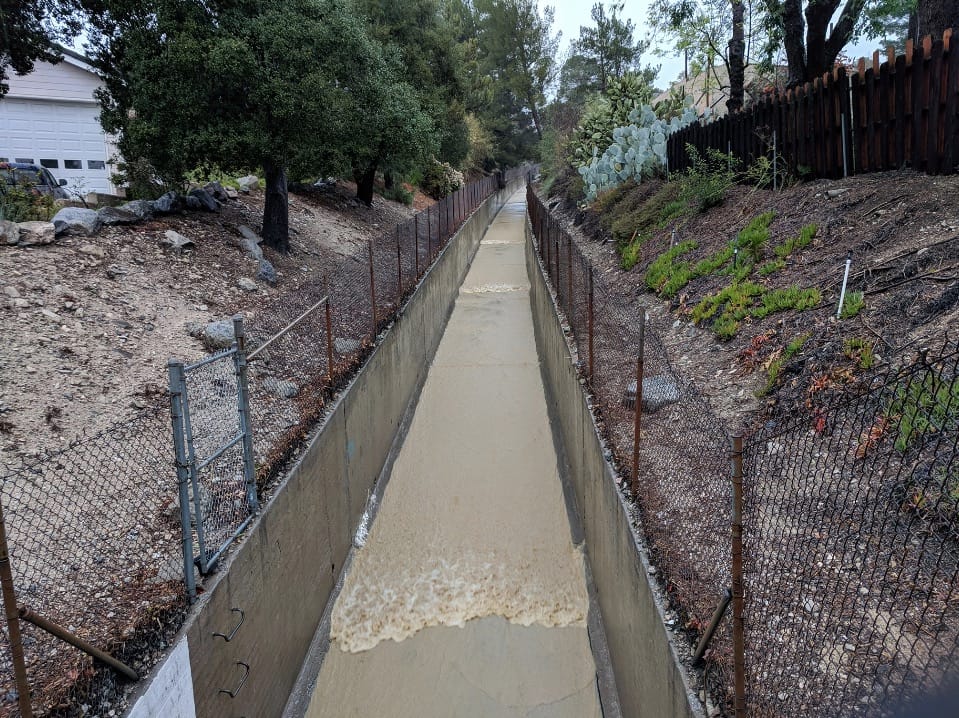
    When a fluid flows downslope, small disturbances in the underlying surface can trigger roll waves, seen above. Rather than moving downstream at the normal wave speed, roll waves surge forward — much like a shock wave — and gobble up every wave in their way.

    Such roll waves are fairly innocuous when flowing down a drainage ditch but far more problematic in the muddy debris flows of a landslide. Debris flows are harder to predict, too, thanks to their combined ingredients of water, small grains, and large debris.

    A new numerical model has shed some light on such debris flows, after showing good agreement with a documented landslide in Switzerland. The model suggests that roll waves get triggered in muddy flows at a higher flow speed than in a dry granular flow but a lower flow speed than is needed in pure water.

    For a great overview of roll waves, complete with videos, check out this post by Mirjam Glessner. (Image credit: M. Malaska; research credit: X. Meng et al.; see also M. Glessmer; via APS)

    Fediverse Reactions
  • Rio 2016: Whitewater Sports

    Rio 2016: Whitewater Sports

    The whitewater rapids of canoe slalom have their origins in mountain streams. Today the sport’s Olympic venues are artificial rivers, specially designed to provide world-class rapids whatever the geography of the host city. Rio’s course, like London’s, is reconfigurable; its features are controlled by the placement of Lego-like plastic blocks.

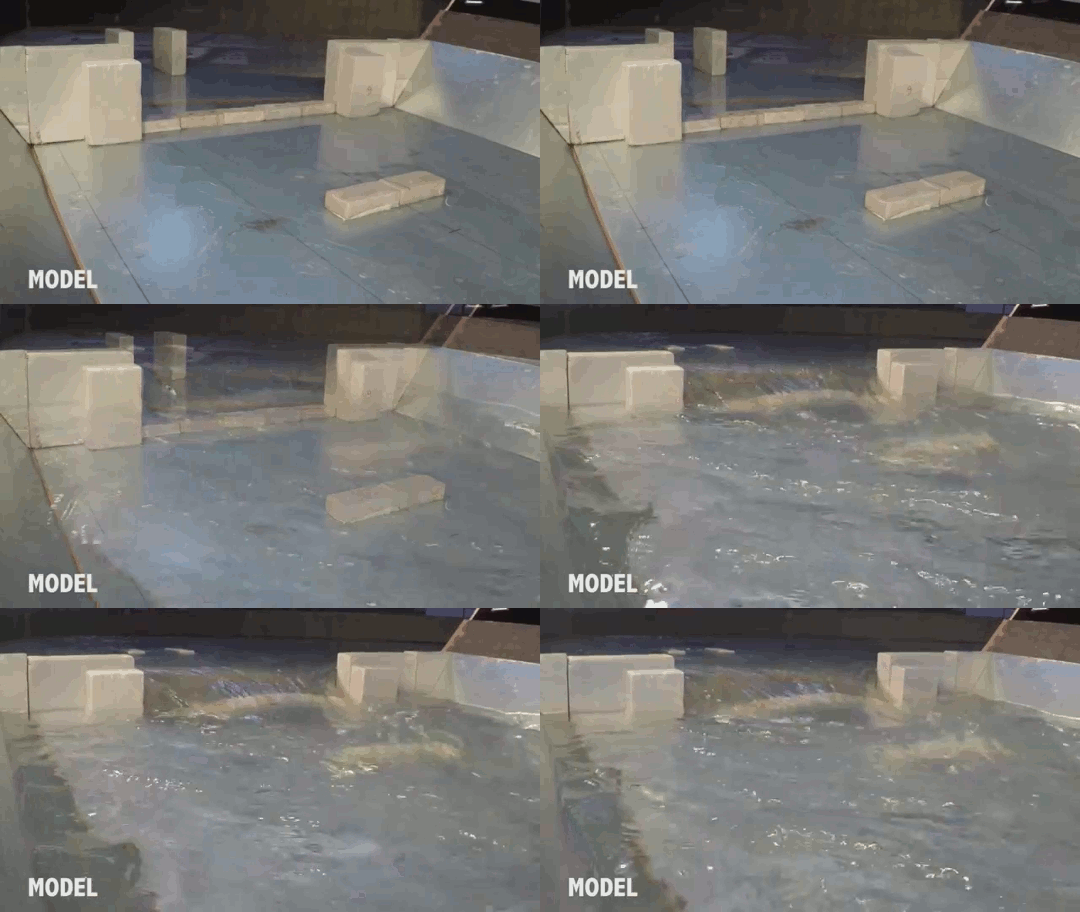
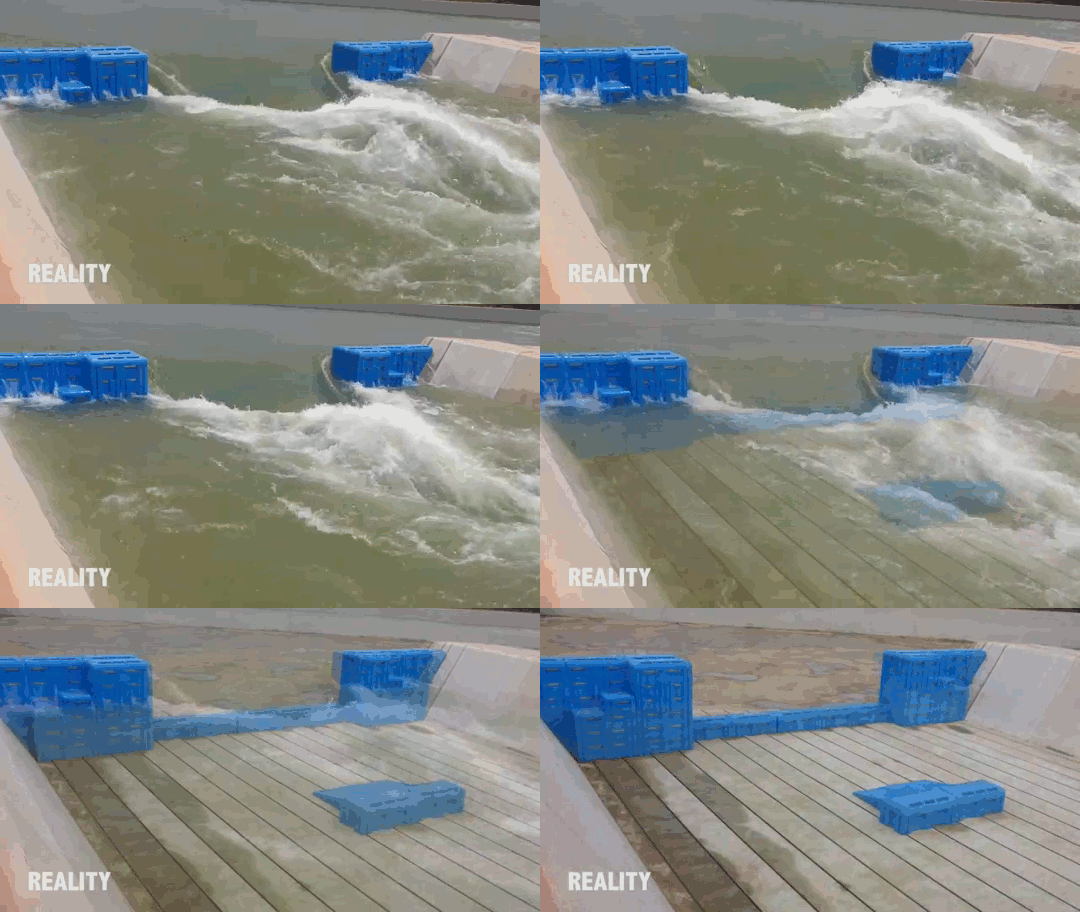
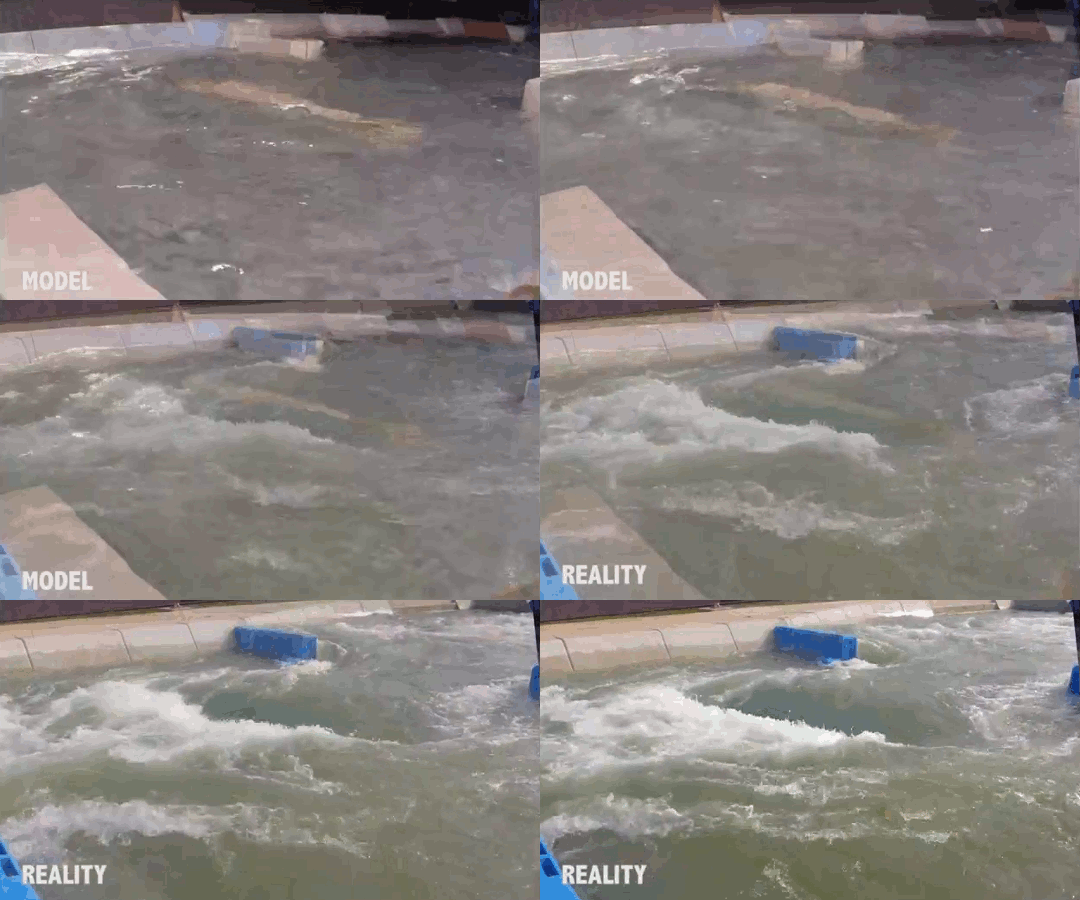
    A key part of the course’s design process was building a small-scale physical model of the course. To maintain the dynamics of the rapids at a smaller physical scale, engineers used a concept called similitude. Surface waves like rapids are a function of the flow’s inertia and the effects of gravity, a ratio that’s captured in the dimensionless Froude number. To match the small-scale model to the real flow, engineers scaled the features of the real course down such that the Froude number stayed the same between the model and the full-scale course. As seen in the animations above, this meant that the model had the same general flow features as the final course, letting engineers and designers test and fine-tune features before construction. Learn more about the model and its construction in these two videos. (Image credits: kayaker – Getty Images; model comparisons – J. Pollert, source)

    Previously: Physics of rowingwhy that octopus kite looks so real

    Join us throughout the Rio Olympics for more fluid dynamics in sports. If you love FYFD, please help support the site!

  • Featured Video Play Icon

    Swirling Fluids

    In this video, researchers investigate swirling fluids by studying the shapes of the free surface between air and the liquid. As parameters like the diameter of the glass, initial (unperturbed) height of the liquid, and angular velocity of the rotation change, the surface of the liquid displays different modal behaviors, seen in the photos on the lower left of the video. By non-dimensionalizing the physical parameters of the system (students: think Buckingham pi theorem), they are able to replicate the shape of the free surface by matching a Froude number and dimensionless depth and offset. Such similitude between fluids under different conditions is key to understanding the underlying physics. (Video credit: M. Reclari et al; submitted by co-author M. Farhat)

  • Reader Question: Froude vs. Reynolds

    @spooferbarnabas asks: I was wondering what the difference is between Froude’s number and Reynold’s number? they seem very similar

    Fluid dynamicists often use nondimensional numbers to characterize different flows because it’s possible to find similarity in their behaviors this way. The Reynolds number is the most common of these dimensionless numbers and is equal to (fluid density)*(mean fluid velocity)*(characteristic length)/(fluid dynamic viscosity). The Reynolds number is considered a ratio of total momentum (or inertial forces) to the molecular momentum (or viscous forces). A small Reynolds number indicates a flow dominated by viscosity; whereas a flow with a large Reynolds number is considered one where viscous forces have little effect.

    The Froude number, in contrast, focuses on resistance to flow caused by gravitational effects, not molecular effects. It is defined as (mean fluid velocity)/(characteristic wave propagation velocity). Initially, it was developed to describe the resistance of a model floating in water when towed at a given speed. As the boat’s hull moves through the water, it creates a wave that travels forward (and backward in the form of the wake), carrying information about the boat–much like pressure waves travel before and behind a subsonic aircraft. The speed of the wave created by the boat depends on gravity (see shallow water waves). The closer the boat’s speed comes to the water wave’s speed, the greater the resistance the boat experiences. In this respect, the Froude number is actually analogous to the Mach number in compressible fluids.

    I hope that helps explain some of the differences!