Every child learns to blow soap bubbles, but it’s rare that we have a chance to look inside them and see the flow there. In this poster, researchers seed a growing bubble with olive oil droplets, then illuminate them with a laser. This provides a glimpse inside the bubble. In the center, we see the incoming jet dividing the bubble in two and forming two large, counter-rotating vortices. Along the left side, snapshots show the bubble’s interior as it grows and, eventually, pops. (Image credit: S. Rau et al.)
Year: 2024

Icelandic Glow
Solar wind particles slam into the atmosphere near Earth’s poles, creating billowing curtains of glowing plasma known as auroras. Beneath the earth, molten rock seethes and flows, squeezed up fissures to release explosive gases and spurts of lava to the surface world. These natural phenomena are captured in the left and center of this image, respectively. To the right, three plumes of water vapor rise from a geothermal power plant. Three very different phenomena — all fluid dynamical in nature and all captured in a single image of Iceland. It’s no wonder the island is covered in tourists. (Image credit: W. Gorecka; via APOD)

Sliding on Fibers
Water drops slide down spiderwebs, along the spines of desert plants, and across the armored exterior of horned lizards. Thin, grooved surfaces like these pop up frequently in nature when organisms need to direct water. A recent study of droplets sliding on fibers suggests why.
A drop sliding down a fiber is constantly shrinking, leaving a little of itself behind as a thin film that coats the fiber. The thicker a fiber is, the slower the drop moves along it. Similarly, if you bundle multiple fibers together, a drop will travel slower along the thicker bundle. But, to the researchers’ surprise, droplets actually travel faster on bundles than they do along single fibers of the same overall diameter. The key to this result seems to be the tiny grooves between fibers in a bundle. Water fills these areas, creating a “rail” along which the droplets slide more efficiently.
The team hope to put their new insights to use on a water harvester that could help capture precious moisture in arid environments, much like those desert-dwelling plants and lizards do. (Image and research credit: M. Leonard et al.; via Physics World)

Shaking on Impact
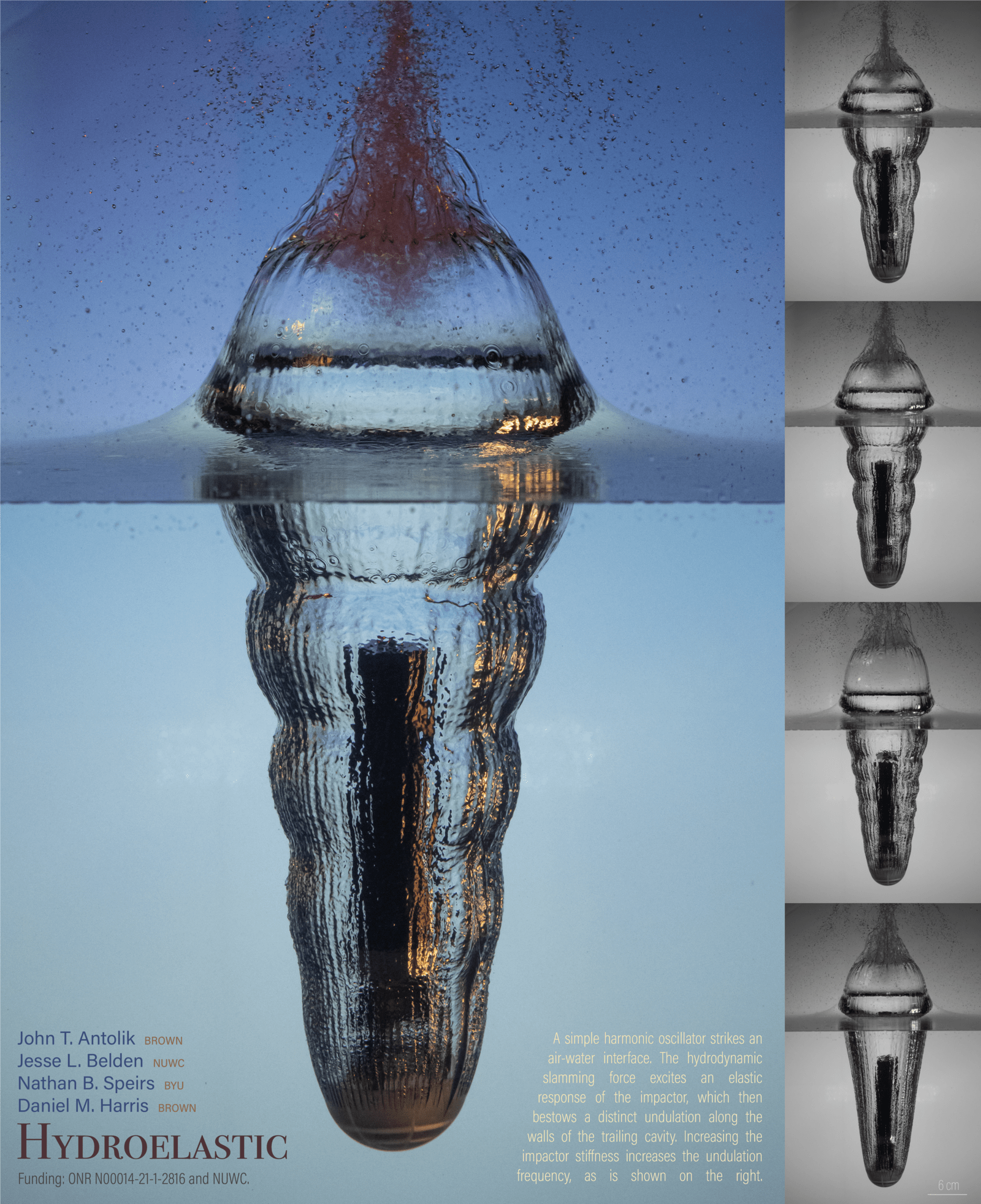
When objects impact water with enough speed, they create a smooth-walled, air-filled cavity around and behind them. Here, the impacting object is one with some give, like a spring. The initial impact squishes the object, setting it to oscillating along its length. The result is a wavy cavity. The stiffer the object, the more frequent the waves. (Image credit: J. Antolik et al.)

Calming the Waves
Wave action can be a major source of erosion along riverbanks and shorelines. But in a recent study, scientists were able to perfectly absorb incoming waves to create a downstream region with calm, wave-free waters.

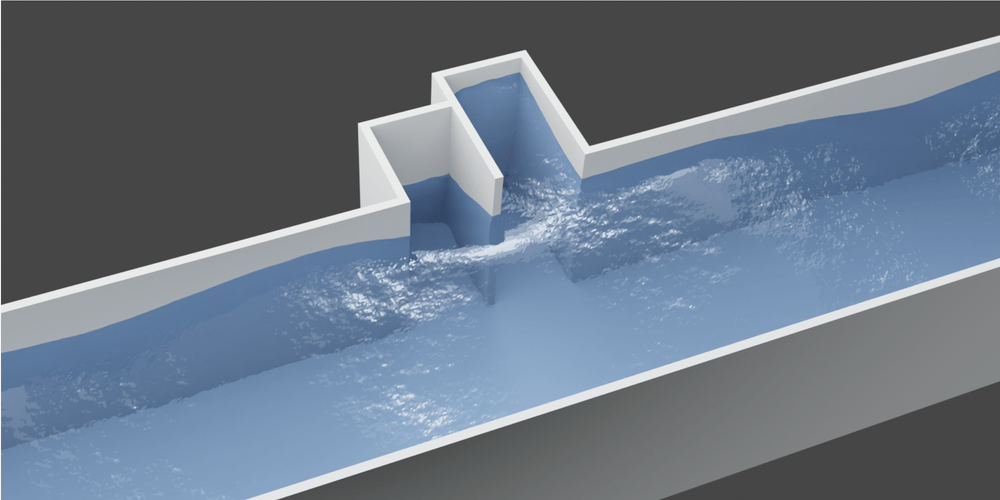
Experimental data shows that waves approaching from the left interact with the resonant chambers and get perfectly absorbed, leaving the water on the right side still. The group began with a narrow channel that waves could move down. They added two small, side-by-side cavities perpendicular to the channel; as waves travel down the channel, they resonate with the cavities, which reflect and transmit their own waves back into the channel. With the right tuning to the size and spacing of the cavities, the team was able to make the cavities’ waves perfectly cancel the channel’s waves. The group demonstrated this absorption theoretically, numerically, and experimentally.
Currently, they’ve only managed perfect absorption with a single wave frequency, but an array of cavities should be able to absorb a range of incoming waves. The authors hope their work will one day help protect coastal structures and prevent erosion by countering incoming waves. (Image and research credit: L-P. Euvé et al.; via APS Physics)

The Best of FYFD 2023


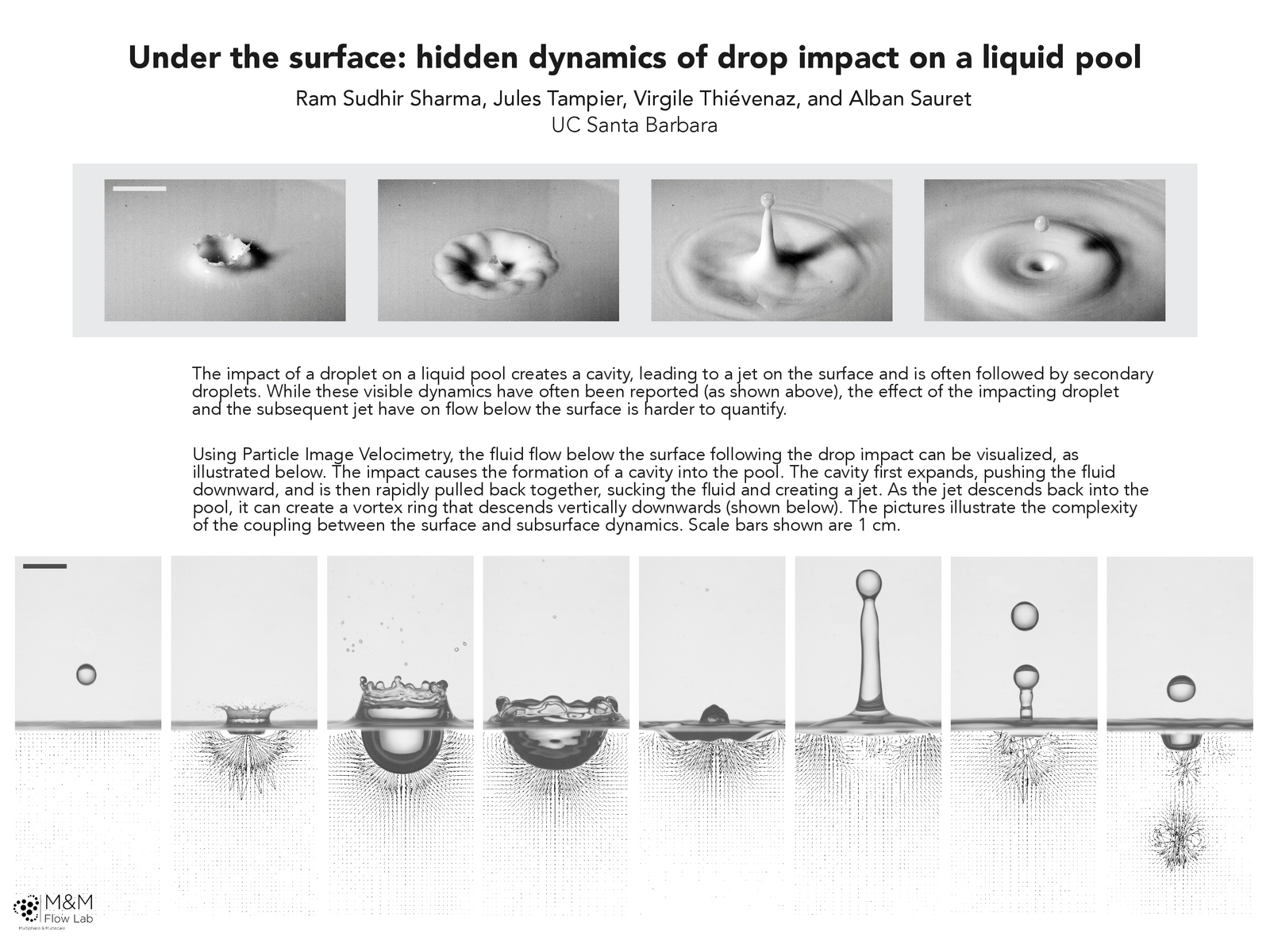

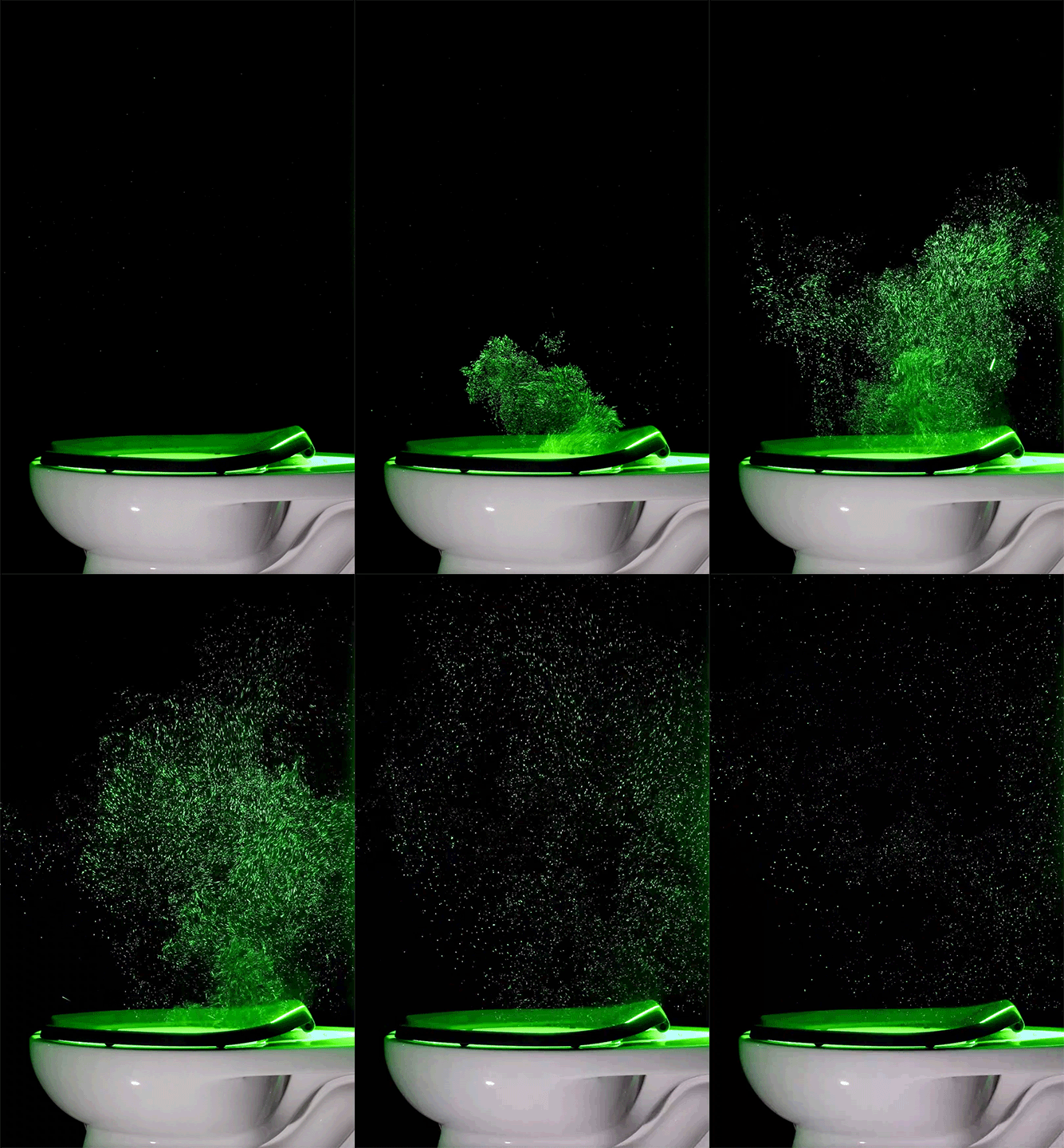


A fresh year means a look back at what was popular last year on FYFD. Usually, I give a numeric list of the top 10 posts, but this year the analytics weren’t as clear. So, instead, I’m combining from a few different sources and presenting an unordered list of some of the site’s most popular content. Here you go:
- Eroding the Sphinx
- Getting Water Out of Your Ear
- Can Water Solve a Maze?
- Dandelion Seeds
- Black Holes in a Bathtub
- Mixing With E. coli
- Beneath the Cavity
- Leidenfrost Explosions
- Toilet Plumes
- Exascale Simulations
- Ghosts of Rivers Past
- Blood Flow in a Fin
- Snake Tracks
- Lagoon Nebula
- “Chaosmosis”
I’m really pleased with the mix of topics this year; many of these topics are straight from research papers, and others are artists’ works. At least one is both. From swimming bacteria to star-birthing nebulas, fluid dynamics are everywhere!
If you enjoy FYFD, please remember that it’s a reader-supported website. I don’t run ads and it’s been years since my last sponsored post. You can help support the site by becoming a patron, making a one-time donation, buying some merch, or simply by sharing on social media. And if you find yourself struggling to remember to check the website, remember you can get FYFD in your inbox every two weeks with our newsletter. Happy New Year!
(Image credits: sphinx – S. Boury et al., ear model – S. Kim et al., maze – S. Mould, dandelion – S. Chaudhry, water tank – P. Ammon, e. coli – R. Ran et al., drop impact – R. Sharma et al., Leidenfrost – L. Gledhill, toilet – J. Crimaldi et al., engine sim – N. Wimer et al., rivers – D. Coe, fin – F. Weston, snake – P. Schmid, nebula – J. Drudis and C. Sasse, flames – C. Almarcha et al.)