Month: December 2024

  • Where to Follow FYFD Online

    Where to Follow FYFD Online

    Hi, folks! As the social media landscape fractured, I’ve been dragging my feet about making some needed changes. But no longer. As of November 2024, I am no longer updating FYFD’s X/Twitter account. Here are the places you can currently follow FYFD online:

    Most of those services get autoposts rather than regular check-ups, so I rarely see messages on Instagram/Tumblr/YouTube. Fediverse replies autopost as comments to the blog, so I do see those, and I will probably hang around on Bluesky some, but email is your best bet these days if you want me to see your message.

    And, if you just want FYFD in your inbox every other week, you can subscribe to the newsletter!

    (Image credit: P. Czerwinski)

    Fediverse Reactions
  • Reinterpreting Uranus’s Magnetosphere

    Reinterpreting Uranus’s Magnetosphere

    NASA launched the Voyager 2 probe nearly 50 years ago, and, to date, it’s the only spacecraft to visit icy Uranus. This ice giant is one of our oddest planets — its axis is tilted so that it rotates on its side! — but a new interpretation of Voyager 2’s data suggests it’s not quite as strange as we’ve thought. Initially, Voyager 2’s data on Uranus’s magnetosphere suggested it was a very extreme place. Unlike other planets, it had energetic energy belts but no plasma. Now researchers have explained Voyager 2’s observations differently: they think the spacecraft arrived just after an intense solar wind event compressed Uranus’s magnetosphere, warping it to an extreme state. Their estimates suggest that Uranus would experience this magnetosphere state less than 5% of the time. But since Voyager 2’s data point is, so far, our only look at the planet, we just assumed this extreme was normal. (Image credit: NASA; research credit: J. Jasinski et al.; via Gizmodo)

  • Growing Downstream

    Growing Downstream

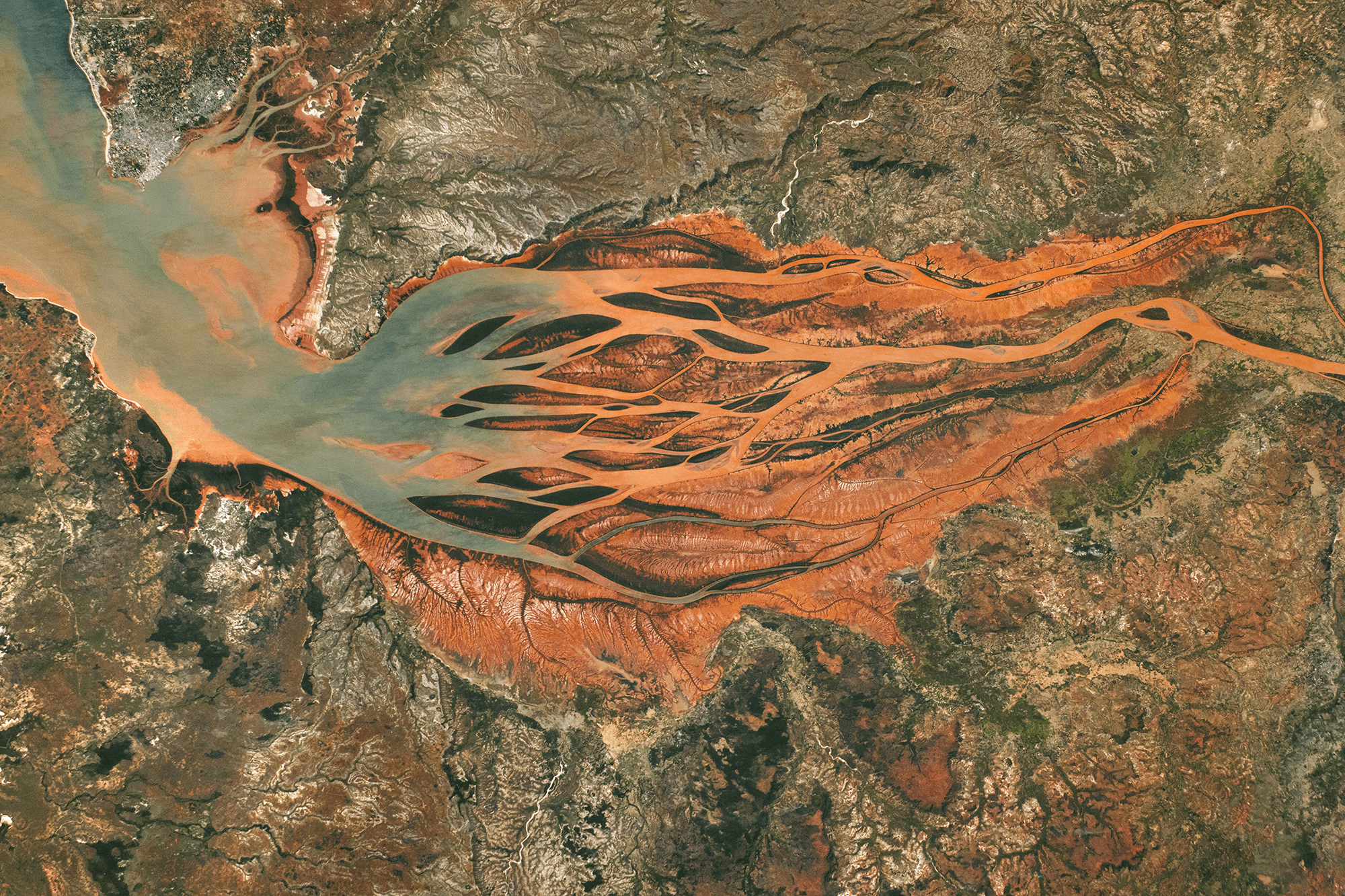
    This astronaut photo shows Madagascar’s largest estuary, as of 2024. On the right side, the Betsiboka River flows northwest (right to left, in the image). Less than 100 years ago, most of the estuary was navigable by ships, but now more than half of it is taken up by the river delta. Upstream on the river, extensive logging and expansions to farmland have caused severe soil erosion; the river carries that sediment downstream, dyeing the waters reddish-orange. As the river branches and the flow slows, that sediment falls out of suspension, building up islands and seeding new sand bars further downstream.

    A difference of 40 years. A 2024 astronaut photo of the Betsiboka River delta compared with one from 1984 (inset). Several islands are labeled in both images. Notice how new islands have formed upstream of the ones seen in 1984.
    A difference of 40 years. A 2024 astronaut photo of the Betsiboka River delta compared with one from 1984 (inset). Several islands are labeled in both images. Notice how new islands have formed upstream of the ones seen in 1984.

    In the image above, you can compare the 2024 delta to the way it looked in 1984. Letters A, B, C, and D mark the downstream-most islands from 1984. Today newer islands and sand bars sit even further downstream. (Image credit: NASA; via NASA Earth Observatory)