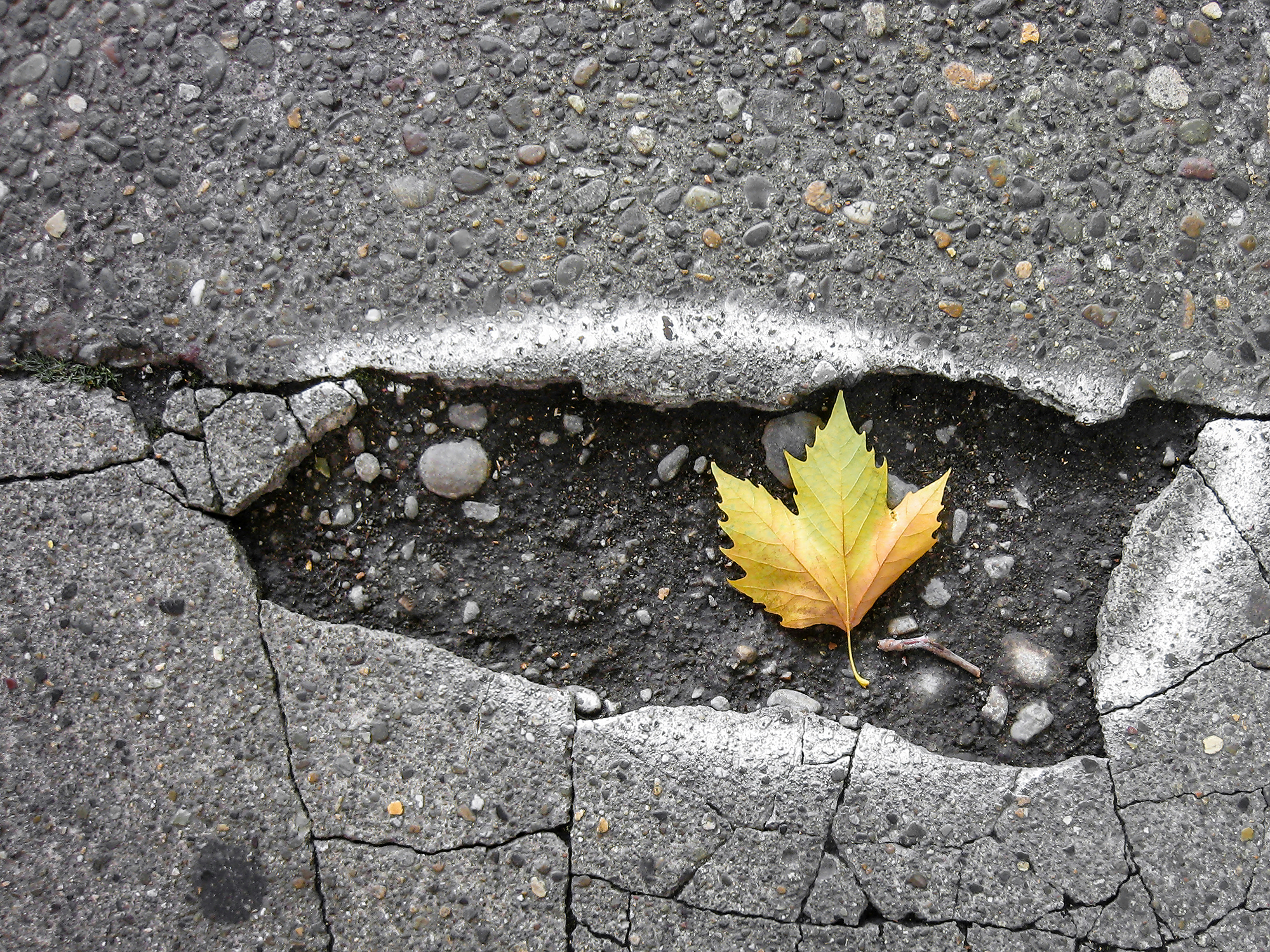
Water expands when it freezes, a fact that’s often blamed for ice-cracked roads. But expansion isn’t what gives ice its destructive power. In fact, liquids that contract when freezing also break up materials like pavement and concrete. A recent study pinpoints veins between ice crystals as the source of this infrastructure-cracking power.
Ice doesn’t like to stick on most surfaces, so when it forms, there’s often a narrow gap between the ice and a solid surface. That gap fills with water, and that water, it turns out, doesn’t just sit there. Instead, grooves between ice crystals act like tiny straws that are frigid on the icy end and warmer on the end connected to water. As ice forms on the cold end, it creates a negative pressure gradient that draws liquid up the groove. This ‘cryosuction’ keeps pumping water into the ice, where it freezes and further expands the icy zone, as seen in the image below.

If the ice is made up of a single crystal, this growth rate is very slow. But most ice is polycrystalline — made up of many crystals, all separated by these liquid-filled grooves. That, researchers found, is a recipe for fast growth and quickly-expanding ice capable of breaking concrete and other structures. (Image credits: pothole – I. Taylor, experiment – D. Gerber et al.; research credit: D. Gerber et al.; via APS Physics)
Leave a Reply