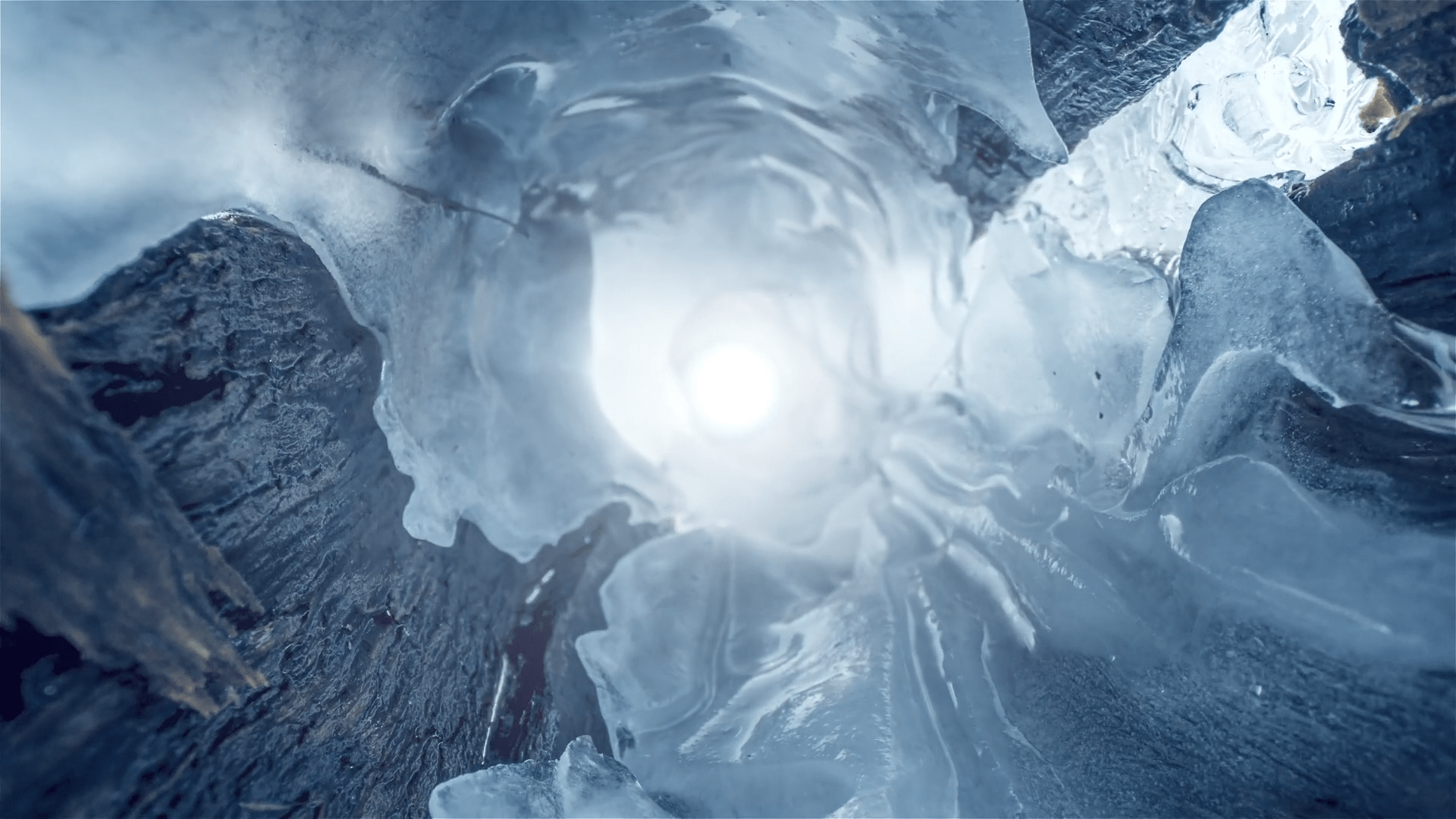
With every spring comes the thaw. Warming temperatures melt winter’s ice, carving it away to reveal the surfaces beneath. Christopher Dormoy’s macroscale timelapse “Eternal Spring” captures this dynamic, showing the process drop-by-drop and rivulet-by-rivulet. It’s also a commentary on melting in general as human-driven climate change chips away at ice that formed over millennia. (Video and image credit: C. Dormoy)
Month: June 2023

Overcoming Turbulence
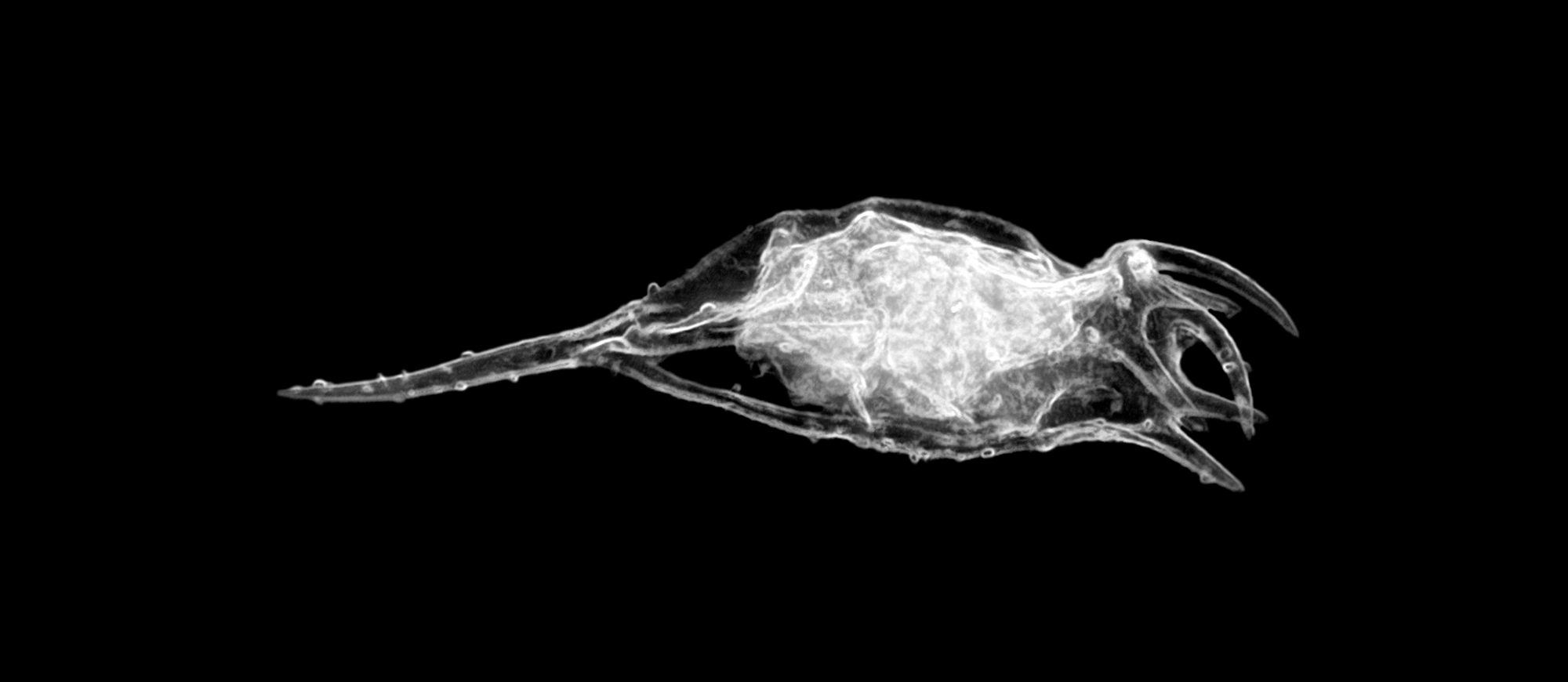
Despite their microscopic size, many plankton undertake a daily migration that covers tens of meters in depth. As they journey, they must contend with currents, turbulence, and other flows that could knock them off-course. And, increasingly, research shows that a plankton’s shape makes a big difference in these flows.
Spherical plankton tend to cluster in areas of flow moving opposite to their direction of travel. But more elongated plankton can resist — or even reverse — this tendency, helping them stay on track. In turbulence, elongated swimmers are also better at keeping their thrust oriented in the desired direction of travel. So both nature and engineers should favor elongated microswimmers when contending with turbulence and potential crossflows. (Image credit: Picturepest/Flickr; research credit: R. Bearon and W. Durham)

Twisted Fibers
A drop sliding down a fiber can do so asymmetrically or symmetrically. The asymmetric configuration is unstable and will spontaneously shift to a symmetric one. Adding a second, parallel fiber stabilizes an asymmetric drop, letting it slide without shifting. And twisting the two fibers together gives even more control, allowing researchers to tweak drop shape, speed, and orientation independent of properties like the drop’s volume or viscosity. (Image and video credit: V. Kern and A. Carlson)

How Hagfish Slime Clogs
When attacked, the eel-like hagfish slimes its predator, clogging the fish’s gills so that it can escape. A recent study looks at just what makes the slime so effective. There are two main (non-seawater) components to hagfish slime: mucus and threads. The team’s experiments showed that the slime’s clogging is due almost entirely to the mucus; the clogging power of full slime and mucus-only slime is almost identical.
So what are the threads for? They make it harder for the mucus to get washed away. Mucus alone isn’t able to clog as effectively after a single rinse, but, with the threads included, the slime hardly budges. That staying power makes it all the harder for a predator to clear its gills once slimed. In fact, it’s still unclear to scientists whether a slimed fish can free itself from the clogging. After all, the attacker can’t use the hagfish’s trick to free itself from slime. (Image credit: dirtsailor2003/Flickr; research credit: L. Taylor et al.)

Solar Coronal Heating
Our Sun‘s visible surface, the photosphere, is about 5800 Kelvin, but the temperature of the wispy corona is far hotter, reaching a million Kelvin in some places. Why the corona is so hot remains something of a mystery. Scientists have theorized multiple culprits for the extreme temperatures found in the corona, but the full details of the phenomenon are still unclear.
Recent solar missions and observations are increasingly identifying small but widespread solar activities, like the nanoflares shown above. Unlike the monstrous coronal loops researchers focused on previously, these flares are tiny and occur in regions without discernible solar flare activity. The nanoflares are brief but they can reach temperatures above a million Kelvin. Since nano- and even picoflares have been observed across the full Sun, they likely play a significant role in the overall picture of coronal heating. (Image credit: ISAS/JAXA; see also L. Sigalotti and F. Cruz)

Fog in the Blue Ridge Mountains
Fog blankets the forest of the Blue Ridge Mountains in this photo by Tihomir Trichkov. It gives the photo the quality of an Impressionist painting. Rain from the day before left lots of moisture in the air and soil, contributing to the ethereal condensation lit by the sunrise. (Image credit: T. Trichkov; via Gizmodo)

Predicting Heat Waves
The United States, Europe, and Russia have all seen deadly, record-breaking heat waves in recent years, largely in areas that are ill-equipped for sustained high temperatures. A new paper presents a theory that predicts how hot these heat waves can get and what mechanism ultimately breaks the hot streak.
Heat waves start when an area of high-pressure air forms over land, with an anticyclone circulating around it. Air at the center of the zone warms and rises, and if the anticylone can’t move, temperatures will just keep rising. Despite the heat, there is still moisture in the rising air of a heat wave. The authors found that if that moist air can reach an altitude where the atmospheric pressure is 500 hPa (a typical altitude of 5-7 km), then the maximum daily temperature will stop rising. At that altitude, the moist air can condense into rain, and, even if that rain evaporates before reaching the ground, it is enough to cool temperatures.
The key variable in the theory is the atmospheric temperature at 500 hPa, something that meteorological models are able to predict well up to three weeks in advance. That means this theory should enable meteorologists to give advanced warning of high temperatures, helping communities prepare. (Image credit: T. Baginski; research credit: Y. Zhang and W. Boos; via APS Physics)

Polymers and Fluid Sheets
Even adding a small amount of polymers to a fluid can drastically change its behavior. Often polymer-doped fluids act more like soft solids, able to hold their shape like your toothpaste does when squeezed onto your toothpaste. Under a little stress, though, the fluids still flow; that’s why your toothpaste gets less viscous as you scrub.
To study the changes polymers make, this research team collides two jets of fluid to create a liquid sheet. Depending on the flow rate and the added polymers, the break-up pattern of the sheet changes. By observing changes in the sheet thickness and the holes that form, they can draw conclusions about what the polymers are doing. (Video credit: C. Galvin et al.)

Bending in the Stream
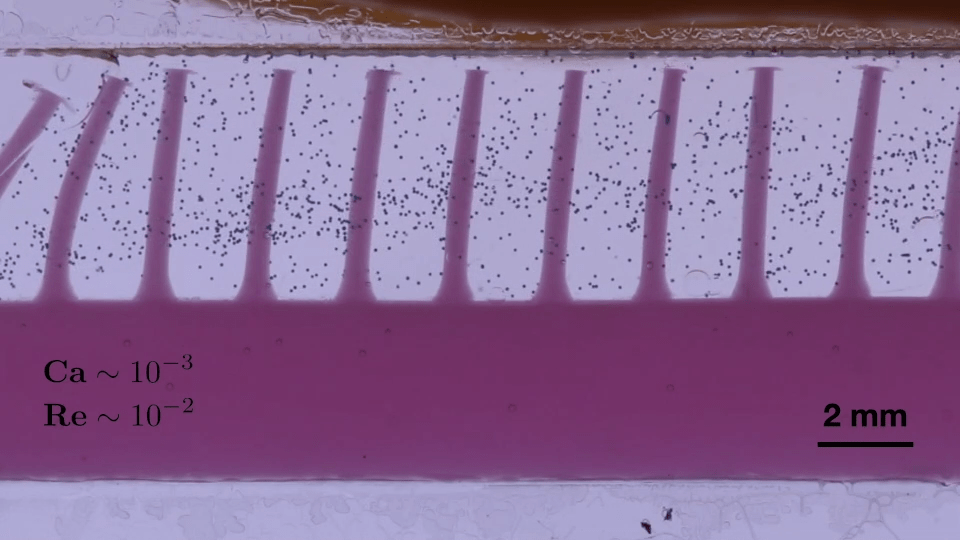
Nature is full of cilia, hairs, and similar flexible structures. Unsurprisingly, flows interact with these structures very differently than with smooth surfaces. Here, researchers investigate flow in a channel lined with flexible, hair-like plates. Initially, the channel is filled with oil and dark particles that help visualize the flow. Then, they pump water into the setup.
As the water intrudes, it forms an interface with the oil. That interface is powerful enough to bend individual hairs in the system. When the hair bends far enough, it can touch its neighbor, sealing the oil inside the gap between them. Along the length of the channel, this behavior leads to trapped pockets of oil that never drain, no matter how much water flows by. (Image and research credit: C. Ushay et al.)

Why We Can’t Control Rivers
Rivers are systems in a constant state of change, balancing flow speeds, path length, sediment deposition, and erosion, as seen in this previous Practical Engineering video. The next video in this mini-series considers what human interventions do to rivers. As convenient as it is for humanity to force a river into a straight and constant course, the long-term effects can be incredibly destructive both upstream and downstream.
In this video, Grady takes a look at several types of interventions: stream straightening, dams, river crossings, and more. With the help of a stream table, he demonstrates just how these efforts shift the river’s balance and what effects — in terms of erosion, deposition, and flooding — each can cause. These disadvantages, along with habitat destruction, are part of why stream remediation projects are on the rise. (Video and image credit: Practical Engineering)